Why Joining the Air Force Could Be Your Best Decision
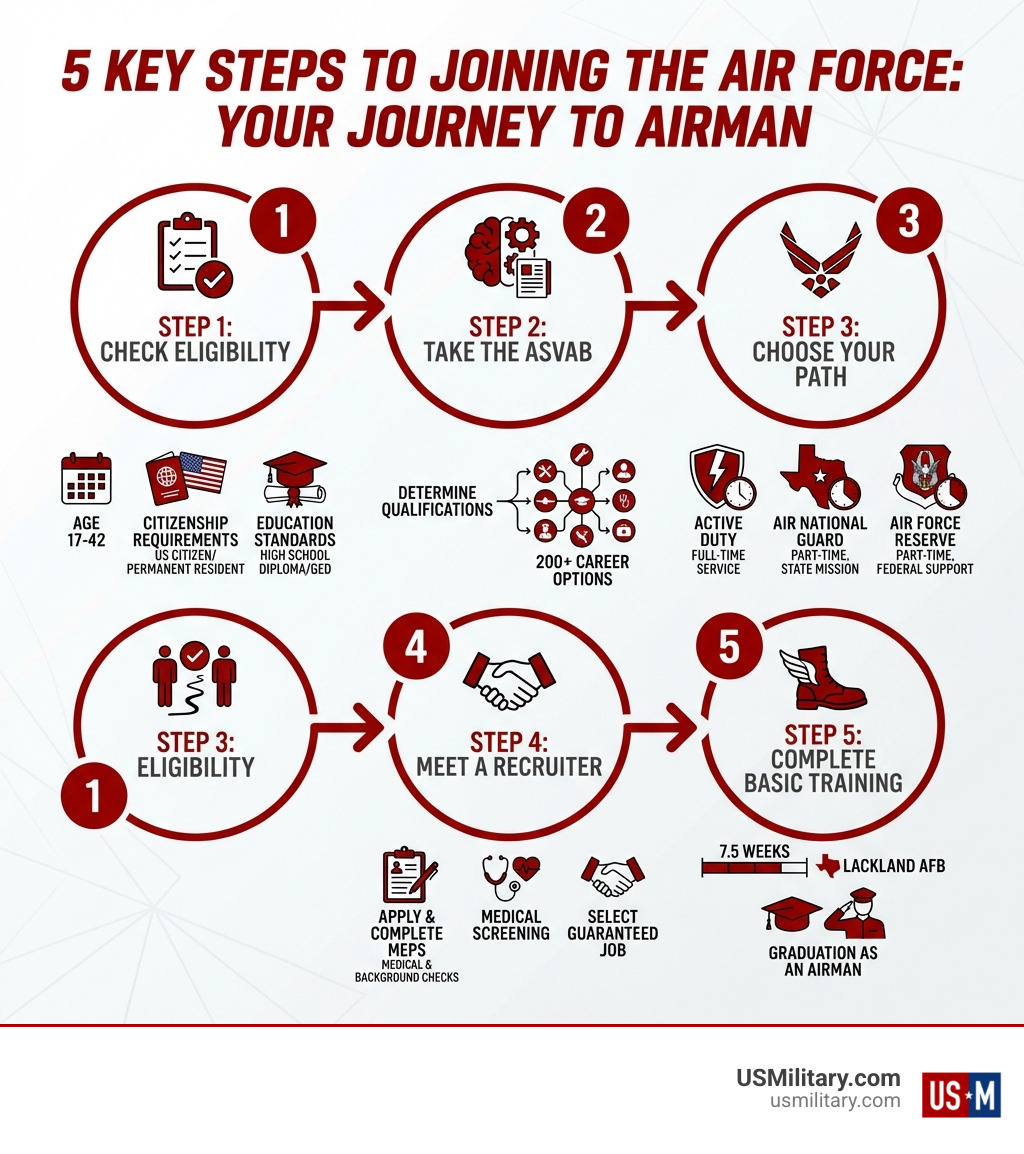
If you want to enlist in the airforce, you need to meet specific requirements, pass the ASVAB test, choose between Active Duty, Guard, or Reserve service, complete the MEPS process, and graduate from Basic Military Training. Here’s the quick breakdown:
The 5 Essential Steps to Enlist:
- Check Eligibility – Age 17-42, U.S. citizen or permanent resident, high school diploma or GED
- Take the ASVAB – Score determines which of 200+ careers you qualify for
- Choose Your Path – Active Duty (full-time), Air National Guard (part-time), or Air Force Reserve (part-time)
- Meet with a Recruiter – Apply, visit MEPS for medical exam and background check, select your job
- Complete Basic Training – 7.5 weeks at Lackland Air Force Base in Texas
The United States Air Force offers one of the most attractive packages in military service. You’ll find over 200 career fields, comprehensive benefits including free healthcare and housing, 30 days of paid vacation annually, and educational opportunities through the GI Bill. Whether you’re looking for cutting-edge technology careers in cyber operations, hands-on work in aircraft maintenance, or service in special warfare, the Air Force provides a clear path from civilian life to meaningful work that serves your country.
The journey from civilian to Airman isn’t complicated, but it does require preparation and understanding of the process. You’ll need to meet physical standards, pass aptitude tests, and make important decisions about how you want to serve. The good news? Every step is clearly defined, and recruiters are available to guide you through the entire process.
I’m Larry Fowler, publisher of USMilitary.com, and since 2007 I’ve helped thousands of Americans steer the process to enlist in the airforce and other military branches by providing reliable, up-to-date information on requirements, benefits, and career opportunities. This guide will walk you through everything you need to know to make an informed decision and successfully complete your enlistment journey.
Are You Eligible? The First Step to Enlist in the Air Force
Before you can even dream of soaring through the skies or working with cutting-edge technology, we first need to make sure you’re eligible. This is the foundational step for anyone looking to enlist in the Air Force. It’s where you conduct a self-assessment against the Air Force’s core requirements. Think of it as checking if you have the right ingredients before you start baking a cake!
Basic Enlistment Requirements
The Air Force, like all military branches, has specific criteria to ensure every recruit is ready for the challenges and responsibilities of service. These are non-negotiable and cover aspects like age, citizenship, and education.
First, let’s talk about age. To enlist in the Air Force, you must generally be between 17 and 42 years old. If you’re 17, you’ll need parental consent, so make sure to have that important conversation with your folks. While the maximum age limit of 42 is higher than some other branches, it’s a testament to the Air Force’s recognition of valuable life experience.
Next, citizenship is key. The Air Force commissions only U.S. citizens. You must be a U.S. citizen to enlist in the Air Force. For non-citizens, those with a U.S. Permanent Resident Card (Green Card) who can fluently speak, read, and write English may be eligible to join the military. However, it’s crucial to understand that you cannot join with the intention of entering the U.S. or obtaining a visa; the military is not an immigration service.
Education is another critical component. To enlist in the Air Force, you must possess a high school diploma or a General Equivalency Diploma (GED). While a GED is acceptable, having a high school diploma is generally preferred. If you have a GED, having some college credits can significantly improve your chances of enlistment, demonstrating your commitment to higher learning and academic capability. For those aspiring to become an officer, a degree from a four-year college is a strict requirement.
Physical, Medical, and Tattoo Standards
Beyond the basic requirements, your physical and medical health, along with any body modifications, will be thoroughly evaluated. The Air Force needs Airmen who are physically capable and medically sound to perform their duties effectively and safely.
The journey into military service includes a mandatory medical exam. This comprehensive assessment takes place at a Military Entrance Processing Station (MEPS). Here, doctors will review your medical history and conduct a thorough physical examination to ensure you meet the strict health standards for military service. They’ll look for any pre-existing conditions that could disqualify you. While some conditions might be “red flags,” they aren’t always automatic disqualifiers, and waivers may sometimes be possible. It’s always best to be upfront and honest about your medical history.
Physical fitness is paramount. Each branch requires recruits to be physically fit, and the Air Force is no exception. As part of the enlistment process, you’ll need to pass a physical fitness test. While specific standards can vary, expect evaluations of your cardiovascular endurance, muscular strength, and flexibility. Additionally, the Air Force maintains height and weight standards. These are typically set as a Body Mass Index (BMI) range or maximum weight for your height, designed to ensure you’re within a healthy and functional range for service. We’ll provide more detailed information on current height and weight standards when you connect with a recruiter.
Finally, let’s address body modifications, a topic that often raises questions for potential recruits. The Air Force has clear and strict requirements and restrictions regarding tattoos, brands, and piercings. The general rule of thumb is that any body modifications that are prejudicial or likely to bring discredit to the organization are prohibited.
Here’s a breakdown of the tattoo restrictions:
- Prohibited Locations: Tattoos, brands, and body markings are absolutely prohibited on the head, face, tongue, lips, and scalp.
- Neck Tattoos: You are allowed one neck tattoo, but it cannot exceed one inch in measurement in any direction. Furthermore, it must be placed discreetly behind either ear.
- Hand Tattoos: Hand tattoos are limited to one single-band ring tattoo on one finger, on one hand. This ring tattoo must not exceed ⅜ of an inch below the knuckle and above the finger joint. Additionally, a single tattoo is allowed on each hand, but it must not exceed one inch in any direction.
- Content Restrictions: Beyond placement and size, the content of your tattoos matters. Anything that is obscene, racist, extremist, or discriminatory is strictly forbidden.
Understanding these policies is crucial. If you have existing tattoos, or are considering getting new ones, ensure they comply with these regulations before you consider joining.

The ASVAB Test: Opening Up Your Air Force Career
Once you’ve confirmed your eligibility, the next significant hurdle is the Armed Services Vocational Aptitude Battery (ASVAB) test. This isn’t just another exam; it’s a pivotal tool that helps us understand your strengths and guide you toward a fulfilling career path within the Air Force.
What is the ASVAB and Why It Matters
The ASVAB is a multiple-choice test designed to measure your aptitude in various academic and vocational areas. It’s important to clarify that it’s an aptitude test, not an IQ test. Its purpose is to assess your potential for success in different military occupations, not just your general intelligence.
The test is divided into several subtests, which include:
- General Science: Measures knowledge of physical and biological sciences.
- Arithmetic Reasoning: Measures ability to solve arithmetic word problems.
- Word Knowledge: Measures ability to understand the meaning of words through synonyms.
- Paragraph Comprehension: Measures ability to obtain information from written passages.
- Mathematics Knowledge: Measures knowledge of high school mathematics principles.
- Electronics Information: Measures knowledge of electrical current, circuits, and electronic devices.
- Auto and Shop Information: Measures knowledge of automotive maintenance and repair, and wood and metal shop practices.
- Mechanical Comprehension: Measures knowledge of mechanical principles, structural support, and simple machines.
Your scores from these subtests are combined to create various composite scores, including the Armed Forces Qualification Test (AFQT) score, which determines your overall eligibility to enlist in the Air Force. More importantly, your scores on specific subtests are used to qualify you for different Air Force Speciality Codes (AFSCs), which are essentially your job options. Each of the over 200 career options in the Air Force has a minimum ASVAB score requirement. A higher score often opens up a wider array of desirable jobs, from cyber operations to aviation mechanics.

How to Prepare and Excel on the ASVAB to Enlist in the Air Force
Excelling on the ASVAB isn’t just about showing up; it’s about preparation. Since your score directly impacts your career placement, it’s wise to invest time in studying. We strongly recommend utilizing official ASVAB online resources to help you prepare.
Here’s how you can prepare:
✉ Get updates like this in your inbox
Weekly VA benefit changes, pay updates, and money tips for service members, veterans, and military families. Free, no spam.
- Study Guides: There are numerous reputable ASVAB study guides available, both online and in print. These guides often break down each subtest and provide practice questions.
- Practice Tests: Taking practice tests is perhaps the most effective way to prepare. They familiarize you with the test format, question types, and help you identify your weak areas. Many official and unofficial practice tests are available online.
- Focus Areas: Identify the areas where you need the most improvement. If you struggle with math, dedicate more time to Arithmetic Reasoning and Mathematics Knowledge. If reading comprehension is a challenge, focus on Word Knowledge and Paragraph Comprehension.
- Time Management: The ASVAB is timed, so practicing under timed conditions can help you manage your pace and complete all sections efficiently.
Each military branch sets its own minimum ASVAB score, and the Air Force is no different. While a minimum score will get you in the door, a higher score will open up more career opportunities, giving you greater choice in what you do. So, aim high!
Choosing Your Path: Active Duty, Guard, or Reserve
One of the most significant decisions you’ll make when you decide to enlist in the Air Force is choosing your path: Active Duty, Air National Guard, or Air Force Reserve. Each option offers a unique service experience, lifestyle, and level of commitment. Understanding these differences is crucial to finding the right fit for your personal and professional goals.
Air Force Active Duty
Active Duty is a full-time commitment, essentially making the Air Force your primary job. If you choose this path, you’ll live, work, and train as a full-time Airman, potentially deploying anywhere in the world. This immersive military lifestyle offers comprehensive benefits, including full pay, housing allowances, and complete healthcare coverage. It’s a path for those seeking a complete career change, global travel opportunities, and a deep dive into military life. The Air Force’s mission is “to fly, fight and win – airpower anytime, anywhere,” and Active Duty Airmen are at the forefront of this mission.
Air National Guard
The Air National Guard offers a unique blend of military service and civilian life. It operates under a dual mission: serving both state and federal needs. As a member of the Air National Guard, you typically serve part-time, often described as “one weekend a month, two weeks a year,” though specific commitments can vary based on your role and operational needs. This allows you to maintain a civilian career, pursue higher education, or stay close to home while still serving your country. When activated by the state governor, Guard members respond to local emergencies like natural disasters. When federalized, they support overseas missions. This path is ideal for those who want to serve their country and community without fully leaving their civilian lives behind. You can learn more about this component at the Air National Guard website.
Air Force Reserve
Similar to the Air National Guard, the Air Force Reserve is a part-time commitment, allowing you to balance military service with your civilian life. However, unlike the Guard, the Reserve primarily supports federal missions, providing strategic depth and operational support to the active-duty Air Force. Reserve Airmen train to be ready for deployment to augment active forces when needed, serving a vital role in national defense. This option is perfect for individuals who want to maintain their civilian careers or education while still contributing to the Air Force’s global presence. You can explore this path further on the Air Force Reserve website.
The Enlistment Process: From Application to Basic Training
Alright, you’ve checked your eligibility, aced the ASVAB, and decided on your preferred service path. Now it’s time to dive into the nuts and bolts of the enlistment process. This is where your journey from civilian to Airman truly begins, guided by dedicated professionals and structured steps.
Step 1: Connect with a Recruiter and Apply
Your first concrete action should be to connect with an Air Force recruiter. Think of them as your personal guide through this sometimes-complex process. They are there to answer all your questions, help you understand the requirements, and ensure you’re on the right track. You can find a local recruiter by visiting the official Air Force website or by calling 1-800-423-USAF (1-800-423-8723).
Once you’ve connected, the recruiter will conduct an initial interview to get to know you, your goals, and verify your eligibility. They’ll then assist you with the application paperwork, which involves providing personal information, educational history, and other relevant documents. This is also where you can start your application and explore career options through platforms like USMilitary.com. The application process is designed to be straightforward, and your recruiter will be there to help you every step of the way.
Step 2: The MEPS Visit
The Military Entrance Processing Station (MEPS) is a crucial stage. This is where you’ll undergo a comprehensive medical screening and physical examination. Doctors will check your vision, hearing, blood pressure, and conduct a thorough review of your medical history to ensure you meet the Air Force’s strict health standards. This is also where you’ll typically take the ASVAB test if you haven’t already, or have your scores verified.
In addition to the medical and aptitude tests, MEPS is where background checks are finalized, and your moral character is evaluated. This includes a review of your criminal record, if any, and other aspects of your personal history. Honesty is always the best policy throughout this process. Any discrepancies can cause delays or even disqualification.
Step 3: Job Selection and Taking the Oath
After successfully navigating MEPS, you’ll sit down with a counselor to review the available Air Force jobs (AFSCs) that you qualify for based on your ASVAB scores and any other relevant qualifications. With over 200 career options, this can be an exciting but sometimes overwhelming step! Your recruiter will help you understand the roles, training, and potential career progression for each. The Air Force aims to match your skills and interests with its needs. Once you’ve made your selection, you’ll sign an enlistment contract that specifies your chosen job, length of service, and other terms. This contract guarantees your job, provided you meet all subsequent requirements.
The culmination of the enlistment process is taking the Oath of Enlistment. This solemn pledge signifies your commitment to serve the United States. Many recruits take this oath at MEPS, surrounded by family and friends. After taking the oath, you’ll officially enter the Delayed Entry Program (DEP). The DEP allows you to return home and prepare for Basic Military Training (BMT) while still officially enlisted. It could be a few weeks or several months, giving you time to get physically and mentally ready for the challenges ahead.
Life as an Airman: Careers, Benefits, and Advancement
Serving in the Air Force isn’t just a job; it’s a lifestyle, a community, and a pathway to immense personal and professional growth. When you enlist in the Air Force, you’re not just signing up for a paycheck; you’re joining a “big family” that emphasizes meaningful work, camaraderie, and a global outlook.
Exploring Over 200 Career Paths
One of the most compelling aspects of joining the Air Force is the sheer diversity of career opportunities. With over 200 career options, we truly offer a path for almost every skill set and interest. Whether you’re a tech wizard, a mechanical genius, a healthcare enthusiast, or someone who thrives in high-stakes environments, there’s a place for you.
Here’s a glimpse at some of the broad career fields:
- Maintenance & Repair: Keeping our aircraft and equipment in peak condition.
- Cyber & Intelligence: Protecting our networks and gathering vital information in the digital domain. This is a rapidly growing area with specialized programs to help you accelerate into these critical roles.
- Aviation & Flight: From pilots and navigators to air traffic controllers and flight engineers, the sky’s the limit.
- Special Warfare & Combat Support: Elite teams performing specialized missions on the ground.
- Healthcare: Providing medical care to Airmen and their families worldwide.
- Logistics & Administration: Ensuring everything runs smoothly behind the scenes.
- Science & Technology: Pushing the boundaries of innovation.
- Law & Order: Maintaining security and enforcing regulations.
Every Air Force career comes with top-tier technical training, often leading to certifications that are highly valued in the civilian sector. This means you’re not just serving your country; you’re building a valuable skill set for life. To find a career that truly fits you and your aspirations, we encourage you to take our career assessment.
Pay, Benefits, and Quality of Life
The Air Force offers a comprehensive benefits package that goes far beyond just a competitive salary. We believe in taking care of our Airmen and their families, ensuring a high quality of life.
- Competitive Salary: Your pay is based on your rank and years of service, increasing steadily throughout your career.
- Housing Allowance (BAH): If you live off-base, you’ll receive a Basic Allowance for Housing to help cover your rent or mortgage. On-base housing is also available, often with excellent amenities.
- Free Healthcare: You and your family will receive comprehensive medical and dental care through TRICARE, often at little to no cost.
- 30 Days Paid Vacation: Every year, Airmen earn 30 days of paid leave, allowing ample time for relaxation, travel, and spending time with loved ones.
- GI Bill for Education: One of the most significant benefits is the Post-9/11 GI Bill, which provides substantial financial support for college tuition, housing, and books after your service. This can literally pay for your entire degree!
- Retirement Plan: After 20 years of service, you’re eligible for a generous retirement plan, providing financial security for your future.
- On-Base Amenities: Many Air Force bases are like small cities, offering a wide array of amenities such as commissaries (grocery stores) and exchanges (department stores) with tax-free shopping, fitness centers, schools, parks, and recreational facilities.
These benefits provide a strong foundation for financial stability and personal well-being, allowing you to focus on your mission and personal growth.
Pathways to Become an Officer After You Enlist in the Air Force
Many individuals enlist in the Air Force with the long-term goal of becoming an officer. The good news is, the Air Force actively supports its enlisted Airmen in achieving this aspiration! While a bachelor’s degree from a four-year college is a fundamental requirement to become an officer, there are several specialized programs designed to help you achieve this while serving.
- Officer Training School (OTS): This is a 14-week program at Maxwell Air Force Base designed for college graduates or degree-holding Airmen to earn commissions as second lieutenants. If you already have your degree, OTS is a direct path.
- Airman Scholarship and Commissioning Program (ASCP): This program offers enlisted Airmen the opportunity to earn a scholarship (including a $15,000 scholarship) to attend a four-year college and commission through Air Force ROTC.
- Scholarships for Outstanding Airman to ROTC (SOAR): Similar to ASCP, SOAR provides a competitive $15,000 college scholarship to high-achieving enlisted Airmen to attend college and commission through ROTC.
- One-year Professional Officer Course-Early Release Program (1-Year POC-ERP): This program allows eligible enlisted Airmen to separate from active duty early to complete their bachelor’s degree and commission through Air Force ROTC.
These programs demonstrate the Air Force’s commitment to developing its talent from within. If you aspire to lead, manage, and take on higher levels of responsibility, the path from enlisted to officer is well-defined and well-supported. You can learn more about officer opportunities and the various commissioning pathways with us.
Conclusion
Starting on the journey to enlist in the Air Force is a significant decision, one that promises a fulfilling career, unparalleled personal and professional growth, and the chance to be part of something truly impactful. From the initial eligibility checks and the strategic ASVAB test to choosing your service path and navigating the enlistment process, every step is designed to prepare you for success.
As an Airman, you’ll gain access to over 200 diverse career fields, comprehensive benefits including competitive pay, free healthcare, generous vacation time, and invaluable educational opportunities through the GI Bill. You’ll join a global family, accept a unique lifestyle, and have the chance to serve your country with pride. And for those with aspirations of leadership, the Air Force provides clear and supported pathways to transition from enlisted service to becoming a commissioned officer.
Your journey from civilian to Airman is a testament to your ambition, capability, and desire to make a difference. We at USMilitary.com are here to provide you with the resources and guidance you need every step of the way. Your future starts now.
Learn more about Air Force enlisted ranks with USMilitary.com
Free for Service Members & Veterans
Get the military benefits intel no one tells you about.
Weekly updates on VA benefits, pay changes, and money tips — free for service members and veterans.
No spam. Unsubscribe anytime. Your info is never shared.


