The Best Way to Appeal a VA Disability Claim: Comparing the Three AMA Lanes

As a disabled veteran, there are only a few things that can be as frustrating as being denied a VA disability that you so deserve. I’m Larry Fowler, a Navy veteran and publisher of USMilitary.com. Listen, the best way to appeal a VA disability claim depends on why the VA denied it. If you have new medical evidence, file a Supplemental Claim.
If the VA made a legal or factual error on the evidence it already had, request a Higher-Level Review. If you need a Veterans Law Judge to settle a complex legal issue, take your case to the Board of Veterans’ Appeals. Navigating the Department of Veterans Affairs can sometimes feel like trying to land a transport plane in dense fog. Under the Appeals Modernization Act (AMA), which completely overhauled the outdated legacy system, veterans are granted three distinct pathways to dispute an unfavorable rating decision. Deciding on the proper review lane is not about guessing; it requires evaluating your existing claims file against the specific legal reasons the VA denied your benefits.
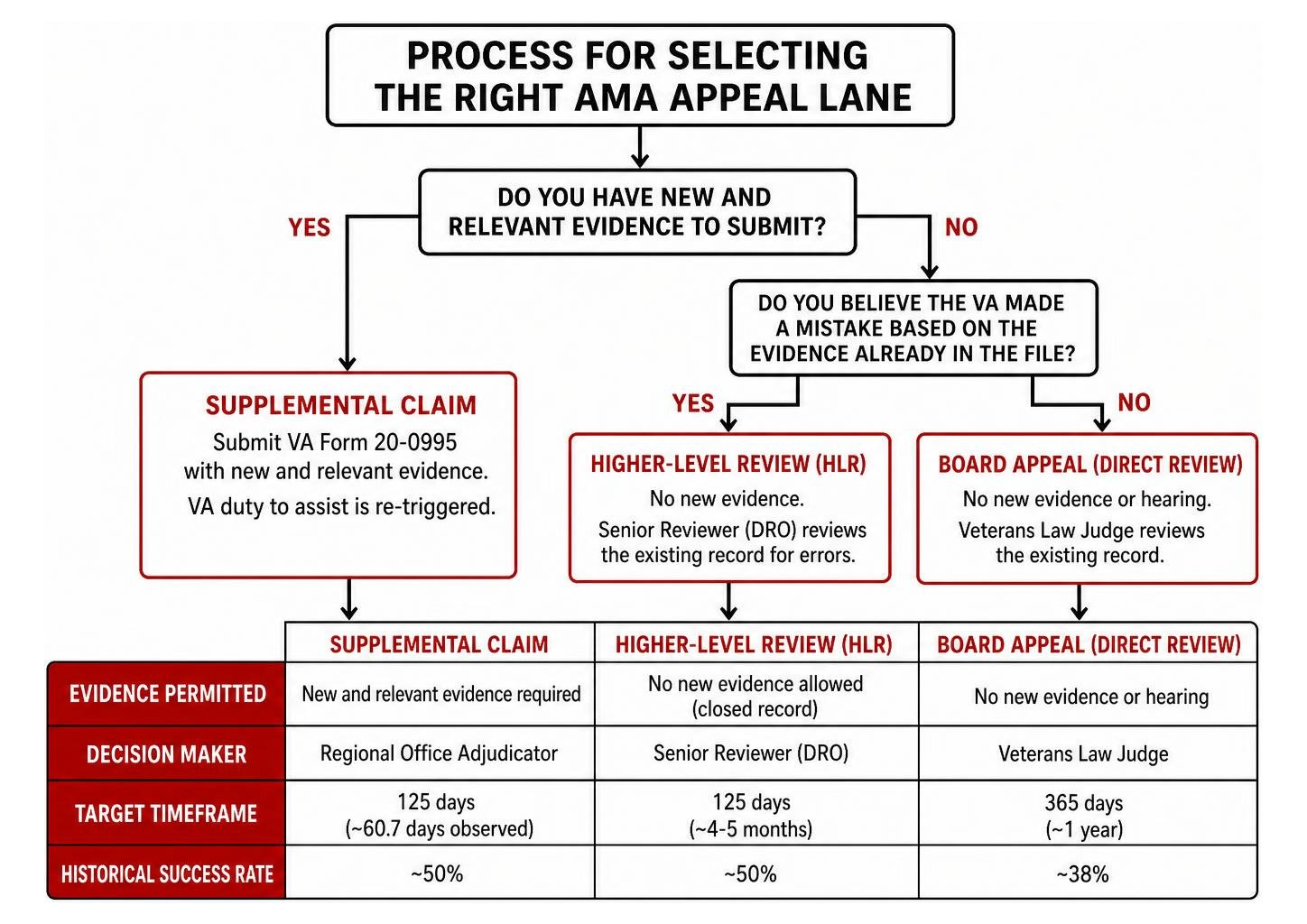
When looking at choosing a decision review option, you must weigh processing speed against the type of evidence you can provide. While an adjudicator’s mistake might prompt an immediate request for senior oversight, missing medical records demand a different route entirely. Discovering how to turn your VA denial into a winning appeal begins with understanding the core differences among these three options:
| Decision Review Lane | Evidence Permitted | Decision Maker | Target Timeframe | Historical Success Rate |
|---|---|---|---|---|
| Supplemental Claim | New and relevant evidence required | Regional Office Adjudicator | 125 days (~60.7 days observed) | ~50% |
| Higher-Level Review (HLR) | No new evidence allowed (closed record) | Senior Reviewer (DRO) | 125 days (~4-5 months) | ~50% |
| Board Appeal (Direct Review) | No new evidence or hearing | Veterans Law Judge | 365 days (~1 year) | ~38% |
| Board Appeal (Evidence Submission) | New evidence within 90-day window | Veterans Law Judge | 550 days (~1.5 years) | ~38% |
| Board Appeal (Hearing Docket) | Testimony + evidence within 90 days post-hearing | Veterans Law Judge | 730 days (~2 years) | ~38% |
Determining the Best Way to Appeal a VA Disability Claim with New Evidence
If your rating decision was denied due to a missing official diagnosis, an absent in-service event, or the lack of a medical link, a Supplemental Claim is your most powerful tool. By submitting VA Form 20-0995, you can officially give your claim new life with Form 20-0995 by presenting new and relevant evidence.
“New” evidence refers to documentation that the VA has never evaluated before, while “relevant” evidence directly proves or disproves an element central to your claim. Filing this form re-triggers the VA’s statutory “duty to assist,” legally requiring the agency to gather service records, obtain clinical records, and schedule new Compensation and Pension (C&P) exams if necessary.
While the official agency target for resolving these claims is 125 days, the VA decided Supplemental Claims in an average of just 60.7 days in early 2026. Submitting comprehensive documentation from day one helps streamline the VA claim process the right way and avoids unnecessary delays.
Higher-Level Review: Correcting Errors Without New Evidence
When the VA makes an obvious mistake—such as ignoring service medical records already in your claims folder, miscalculating bilateral factors, or incorrectly applying the diagnostic codes—a Higher-Level Review (HLR) is the appropriate choice. Filed using VA Form 20-0996, an HLR places your claim in the hands of an experienced, senior adjudicator for a fresh look, known as a de novo review.
Under HLR rules, you are prohibited from submitting any new medical or lay evidence; the reviewer is strictly limited to the record at the time the prior decision was issued. However, you can request an optional informal telephone conference. This call allows you or your accredited representative to speak directly with the senior rater to point out specific errors of law or overlooked evidence.
If the senior reviewer uncovers that the original rater failed to gather records or improperly conducted your C&P exam, they will identify a “duty-to-assist error,” which closes the HLR and automatically converts your claim into a Supplemental Claim to gather the missing proof.
Finding the Best Way to Appeal a VA Disability Claim at the Board Level
When Regional Office adjudicators repeatedly misunderstand complex medical legalities or fail to apply service-connection presumptions, escalating your case to Washington, D.C. may be necessary. By completing VA Form 10182, finding the Board of Veterans Appeals becomes straightforward. An appeal submitted to the Board Appeals system places your case before a Veterans Law Judge who specializes exclusively in veterans law.
When filing for a Board Appeal, you must choose one of three distinct dockets:
- Direct Review Docket: The judge decides your case based purely on the existing evidence. With no hearings or new submissions permitted, this is the quickest Board route, targeting a 365-day turnaround.
- Evidence Submission Docket: You can introduce new records within a 90-day window following your appeal submission without needing an in-person appearance (targeted at 550 days).
- Hearing Docket: You can testify directly before a judge via a virtual tele-hearing, at a local VA video facility, or in person in Washington, D.C. You have a 90-day window after your hearing to submit additional medical evidence (targeted at 730 days).
While Board Appeals provide comprehensive legal oversight, historical data indicates an overall success rate of roughly 38%, which is lower than the roughly 50% success rates found in Supplemental Claims and Higher-Level Reviews. For this reason, exhausting your Regional Office options first is often the most practical move.
Navigating Deadlines, Evidence Rules, and Effective Dates
Understanding procedural rules and evidence standards is critical when disputing any VA decision. The Appeals Modernization Fact Sheet outlines clear guidelines designed to keep claims progressing smoothly. Selecting the right paperwork from our map of VA disability reconsideration forms ensures your case remains active and that your valuable benefits remain fully protected.
The 1-Year Filing Rule and Retroactive Pay Protection
The single most critical rule under the AMA framework is the one-year deadline (365 days). You have exactly one year from the date printed on your rating decision letter to file a Supplemental Claim, request a Higher-Level Review, or submit a Notice of Disagreement to the Board of Veterans’ Appeals.
Maintaining this timeline establishes what the VA terms “continuous prosecution.” When you appeal within that one-year window, you protect your original effective date. This preserves your right to retroactive back pay, which covers the monthly difference between your old rating and your new, corrected rating all the way back to when you initially filed.
Given that VA disability compensation rates in 2026 provide $3,938.58 per month for a single 100% disabled veteran, missing this window can cost you tens of thousands of dollars. While pursuing a legitimate VA disability rating increase is a viable path forward, letting a denial lapse past the 365-day mark permanently resets your effective date unless rare legal exceptions apply.
Securing Medical Nexus Letters and Buddy Statements
Medical opinions frequently determine the outcome of a VA claim dispute. If the VA denied your claim citing “no link between your current diagnosis and active service,” an Independent Medical Opinion (IMO), commonly known as a medical nexus letter, is essential.
A high-quality nexus letter should be written by a qualified medical professional who has reviewed your complete military and civilian medical history. To satisfy VA legal criteria, the doctor must state that it is “at least as likely as not” (a 50% or greater probability) that your condition was caused or aggravated by your military service, backed by clear clinical rationale.
Along with nexus letters and structured Disability Benefits Questionnaire (DBQ) forms, lay evidence provides critical support. Sworn statements and “buddy letters” from spouses, relatives, or fellow service members can document:
- The initial onset of symptoms during service.
- The real-world severity of your daily physical or psychological limitations.
- The steady progression of your condition over time.
These observations help bridge any gaps in your historical treatment records, offering a clear path toward achieving your rightful VA disability approval.
Next Steps When Your Appeal Is Denied Again
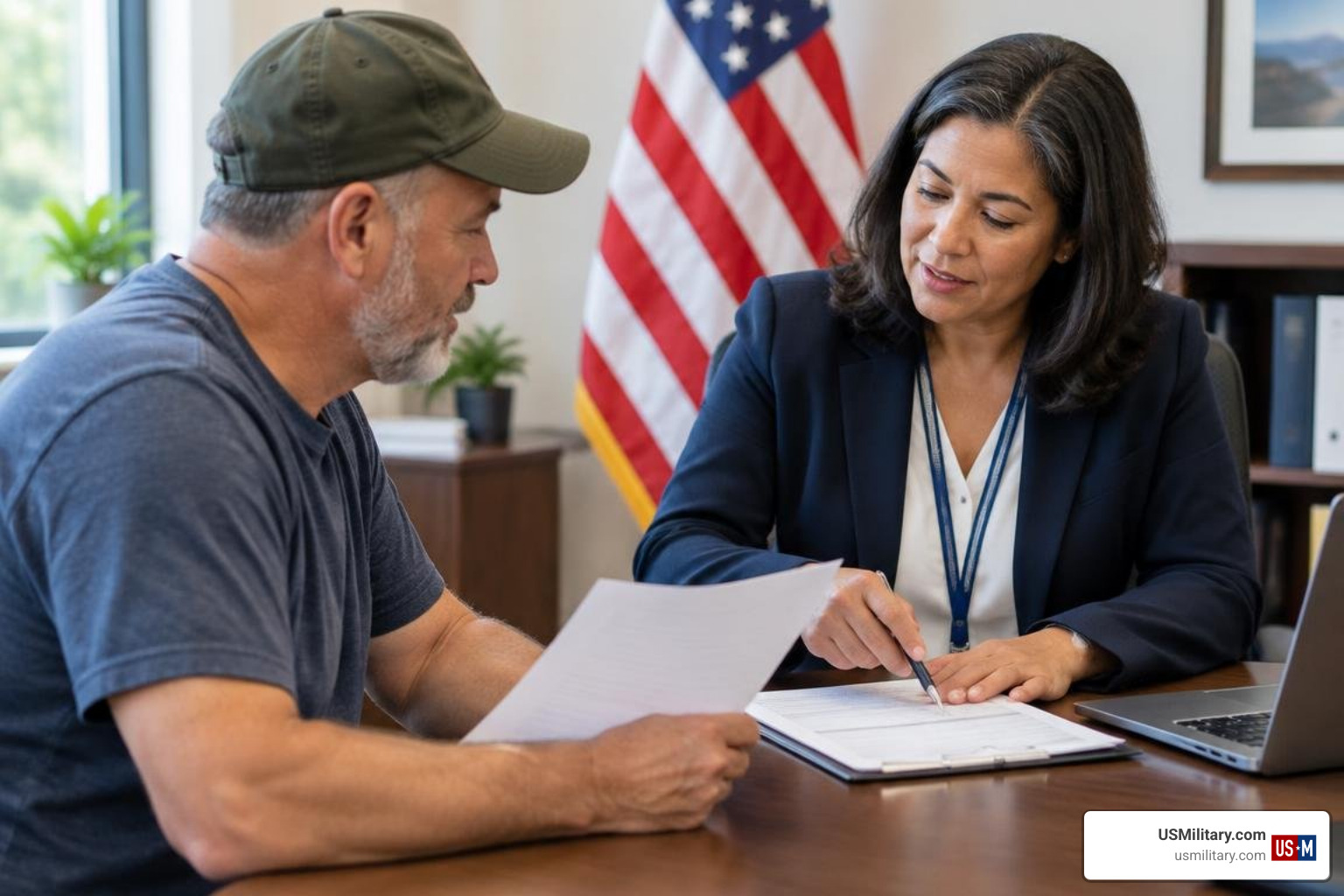
Receiving an unfavorable decision on an appeal can be frustrating, but under the AMA rules, a denial does not bring your case to an end. As long as you respect statutory deadlines, you can strategically move between appeal lanes to address why the claim was turned down.
Chaining Appeal Lanes and Court of Appeals Escalation
The modern VA appeals framework allows you to connect review lanes sequentially. If your Higher-Level Review comes back unfavorable, you cannot immediately file another HLR on that exact same decision. However, you can file a Supplemental Claim with fresh medical records or appeal directly to the Board of Veterans’ Appeals within one year, keeping your original effective date intact.
If you take your case to the Board and receive a complete denial, you have two primary options:
- Submit a Supplemental Claim: File VA Form 20-0995 along with new and relevant evidence at the Regional Office level within one year of the Board’s decision.
- Escalate to Federal Court: Appeal the Board’s decision to the United States Court of Appeals for Veterans Claims (CAVC). You have 120 days from the date of the Board’s final decision to file a CAVC appeal.
If your case involves contested claims featuring competing beneficiaries, keep in mind that a stricter 60-day deadline applies instead of the usual one-year window. Additionally, when a Veterans Law Judge detects procedural oversights, they may issue a “remand,” sending your case back to the Regional Office to correct evidence collection errors before making a final ruling.
Working with Accredited Representatives and Attorneys
Navigating multi-lane appeals, drafting legal arguments, and cross-examining C&P exam findings can quickly become complex. Fortunately, you do not have to manage it alone.
Veterans can partner with Veterans Service Organizations (VSOs) like the VFW, DAV, or American Legion for free representation. For intricate cases involving multiple denials, partnering with vetted legal counsel through our directory of top veteran disability lawyers can help level the playing field.
Under 38 U.S.C. § 5904, accredited attorneys and claims agents can only charge fees for assisting with appeals after the VA has issued an initial decision. These fees are almost universally structured on a contingency basis, meaning your representative receives a reasonable percentage of your retroactive back pay only if your appeal succeeds. Learning how to afford a VA lawyer on a budget helps ensure you retain experienced representation without paying out-of-pocket fees up front.
Frequently Asked Questions About VA Appeals
What is the fastest appeal lane under the AMA?
Supplemental Claims are consistently the fastest way to resolve an appeal, averaging approximately 60.7 to 125 days for an updated decision. Higher-Level Reviews share a similar 125-day target. In comparison, Board Appeals can take between 365 days (Direct Review) and 730 days (Hearing Docket) to reach completion.
Can I submit new medical records during a Higher-Level Review?
No. Higher-Level Reviews operate under a strict closed-record rule, meaning the senior reviewer can only evaluate the evidence that was already in your file on the date of the original decision. If you have obtained new private treatment notes, MRI results, or an updated nexus letter, you must submit them through a Supplemental Claim using VA Form 20-0995.
How do I protect my original effective date across multiple appeals?
You protect your effective date by continuously pursuing your claim within the one-year (365-day) deadline after every unfavorable decision. As long as you submit an HLR, a Supplemental Claim, or a Board Appeal before the 365 days expire, your effective date remains anchored to your original filing date, fully protecting your retroactive back pay.
Conclusion
Overturning a VA disability denial requires selecting the review lane that directly addresses why your claim was rejected in the first place. If your denial came down to an adjudicator’s administrative error, request a Higher-Level Review. If your claim was missing critical medical documentation or a clear service connection, submit a Supplemental Claim backed by strong clinical evidence and nexus letters.
At USMilitary.com, we are committed to ensuring our nation’s service members, veterans, and military families secure every dollar of compensation they have earned. To take control of your case and build a winning strategy, explore our complete VA claim appeals guide today.
Free for Service Members & Veterans
Get the military benefits intel no one tells you about.
Weekly updates on VA benefits, pay changes, and money tips — free for service members and veterans.
No spam. Unsubscribe anytime. Your info is never shared.



Leave a Reply