What Is the VA Claim Process? (2026 Quick Answer)
The VA Claim Process is the step-by-step system the Department of Veterans Affairs uses to evaluate your disability claim and determine your benefits. Here’s a fast overview:
- Claim Received – VA acknowledges your submission (7-14 days)
- Initial Review – VA checks for completeness (7-14 days)
- Evidence Gathering – The longest step; VA collects records, may schedule exams (30-90+ days)
- Evidence Review – VA evaluates all gathered evidence (7-30 days)
- Rating – A VA rater assigns your disability percentage (7-14 days)
- Preparing Decision Letter – VA drafts your decision document (7-14 days)
- Final Review – Last check before notification (7-14 days)
- Claim Complete – Decision sent to you (7-10 days)
Current average processing time: 75.7 days (March 2026)
Filing a VA disability claim can feel overwhelming. There are forms to track down, medical records to gather, exams to attend, and steps that can loop backward without warning. Many veterans wait months — sometimes longer — without fully understanding where their claim stands or what’s holding it up.
The good news? The process follows a clear, predictable structure. When you know what each step involves and what to expect at every stage, you can file smarter, avoid common delays, and give your claim the best possible chance of success.
I’m Larry Fowler, publisher of the USMilitary.com Network and a longtime resource for veterans navigating the VA Claim Process and disability benefits. With nearly two decades of experience covering VA trends and veteran benefits since 2007, I’ll walk you through exactly what you need to know to get this right.
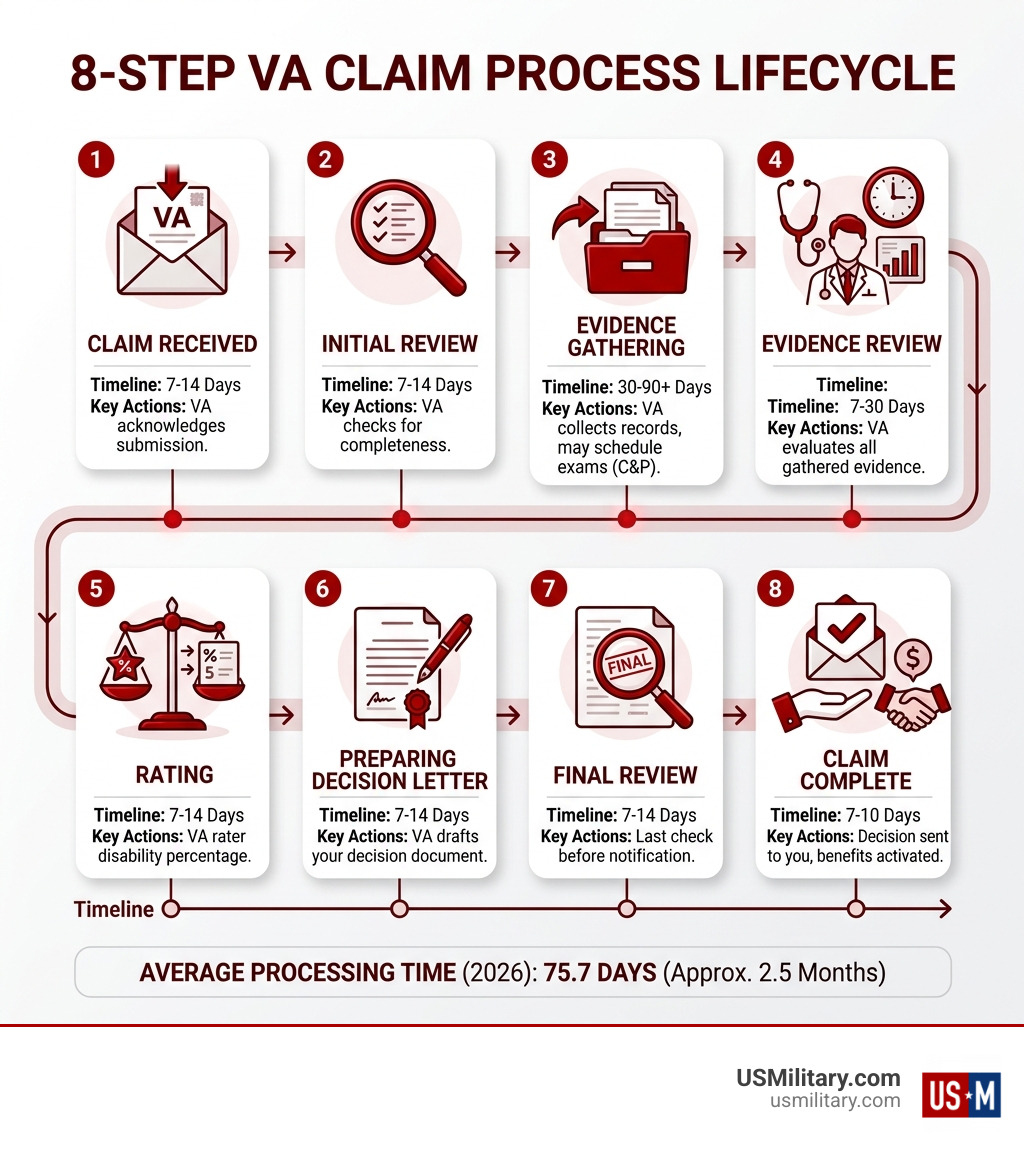
Understanding the 8 Steps of the VA Claim Process

Navigating the VA Claim Process is a bit like a cross-country flight: there are several legs to the journey, and occasionally, you might get diverted due to “weather” (otherwise known as missing paperwork). While the VA often groups these into five broader phases on their website, the internal system actually tracks your claim through eight distinct stages.
Understanding these Stages of a VA Disability Claim helps take the mystery out of why your status hasn’t changed in three weeks. It’s important to remember that this isn’t always a linear path. If a rater realizes a piece of evidence is missing in Step 5, they will kick the claim back to Step 3. Don’t panic if this happens; it’s just the VA’s way of ensuring they have the full picture before making a final call.
If you are just starting out, we recommend reading our guide on Filing Veterans Disability Claim to ensure your initial application is as strong as possible.
Step 1 through Step 3: Submission and Evidence
The first three steps are where the heavy lifting happens. Once you hit “submit,” your claim enters the system and begins its journey through the bureaucracy.
- Step 1: Claim Received: Your claim is officially in the VA’s hands. If you file online, you’ll get a confirmation almost immediately. If you mail it, expect a wait of about a week or two for a confirmation letter.
- Step 2: Initial Review: A Veterans Service Representative (VSR) takes a first look. They are checking for the basics: Did you sign it? Did you include your Social Security number? Is there enough information to actually start a claim?
- Step 3: Evidence Gathering, Review, and Association: This is the “Big One.” This is where the VA gathers your service treatment records, private medical records, and any personnel files. This is also the stage where you will likely be scheduled for a Compensation & Pension (C&P) exam.
As of March 2026, the data shows that the VA is moving faster than in previous years. The average number of days to complete disability-related claims was 75.7 days in March, a slight improvement from the 76.6 days recorded in February 2026 and a significant drop from the 81.1 days seen in November 2025.
| Step Number | Phase Name | Estimated Timeline |
|---|---|---|
| Step 1 | Claim Received | 7 – 14 Days |
| Step 2 | Initial Review | 7 – 14 Days |
| Step 3 | Evidence Gathering | 30 – 90+ Days |
| Step 4 | Evidence Review | 7 – 30 Days |
| Step 5 | Rating | 7 – 14 Days |
| Step 6 | Preparing Decision Letter | 7 – 14 Days |
| Step 7 | Final Review | 7 – 14 Days |
| Step 8 | Claim Complete | 7 – 10 Days |
Step 4 through Step 8: Review and Decision
Once the evidence is in, the claim moves into the “decision” pipeline. This is where the VA determines if your condition is service-connected and how severe it is.
- Step 4: Evidence Review: The VSR reviews all the collected evidence. If they realize they need more info, back to Step 3 you go. If everything looks good, it moves to a Rating Veterans Service Representative (RVSR).
- Step 5: Rating: This is where the “magic” happens. The RVSR reviews the medical evidence and the C&P exam results to assign a disability rating based on the VA Schedule for Rating Disabilities (VASRD).
- Step 6: Preparation for Decision: The rater completes their recommendation and prepares the decision packet.
- Step 7: Pending Decision Approval: A senior official reviews the rater’s decision for accuracy. Think of this as the “quality control” check.
- Step 8: Preparation for Notification: The VA prepares your final decision letter and sends it out. You can usually see the results online before the paper letter arrives in your mailbox.
For more details on what happens in these final moments, check out The VA Claim Process After You File Your Claim.
How to File Your Claim: Methods and Evidence
How you start the VA Claim Process can dictate how fast it ends. You have several options for filing:
- Online: By far the fastest and most reliable method via VA.gov.
- Mail: Sending VA Form 21-526EZ to the Claims Intake Center in Janesville, WI.
- In-Person: Visiting a VA Regional Office.
- With Help: Working with an accredited Veterans Service Officer (VSO) or attorney.
One of the most important tools at your disposal is the Intent to File. By submitting this simple notification (or even just starting an application online), you “lock in” your effective date. This means if it takes you 11 months to gather your medical records and submit the formal claim, the VA will still pay you back-pay all the way to that original Intent to File date if you’re approved.
When you are ready to submit, your “evidence locker” should include:
- Service Treatment Records (STRs): Your medical history while in uniform.
- Private Medical Records: Records from doctors you’ve seen since leaving the military.
- Buddy Letters: Statements from friends, family, or fellow service members who witnessed your injury or can testify to how your disability affects your daily life.
- Nexus Letters: A formal statement from a medical professional linking your current condition to your service. Learn more about How To Submit A Nexus Letter To The Va/.
For a full breakdown of the application steps, see the official guide on How To File A VA Disability Claim.
✉ Get updates like this in your inbox
Weekly VA benefit changes, pay updates, and money tips for service members, veterans, and military families. Free, no spam.
Speeding Up the VA Claim Process with Fully Developed Claims (FDC)
If you want to skip the line (legally!), the Fully Developed Claim (FDC) Program is your best friend. In a standard claim, you tell the VA where your records are, and they go get them. This takes time.
In an FDC, you do the legwork. You gather all your private medical records, buddy statements, and nexus letters, and you submit them all at once with your application. You then certify that you have no more evidence to provide. This tells the VA, “Everything you need is right here. Please go straight to the rating step.”
Using the FDC method is one of our 10 Do Or Die Tips When Filing Va Disability Claim/. It can shave weeks or even months off your wait time. Just be careful: if you submit more evidence after filing an FDC, the VA will automatically convert it back to a “Standard Claim,” and you’ll lose that expedited status.
Monitoring Your VA Claim Process Status
We know the feeling of checking the mailbox every day like it’s a holiday. Thankfully, you don’t have to wait for the mailman. You can track your VA Claim Process status in real-time:
- VA.gov: Sign in to your account and navigate to “Check your claim or appeal status.”
- VA Health and Benefits App: A convenient way to check from your phone.
- Phone Support: Call 1-800-827-1000 to speak with a representative.
While checking the status can be addictive, try not to obsess. Claims often sit in Step 3 for a long time while the VA waits on records from other government agencies. If you see your claim move to “Preparation for Decision,” that is one of the major Signs Your Disability Claim Will Be Approved/ (or at least that a decision is imminent).
What to Expect After Filing: C&P Exams and Ratings
After you file, the most significant milestone is the Compensation & Pension (C&P) exam. The VA uses these exams to confirm your diagnosis and determine the severity of your symptoms.
Think of the C&P exam as a job interview for your benefits. You need to be honest, but you also need to ensure the doctor understands your “worst day,” not just how you feel in that specific 20-minute window. The results of this exam, combined with your medical records, lead to your rating percentage (0% to 100%).
For the latest on what these percentages mean for your wallet, see 2026 Va Disability Rates Everything You Need To Know/ and our updated guide on Va Disability Ratings 2026/.
Factors Influencing the VA Claim Process Timeline
Why does your buddy’s claim take 60 days while yours takes 150? Several factors influence the speed of the VA Claim Process:
- Type of Claim: Original claims usually take longer than claims for an increase.
- Complexity: Filing for one condition (like tinnitus) is faster than filing for eight complex conditions (like PTSD, back pain, and Gulf War Illness).
- Evidence Availability: If the VA has to hunt down records from a private doctor who isn’t responding, your claim will stall.
- Regional Backlog: Some VA regional offices have more “traffic” than others.
The March 2026 data shows an average completion time of 120 calendar days from submission to award for the total process, though many veterans are seeing decisions much faster—around the 75-day mark—if their evidence is well-organized.
Handling Denials and Disagreements
If you get a decision back and it’s not what you expected—or if you were denied entirely—don’t lose heart. A denial is not the end of the road; it’s often just the beginning of a different path.
You generally have one year from the date of your decision letter to disagree. Under the Appeals Modernization Act, you have three main paths:
- Supplemental Claim: You provide “new and relevant” evidence that the VA didn’t have before.
- Higher-Level Review (HLR): A more senior rater reviews your existing file to see if the first rater made an error. You cannot submit new evidence here.
- Board Appeal: Your claim goes to a Veterans Law Judge at the Board of Veterans’ Appeals in Washington, D.C. This is the slowest path but offers the most thorough review.
If you find yourself in this position, start by reading our guide on what to do when your Va Claim Denied/. You’ll also want to familiarize yourself with The Veterans Map To Every Va Disability Reconsideration Form/ to ensure you choose the right appeal lane.
Frequently Asked Questions about the VA Claim Process
Why did my claim move back to the Evidence Gathering step?
This is the most common point of frustration for veterans. It usually happens for one of three reasons: the VA needs to clarify a medical opinion from a C&P examiner, they discovered a new medical facility where you received treatment, or you submitted new evidence that requires a new round of reviews. It feels like a setback, but it’s actually the VA doing its “duty to assist” to make sure your claim is fully supported.
How long does the VA take to decide a claim in 2026?
While the VA’s goal is under 125 days, the current “on the ground” average in March 2026 is 75.7 days. If you file a Fully Developed Claim, you are more likely to see a decision on the faster end of that spectrum. Keep an eye on the Veteran Disability Pay 2026 Rate/ to see how much your monthly benefit might be once that decision arrives.
What free resources are available to help with my claim?
You never have to go through the VA Claim Process alone. Accredited Veterans Service Officers (VSOs) from organizations like the American Legion, VFW, or DAV provide their services for free. They have access to the VA’s internal systems and can help you file paperwork correctly the first time. You can find a VSO near you through the VA.gov directory.
Conclusion
Mastering the VA Claim Process requires a mix of preparation, patience, and persistence. By understanding the eight steps—from that initial submission to the final decision letter—you can navigate the system with confidence rather than confusion.
Remember to lock in your effective date with an Intent to File, gather your medical evidence early, and consider the Fully Developed Claim route to speed things up. At USMilitary.com, we are committed to providing you with the most current data and resources to ensure you get the benefits you earned through your service.
If you’re ready to take the next step, revisit our core guide on Filing Veterans Disability Claim and start building your case today. You’ve served your country; now let the system serve you.
Free for Service Members & Veterans
Get the military benefits intel no one tells you about.
Weekly updates on VA benefits, pay changes, and money tips — free for service members and veterans.
No spam. Unsubscribe anytime. Your info is never shared.


