What Are VA Aid and Attendance or Housebound Benefits?
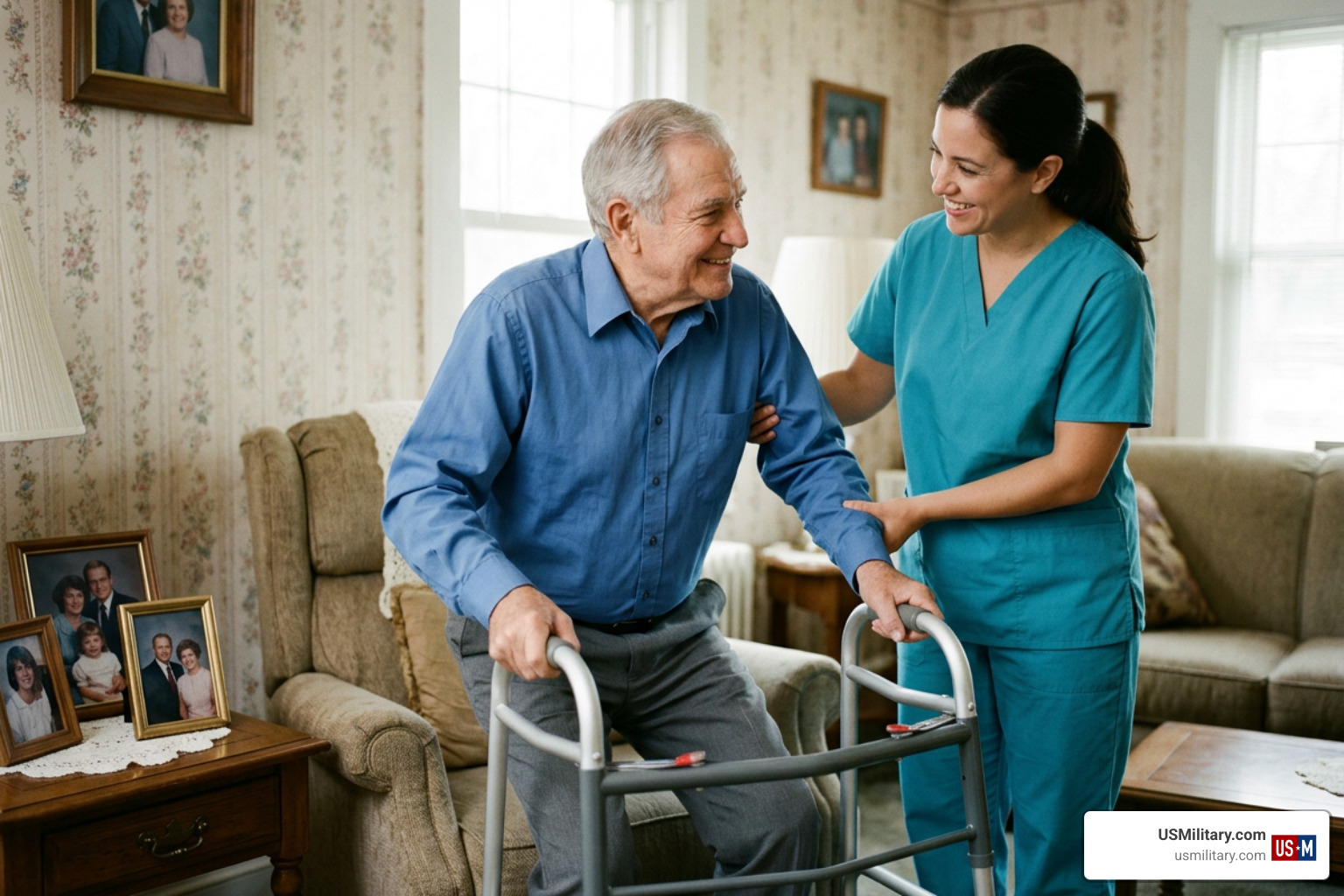
VA Aid and Attendance or Housebound benefits are monthly payments added on top of a standard VA pension for veterans and survivors who need daily personal care help or are confined to their home due to a permanent disability.
Here is a quick comparison to help you decide which benefit fits your situation:
| Aid and Attendance | Housebound | |
|---|---|---|
| Who it’s for | Veterans needing help with daily tasks (bathing, dressing, eating) | Veterans confined to home due to permanent disability |
| 2025 MAPR (no dependents) | $29,093/year | $21,313/year |
| Key requirement | Need for another person’s assistance OR meet related criteria | Substantially confined to home |
| Can you receive both? | No | No |
| Base requirement | Must qualify for VA Pension first | Must qualify for VA Pension first |
Both benefits require you to already qualify for a basic VA pension. You cannot receive both at the same time — you must choose one.
I’m Larry Fowler, publisher of the USMilitary.com Network, and since 2007 I’ve helped veterans navigate complex topics like VA Aid and Attendance or Housebound benefits through one of America’s largest privately owned military information networks. In this guide, I’ll break down exactly who qualifies, how much you can receive, and how to apply.
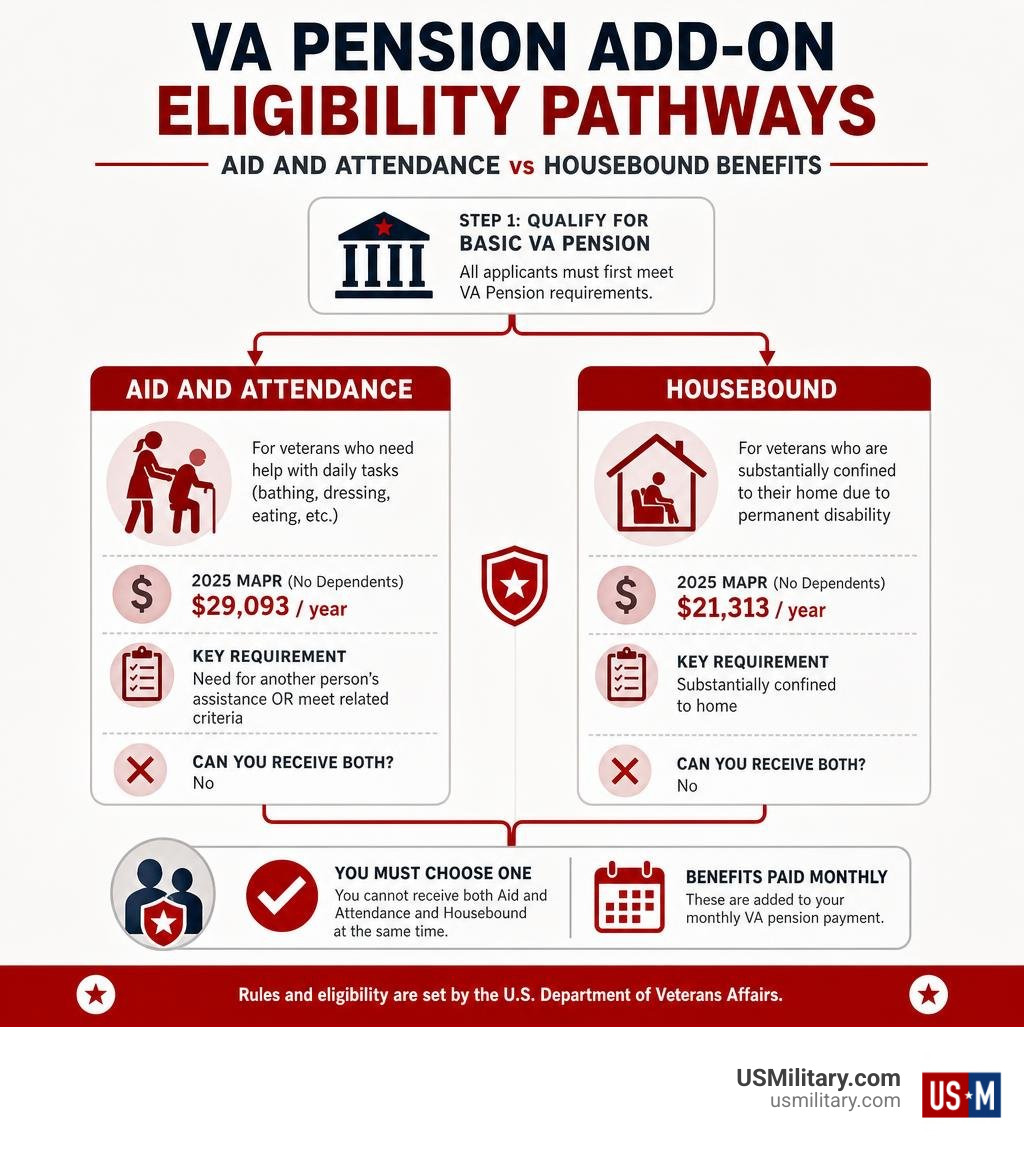
Overview of VA Aid and Attendance or Housebound Benefits
When exploring long-term care options or financial assistance for senior care, many families find themselves overwhelmed by VA jargon. The Department of Veterans Affairs provides supplemental pension allowances designed to cover the escalating costs of long-term care, in-home support, and assisted living. These payments are paid in addition to monthly basic pension payments.
To receive either allowance, a veteran or surviving spouse must first meet the baseline requirements for a basic VA Pension. Generally, wartime veterans must have served at least 90 days of active duty with at least 1 day during a recognized wartime era (or 24 continuous months if service began after September 7, 1980). Additionally, the veteran must be at least 65 years old or permanently disabled, and meet strict household income and net worth thresholds established by Congress.
The two main pension add-ons—Aid and Attendance and Housebound allowance—address distinct physical and medical situations:
- Aid and Attendance (A&A): Focuses on hands-on physical or cognitive assistance. It helps cover expenses when a veteran requires regular help with Activities of Daily Living (ADLs) such as showering, dressing, eating, or managing prosthetic devices.
- Housebound Status: Focuses on spatial restriction due to disability. It is intended for veterans who are substantially confined to their immediate premises or home environment due to a permanent medical condition.
For additional information on baseline allowance structures, you can check the official Aid And Attendance Benefits And Housebound Allowance | Veterans Affairs page or read our detailed article on Veterans Aid And Attendance Benefits.
| Feature / Criteria | Aid and Attendance (A&A) Pension Add-On | Housebound Pension Add-On |
|---|---|---|
| Primary Goal | Assist with hands-on personal daily care | Provide financial aid for home-confined veterans |
| Medical Requirement | Inability to perform ADLs, bedridden, or nursing home care | Substantially confined to home or premises |
| Visual Impairment Threshold | Corrected vision 5/200 or 5-degree field of vision | Standard disability rules apply |
| 2025 MAPR (Single Veteran) | $29,093 | $21,313 |
| Impact on Allowable Income | Higher allowable income threshold | Lower allowable income threshold than A&A |
| Concurrent Receipt Allowed? | No (cannot receive both simultaneously) | No (cannot receive both simultaneously) |
Pension Add-Ons vs. Special Monthly Compensation
A common point of confusion for wartime veterans is distinguishing between pension-based Aid and Attendance and Special Monthly Compensation (SMC) Aid and Attendance. While they share similar titles, they operate under completely different legal frameworks and benefit systems:
- Pension-Based Add-Ons (Needs-Based): These are paid to wartime veterans or surviving spouses who receive a non-service-connected pension. Financial eligibility is tied to household net worth limits and countable income calculations.
- Special Monthly Compensation (SMC): This is a tax-free benefit paid to veterans who have service-connected disabilities. SMC benefits are not needs-based and do not depend on income or asset limits. For instance, SMC-M status is granted for housebound needs, while higher tiers like SMC-N, SMC-O, SMC-P, and SMC-R provide additional compensation ranging from roughly $548 to over $4,000 per month for severe service-connected disabilities requiring specialized 24/7 care.
Non-Duplication Rules
Under Department of Veterans Affairs regulations, a claimant cannot draw both Aid and Attendance and Housebound benefits concurrently. This non-duplication rule ensures that a single pension recipient receives only one enhanced allowance at any given time.
When evaluating claims, the VA automatically calculates which benefit yields the highest monthly payment based on the applicant’s medical documentation and allowable medical expenses. Because Aid and Attendance provides a significantly higher Maximum Annual Pension Rate (MAPR), most veterans who qualify for both through physical care needs will be awarded the Aid and Attendance rate.
Eligibility and Financial Criteria
Qualifying Criteria for VA Aid and Attendance or Housebound Benefits
To qualify for VA Aid and Attendance or Housebound benefits, veterans or surviving spouses must meet specific medical and functional benchmarks established by federal regulations.
To qualify for Aid and Attendance, an applicant must satisfy at least one of the following conditions:
- Requires the physical assistance of another person to perform basic Activities of Daily Living (ADLs), such as bathing, dressing, grooming, eating, or using the restroom.
- Must remain in bed, or adjust routine due to being bedridden as a direct result of physical or cognitive disability.
- Is a patient residing in a nursing home or extended care facility due to mental or physical incapacity.
- Suffers from severe visual impairment, defined as corrected visual acuity of 5/200 or less in both eyes, or a concentric contraction of the visual field to 5 degrees or less.
To qualify for Housebound benefits, an applicant must demonstrate:
✉ Get updates like this in your inbox
Weekly VA benefit changes, pay updates, and money tips for service members, veterans, and military families. Free, no spam.
- A single permanent disability rated at 100% disabling, which forces the veteran to be substantially confined to their home or immediate premises; OR
- A single 100% permanent disability rating along with a secondary, separate service-connected or non-service-connected disability rated at 60% or higher.
To learn more about navigating these functional standards, review our comprehensive Va Aid Attendance Ultimate Guide.
Income Limits and Maximum Annual Pension Rates
The VA Pension program is a needs-based safety net. The VA sets a Maximum Annual Pension Rate (MAPR), which represents the maximum monetary ceiling a veteran can receive per year. The VA calculates your monthly payment by subtracting your household’s countable income from the applicable MAPR threshold.
For context, the 2025 MAPR amounts for a veteran with no dependents are:
- Basic VA Pension: $17,441
- Housebound Benefit: $21,313
- Aid and Attendance: $29,093
To determine countable income, the VA allows applicants to deduct unreimbursed medical expenses (UMEs)—such as assisted living fees, home health caregiver pay, and prescription costs—that exceed 5% of the basic pension rate.
In addition to annual income limits, applicants must comply with strict net worth thresholds set by Congress. The VA enforces a net worth cap (which includes real property and liquid assets, excluding the primary home and vehicle) along with a three-year financial lookback period. Transferring assets for less than fair market value during this 36-month window can trigger a penalty period of inadmissibility. For an in-depth breakdown of financial asset rules, read our guide on Navigating The Maze Of Va Aid And Attendance Income Requirements.
Application Process and Required Documentation
Submitting Claims for VA Aid and Attendance or Housebound Benefits
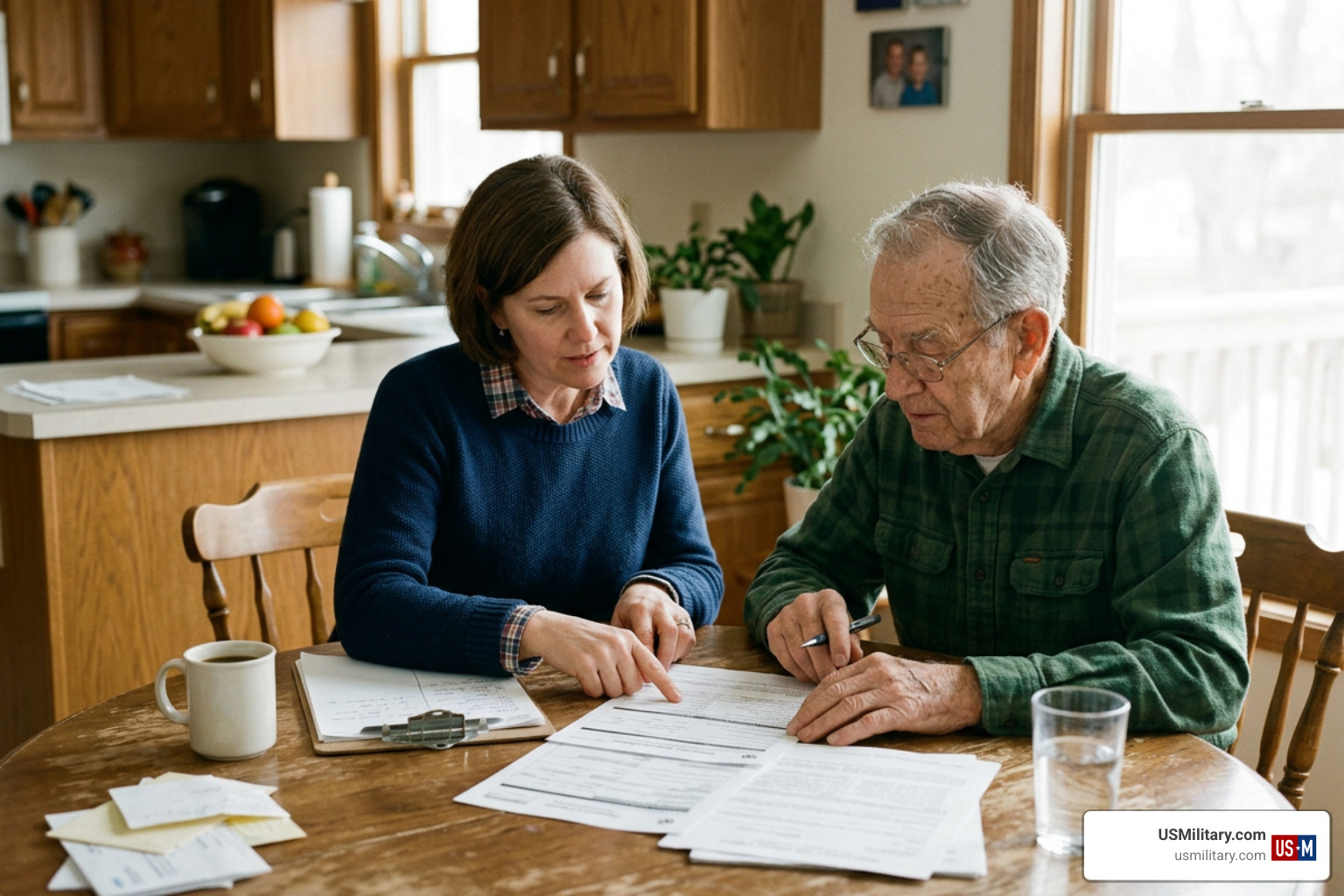
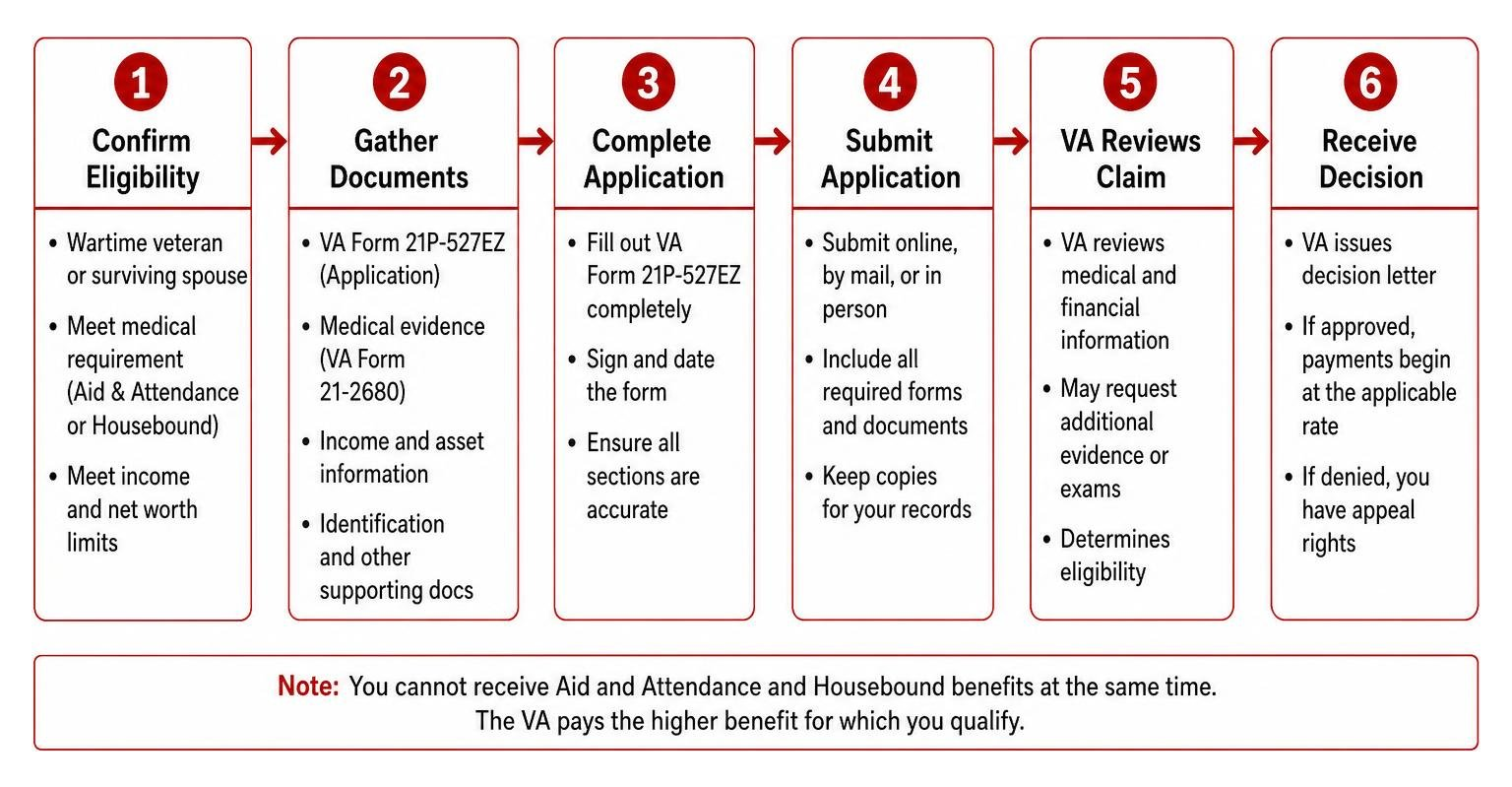
Filing a claim for va aid and attendance or housebound benefits requires gathering accurate medical evidence and submitting the paperwork through official VA channels. Claims can be filed online via VA.gov, by mail through the centralized VA Pension Intake Center in Janesville, Wisconsin, or in person at a local VA Regional Office.
Working alongside an accredited Veterans Service Officer (VSO) or certified representative helps ensure that medical records, financial statements, and military discharge papers (DD Form 214) are organized properly prior to submission.
Required Medical Forms and Evidence
The cornerstone of any successful claim is comprehensive medical documentation. You must provide clear clinical evidence proving that your medical conditions impair your physical independence or restrict you to your home.
Key administrative and medical forms include:
- VA Form 21-2680 (Examination for Housebound Status or Permanent Need for Regular Aid and Attendance): This official document must be completed by a licensed medical professional—such as a Medical Doctor (MD), Doctor of Osteopathic Medicine (DO), Physician Assistant (PA), or Advanced Practice Registered Nurse (APRN). The examiner must detail physical movement limitations, gait, mental capacity, and daily assistance needs. Download the official VA Form 21-2680 to begin.
- VA Form 21-0779 (Request for Nursing Home Information in Connection with Claim for Aid and Attendance): If the applicant resides in a care facility, this form must be completed by an authorized nursing home official to confirm care details and fee structures.
- Attending Physician Statements & Personal Statements: Detailed written statements from primary care doctors, family caregivers, or home nursing agencies explaining specific functional limitations (e.g., risk of falling, inability to prepare meals, or memory impairment).
To ensure your application is filled out correctly, consult our detailed walkthrough on the Aid And Attendance Form.
Frequently Asked Questions About VA Allowances
Can a veteran receive both benefits concurrently?
No. Federal statutory regulations explicitly prohibit receiving both Aid and Attendance and Housebound allowances at the same time. If a claimant meets criteria for both programs, the Department of Veterans Affairs will automatically grant the benefit option that provides the higher monthly payout—which is almost always the Aid and Attendance rate.
What is the difference between pension add-ons and SMC?
Pension add-ons (Special Monthly Pension) are needs-based payments granted to eligible wartime veterans who meet net worth and income limits, regardless of whether their disability was caused by military service. In contrast, Special Monthly Compensation (SMC) is an additional tax-free benefit awarded exclusively to veterans with service-connected disabilities rated at 50% or higher, operating entirely outside of household income restrictions.
How long does the claim decision process take?
The average processing time for Aid and Attendance or Housebound claims ranges between 60 and 120 days. Processing timelines vary based on the completeness of the initial submission, the speed at which private medical facilities release clinical records, and total regional office claim volume. Claims submitted with fully completed medical forms (like VA Form 21-2680) and detailed financial receipts achieve approval rates between 70% and 80%. Priority processing is available for veterans facing extreme financial hardship or severe medical crises. For a full timeline analysis, read our article on How Long Does It Take To Get Approved For Aid And Attendance.
Conclusion

Understanding the distinctions between va aid and attendance or housebound benefits empowers wartime veterans and their families to make informed long-term care decisions. Whether you require hands-on support for daily tasks or financial assistance due to home confinement, these VA pension add-ons offer vital financial relief.
At USMilitary.com, we are dedicated to helping service members, veterans, and military families access the benefits they have earned. To explore additional tools, payment charts, and step-by-step filing guidance, visit our comprehensive VA Aid and Attendance Resource Guide today.
Free for Service Members & Veterans
Get the military benefits intel no one tells you about.
Weekly updates on VA benefits, pay changes, and money tips — free for service members and veterans.
No spam. Unsubscribe anytime. Your info is never shared.


