Why Veterans Struggle with Aid and Attendance Applications
How hard is it to get VA Aid and Attendance depends on three main factors: your ability to prove medical need, meet financial limits, and submit complete documentation. Many veterans find the process challenging, with approval taking 9-12 months on average.
Quick Answer:
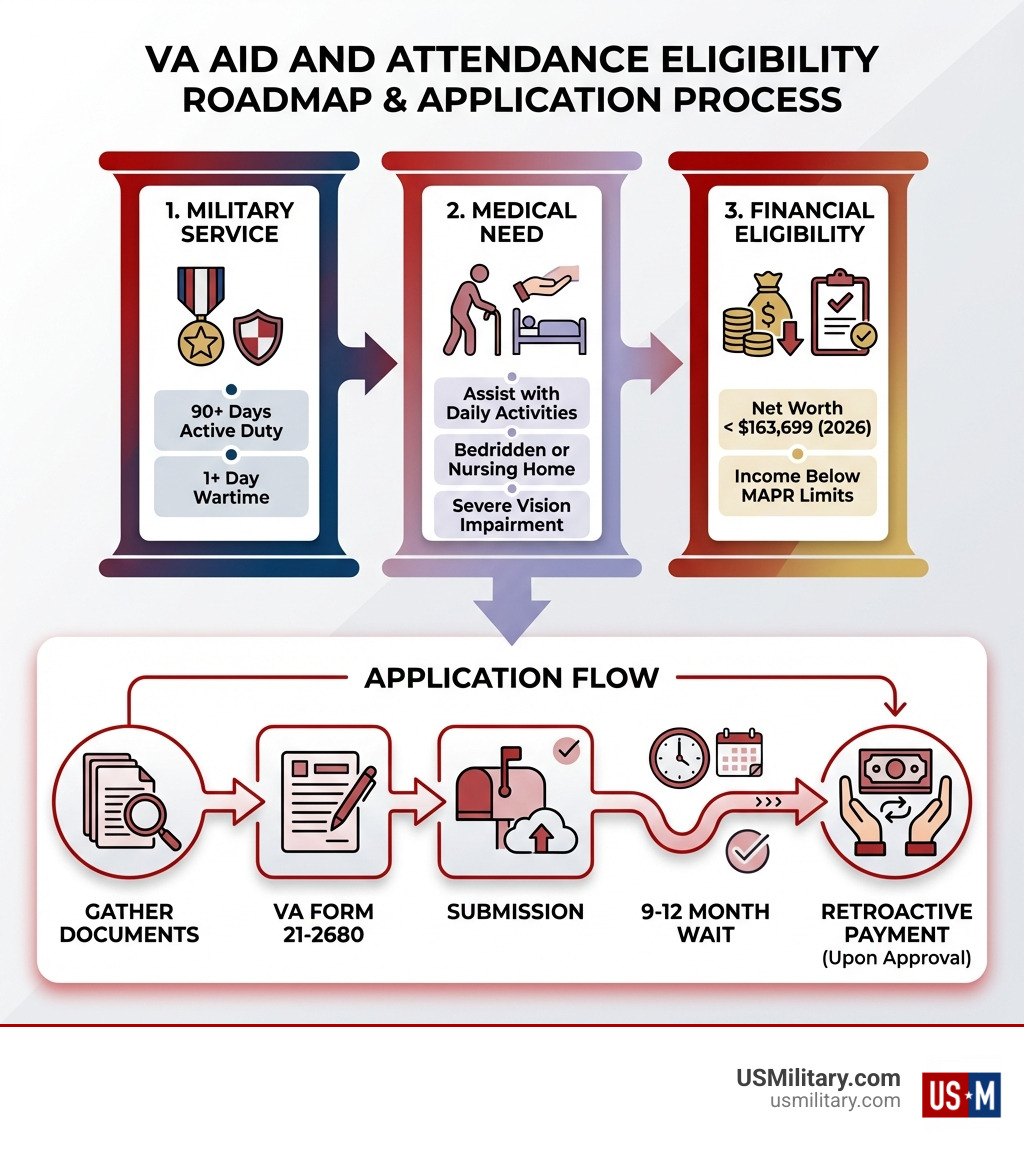
- Medical Requirements: You must need help with at least 2 daily activities (bathing, dressing, eating), be bedridden, live in a nursing home, or have severe vision impairment
- Financial Limits: Net worth must be below $163,699 (Dec 2025-Nov 2026), not counting your home and car
- Service Requirements: 90 days active duty with at least 1 day during wartime
- Processing Time: 9-12 months average, with retroactive pay to filing date if approved
- Common Failures: Missing paperwork, incomplete medical documentation, or financial eligibility errors
The VA Aid and Attendance benefit provides tax-free monthly payments in addition to your basic VA pension. It’s designed to help veterans and surviving spouses pay for long-term care when they can no longer fully care for themselves.
This isn’t a standalone benefit. You must first qualify for the basic VA pension, then prove you need extra help with daily living. The application requires detailed medical evidence, complete financial disclosure, and specific VA forms that must be filled out correctly.
The reality: Getting approved is not easy. The VA has strict eligibility criteria, and many applications are denied over small mistakes or missing paperwork—not because the applicant is ineligible. Success depends on understanding what the VA needs and providing thorough documentation upfront.
I’m Larry Fowler, publisher of USMilitary.com since 2007, where we’ve helped thousands of veterans understand how hard is it to get VA Aid and Attendance and steer the application process successfully. Our network has provided up-to-date trends on VA benefits and disability, helping veterans access the care they’ve earned.
How hard is it to get VA Aid and Attendance terms made easy:
- 2026 aid and attendance rates
- aid and attendance 2026
- What is the income limit for VA Aid and Attendance
How hard is it to get VA Aid and Attendance?
Many veterans and their families ask us, “How hard is it to get VA Aid and Attendance?” The honest answer is that it can be quite challenging, but certainly not impossible with the right preparation and understanding. The VA’s Aid and Attendance (A&A) benefit is a crucial financial resource for many, providing additional monthly payments to veterans and surviving spouses who need help with daily living due to age or disability. However, the path to approval is paved with strict criteria and a detailed application process.

The primary reason many find it difficult is the comprehensive nature of the eligibility requirements. You must meet specific military service, medical, and financial criteria. Missing even a single piece of documentation or making a small error on a form can lead to significant delays or outright denial. The VA’s process is designed to ensure that benefits go to those who truly need and qualify for them, which means a thorough review of every application.
The medical necessity must be clearly demonstrated, often requiring detailed physician reports. Financial limits, including income and net worth, are rigorously assessed. We often see applications get denied not because the applicant is ineligible, but simply due to errors in paperwork or insufficient evidence.
We understand that navigating these complexities can feel overwhelming. That’s why we at USMilitary.com are dedicated to providing clear, non-biased information to help you understand every step. For a general overview of the benefit, check out our page on Aid and attendance. If you’re specifically looking into care options, our guide on Who qualifies for veteran benefits for assisted living offers valuable insights.
Medical and Service Requirements for Eligibility
To even begin considering Aid and Attendance, a veteran or surviving spouse must first meet the basic eligibility criteria for a VA pension. This means proving qualifying military service and demonstrating a medical need that rises to the level of requiring Aid and Attendance.
Military Service Requirements:
For veterans, the service requirements for the basic VA pension, which is a prerequisite for Aid and Attendance, are quite specific:
- Wartime Service: Generally, a veteran must have served at least 90 days of active duty, with at least one day during a designated wartime period.
- Post-1980 Service: If active duty began after September 7, 1980, the veteran generally needs to have served at least 24 months or the full period for which they were called or ordered to active duty, with at least one day during a wartime period.
- Discharge: The veteran must have received an honorable discharge. A dishonorable discharge makes a veteran ineligible for VA pensions.
The VA defines specific wartime periods for these benefits. These include:
- World War II: December 7, 1941, to December 31, 1946
- Korean Conflict: June 27, 1950, to January 31, 1955
- Vietnam Era: February 28, 1961, to May 7, 1975 (for those who served in Vietnam or offshore) or August 5, 1964, to May 7, 1975 (for all others)
- Persian Gulf War: August 2, 1990, to the present
For the most up-to-date information on service requirements, we always recommend you visit the VA website.
Specific Medical Conditions or Needs for Aid and Attendance:
Once the service requirements are met, the medical criteria are what truly define the need for Aid and Attendance. The VA recognizes that certain health conditions necessitate extra care. You must meet at least one of the following conditions to qualify for Aid and Attendance:
- ADL Assistance: You need the aid of another person to perform at least two “Activities of Daily Living” (ADLs). These commonly include bathing, feeding, dressing, toileting, and medication management. This means you can’t perform these tasks on your own, or you need substantial supervision to remain safe.
- Bedridden Status: You are largely confined to bed due to illness, with the exception of necessary medical appointments or prescribed therapy.
- Nursing Home Patient: You are a patient in a nursing home due to physical or mental incapacity.
- Vision Impairment: Your eyesight is severely limited, defined as corrected visual acuity of 5/200 or less in both eyes, or concentric contraction of the visual field to 5 degrees or less.
Understanding these conditions is critical to successfully answering the question of how hard is it to get VA Aid and Attendance. We dig deeper into these specific requirements in our detailed article, Aid and attendance medical criteria explained for veterans.
Understanding the medical difficulty of how hard is it to get VA Aid and Attendance
The medical aspect is often where applicants face the most problems. It’s not enough to simply state you need help; you must provide compelling evidence. The VA relies heavily on detailed medical documentation to assess your need for Aid and Attendance.
The most crucial piece of medical documentation is usually a doctor’s report, which your physician completes on VA Form 21-2680 (Examination for Housebound Status or Permanent Need for Regular Aid and Attendance). This form must clearly describe:
- Physical Impairment: The nature and extent of any physical limitations.
- Mental Incapacity: If applicable, details of cognitive decline, memory issues, or other mental health conditions affecting daily function.
- Daily Functions: How your condition impacts your ability to perform ADLs, how well you get around, where you go, and what you can do on a daily basis. The report should paint a clear picture of your functional limitations.
- Need for Supervision: If you require substantial supervision to protect yourself from hazards or the daily environment.
A generic doctor’s note saying “patient needs help” simply won’t cut it. The VA needs specific, detailed information. Think of it this way: the VA representative reviewing your claim has never met you. This report needs to tell your story and medically justify your need for Aid and Attendance.
Beyond the physician’s report, additional evidence can include:
- Caregiver affidavits: Statements from family members or paid caregivers detailing the type and frequency of assistance you receive. These accounts can be incredibly powerful in illustrating your daily needs.
- Medical records: Clinic visit summaries, hospital discharge papers, and home health agency reports can all support your claim.
- Nursing home or assisted living statements: If you reside in such a facility, a signed letter from the care provider outlining the level of care you receive is vital.
The more comprehensive and specific your medical evidence, the less how hard is it to get VA Aid and Attendance becomes in the medical evaluation phase.
Financial Problems: Income, Net Worth, and the Lookback Period
Beyond military service and medical need, the financial eligibility criteria are another significant hurdle, and often where the process of getting Aid and Attendance can feel most complicated. The VA Pension, and by extension Aid and Attendance, is a needs-based benefit, meaning your income and assets are taken into account.
| Financial Requirement | Limit (Dec 1, 2025 – Nov 30, 2026) | Notes TABLE
| Item | Net Worth Limit (Dec 1, 2025 – Nov 30, 2026) |
|---|---|
| Net Worth | $163,699 |
| Exclusions | Primary residence, one automobile |
The VA’s pension program, including Aid and Attendance, is designed to help veterans and their families who have limited income and assets. This means that to qualify, your financial situation must fall within specific limits set by Congress.
Countable Income:
Your yearly family income must be below a certain threshold. The VA calculates your countable income by taking your gross annual household income and subtracting qualified un-reimbursed medical expenses (UMEs). The remaining amount is then compared to the Maximum Annual Pension Rate (MAPR) for your specific beneficiary category (e.g., single veteran, veteran with dependent, surviving spouse). If your countable income is below the MAPR, you may be eligible.
We understand that these calculations can be complex. For detailed information on the financial requirements for the upcoming year, refer to our comprehensive guide on Veterans aid and attendance requirements 2026.
Unreimbursed Medical Expenses (UMEs):
This is a critical factor for many applicants. The VA allows you to deduct certain out-of-pocket medical expenses from your gross income. These UMEs can significantly reduce your countable income, potentially bringing you below the eligibility threshold. To be deductible, these expenses must generally exceed 5% of the MAPR. Examples include:
- Payments for in-home care, assisted living, or nursing home care.
- Health insurance premiums (including Medicare Part B and D).
- Prescription medications.
- Medical supplies and equipment.
- Transportation costs to medical appointments.
- Care provided by a family member, if they are not legally obligated to provide care and are paid for their services.
Keeping meticulous records of all UMEs is absolutely essential.
✉ Get updates like this in your inbox
Weekly VA benefit changes, pay updates, and money tips for service members, veterans, and military families. Free, no spam.
The 3-Year Lookback Period:
One of the most significant changes to VA pension eligibility, implemented on October 18, 2018, is the 3-year lookback period. This rule was put in place to prevent applicants from artificially reducing their net worth to qualify for benefits.
- How it Works: The VA reviews all asset transfers (gifts or sales below fair market value) made by the applicant, and their spouse if applicable, during the 36 months immediately preceding the application date.
- Purpose: To determine if assets were transferred out of the applicant’s name to meet the net worth limit.
- Penalty Periods: If the VA finds that assets were transferred in violation of this rule, a penalty period of ineligibility may be imposed. This penalty can last up to five years, depending on the amount transferred. If the gifted asset can be retrieved, the penalty may be avoided.
This lookback period means that careful financial planning is more important than ever. We often get questions about how these rules affect planning for long-term care, especially concerning assisted living costs. Our article, Does VA pay for assisted living, addresses how Aid and Attendance can help with these expenses.
Navigating financial barriers: How hard is it to get VA Aid and Attendance?
Navigating the financial eligibility criteria can be one of the most challenging aspects of the application process. The VA’s rules around income, net worth, and asset transfers are complex and can be easily misunderstood. This is where many applicants find themselves asking, “How hard is it to get VA Aid and Attendance?”
For example, understanding Who is eligible for VA aid and attendance 2026 requires a clear grasp of these financial nuances. Your net worth includes most assets like bank accounts, stocks, bonds, and retirement accounts, but excludes your primary residence and one automobile. For married couples, the assets and income of both spouses are considered.
Gifted Assets and Penalties: The lookback period is particularly tricky. If you’ve gifted assets to family members or friends within the 36-month window prior to applying, you could face a penalty period. This period is calculated by dividing the uncompensated value of the transferred assets by the maximum annual pension rate. It’s designed to ensure fairness and prevent individuals from simply giving away their wealth to qualify for benefits.
MAPR Limits: The Maximum Annual Pension Rate (MAPR) is the highest amount of pension you can receive in a year. Your countable income is subtracted from this MAPR to determine your annual benefit amount. If your countable income (after UMEs) is higher than the MAPR, you won’t qualify. This constantly changing figure means planning needs to be dynamic.
Asset Valuation: The VA uses specific rules to value assets. Understanding what counts and what doesn’t, and how different types of assets are assessed, is crucial. For instance, certain trusts or annuities might be treated differently.
Medicaid Interaction: Many families also wonder, How does aid attendance affect medicaid? It’s important to know that while Aid and Attendance benefits themselves are typically not counted towards Medicaid’s income limits, the basic VA pension amount might be. Medicaid often requires applicants to apply for any VA pension benefits they’re entitled to. For married couples with differing care needs, exploring both Medicaid and VA pensions might require careful planning, often best steerd with professional advice.
Because of these complexities, we highly recommend seeking assistance from a qualified VA-accredited representative or elder law attorney. They can help you understand these rules, accurately calculate your countable income and net worth, and ensure your application is submitted correctly, significantly reducing the financial barriers to approval.
The Application Process and Avoiding Common Denials
The application process for VA Aid and Attendance can be detailed and lengthy, making it another reason why veterans often feel that how hard is it to get VA Aid and Attendance is a valid question. However, with careful attention to detail and a strategic approach, you can significantly improve your chances of success.
Processing Time and Retroactive Pay:
One of the most common questions we hear is, How long does it take VA to make a decision on aid and attendance? On average, approval takes between 9 to 12 months from the time the application is filed. This timeline can be shorter or longer depending on the completeness of your application and the VA’s current workload.
The good news is that if approved, benefits are paid retroactively to your original filing date, provided the evidence shows entitlement existed at that time. This means that even with a lengthy waiting period, you won’t lose out on benefits you were eligible for.
Key Forms and Submission Strategies:
- Basic Pension Application: You must first be eligible for the basic VA pension. Veterans typically apply using VA Form 21P-527EZ (Application for Pension).
- Aid and Attendance Request: To apply for the Aid and Attendance benefit specifically, you’ll need to submit VA Form 21-2680 (Examination for Housebound Status or Permanent Need for Regular Aid and Attendance). This form must be completed and signed by your physician.
- Nursing Home Information: If you are in a nursing home, you’ll also need to fill out VA Form 21-0779 (Request for Nursing Home Information in Connection with Claim for Aid and Attendance).
You can submit these forms and supporting documentation in several ways:
- Mail: Send to the Pension Management Center (PMC) that serves your state.
- In-person: Visit your local regional VA benefit office.
- Online: While the initial pension form (21P-527EZ) can be started online, medical forms often require physical submission. The VA’s QuickSubmit tool can be used to upload documents.
The Fully Developed Claim (FDC) Program:
To expedite the process, consider using the Fully Developed Claim program. An FDC means you submit all necessary evidence and documentation upfront with your application, rather than waiting for the VA to request it. This can significantly shorten the processing time.
Intent to File:
We strongly recommend submitting an Intent to File form (VA Form 21-0966) as early as possible. This form establishes your effective date for benefits, meaning that once your claim is approved, your payments will be retroactive to the date the VA received your Intent to File. It gives you up to a year to gather all necessary evidence without losing potential benefits.
Evidence Collection: This cannot be stressed enough. Gather all necessary documentation including:
- Military service records (DD-214).
- Detailed medical records and physician statements.
- Proof of income and assets.
- Receipts for all unreimbursed medical expenses.
- Caregiver affidavits.
- Marriage certificate (for spouses) or death certificate (for surviving spouses).
Surviving Spouses and Housebound Benefits
The Aid and Attendance benefit isn’t just for veterans; surviving spouses can also qualify, though they have their own specific criteria. Additionally, it’s important to understand the distinction and relationship between Aid and Attendance and Housebound benefits.
Aid and Attendance for Surviving Spouses:
Yes, surviving spouses can indeed qualify for Aid and Attendance benefits. This is a critical resource for many who cared for their veteran spouse and now face their own health and financial challenges. Our guide, Aid and attendance for surviving spouses, provides a deep dive into this topic.
The eligibility criteria for surviving spouses mirror those of veterans in many ways:
- Veteran’s Service: The deceased veteran must have met the military service requirements for the basic VA pension.
- Marital Status: The surviving spouse must have been married to the veteran for at least one year (or had a child with the veteran) and must not have remarried after the veteran’s death (unless the remarriage ended before November 1, 1990, and certain other conditions are met).
- Medical Needs: The surviving spouse must meet the same medical criteria for Aid and Attendance (e.g., needing ADL assistance, being bedridden, nursing home resident, or severe vision impairment).
- Financial Limits: The surviving spouse must meet the income and net worth limits.
- Application Form: Surviving spouses will typically use VA Form 21P-534EZ (Application for DIC, Pension, and/or Accrued Benefits) to apply for the Survivors Pension, along with VA Form 21-2680 for the Aid and Attendance portion. A death certificate for the veteran is also required.
Housebound Benefits:
The VA also offers Housebound benefits, which are similar to Aid and Attendance but have different medical criteria. Like A&A, Housebound benefits are an increased monthly payment added to a basic VA pension.
- Eligibility: You must have a single permanent disability evaluated as 100% disabling AND be substantially confined to your immediate premises due to that disability. Alternatively, you can qualify if you have a single permanent disability evaluated as 100% disabling AND another disability or disabilities evaluated as 60% or more disabling.
- Non-Simultaneous Benefits: This is crucial: you cannot receive both Aid and Attendance and Housebound benefits at the same time. The VA will award whichever benefit provides the higher payment amount if you qualify for both.
Understanding which benefit best fits your situation is key to a successful application.
Frequently Asked Questions about VA Aid and Attendance
We often hear many questions about the Aid and Attendance benefit. Here, we address some of the most common ones to help explain the process and shed light on how hard is it to get VA Aid and Attendance.
Are VA Aid and Attendance benefits taxable?
No, VA Aid and Attendance benefits are not considered taxable income by the IRS. As part of veteran’s disability benefits, they are tax-exempt. This is a significant advantage, as the full amount received can be used to cover care expenses without worrying about federal income tax deductions.
How much is the maximum monthly payment?
The maximum monthly payment for Aid and Attendance varies depending on your beneficiary category (e.g., single veteran, veteran with a dependent, surviving spouse) and is adjusted annually by Congress. These rates are based on the Maximum Annual Pension Rate (MAPR) and are typically updated on December 1st each year.
For the period of December 1, 2025, to November 30, 2026, here are some approximate maximum monthly payment rates for Aid and Attendance (these figures can be subject to change, so always check the latest VA updates or our specific guide on How much is aid and attendance pay for 2025):
- Single Veteran: Around $2,424 per month
- Veteran with a Spouse or Dependent Child: Around $2,873 per month
- Surviving Spouse (no dependent child): Around $1,558 per month
- Two Married Veterans (both qualify for A&A): Around $3,845 per month
These amounts represent the maximum you could receive. Your actual benefit amount is determined by subtracting your countable income (after UMEs) from the applicable MAPR. The dependent allowance also plays a role, increasing the benefit for veterans with qualifying dependents.
What are the most common reasons for denial?
The reality is that many Aid and Attendance claims are initially denied. This contributes significantly to the perception of how hard is it to get VA Aid and Attendance. However, many denials are not because an applicant is truly ineligible, but due to preventable errors. Common reasons for denial include:
- Missing Paperwork or Incomplete Forms: This is arguably the most frequent reason. Applications often require a multitude of documents, and if even one is missing or incorrectly filled out, it can lead to denial. The VA is very particular about the specific forms and information required.
- Insufficient Medical Documentation: The doctor’s report (VA Form 21-2680) is not detailed enough or doesn’t clearly articulate the need for assistance with ADLs, bedridden status, or other qualifying medical conditions. Generic statements won’t suffice; specific functional limitations must be described.
- Financial Eligibility Gaps: Errors in reporting income, assets, or failing to properly document unreimbursed medical expenses can lead to exceeding the financial limits. Misunderstanding the 3-year lookback period and asset transfers is another common pitfall.
- Lack of Proof of Wartime Service: Not providing clear documentation of qualifying military service, including dates and discharge status.
- Not Meeting Basic Pension Requirements: Aid and Attendance is an improved pension, so if you don’t meet the basic VA pension eligibility first, you won’t qualify for A&A.
The Appeal Process: If your claim is denied, don’t give up! You have options for appeal:
- Supplemental Claim: If you have new and relevant evidence that was not previously submitted, you can file a Supplemental Claim.
- Higher-Level Review: You can request a Higher-Level Review if you believe there was an error in the previous decision based on the evidence already submitted.
- Appeal to the Board of Veterans’ Appeals: If you disagree with the Higher-Level Review decision, you can appeal to the Board of Veterans’ Appeals, which is the highest level of appeal within the VA.
Seeking assistance from a VA-accredited representative or veterans service organization (VSO) is highly recommended if your claim is denied. They can help you understand the reason for denial and guide you through the appeals process.
Conclusion
Understanding how hard is it to get VA Aid and Attendance is the first step toward successfully navigating the application process. While the journey can be challenging due to strict medical, financial, and service requirements, it is far from impossible. Many veterans and their surviving spouses successfully secure these vital benefits each year, providing much-needed financial relief for long-term care.
The key to success lies in thorough preparation, meticulous documentation, and a clear understanding of the VA’s specific criteria. Don’t underestimate the importance of a detailed physician’s report, accurate financial disclosure, and a complete application package. Submitting an Intent to File early and considering the Fully Developed Claim program can also significantly impact your timeline and potential retroactive payments.
We at USMilitary.com are committed to empowering our military community with the knowledge and resources needed to access the benefits they’ve earned. We believe that no veteran or surviving spouse should have to face this complex process alone. Whether you’re just starting your research or are navigating an appeal, professional assistance is available and can make a significant difference in your outcome.
For a comprehensive resource that covers everything you need to know about this benefit, we invite you to explore our VA Aid and Attendance Complete Guide. We’re here to help you every step of the way.
Free for Service Members & Veterans
Get the military benefits intel no one tells you about.
Weekly updates on VA benefits, pay changes, and money tips — free for service members and veterans.
No spam. Unsubscribe anytime. Your info is never shared.


