Understanding the Age Requirements to Join the Navy Reserve
The age requirement for navy reserve service is between 18 and 42 years old for non-prior service recruits. However, this range changes significantly if you have prior military experience or are pursuing an officer commission.
Quick Answer: Navy Reserve Age Limits
| Category | Minimum Age | Maximum Age | Notes |
|---|---|---|---|
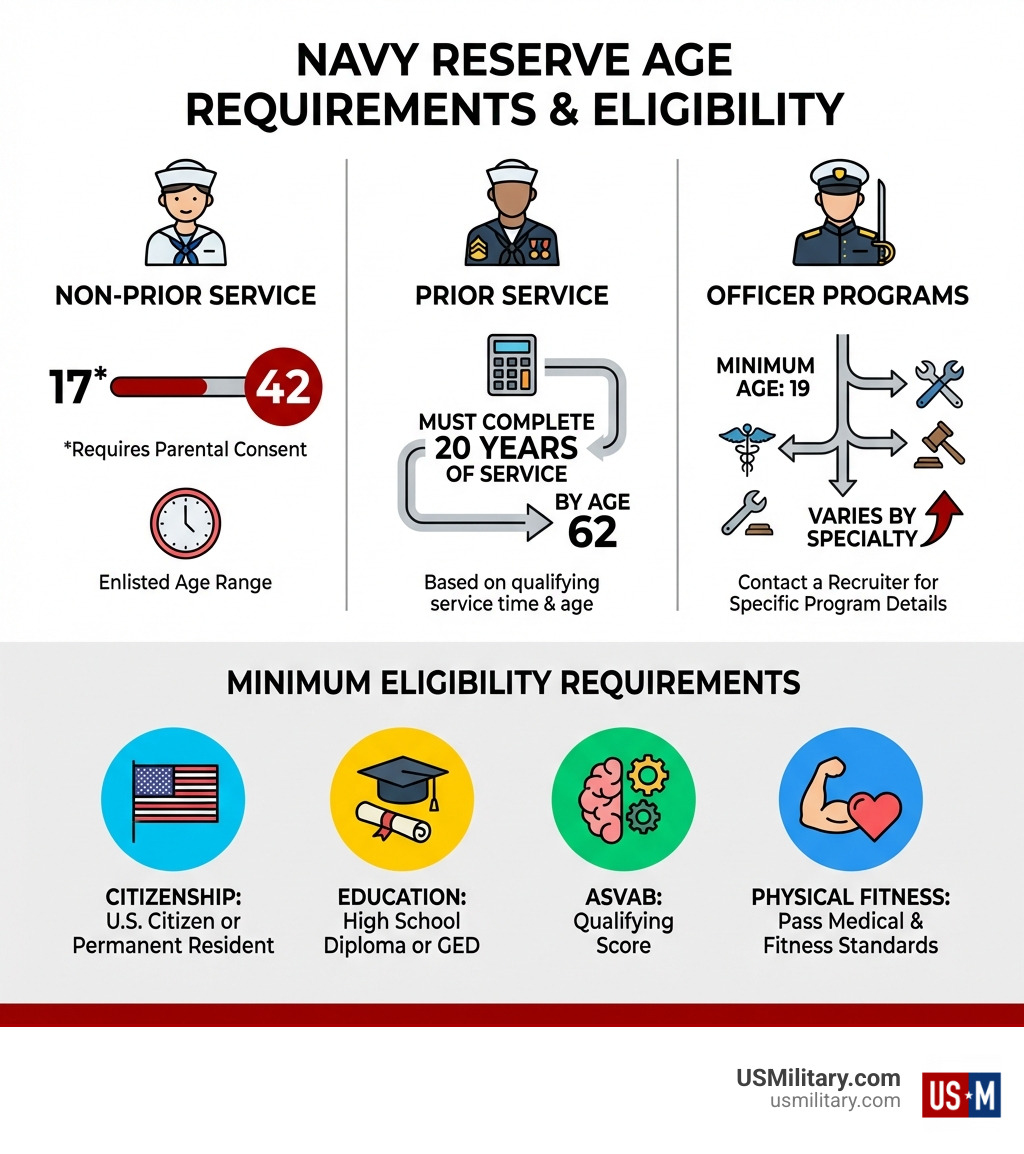
| Non-Prior Service (Enlisted) | 17* | 42 | *17-year-olds need parental consent |
| Prior Service | 17* | Varies | Must complete 20 years by age 62 |
| Officer Programs | 19 | Varies by program | Different limits for each specialty |
The Navy Reserve offers a unique opportunity to serve your country part-time while maintaining your civilian career. Unlike active duty service, Reserve Sailors typically drill one weekend per month and complete two weeks of annual training. This flexibility makes the Reserve an attractive option for many Americans who want to serve but can’t commit to full-time military life.
Age is one of the first factors the Navy evaluates when you express interest in joining. In fall 2022, the Navy raised its maximum enlistment age from 39 to 41 for active duty, and the Reserve quickly followed suit, expanding opportunities for older Americans to serve. This change reflects the Navy’s recognition that maturity and life experience bring valuable skills to military service.
But age is just one piece of the eligibility puzzle. You’ll also need to meet citizenship requirements, pass the Armed Services Vocational Aptitude Battery (ASVAB) test, complete a physical examination, and demonstrate good moral character. Understanding where you fall within the age ranges—and what exceptions might apply to your situation—is the first step toward determining if Navy Reserve service is right for you.
Age Limits for New Navy Reserve Recruits (Non-Prior Service)
For those who have never served in any branch of the U.S. military, joining the Navy Reserve as a new recruit, or Non-Prior Service (NPS) member, comes with specific age guidelines. These are often the most straightforward age requirements you’ll encounter.

What is the minimum age to join the Navy Reserve?
The minimum age to enlist in the Navy Reserve is 17 years old. However, if you’re 17, you’ll need to have the written consent of a parent or legal guardian to join. If you’re 18 or older, parental consent is no longer required. This ensures that younger individuals have the full support of their families when making such a significant commitment.
What is the maximum age to join the Navy Reserve?
For Non-Prior Service individuals, the maximum age to join the Navy Reserve is 42 years old. This age limit was recently increased, making it possible for more individuals to consider a career in the Naval Reserve. This expansion reflects the Navy’s need for diverse talent and skills, acknowledging that valuable contributions can come from individuals with more life experience.
Beyond age, new recruits also need to meet other fundamental requirements to ensure they’re ready for military service. We’ll need to be U.S. citizens or legal permanent residents, and typically possess a high school diploma or GED. A crucial step is passing the Armed Services Vocational Aptitude Battery (ASVAB) test, which helps determine your aptitude for various Navy jobs. Of course, a thorough physical examination is also mandatory to ensure you meet the Navy’s health and fitness standards. These collective requirements ensure that everyone joining our ranks is prepared, capable, and committed.
How Prior Service and Officer Goals Change the Age Equation
If you’ve previously served in the military, or if your sights are set on becoming an officer, the age requirement for navy reserve service can look quite different. The Navy values the experience and dedication that prior service members bring, and officer roles often have their own specific criteria.

How does the age requirement differ for prior service members compared to new recruits?
For prior service (PS) members, the age limits are generally more flexible than for new recruits. While the standard maximum age for NPS is 42, exceptions are frequently made for those who have previously served. We’ve seen instances where prior service members can join the Reserve up to the age of 59, provided they can still complete 20 years of creditable service for retirement by age 60 (or 62, as we’ll discuss shortly). This means that if you’ve already accumulated some years of service, your window to rejoin could be significantly extended.
Does the age requirement change if someone has prior military service?
Absolutely, yes! Prior military service is the primary factor that allows for exceptions to the standard age limits. The Navy recognizes the invaluable skills, training, and discipline that former service members possess. Whether you’re transitioning directly from active duty or re-affiliating after a break in service, your prior experience often grants you more leeway with age. This is particularly true if you held a specialized skill or rating that the Reserve needs. You can explore more about transitioning to the Reserve on MyNavyHR SELRES Overviews.
What is the age limit for completing 20 years of service in the Navy Reserve?
One of the most important considerations for prior service members, and indeed for anyone looking to make a career in the Reserve, is the “20-year rule.” To be eligible for retirement benefits from the Navy Reserve, you must complete 20 qualifying years of service. The general guideline is that you must be able to complete these 20 years of service by the age of 62.
This means that if you’re joining later in life, you’ll need to calculate whether your remaining years of eligible service will allow you to reach that 20-year mark before your 62nd birthday. For example, if you’ve already served 10 years on active duty, you would need to complete another 10 years in the Reserve before turning 62. This rule helps ensure that those who dedicate a significant portion of their lives to service can ultimately reap the benefits of their commitment.
Are there different age requirements for officers versus enlisted personnel?
Yes, there are often different age requirements for officers compared to enlisted personnel in the Navy Reserve, and these can vary significantly depending on the specific officer program. While enlisted sailors generally follow the 17-42 age range (with prior service exceptions), officer candidates typically have different entry points and maximum age cutoffs.
Generally, to become an officer, you must be at least 19 years old. However, the maximum age can be quite varied. For instance, specific direct commissioning programs for professionals like doctors (Medical Corps) or lawyers (JAG Corps) might have higher age limits, sometimes even into the late 40s or early 50s, because they seek individuals with established civilian expertise. These programs prioritize specialized skills and advanced education over youth. Other officer programs, such as those for pilots, might have stricter, lower maximum age limits due to the extensive training requirements and physical demands.
Officer accession paths often require a bachelor’s degree at minimum, and sometimes advanced degrees, which naturally means candidates are typically older than enlisted recruits.
Here’s a simplified comparison:
| Category | General Age Limits | Typical Education | Entry Path |
|---|---|---|---|
| Enlisted Personnel | 17-42 (NPS), up to 59 (PS) | High School Diploma/GED | Basic Training, Rating Specialty |
| Officer Personnel | 19-42 (general), varies by program (up to 50s for specialists) | Bachelor’s Degree (minimum) | Officer Candidate School (OCS), Direct Commissioning, ROTC |
Frequently Asked Questions About the Age Requirement for Navy Reserve
We understand that navigating military eligibility can be complex, especially with all the nuances around age. Here, we address some of the most common questions we hear about the age requirement for navy reserve service.
How does the Navy Reserve age limit compare to other branches?
The Navy Reserve’s age limits are quite competitive, and in some cases, more generous than other branches, especially for non-prior service individuals.
- Navy Reserve: As we’ve discussed, the maximum age for non-prior service is 42, with exceptions for prior service members.
- Army Reserve: Generally, the Army Reserve has an age limit of 35 for non-prior service. For prior service, it can extend to 59, provided you can complete 20 years of service by age 60.
- Air Force Reserve: The Air Force Reserve typically has an age limit of 39 for non-prior service.
- Marine Corps Reserve: The Marine Corps Reserve usually caps non-prior service enlistment at age 29.
The Navy’s recent increase to 42 for NPS enlistment puts it in a favorable position for older individuals looking to serve part-time. While other branches have their own specific needs and flexibility, the Navy Reserve often offers one of the broadest age windows for potential recruits.
Are there age restrictions for specific Navy Reserve programs or roles?
While the general age limits apply to most enlisted roles in the Navy Reserve, some specialized officer programs or highly demanding roles might have more specific age considerations. For instance, officer programs, as detailed earlier, often have varying age cutoffs depending on the specialty (e.g., medical, aviation, legal).
For enlisted roles, while there aren’t typically separate, explicit age restrictions for specific programs beyond the overall maximum, certain roles might be more physically demanding or require extensive training that could implicitly favor younger candidates. However, programs like the Advanced Pay Grade (APG) program, which allows individuals with in-demand civilian skills to enter at a higher pay grade, focus more on your professional experience and less on being at the absolute youngest end of the age spectrum, as long as you meet the overall age limit. The Navy prioritizes getting the right skills, and often, those skills come with life experience.
What other requirements are there besides the age requirement for Navy Reserve?
While age is a significant factor, it’s just one piece of the puzzle. To join the Navy Reserve, we look for a combination of qualifications that ensure you’re ready for service. Here are some of the other key requirements:
- Citizenship: You must be a U.S. citizen or a legal permanent resident.
- Education: A high school diploma or GED is generally required. However, the Navy recently updated its policy: as of early 2024, if you score 50 or higher on the Armed Forces Qualification Test (AFQT), you may be able to enlist even without a diploma or GED.
- ASVAB Scores: You’ll need to take and pass the Armed Services Vocational Aptitude Battery (ASVAB) test. Your scores will help determine which Navy Reserve jobs you’re eligible for. The minimum ASVAB score for Navy enlistment is typically 31, though a score of 26 may be accepted in some cases.
- Physical Fitness Standards: All Reserve Sailors are expected to be in good physical health and maintain a healthy weight. You’ll undergo a comprehensive physical examination, including vision and hearing tests, blood work, and a drug test. Physical fitness standards vary by sex and age, and you’ll need to pass the Navy’s Physical Readiness Test (PRT), which includes cardio exercises, push-ups, and planks.
- Moral Character: We expect our service members to uphold the highest standards of integrity. This involves a background check, and certain legal or moral issues (like felony convictions, multiple DUIs, or unfavorable military separations) can be disqualifying. However, waivers may be possible for some issues, depending on the circumstances.
Meeting these requirements, alongside the age criteria, will pave your way to a rewarding career in the Navy Reserve.
Are You Ready to Serve?
We’ve covered a lot of ground regarding the age requirement for navy reserve service. From the straightforward limits for new recruits to the flexible exceptions for prior service members and the varied criteria for officers, age is a critical, but not singular, component of eligibility.
For non-prior service individuals, the general window is 17 to 42 years old (with parental consent needed for 17-year-olds). If you have prior military experience, your maximum age could extend significantly, often up to 59, provided you can complete 20 years of qualifying service by age 62. Officer programs have their own unique age limits, which depend heavily on the specific role and your educational background.
But age is just the starting point. We also look for dedication, physical fitness, educational attainment, and a strong sense of moral character. The Navy Reserve offers an incredible opportunity to serve our nation, gain valuable skills, and enjoy excellent benefits, all while maintaining your civilian life.
If you’re feeling the call to serve and believe you meet these requirements, we encourage you to take the next step. Don’t let uncertainty hold you back; our recruiters are ready to help you steer the process.
Ready to explore your options and see if the Navy Reserve is the right fit for you? Find out more about military age limits and connect with a recruiter today on Find out more about military age limits.
Free for Service Members & Veterans
Get the military benefits intel no one tells you about.
Weekly updates on VA benefits, pay changes, and money tips — free for service members and veterans.
No spam. Unsubscribe anytime. Your info is never shared.


