Why Understanding TRICARE Select Coverage Matters for Military Families
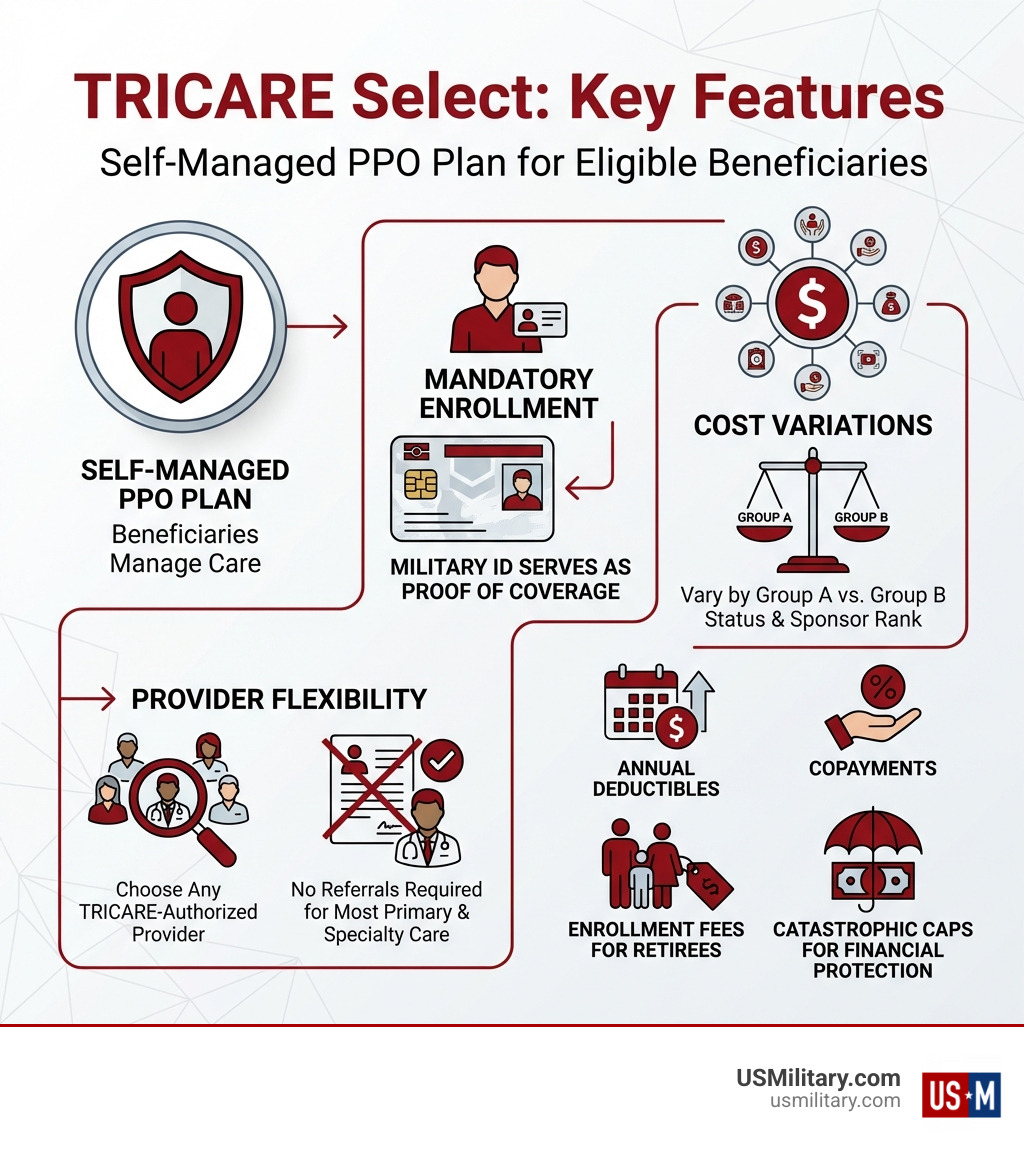
TRICARE Select coverage is a self-managed, preferred provider organization (PPO) health plan available to eligible military beneficiaries throughout the United States. If you’re trying to understand whether this plan is right for you, here’s what you need to know:
Quick Overview of TRICARE Select:
- Plan Type: Fee-for-service PPO plan with provider flexibility
- Eligibility: Active-duty family members, retirees, Guard/Reserve members, survivors, and qualified former spouses (active-duty service members cannot use TRICARE Select)
- Provider Choice: See any TRICARE-authorized provider—network or non-network
- Referrals: Not required for most primary and specialty care appointments
- Enrollment: Required (you won’t receive a wallet card; your military ID is proof of coverage)
- Costs: Vary based on your sponsor’s military status and whether you’re in Group A or Group B
Navigating military healthcare benefits can feel overwhelming, especially when you’re trying to understand costs, eligibility, and how to actually use your coverage. TRICARE Select offers significant flexibility in choosing your healthcare providers, but that flexibility comes with varying costs depending on your specific situation.
The biggest factor affecting your costs is whether you fall into Group A (sponsor entered military before January 1, 2018) or Group B (sponsor entered on or after that date). This distinction determines everything from enrollment fees to deductibles to copayments—and the differences can be substantial.
This guide breaks down exactly what TRICARE Select coverage includes, who qualifies, how much you’ll pay, and when this plan makes the most sense for your family’s healthcare needs.
What is TRICARE Select and Who is Eligible?
TRICARE Select is a robust healthcare option designed to give eligible military beneficiaries more control over their healthcare choices. At its core, it’s a self-managed, preferred provider organization (PPO) plan. This means you generally have the freedom to choose your own doctors and other healthcare providers, without needing a referral for most primary or specialty appointments. It operates on a fee-for-service model, where you pay a portion of the cost for each service you receive, after meeting your annual deductible.
One important detail to remember is that TRICARE Select is available exclusively within the United States. While TRICARE offers overseas options, TRICARE Select itself is custom for beneficiaries residing stateside. For those serving active duty, it’s important to note that active duty service members themselves cannot enroll in TRICARE Select; this plan is primarily for their family members and other eligible beneficiary groups.
So, who exactly can enroll in this flexible plan? The eligibility criteria are quite broad, encompassing a wide range of individuals connected to military service. We’ve outlined the main groups below:
- Active-duty family members: If you’re a spouse or child of an active-duty service member, you’re likely eligible for TRICARE Select.
- Retired service members and their families: Our esteemed retirees and their loved ones can also benefit from TRICARE Select, providing continued healthcare support after years of service.
- Family members of activated Guard/Reserve members: When Guard or Reserve members are activated, their families often become eligible for TRICARE Select coverage.
- Non-activated Guard/Reserve members and their families who qualify for care under the Transitional Assistance Management Program (TAMP): TAMP provides transitional healthcare benefits, and those who qualify can often elect TRICARE Select.
- Retired Guard/Reserve members at age 60 and their families: Once Guard/Reserve members reach age 60 and begin receiving retired pay, they and their families typically become eligible.
- Survivors: Family members of deceased service members or retirees may continue to receive TRICARE Select benefits.
- Medal of Honor recipients and their families: These distinguished individuals and their families receive special healthcare considerations, including eligibility for TRICARE Select.
- Qualified former spouses: In certain situations, former spouses of service members may retain TRICARE Select eligibility. For more details on this, you can explore our resources on Military Former Spouse Medical Benefits.
It’s worth emphasizing that enrollment is required for TRICARE Select. This isn’t a plan you automatically get; you need to actively sign up. And don’t worry about a special wallet card—your military ID serves as your proof of coverage, keeping things simple.
For more comprehensive information on how military support benefits extend to families, we encourage you to visit our page on Dependent Medical Care Military Support Benefits. Understanding these eligibility requirements is the first step in open uping the comprehensive healthcare support that TRICARE Select offers to our military community.
How TRICARE Select Works: Getting Care
Once you’ve determined your eligibility and enrolled in TRICARE Select coverage, the next logical question is: “How do I actually use this thing?” Well, that’s where the “self-managed” and “PPO” aspects really shine. TRICARE Select is designed to give you significant flexibility in how you access healthcare.

The core principle is simple: you can see any TRICARE-authorized provider. What’s a TRICARE-authorized provider? It’s any physician, hospital, or other healthcare professional who is licensed, accredited, or meets other medical community standards and is certified to provide benefits under TRICARE.
Here’s a breakdown of how it works:
- Finding a Provider and Making Appointments: With TRICARE Select, you have the freedom to find your own doctors and specialists. We don’t assign you a primary care manager (PCM), so you get to choose who you want to see. You can schedule appointments directly with any TRICARE-authorized provider that accepts TRICARE. This means you can often continue seeing doctors you already trust, or find new ones that fit your family’s needs.
- Network vs. Non-Network Providers: This is a crucial distinction that impacts your out-of-pocket costs.
- Network Providers: These are providers who have an agreement with your TRICARE regional contractor (Humana Military for the East Region, or Health Net Federal Services for the West Region) to accept TRICARE’s allowable charge as payment in full. When you see a network provider, you’ll generally pay only your deductible and applicable copayments or cost-shares at the time of service. They also file claims for you, which is a nice convenience!
- Non-Network Providers: These providers are TRICARE-authorized but don’t have a contract with your regional contractor. While you can still see them, your costs will typically be higher. Non-network providers may require you to pay the entire bill upfront, and then you’ll need to file a claim with TRICARE for reimbursement. They can also charge up to 15% above the TRICARE allowable charge (this is called “balance billing”), which becomes your responsibility on top of your standard cost-share.
- Referral Requirements: One of the most beloved features of TRICARE Select is that referrals are generally not required for most primary and specialty appointments. This means you can usually go straight to a dermatologist, orthopedist, or any other specialist without needing a note from your family doctor first. However, remember that pre-authorization requirements still apply for some services, like certain surgeries, mental health services, or inpatient stays. Always check with your regional contractor or the TRICARE website before receiving care for specific services.
- Proof of Coverage: Forget about carrying a separate insurance card. With TRICARE Select, your military ID is your proof of coverage. Just present it at your healthcare appointments, and providers will use it to verify your eligibility.
- Filing Claims for Out-of-Network Care: If you opt to see a non-network provider who doesn’t file claims on your behalf, don’t fret! We’ve got you covered. You’ll need to pay for the services upfront, and then submit a claim to your regional contractor for reimbursement. Keep detailed records of all your medical expenses and payments, and be sure to submit claims promptly to avoid any issues.
For a deeper dive into the practicalities of using your TRICARE Select benefits, including how to find providers and manage your care, we recommend visiting the official TRICARE page on More details on using the plan. It’s a valuable resource for navigating your healthcare journey with confidence.
A Detailed Breakdown of Your TRICARE Select Costs
Understanding the costs associated with TRICARE Select coverage is crucial for budgeting and making informed healthcare decisions. Unlike some other plans, TRICARE Select costs aren’t one-size-fits-all. They vary significantly based on your sponsor’s military status (active-duty family versus retired) and, critically, whether you fall into what TRICARE calls Group A or Group B. Think of it like a choose-your-own-adventure book, but with healthcare costs!

For a broader perspective on the range of benefits available to military members and their families, our TRICARE Broad Military Medical Benefits page offers a great overview. But right now, let’s zero in on the specifics for TRICARE Select.
Group A vs. Group B: How Your Costs Are Determined
This distinction is perhaps the most impactful factor in your TRICARE Select costs. It was introduced as part of changes to the TRICARE program, primarily affecting retirees and their families.
- Group A Definition: You (or your sponsor) are in Group A if your sponsor’s initial entry into the uniformed services occurred before January 1, 2018. Generally, beneficiaries in Group A pay lower enrollment fees and deductibles compared to Group B.
- Group B Definition: You (or your sponsor) are in Group B if your sponsor’s initial entry into the uniformed services occurred on or after January 1, 2018. Beneficiaries in Group B typically face higher enrollment fees and deductibles.
This distinction was established to help manage healthcare costs for the military system over the long term, but it means you need to know which group you’re in to accurately estimate your out-of-pocket expenses.
Enrollment Fees and Annual Deductibles
Let’s talk about the fees you might encounter.
- Enrollment Fees:
- For active-duty family members, we’re happy to report that there are no enrollment fees for TRICARE Select. Hooray!
- However, for retirees and their families, enrollment fees apply. These fees are paid annually or monthly and vary significantly between Group A and Group B.
- For family members of retirees in Group A, the 2026 annual enrollment fee for TRICARE Select is $186.96 for an individual and $375 for a family.
- For family members of retirees in Group B, the 2026 annual enrollment fee for TRICARE Select is $594.96 for an individual or $1,191 for a family. As you can see, the difference is quite substantial!
- Annual Deductibles: Before TRICARE Select begins to share the cost of your care, you’ll need to meet an annual deductible. This is the amount you pay out-of-pocket each fiscal year (October 1 – September 30) before your cost-shares kick in. Deductibles also vary by group, sponsor rank, and whether you’re active-duty family or retired.
Here’s a breakdown of the 2026 annual deductibles:
| Beneficiary Type | Group A (Individual/Family) | Group B (Individual/Family) |
|---|---|---|
| Active-Duty Family Members (ADFM) – Sponsor E-4 and below | $50 / $100 | $66 / $132 |
| ADFM – Sponsor E-5 and above | $150 / $300 | $193 / $386 |
| Retirees | $150 / $300 | In-Network: $198 / $397 Out-of-Network: $397 / $794 |
Copayments and Cost-Shares for TRICARE Select Coverage
Once you’ve met your annual deductible, you’ll pay a portion of the cost for each service you receive. This is known as a copayment (a fixed amount) or a cost-share (a percentage of the cost). These amounts primarily apply to in-network care. For out-of-network care, your cost-shares are generally higher, and you might also be responsible for balance billing from the provider.
Let’s look at some of the 2026 in-network copayments for various services:
- Primary Care Visits:
- Active-Duty Family (Group A): $28
- Retirees (Group A): $38
- Active-Duty Family (Group B): $19
- Retirees (Group B): $33
- Specialist Care Visits:
- Active-Duty Family (Group A): $39
- Retirees (Group A): $52
- Active-Duty Family (Group B): $33
- Retirees (Group B): $52
- Emergency Room Visits:
- Active-Duty Family (Group A): $103
- Retirees (Group A): $138
- Active-Duty Family (Group B): $52
- Retirees (Group B): $105
- Ambulance Services:
- Active-Duty Family (Group A): $88
- Retirees (Group A): $117
- Active-Duty Family (Group B): $19
- Retirees (Group B): $79
- Hospital Stays:
- Active-Duty Family (Group A): $24.50/day
- Retirees (Group A): $250/day up to 25% of hospital charges, plus 20% of separately billed services
- Active-Duty Family (Group B): $79 per admission
- Retirees (Group B): $231 per admission
These figures give you a clear picture of how your costs can vary depending on your group and military status. It’s always a good idea to check the most current cost information directly from official sources. For the most detailed and up-to-date cost information, we strongly recommend you View the official TRICARE Select Costs page.
✉ Get updates like this in your inbox
Weekly VA benefit changes, pay updates, and money tips for service members, veterans, and military families. Free, no spam.
The Catastrophic Cap: Your Financial Safety Net
Even with deductibles and copayments, healthcare costs can sometimes add up unexpectedly, especially in the event of a serious illness or injury. That’s where the catastrophic cap comes in – it’s your financial safety net.
The catastrophic cap is the maximum amount you will pay out-of-pocket annually for all covered health care services. Once your family reaches this cap within a fiscal year, TRICARE pays 100% of all additional covered services for the remainder of that year. This provides invaluable financial protection and peace of mind.
Just like other costs, the catastrophic cap also varies by your military status and group. Here are the 2026 catastrophic caps for TRICARE Select:
- Active-Duty Family (Group A): $1,000
- Active-Duty Family (Group B): $1,324
- Retired (Group A): $4,381
- Retired (Group B): $4,635
Knowing these caps can help you understand your potential maximum financial responsibility for healthcare in a given year, allowing you to plan accordingly.
Enrolling and Deciding if TRICARE Select is for You
So, you’ve learned about what TRICARE Select coverage is, who’s eligible, and the nitty-gritty of the costs. Now comes the decision-making and enrollment part! Enrollment in TRICARE Select is not automatic; it’s a required step to ensure you have coverage.
You can typically enroll during TRICARE Open Season, which happens annually in the fall. This is your chance to enroll in or change your TRICARE health plan for the upcoming year. However, life doesn’t always wait for open season! If you experience a Qualifying Life Event (QLE), such as marriage, birth of a child, divorce, or moving to a new location, you may be able to enroll or change your plan outside of open season. These QLEs usually open a specific window (often 90 days) for you to make changes.
Before you even think about enrollment, ensure your eligibility is properly registered in the Defense Enrollment Eligibility Reporting System (DEERS). DEERS is the foundation of all military benefits, and if your information isn’t up-to-date, it can cause delays or issues with your TRICARE coverage. Always keep your family’s information current in DEERS!
Ready to take the plunge? We encourage you to visit the official TRICARE website dedicated to enrollment. You can find more detailed instructions and begin your enrollment process by going to Learn how to enroll in TRICARE Select.
When to Choose TRICARE Select
With various TRICARE options available, how do you know if TRICARE Select is the right fit for you and your family? It’s all about balancing flexibility, costs, and your healthcare preferences. Here are some scenarios where TRICARE Select often shines:
- You desire provider flexibility: If having the freedom to choose any TRICARE-authorized provider (network or non-network) is a top priority, without needing a referral for most appointments, TRICARE Select offers that choice. You’re not tied to a specific primary care manager or facility.
- You live outside a Prime Service Area: TRICARE Prime is typically only available in areas with military treatment facilities (MTFs) or a robust network of civilian providers. If you live in a more rural area or simply outside a Prime Service Area, TRICARE Select might be your primary TRICARE option.
- You have Other Health Insurance (OHI): If you or your family members have other health insurance (like an employer-sponsored plan), TRICARE Select can work alongside it. TRICARE typically acts as the secondary payer, coordinating benefits with your OHI. This can sometimes lead to lower out-of-pocket costs overall.
- You need access to non-network doctors: While network providers offer lower costs, sometimes you have a specific doctor or specialist who is TRICARE-authorized but not part of the network. TRICARE Select allows you to see these providers, albeit with potentially higher out-of-pocket expenses and the need to file your own claims.
The best healthcare plan is the one that best suits your family’s unique needs and circumstances. To explore other military health benefit options and compare them, our Military Health Benefit Options Available page is an excellent resource.
Finding Providers and Regional Contacts
Finding a TRICARE-authorized provider is straightforward. You can typically use the online provider directories provided by the regional contractors. These tools allow you to search for doctors, specialists, hospitals, and other facilities by location, specialty, and whether they are network or non-network.
TRICARE is administered through two main regional contractors in the United States, each serving specific states:
- TRICARE East Region: This region is managed by Humana Military. If you reside in states generally east of the Mississippi River, you’re likely in the East Region. For specific details and to find providers, visit the TRICARE East Region Website.
- TRICARE West Region: Health Net Federal Services manages the West Region, covering states generally west of the Mississippi River. Their website is a key resource for beneficiaries in this area. You can find more information on the TRICARE West Region Website.
A unique insight for those in the West Region: there has been a referral approval waiver in place through June 30, 2025. This means that for beneficiaries in the West Region, certain referral requirements may be temporarily waived, further enhancing your flexibility in accessing care. Always check with your regional contractor for the most current information.
VA Home Loan
One Benefit Many Veterans Never Use: The VA Loan
Eligible veterans, service members and some surviving spouses can buy a home with no down payment and no PMI. Checking costs nothing.
USMilitary.com may be compensated when you request quotes from lenders through this link.
Frequently Asked Questions about TRICARE Select Coverage
We know that even with a detailed guide, questions can linger. Let’s tackle some of the most common inquiries we hear about TRICARE Select coverage.
Do I need referrals for specialists with TRICARE Select?
This is one of the most popular questions, and we love answering it! For the vast majority of primary and specialty appointments under TRICARE Select, no, you do not need referrals. This is a significant advantage for many beneficiaries, as it streamlines access to care and gives you direct control over choosing your specialists.
However, it’s not a blanket “no referrals ever” situation. While you generally don’t need a referral to simply see a specialist, some specific services, procedures, or types of care may still require pre-authorization from your TRICARE regional contractor. This isn’t a referral, but rather an approval process to ensure the service is medically necessary and covered before you receive it. Always check with your regional contractor or the TRICARE website if you’re unsure whether a particular service requires pre-authorization. It’s a small step that can save you from unexpected costs down the road.
What is the cost difference between network and non-network providers?
The cost difference between network and non-network providers is a critical aspect of TRICARE Select that every beneficiary should understand. It can significantly impact your out-of-pocket expenses.
- Network Providers: When you choose a network provider, you typically pay lower out-of-pocket costs. These providers have agreements with TRICARE to accept the TRICARE-allowed amount as payment in full. You’ll pay your annual deductible first, and then your standard copayments or cost-shares for services. A major convenience is that network providers typically file claims on your behalf, so you don’t have to worry about paperwork.
- Non-Network Providers: While you have the flexibility to see a TRICARE-authorized non-network provider, it usually comes with higher costs. Your cost-shares will be a higher percentage of the TRICARE-allowed amount. Furthermore, non-network providers are permitted to charge up to 15% above the TRICARE-allowed amount (this is called “balance billing”), and you will be responsible for that additional charge. You might also be required to pay the full cost of the service upfront and then file your own claim with TRICARE for reimbursement. This means more paperwork for you and potentially waiting for TRICARE to process your claim before you get your money back.
For these reasons, while the flexibility of non-network providers is there, we generally recommend utilizing network providers whenever possible to minimize your out-of-pocket expenses and simplify the billing process.
How do I know if I am in Group A or Group B?
This is a fundamental question that dictates many of your TRICARE Select costs, especially for retirees and their families. Determining your group status is straightforward: it depends on the date your sponsor initially entered the uniformed services.
- You are in Group A if your sponsor’s initial entry into the uniformed services was before January 1, 2018.
- You are in Group B if your sponsor’s initial entry into the uniformed services was on or after January 1, 2018.
This date is fixed and does not change. So, if your sponsor joined the military in 2017, you’re in Group A. If they joined in 2019, you’re in Group B. This distinction profoundly impacts your enrollment fees (for retirees), deductibles, and cost-shares, as we detailed in the “Detailed Breakdown of Your TRICARE Select Costs” section above. Always confirm your sponsor’s entry date to understand which cost structure applies to your family.
Conclusion
Navigating the complexities of military healthcare can sometimes feel like a mission in itself, but with TRICARE Select coverage, we hope you now feel better equipped and more confident. This self-managed PPO plan offers incredible flexibility and choice, allowing you to select your own TRICARE-authorized providers without the need for referrals for most services. It’s an excellent option for those who value autonomy in their healthcare decisions.
We’ve explored the ins and outs, from who is eligible to how the plan works, and most importantly, a detailed breakdown of the costs. Understanding the distinction between Group A and Group B, and how it impacts your enrollment fees, deductibles, and copayments, is key to maximizing your benefits and managing your family’s healthcare budget. While the flexibility is a huge perk, being aware of network versus non-network costs and pre-authorization requirements will help you avoid any surprises.
At USMilitary.com, we are committed to providing our military families with the information they need to make informed decisions about their benefits. TRICARE Select is a powerful tool in your healthcare arsenal, offering peace of mind and access to quality care across the United States. We encourage you to continue exploring all the resources available to you. For a comprehensive overview of all your military benefits, we invite you to Explore all your military benefits to make informed decisions. Your health, and the health of your family, is a top priority, and we’re here to help you every step of the way.
Free for Service Members & Veterans
Get the military benefits intel no one tells you about.
Weekly updates on VA benefits, pay changes, and money tips — free for service members and veterans.
No spam. Unsubscribe anytime. Your info is never shared.