Primary Missions and Operational Environments of Elite Units
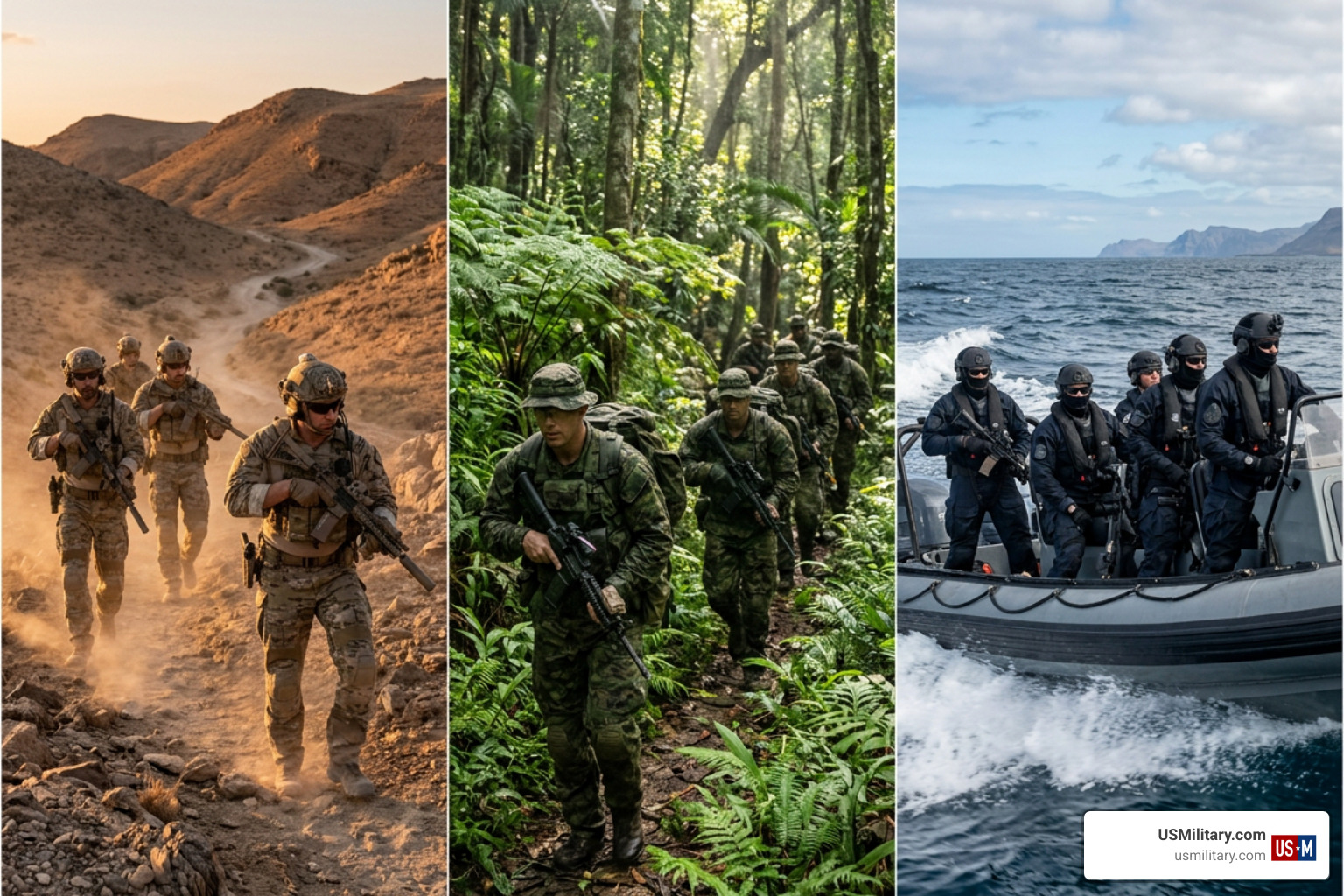
To truly understand which pipeline gives you the best chance of success, we must first look at what these units actually do. While Hollywood often paints all special operations forces with a single, action-packed brush, the reality is that their primary missions, operational environments, and team dynamics are vastly different.
Navy SEALs: Maritime Masters and Direct Action Specialists
The Navy SEALs (Sea, Air, and Land) are the maritime component of U.S. Special Operations Command (SOCOM). Established in 1962 by President John F. Kennedy, their primary focus remains rooted in the water. SEALs specialize in direct action raids, maritime interdiction, counterterrorism, and special reconnaissance.
Whether they are inserting from a submarine, piloting high-speed combat watercraft, or conducting coastal reconnaissance, the water is their home. They typically operate in 16-man platoons or smaller 4-to-6-man squads. If your passion lies in diving, amphibious assaults, and offensive operations, the Navy SEAL path is the classic choice. You can learn more about how they measure up in our breakdown of Air Force PJs vs. Navy SEALs Compared.
Air Force PJs: “That Others May Live”
Air Force Pararescuemen (PJs) are the only special operations force in the U.S. military dedicated entirely to combat search and rescue (CSAR) and personnel recovery. Their mission is fundamentally defensive and humanitarian: to rescue downed pilots, isolated soldiers, or civilians in catastrophic conditions, and to provide advanced trauma care under heavy enemy fire.
PJs are essentially “SEALs with stethoscopes.” They are trained in combat diving, military freefall, mountaineering, and survival techniques, but they are also fully certified EMT-Paramedics. PJs often operate in very small teams or even as single operators embedded with other special operations units. If you are driven by a desire to save lives rather than take them, this rescue-centric mindset is the defining characteristic of the PJ community.
Army Delta Force: The Shadow Warriors
Officially known as 1st Special Forces Operational Detachment-Delta (1st SFOD-D), “the Unit” or Delta Force was formed in 1977 by Colonel Charles Beckwith, who modeled it after the British SAS. Operating under the Joint Special Operations Command (JSOC) as a Tier 1 National Mission Force, Delta’s existence was denied by the government for decades.
Delta’s primary missions are counterterrorism, hostage rescue, and direct action against high-value targets. Unlike the maritime focus of the SEALs, Delta operates heavily in land-based, urban, and highly permissive or non-permissive environments globally. They operate in larger, highly autonomous teams of 10 to 20 operators, where individual expertise, mature decision-making, and “quiet professionalism” are prized above all else.
Do You Have A Better Chance To Become a Navy SEAL, Air Force PJ, or Army Delta Force Operator?
When we look at the raw statistical question—Do You Have A Better Chance To Become a Navy SEAL, Air Force PJ, or Army Delta Force Operator—the answer depends entirely on your starting point.
Let’s look at the numbers side-by-side:
| Factor | Navy SEALs | Air Force PJs | Army Delta Force |
|---|---|---|---|
| Active Duty Force Size | ~2,500 | ~300 | ~1,200 |
| Pipeline Attrition Rate | 75-85% | ~90% | 70-80% (from an elite pool) |
| Entry Point | Civilian, Enlisted, Officer | Civilian, Enlisted, Officer | Prior Military (primarily SF/Rangers) |
| Average Operator Age | Mid-20s | Mid-20s | 29 (with 7+ years of service) |
Statistically, the Navy SEALs offer the highest probability of success for a civilian applicant. Why? Because the pipeline is open to anyone who can pass the basic physical screening test, and the Navy maintains a larger force of roughly 2,500 active-duty SEALs.
Conversely, the Air Force PJ pipeline has a staggering ~90% washout rate, and with only about 300 active-duty PJs in existence, the margins for error are razor-thin.
Delta Force presents a different statistical barrier altogether. You cannot walk into a recruiting office and sign a “Delta Force contract.” To even get invited to Delta selection, you must already be an experienced service member—usually an Army Ranger or Green Beret with an impeccable record. Once there, you face a 70-80% attrition rate against a pool of candidates who are already elite.
To understand these differences more deeply, you can read our comparison on Delta Force vs Navy SEALs: The Differences – USAMM.
Comparing the Selection Processes and Training Pipelines
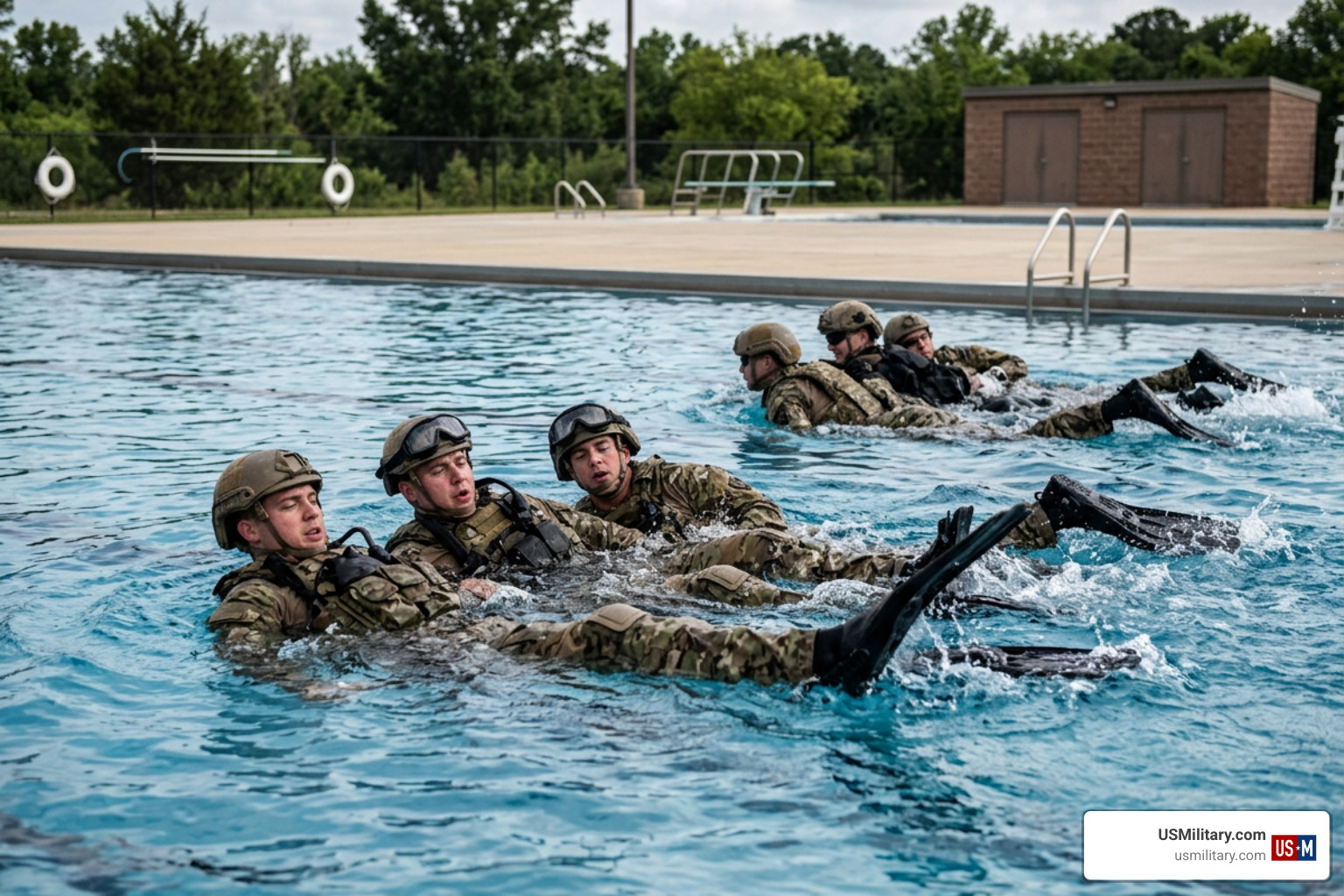
The journey to earning the Navy SEAL Trident, the PJ Maroon Beret, or the Delta Force patch involves some of the most grueling training pipelines in the world.
The Navy SEAL Pipeline: Forging Operators from Scratch
For civilians, the path begins with a SEAL contract during enlistment. After boot camp, candidates attend Prep School before arriving at Coronado, California, for Basic Underwater Demolition/SEAL (BUD/S) training.
BUD/S is a 24-week test of physical and mental endurance, famous for “Hell Week”—five and a half days of continuous training, freezing Pacific water, and less than four hours of sleep total. If you survive BUD/S, you move on to the 26-week SEAL Qualification Training (SQT), where you learn tactical shooting, land navigation, parachuting, and cold-weather survival. From civilian to deployable SEAL takes roughly 12 to 18 months. For a step-by-step breakdown, check out our guide on How to Become a Navy SEAL.
The Air Force PJ Pipeline: The Longest Medical and Combat Track
Often referred to as “The Superman School,” the PJ pipeline takes nearly two years to complete. It begins with the Special Warfare Prep and the Assessment & Selection (A&S) course, where candidates face extreme water confidence challenges, including heavy underwater swims and buddy breathing exercises.
Once selected, candidates enter a relentless training circuit:
- Army Airborne School
- Air Force Combat Diver School
- Military Freefall School
- Survival, Evasion, Resistance, and Escape (SERE) School
- EMT-Paramedic Certification: A grueling 37-week medical phase where candidates must pass national registry standards.
- PJ Apprentice Course: Where combat tactics and technical rescue are combined.
The medical phase alone washes out many who survived the physical selection. To learn more about this unique track, read The Complete Guide to Air Force Pararescuemen (PJs).
✉ Get updates like this in your inbox
Weekly VA benefit changes, pay updates, and money tips for service members, veterans, and military families. Free, no spam.
The Army Delta Force Selection: Picking the Best of the Best
Delta Force selection is entirely different because it does not train candidates from scratch. It is designed to evaluate mature, experienced soldiers.
The selection course, held in the Appalachian Mountains, is highly classified and psychological. Candidates are subjected to extreme physical isolation. They are given land navigation coordinates and told to march alone with heavy rucksacks, without knowing the distance, the time limits, or how they are being graded.
This culminates in “The Long Walk”—a solo 40-mile land navigation march over mountainous terrain with a 45-pound rucksack. If selected, candidates must still complete the six-month Operator Training Course (OTC), which teaches advanced marksmanship, executive protection, and structural breaching. Explore this secretive process further in our article on the Army Delta Force Selection Process.
Physical Fitness Standards and Attrition Rates Compared

Physical Demands and Attrition for Navy SEALs and Air Force PJs
Both the Navy SEAL Physical Screening Test (PST) and the Air Force PJ Physical Ability and Stamina Test (PAST) measure similar bodyweight and cardiovascular metrics.
To be competitive, candidates should aim for these recommended scores, which go far beyond the minimums:
- 500-Yard Swim: Under 9:00 minutes (using combat sidestroke or breaststroke)
- Push-ups: 80-100 in 2 minutes
- Sit-ups: 80-100 in 2 minutes
- Pull-ups: 15-20 (dead hang)
- 1.5-Mile Run: Under 9:00 minutes
While the physical events are similar, the training environments differ. BUD/S focuses heavily on ocean swims, cold-water tolerance, and boats-on-heads physical conditioning. The PJ pipeline focuses on water confidence—requiring candidates to remain calm while performing complex tasks underwater on a single breath.
For a detailed look at how these two pipelines compare physically, check out Air Force PJs vs Navy SEALs: Who Are They and How Do They Compare? | SEALgrinderPT.
Delta Force Physical Standards and the Psychological Ego Check
Delta Force does not publish its physical fitness test metrics, but candidates must be in world-class rucking shape. The entry physical test includes a 2-mile run, a 100-meter swim in full uniform, and immediate rucking evaluations.
The real test at Delta selection is mental. Because candidates are already successful Green Berets or Rangers, the instructors do not scream or use the “shared misery” motivation found at BUD/S. Instead, they treat candidates with quiet, professional distance. They want to see how you perform when you are cold, starving, sleep-deprived, and completely alone with your own thoughts. It is an ego-crushing environment designed to find the top 1% of the military’s elite. If you think you have what it takes, read up on how to Become an Army Delta Force Operator.
Eligibility, Crossover Opportunities, and Lifestyle Tradeoffs
Can a Navy SEAL Join Delta Force and Other Crossover Paths?
Yes, a Navy SEAL can try out for Delta Force. Because Delta Force is a joint-service unit operating under JSOC, it technically accepts candidates from all branches of the military. Highly qualified SEALs, Air Force Combat Controllers, and Marine Raiders have successfully crossed over and passed Delta selection.
However, the reverse is rarely true. Delta Force does not recruit civilians, and you cannot easily transfer from Delta to become a Navy SEAL without first entering the Navy and attending BUD/S.
The distinction between these units often comes down to the “Tier” system. Delta Force and SEAL Team 6 (DEVGRU) are Tier 1 National Mission Forces, while regular SEAL Teams and PJs are Tier 2 units. You can read more about these community debates on the OT: Seals vs. Delta vs. PJ’s – Slowtwitch Forum.
Lifestyle, Secrecy, and Post-Service Career Opportunities
The lifestyle differences between these units are stark:
- Navy SEALs: Have a higher public profile. This has led to books, movies, and civilian transition opportunities in leadership consulting and entrepreneurship, though it sometimes clashes with the military’s quiet professional ethos.
- Air Force PJs: Enjoy a highly respected reputation within the military. Post-service, many PJs easily transition into civilian medical careers, becoming paramedics, physician assistants, or doctors due to their extensive medical training.
- Delta Force: Maintains absolute secrecy. Operators are expected to remain completely anonymous even after they retire. Their post-service careers often involve high-level private security, intelligence consulting, or government agency work.
To see who comes out on top across different lifestyle categories, check out Army vs. Navy vs. Air Force Elite SF Winner Revealed.
Frequently Asked Questions about Special Operations Selection
Do You Have A Better Chance To Become a Navy SEAL, Air Force PJ, or Army Delta Force Operator from Civilian Life?
You have the best chance of becoming a Navy SEAL from civilian life. The Navy offers direct enlistment contracts (the SO rating) that guarantee you a shot at BUD/S if you pass the physical screening. The Air Force also offers direct entry contracts for Special Warfare (including PJs), but the pipeline’s 90% attrition rate makes it statistically harder to complete. You cannot join Delta Force from civilian life.
Do You Have A Better Chance To Become a Navy SEAL, Air Force PJ, or Army Delta Force Operator as Prior Service?
If you are already in the military—especially within the Army Rangers or Green Berets—you have a far better chance of attempting Delta Force selection. Delta specifically recruits experienced operators who have already proven themselves in combat and high-stress environments.
Which unit has the highest training attrition rate?
The Air Force PJ pipeline has the highest overall attrition rate, frequently exceeding 90%. This is due to the combination of extreme water confidence testing and the academic difficulty of the 37-week paramedic phase. BUD/S follows closely with a 75-85% attrition rate.
Conclusion
Whether you are aiming for the maritime mastery of the Navy SEALs, the life-saving mission of the Air Force PJs, or the surgical precision of Army Delta Force, there is no easy path.
If you are looking for the most accessible starting point from civilian life, the Navy SEAL pipeline offers the clearest path and the largest active-duty force. If your heart is set on medicine and rescue, the Air Force PJ track is unmatched. And if you are already a seasoned soldier looking to test yourself at the absolute peak of military secrecy, Delta Force is the ultimate destination.
At USMilitary.com, we are dedicated to helping you navigate your military career goals. From choosing the right branch to understanding your post-service benefits and VA resources, we are here to support your journey. To begin preparing for your path, explore our Navy SEALs Complete Guide.
Free for Service Members & Veterans
Get the military benefits intel no one tells you about.
Weekly updates on VA benefits, pay changes, and money tips — free for service members and veterans.
No spam. Unsubscribe anytime. Your info is never shared.


