Why Comparing All The Military Branches Elite Special Forces With One Another Matters More Than You Think
Comparing All The Military Branches Elite Special Forces With One Another reveals something most people miss: there is no single “best” unit — each branch fields elite warriors built for different jobs.
Here’s a quick breakdown of the top elite unit from each U.S. military branch:
| Branch | Elite Unit(s) | Primary Specialty |
|---|---|---|
| Army | Green Berets, 75th Rangers, Delta Force | Unconventional warfare, direct action, counter-terrorism |
| Navy | SEALs, DEVGRU (SEAL Team 6) | Maritime ops, hostage rescue, direct action |
| Air Force | Combat Controllers, Pararescuemen | Air traffic control in combat, personnel recovery |
| Marine Corps | Marine Raiders (MARSOC) | Special reconnaissance, foreign internal defense |
| Coast Guard | MSRT, Deployable Specialized Forces | Maritime counter-terrorism |
| Space Force | Developing | Space domain operations |
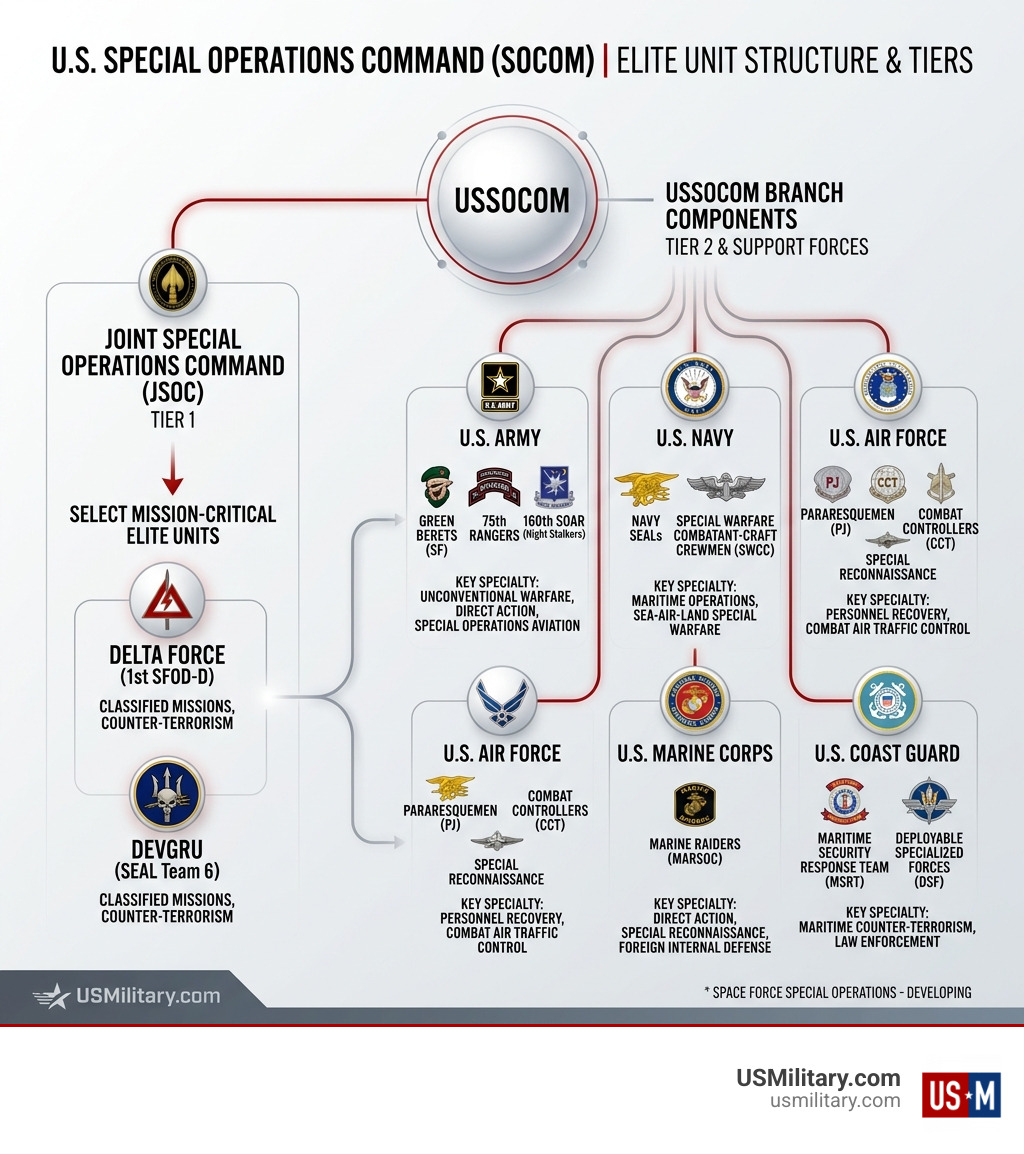
Together, these units fall under U.S. Special Operations Command (SOCOM), which oversees more than 70,000 special operations personnel drawn from across all branches. Think of them less as rivals and more as a toolkit — each unit is the right tool for a different kind of problem.
Some units, like Delta Force and DEVGRU (SEAL Team 6), operate at the very top under the Joint Special Operations Command (JSOC) — handling the nation’s most sensitive, classified missions. Others are Tier 2 units that are still extraordinarily elite, but operate more openly under their branch’s own command.
As of April 2026, these forces continue to evolve — shaped by two decades of post-9/11 combat and the growing demands of multi-domain warfare.
I’m Larry Fowler, publisher of USMilitary.com and a long-time resource for active military and veterans — and comparing all the military branches elite special forces with one another is one of the questions I hear most from people weighing their enlistment options. Read on for the full breakdown, and by the end you’ll know exactly how these units stack up.
Essential Comparing All The Military Branches Elite Special Forces With One Another terms:
Defining the Tiers: JSOC vs. Service-Specific Units
When we talk about “the best of the best,” we are usually referring to the Tier 1 units. These units fall under the Joint Special Operations Command (JSOC). While SOCOM oversees the broad community of 70,000 operators, JSOC is the scalpel used for national-level missions that require the highest degree of secrecy and precision.
The most famous Tier 1 units are the Army’s 1st Special Forces Operational Detachment-Delta (Delta Force) and the Navy’s Naval Special Warfare Development Group (DEVGRU), better known as SEAL Team 6. Rounding out this elite group is the Air Force’s 24th Special Tactics Squadron, which provides the specialized air integration these teams need to operate.
The distinction between Tier 1 and Tier 2 isn’t necessarily about who is a “better” shooter; it’s about funding, mission sensitivity, and command structure. Tier 1 units are “black” SOF, meaning their operations are often classified and directed by the President or Secretary of Defense. Tier 2 units, like the regular Navy SEALs or Army Green Berets, are “white” SOF. They handle critical missions like foreign internal defense and unconventional warfare but operate with more public visibility.
If you find yourself Confused by All the U.S. Special Forces? Here’s a Guide. to help simplify things: Delta Force was modeled after the British SAS and excels in land-based counter-insurgency, while DEVGRU specializes in maritime environments and amphibious warfare. For a deeper dive into these two titans, check out our analysis of Delta Force vs SEAL Team 6.
Comparing All The Military Branches Elite Special Forces With One Another
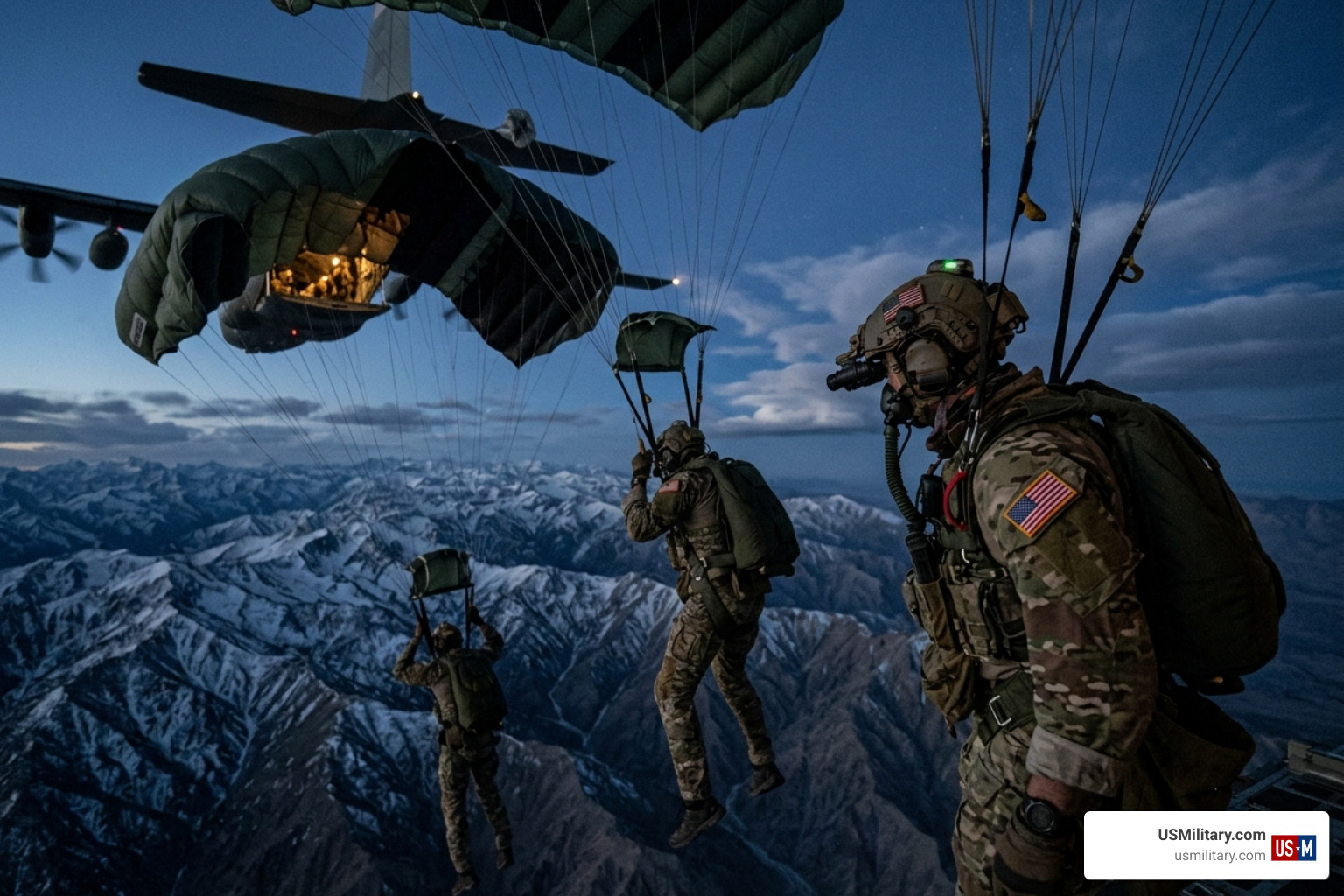
To understand how these units interact, we have to look at their unique DNA. Each branch brings a specific flavor to the fight. Comparing All The Military Branches Elite Special Forces With One Another isn’t just about comparing muscle; it’s about comparing mission sets.
| Feature | Army Special Forces | Navy SEALs | Air Force Special Tactics | Marine Raiders |
|---|---|---|---|---|
| Primary Focus | Unconventional Warfare | Maritime Direct Action | Air-Ground Integration | Foreign Internal Defense |
| Unit Size (approx.) | 7,000 (Operators) | 2,900 (Active SEALs) | 1,500 (CCTs/PJs) | 1,000 (Raiders) |
| Core Team | 12-man ODA (A-Team) | 16-man Platoon | Individual Attachments | 14-man Team |
| Typical Environment | Land / Rural / Urban | Sea / Air / Land | Any (with Air focus) | Land / Littoral |
We often see mission redundancy across the branches, and that’s a good thing. As we’ve seen since 9/11, having multiple units capable of direct action ensures that the force doesn’t burn out. However, if the mission requires building a local guerrilla army over six months, you call the Green Berets. If you need to hit a ship at sea in the middle of the night, you call the SEALs. For a broader look at these roles, visit the official About the Military’s Special Forces page.
✉ Get updates like this in your inbox
Weekly VA benefit changes, pay updates, and money tips for service members, veterans, and military families. Free, no spam.
The global reach of these units is maintained through various geographical Special Operations Commands. Whether it’s the Army Special Forces Groups assigned to specific continents or the Navy SEAL Teams rotating through different theaters, the U.S. has an elite presence everywhere. If you’re torn between the two most famous units, our Comparison of Green Berets and SEALs breaks down the “warrior vs. teacher” dynamic.
Mission Specialties: Comparing All The Military Branches Elite Special Forces With One Another
Each unit has a “bread and butter” mission that defines its training.
- Army Special Forces (Green Berets): Their primary mission is Unconventional Warfare (UW). They are the “thinking man’s” special forces, often required to learn a foreign language and live among local populations to train them to fight.
- 75th Ranger Regiment: These are the premier light infantry raiders of the U.S. Army. They specialize in large-scale direct action, such as seizing airfields. There is a long-standing debate regarding Army Rangers vs Navy SEALs training, but the reality is they serve different tactical purposes.
- Navy SEALs: Experts in Maritime Interdiction and Special Reconnaissance. They are the masters of the hydrographic environment, able to infiltrate from a submarine or a high-speed boat.
- Marine Raiders (MARSOC): The newest addition to the SOCOM family, Raiders focus on Foreign Internal Defense (FID) and direct action. They combine the traditional Marine Corps “expeditionary” mindset with elite special operations training.
- Coast Guard MSRT: Often overlooked, the Maritime Security Response Team is the only unit with the legal authority to perform law enforcement missions in U.S. waters while maintaining counter-terrorism capabilities.
Selection and Attrition: Comparing All The Military Branches Elite Special Forces With One Another
You don’t just “join” these units; you survive the process of becoming one of them. The pipelines are long, expensive, and designed to break anyone who isn’t 100% committed.
- Navy SEALs (BUD/S): Basic Underwater Demolition/SEAL training is legendary for its 75-80% attrition rate. “Hell Week” is the ultimate test of physical and mental resilience.
- Army Rangers (RASP): The Ranger Assessment and Selection Program has a historical attrition rate of about 47% for RASP 1. It is a grueling eight-week sprint. We have a guide on Qualifying as an Army Ranger for those interested in the path.
- Green Berets (SFQC): The Special Forces Qualification Course can last anywhere from 12 to 24 months. It isn’t just a physical test; it’s an intellectual one, involving language school and the famous Robin Sage wargame.
- Air Force Special Tactics: The pipeline for Combat Controllers (CCT) and Pararescuemen (PJ) is often cited as having the highest attrition rates in the military, sometimes exceeding 90%. CCT training lasts over 94 weeks, making them some of the most highly trained individuals in the world.
When looking for the World’s toughest special forces, these U.S. units consistently rank at the top because of their psychological screening. It isn’t just about how many pushups you can do; it’s about how you solve a problem when you haven’t slept in three days.
The Silent Enablers: Air Force Special Tactics and Night Stalkers
No special operations mission happens in a vacuum. The operators on the ground rely on “enablers” who are just as elite as the door-kickers themselves.
The Air Force Special Tactics community includes Combat Controllers (CCT), who are FAA-certified air traffic controllers capable of setting up a runway in the middle of a warzone. They also include Pararescuemen (PJs), whose sole mission is personnel recovery and combat medicine. Their motto, “That Others May Live,” reflects their dedication to rescuing downed pilots or wounded operators behind enemy lines.
Then there are the Night Stalkers of the 160th Special Operations Aviation Regiment (SOAR). These are the best helicopter pilots in the world. Whether it’s flying a MH-6 Little Bird through a narrow city street or a MH-47 Chinook into a high-altitude mountain range, they provide the precision extraction and infiltration that makes SOF missions possible.
If you want to see where they land on the list of the Top 5 most fierce military special forces, you’ll find that their specialized skills in air traffic control and Special Reconnaissance make them indispensable.
Cultural Hierarchies and Social Dynamics in the SOF Community
While all these units work together under SOCOM, they each have a distinct “personality” or social hierarchy. This is often jokingly referred to as the “cliques” of the special operations world.
- Navy SEALs: Often seen as the “popular jocks.” They have a high public profile and an ego to match, though their results in maritime direct action are undisputed.
- Army Special Forces: The “Quiet Professionals” or “Snake Eaters.” They tend to be older, more academic, and less interested in the limelight. They value their ability to blend in and influence local cultures.
- Army Rangers: The high-energy “ROTC kids” who grew up to be professional door-kickers. They are known for their discipline, rigid standards, and incredible work ethic.
- Air Force Special Tactics: The “nerdy specialists.” They are highly technical, often carrying millions of dollars’ worth of communications gear while still being expected to keep up with SEALs or Rangers on the ground.
Post-9/11 evolution has forced these units into interoperability. In 2026, it is common to see a SEAL platoon with an Air Force CCT attached, being flown into a mission by a 160th SOAR pilot. The social rivalries remain, but on the battlefield, the joint operations mindset has never been stronger. For a look at the history and legend of the most famous branch, read our Guide to the US Navy SEALs.
Frequently Asked Questions about Elite Special Forces
Which special forces unit has the highest attrition rate?
While it varies by year, the Air Force Special Tactics pipelines (CCT and Pararescue) and the Navy SEAL BUD/S course consistently see attrition rates between 80% and 90%. These are widely considered the most difficult courses to complete in the U.S. military.
Are there women serving in elite special operations units?
Yes. As of recent years, women have successfully graduated from the Army Ranger School, the 75th Ranger Regiment’s RASP, and the Army Special Forces Qualification Course. Captain Kate Wilder was the first woman to earn the Green Beret “Long Tab.” The integration of women into SOF signifies a shift toward a standards-based force where capability matters more than gender.
What is the difference between a Tier 1 and a Tier 2 unit?
Tier 1 units (like Delta Force and SEAL Team 6) are Special Mission Units under JSOC, focusing on national-level, often classified missions. Tier 2 units (like regular SEAL Teams, Green Berets, and Raiders) handle the bulk of special operations missions and are managed by their respective service branches under SOCOM.
Conclusion
Comparing All The Military Branches Elite Special Forces With One Another shows us that the U.S. military doesn’t have a “best” unit—it has a “best” unit for every specific scenario. Whether it’s the maritime expertise of the SEALs, the cultural immersion of the Green Berets, or the precision air integration of the Air Force, these warriors represent the pinnacle of American military capability.
In the landscape of April 2026, these units are more integrated than ever. If you are a recruit or a veteran looking to transition into these elite ranks, the “winner” is always the operator who is best suited for the mission at hand.
For more help navigating your military career or understanding your benefits, stay tuned to USMilitary.com. If you’re still debating your path, take a look at our head-to-head breakdown to Compare Army Delta Force vs Navy SEALs.
Free for Service Members & Veterans
Get the military benefits intel no one tells you about.
Weekly updates on VA benefits, pay changes, and money tips — free for service members and veterans.
No spam. Unsubscribe anytime. Your info is never shared.


