What It Really Takes To Become a Delta Force Operator?
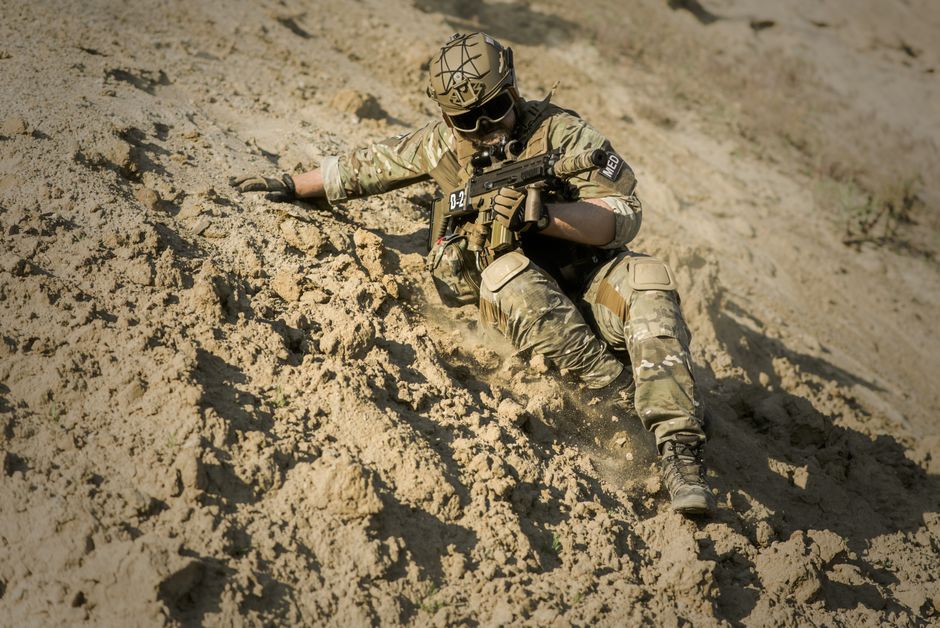
If you’re researching 10 ways to prepare and become an Army Delta Force Operator, here’s a quick snapshot of the path:
- Enlist in the U.S. Army and complete Basic Combat Training
- Serve in a demanding unit like the 75th Ranger Regiment or Special Forces (Green Berets)
- Meet rank requirements — E-4 to E-8 (enlisted) or O-3 to O-4 (officer)
- Score 110+ on the ASVAB (GT score)
- Earn Airborne qualification
- Obtain a Top Secret security clearance
- Build 4–6 years of solid military experience with a clean disciplinary record
- Train hard for rucking, land navigation, and functional fitness
- Develop mental resilience — self-reliance, adaptability, and integrity
- Apply and survive the four-week Delta Force Selection Course at Camp Dawson, West Virginia
Delta Force — officially the 1st Special Forces Operational Detachment-Delta (1st SFOD-D) — is widely considered the most elite fighting force in the U.S. military. It operates under JSOC (Joint Special Operations Command) and focuses on counterterrorism, hostage rescue, and direct action missions. The unit’s motto, Sine Pari, means “Without Equal” — and its selection process lives up to that standard.
Only 8–12% of candidates pass selection, and as few as 4–8% ultimately earn the job. Out of a typical class of around 120 candidates, only 12–16 make the cut. Most who fail don’t quit because their bodies give out — they quit in their minds.
This is not a shortcut for people chasing a cool title. It is one of the longest, hardest career paths in the entire U.S. military.
I’m Larry Fowler, publisher of USMilitary.com — a network I’ve operated since 2007 to help active military members, recruits, and veterans navigate complex military career decisions, including elite pathways like the 10 ways to prepare and become an Army Delta Force Operator covered in this guide. Having connected hundreds of thousands of service members with recruiters and military career resources, I’ll walk you through exactly what it takes — step by step.
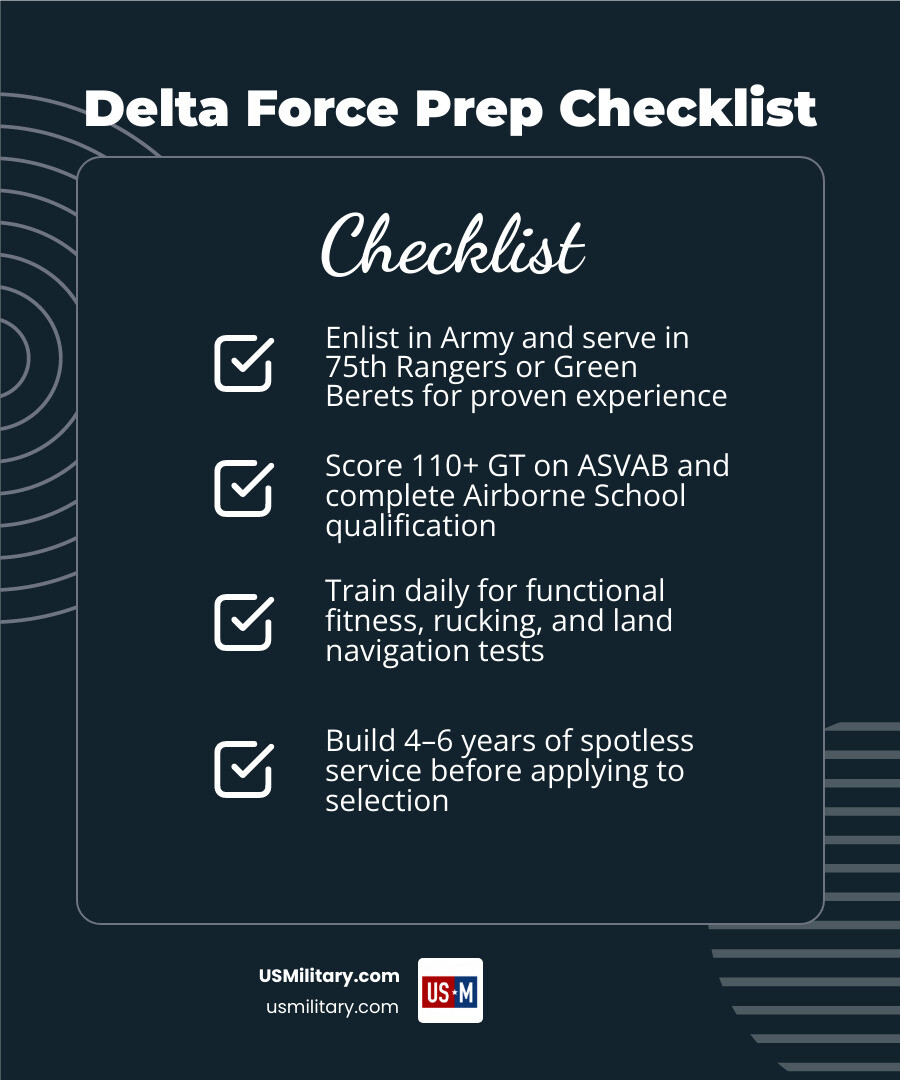
10 Ways To Prepare And Become an Army Delta Force Operator:
- Delta Force gear
- Family Life Dyanmites of Army Delta Force and Ranger Families
- are there any women on army delta force
What is Delta Force, and Who Can Join?
Before we dive into how to prepare, we need to understand what this legendary unit actually is. Delta Force is not a movie fantasy or a video game character class. It is a real-world, highly secretive, and incredibly selective Tier 1 Special Mission Unit.
To understand its roots, we look back to 1977. Col. Charles Beckwith, a U.S. Army Special Forces officer, had spent time serving with the British Special Air Service (SAS). He recognized a massive gap in America’s military capabilities: we lacked a dedicated, ultra-precise counterterrorism and hostage rescue unit. After years of advocating, Beckwith formed Delta Force, modeling its selection and training heavily after the grueling standards of the British SAS.
Today, Delta operates under the Joint Special Operations Command (JSOC). Its primary missions are shrouded in secrecy but generally include counterterrorism, high-value target capture or elimination, hostage rescue, and specialized direct action. If you want to dive deeper into the history, check out this guide on What is Delta Force and the foundational history of Army Delta Force.
Because of the extreme sensitivity of these missions, the military cannot afford to send unproven soldiers. As detailed in the Wanna Join the U.S. Army’s Delta Force? Here’s What It Takes – 19FortyFive analysis, the unit demands a level of maturity, tactical capability, and mental stability that can only be forged through years of service in the conventional or special operations military.
Minimum Eligibility Requirements
There is no “Delta Force Recruiter” at your local civilian strip mall. You must already be in the military to apply. To even be considered for the twice-yearly selection course, you must meet these strict minimum eligibility requirements:
- Service & Citizenship: You must be a U.S. citizen and an active-duty soldier in the U.S. Army.
- Age: You must be at least 22 years old.
- Rank (Enlisted): E-4 (Corporal/Specialist) through E-8 (Master Sergeant/First Sergeant).
- Rank (Officer): O-3 (Captain) or O-4 (Major) with a solid leadership record.
- Aptitude: You must score a General Technical (GT) score of 110 or higher on the ASVAB.
- Security Clearance: You must be eligible for, or currently hold, a Top Secret security clearance.
- Disciplinary Record: A clean military record with no history of disciplinary action (no Article 15s or court-martials).
- Physical & Medical: Must pass the Army Combat Fitness Test (ACFT), meet strict height/weight standards, be Airborne qualified (or volunteer for Airborne school), and pass a rigorous physical exam.
- Service Remaining: You must have at least 2.5 years of active service remaining on your contract upon entering selection.
10 Ways To Prepare And Become an Army Delta Force Operator

Now that you know the entry gates, let’s look at the actual roadmap. Becoming a Delta Force Operator requires a strategic career plan. You do not just wake up one day and decide to try out. You must spend years building a competitive resume, and the best way to do that is by serving in elite units like the 75th Ranger Regiment or the Special Forces (Green Berets).
If you are deciding which path to take first, we recommend reading our comparison on Army Ranger vs Green Beret to understand how these starting points shape your tactical foundation.
Step-by-Step Roadmap: 10 Ways To Prepare And Become an Army Delta Force Operator
If you are starting from scratch as a civilian or a junior soldier, here is the recommended step-by-step roadmap to position yourself for a Delta Force selection invitation.
- Enlist with a Plan: Enlist in the U.S. Army. While you can enlist in any Military Occupational Specialty (MOS), opting for an Option 40 contract (Ranger) or an 18X contract (Special Forces Candidate) puts you on an accelerated path toward elite military communities.
- Crush Infantry OSUT: Complete One Station Unit Training (OSUT) at Fort Moore (formerly Fort Benning). Focus on mastering the basics of infantry tactics, weapon systems, and physical conditioning.
- Graduate Airborne School: Airborne qualification is a mandatory requirement. You will learn to jump from static-line aircraft, completing five jumps at 1,250 feet.
- Earn Your Stripes in a Tier 2 Unit: Join the 75th Ranger Regiment through the Ranger Assessment and Selection Program (RASP), or complete the Special Forces Qualification Course (SFQC) to earn your Green Beret. These units provide the combat deployments, advanced tactical training, and leadership experience that Delta recruiters look for.
- Build a Decorated Career: Spend 4 to 6 years proving your worth. Seek leadership roles, earn outstanding evaluation reports, and keep your disciplinary record spotless.
- Master Land Navigation: This is the single biggest physical filter during selection. You must be able to navigate rugged, unfamiliar terrain alone, at night, carrying heavy loads, without relying on electronic GPS.
- Optimize Your GT Score: If your initial ASVAB GT score was below 110, take functional academic classes in the Army and retake the test. There are no waivers for this requirement.
- Initiate the Application: Delta recruiters visit major Army bases twice a year. Attend a briefing, submit your packet, and undergo the initial screening process.
- Prepare for Ambiguity: Learn to perform when there are no clear instructions, no feedback, and no encouragement. Delta wants self-starters who do the right thing when nobody is watching.
- Survive the Selection Course: Attend the four-week assessment at Camp Dawson, West Virginia, and give everything you have.
Physical and Mental Standards: 10 Ways To Prepare And Become an Army Delta Force Operator
To prepare your body and mind for the sheer physical brutality of selection, you must move beyond the standard “gym bro” workout routine.
- Functional Fitness: Focus on compound movements, core stability, and grip strength. Your workouts should include deadlifts, pull-ups, push-ups, squats, and sandbag carries. Use block periodization—focusing three weeks on building up your weakest physical areas (like running speed or upper body strength) followed by one week of active recovery and maintenance.
- Rucking is King: You must get comfortable walking long distances over steep hills with a heavy rucksack. Work your way up to rucking with a 45-to-65-pound pack. Focus on building the connective tissue in your knees, ankles, and lower back.
- The 24-Hour Rule: In elite operations, we train under the assumption that a mission scheduled for 2 hours might easily last 24 hours or longer. Always carry enough extra water, dry socks, batteries, and basic emergency gear to survive 24 hours past your planned timeline. Apply this level of meticulous preparation to your training runs and rucks.
- Mental Resilience: You must train yourself to tolerate isolation. In selection, you will not have a battle buddy to complain to, and instructors will not coach or encourage you. You must find your “why” and hold onto it when your feet are bleeding and your body is begging you to quit.
Surviving the Delta Force Selection Course and OTC
If your application packet is approved, you will travel to the remote, heavily forested mountains of Camp Dawson, West Virginia. The Selection Course is a four-week test of physical endurance, mental stamina, and psychological stability. To learn more about the training timeline, check out the Delta Force Training: What It Takes to Join Delta Force – USAMM overview.
The Physical Gates and Land Navigation
The first phase of selection consists of the physical gates. You must pass a modified physical fitness test, a swim test, and a series of run-and-ruck gates. If you fail to meet the standard on any of these initial physical events, you are sent home immediately.
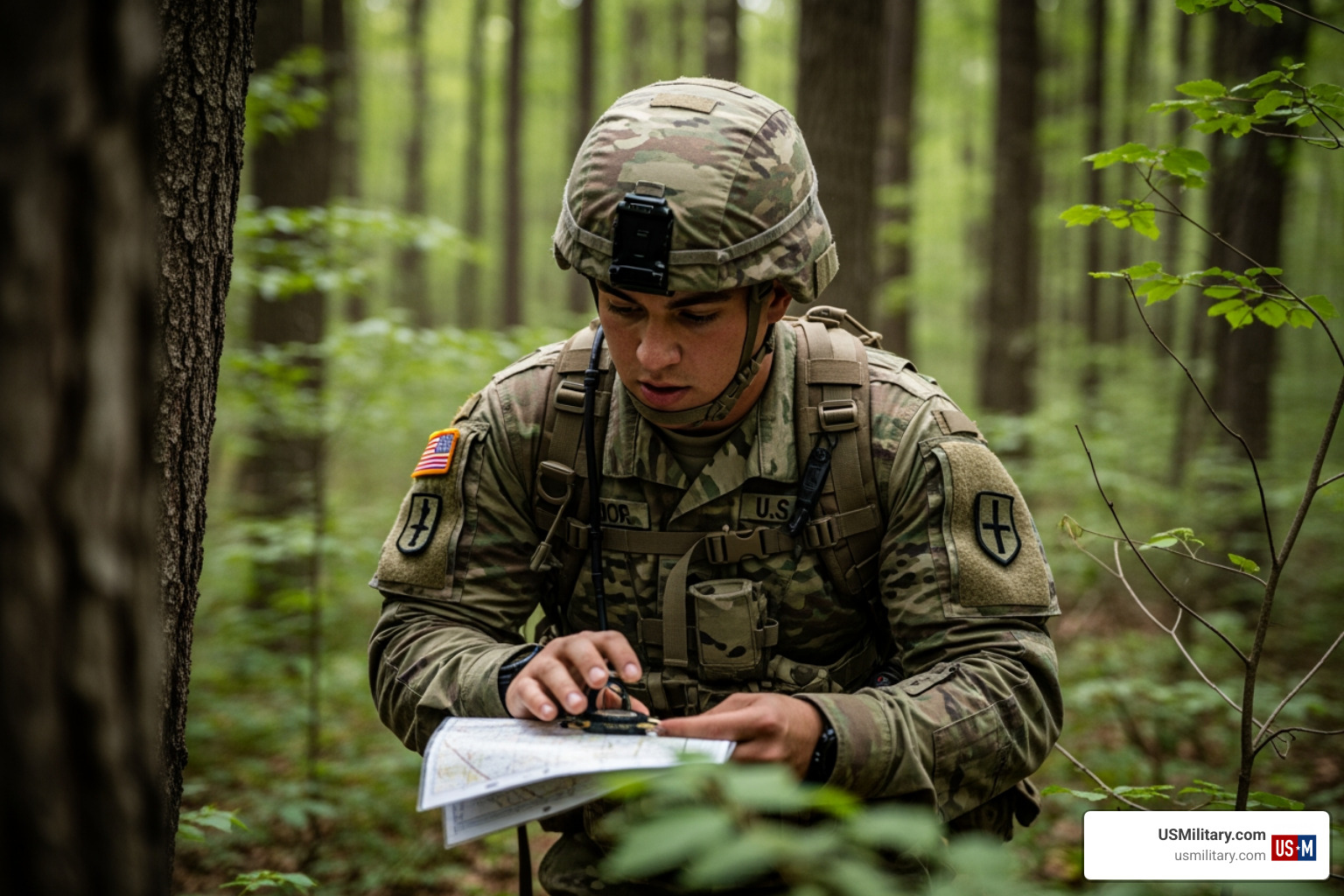
Once you pass the gates, you enter the land navigation phase. Candidates are dropped off alone in the rugged West Virginia wilderness with a map, a lensatic compass, and a heavily weighted rucksack. You are given coordinates and a time limit.
There are no trails, no markers, and no GPS. You must navigate through dense brush, steep ravines, and swampy terrain. To make it more mentally taxing, the instructors employ the “silent treatment.” When you reach a checkpoint, the instructors will not tell you if you are on time, how many points you have left, or even if you got the coordinate right. They will simply record your arrival and point you toward your next coordinate. This psychological isolation is designed to break down your ego and test your self-reliance.
The Long Walk
The climax of the four-week selection course is the infamous “Long Walk.” This is a grueling, solo 40-mile ruck march across the mountainous terrain of West Virginia.
- The Load: You will carry a rucksack weighing at least 45 pounds, plus water, food, and gear.
- The Time: The time limit is highly classified, but candidates must maintain an incredibly fast, grueling pace for up to 20 continuous hours.
- The Mental Battle: You are entirely alone. There are no cheering crowds, no milestones, and no indications of how much further you have to go. The instructors are testing your refusal to quit when you are physically exhausted and mentally depleted.
This single event accounts for the majority of the course’s high attrition rate. Only about 10–13% of candidates make it to the end of the selection course. If you survive, you must still pass a board of senior Delta operators and psychologists who will evaluate your personality, integrity, and compatibility with the unit.
Those selected then enter the six-month Operator Training Course (OTC). OTC is where you learn the actual tradecraft of a Tier 1 operator. You will receive world-class instruction in advanced marksmanship, close-quarters combat (CQC), demolitions, offensive driving, espionage tradecraft, and executive protection.
Comparing Delta Force to Other Elite Units
Aspiring soldiers often wonder how Delta Force compares to other legendary units like the Navy SEALs or the Green Berets. While all of these units are incredibly elite, they serve different primary functions within the U.S. military.
To get a complete breakdown of how these units differ in mission and culture, read our comparison of Delta Force vs Seals and Delta Force Seal Team 6. You can also explore The Shadow Warriors Everything You Need to Know About Delta Force to understand their unique place in the Special Operations Command hierarchy.
| Feature / Metric | Army Delta Force (1st SFOD-D) | Navy SEAL Team 6 (DEVGRU) | Army Green Berets (Special Forces) |
|---|---|---|---|
| Service Branch | U.S. Army | U.S. Navy | U.S. Army |
| Tier Level | Tier 1 Special Mission Unit | Tier 1 Special Mission Unit | Tier 2 Special Forces |
| Primary Mission | Counterterrorism, Hostage Rescue, Direct Action | Counterterrorism, Maritime Hostage Rescue, Direct Action | Unconventional Warfare, Foreign Internal Defense |
| Recruiting Source | Active-duty Army (Rangers, Green Berets, Airborne) | Active-duty Navy SEALs and SWCC | Civilian (18X) or active-duty Army |
| Selection Location | Camp Dawson, West Virginia | Oceanside / Dam Neck, Virginia | Camp Mackall / Fort Liberty, NC |
| Key Selection Test | “The Long Walk” (40-mile solo mountain ruck) | Hell Week (BUD/S) & Green Team | Robin Sage (unconventional warfare exercise) |
| Approx. Selection Pass Rate | 8–12% | Highly selective (from existing SEALs) | 20–30% (SFAS) |
Frequently Asked Questions About Delta Force Preparation
Can civilians join Delta Force directly?
No, there is absolutely no direct civilian pipeline to join Delta Force. You cannot walk into a recruiting office and sign a “Delta Force contract.” To be eligible, you must first enlist in the U.S. Army, complete basic training, and build a highly successful military record.
While you can technically apply from any conventional Army unit, the vast majority of successful candidates come from the 75th Ranger Regiment or Army Special Forces. Serving in these units first gives you the tactical maturity, advanced marksmanship, and rucking endurance required to survive selection.
For more details on navigating the recruitment process from scratch, you can read the guide on How to Join Delta Force: The Elite Step-by-Step Guide or check out the step-by-step advice on How to go about to join the Delta Force because I plan on … – Quora.
What is the pass rate for Delta Force selection?
The historical pass rate for the Delta Force Selection Course is roughly 8–12%. Out of an average starting class of 120 highly conditioned, elite soldiers (most of whom are already Rangers or Green Berets), only about 12 to 16 candidates will successfully complete the four-week selection course.
Furthermore, completing the selection course does not guarantee a spot in the unit. Candidates must still pass the psychological board, and only 4–8% of those who originally applied will ultimately be selected to attend the Operator Training Course (OTC). If you want to see what this process looks like from the inside, watch Delta Force: Inside America’s Secret Selection – YouTube.
What is the Operator Training Course (OTC)?
The Operator Training Course (OTC) is a highly classified, six-month training program that candidates must pass after surviving the initial four-week selection course. OTC is designed to turn a highly fit soldier into a lethal, independent Tier 1 operator.
The training covers advanced marksmanship (shooting thousands of rounds a day until weapon manipulation becomes second nature), close-quarters combat (CQC) in live-fire shoot houses, advanced demolitions, tactical driving, espionage tradecraft, and executive protection. To learn more about how to structure your career path toward this level of training, consult How to become a Delta Force Operator in the US Army? and the comprehensive overview on Delta Force: History, Selection, Missions, and How to Join.
Conclusion
Preparing for and becoming an Army Delta Force Operator is the ultimate challenge in the military world. It requires a rare combination of physical dominance, high intelligence, extreme self-reliance, and quiet humility. If you are serious about this path, your preparation starts today by becoming the absolute best soldier you can be in your current unit.
At USMilitary.com, we are dedicated to providing active-duty service members, recruits, and veterans with the trusted resources they need to navigate their military careers. Whether you are comparing elite paths, planning your military retirement, or looking for VA loans and financial benefits, we are here to support you every step of the way.
If you are still deciding which elite path is right for your career goals, take a look at our detailed comparison guide on how to compare Army Delta Force vs Navy Seals. Your journey to the tip of the spear starts with a single step—train hard, stay focused, and never quit.
Free for Service Members & Veterans
Get the military benefits intel no one tells you about.
Weekly updates on VA benefits, pay changes, and money tips — free for service members and veterans.
No spam. Unsubscribe anytime. Your info is never shared.


