Who Are The Air Force’s Pararescuemen (PJs) is one of the most searched questions about U.S. military special operations — and for good reason. Here’s the short answer:
| Who they are | Elite U.S. Air Force special operators (enlisted) trained for Personnel Recovery |
| What they do | Rescue, treat, and evacuate downed military personnel and civilians in combat and humanitarian missions |
| Where they serve | AFSOC, Air Combat Command, Air National Guard, and Reserve units worldwide |
| How they’re identified | Maroon beret, Pararescue Crest, and the motto “These Things We Do, That Others May Live” |
| How elite are they | ~500 active PJs; 80% training washout rate; most decorated enlisted force in the Air Force |
PJs aren’t just combat medics. They’re also expert parachutists, combat divers, and search-and-rescue specialists — trained to go anywhere, in any environment, to bring people home alive.
Since September 11, 2001, PJs have completed over 12,000 combat rescue missions and rescued more than 5,000 civilians during natural disasters. They’ve earned 1 Medal of Honor, 12 Air Force Crosses, and over 105 Silver Stars in the process.
Their creed says it plainly: “It is my duty as a Pararescueman to save life and to aid the injured. I will be prepared at all times to perform my assigned duties quickly and efficiently, placing these duties before personal desires and comforts.”
I’m Larry Fowler, publisher of USMilitary.com — and through over 15 years helping service members navigate military career decisions, I’ve covered who are the Air Force’s Pararescuemen (PJs) and why this path stands apart from every other special operations role. Read on for everything you need to know, whether you’re considering enlistment or simply want to understand what these warriors do.
Who Are The Air Force’s Pararescuemen (PJs)
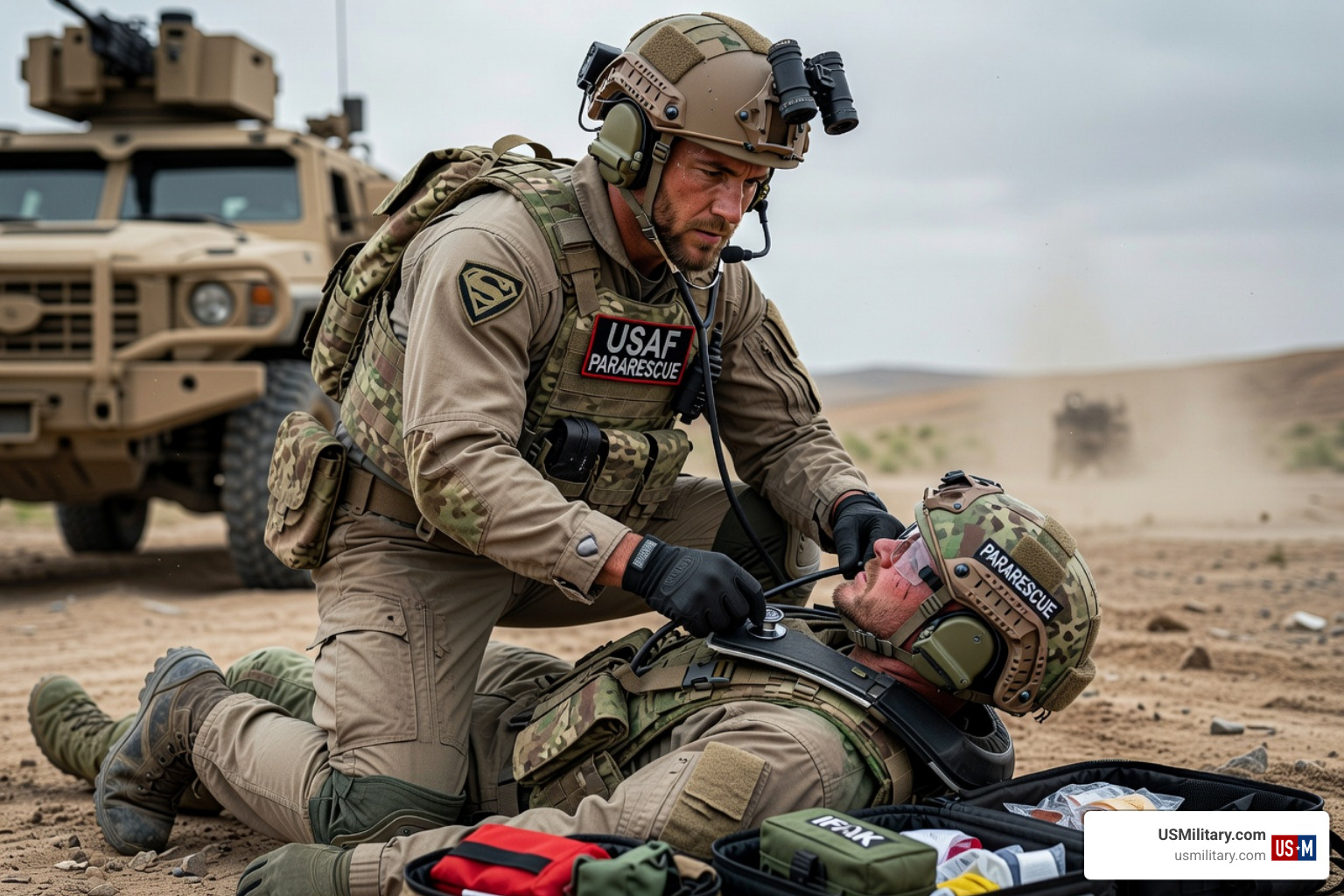
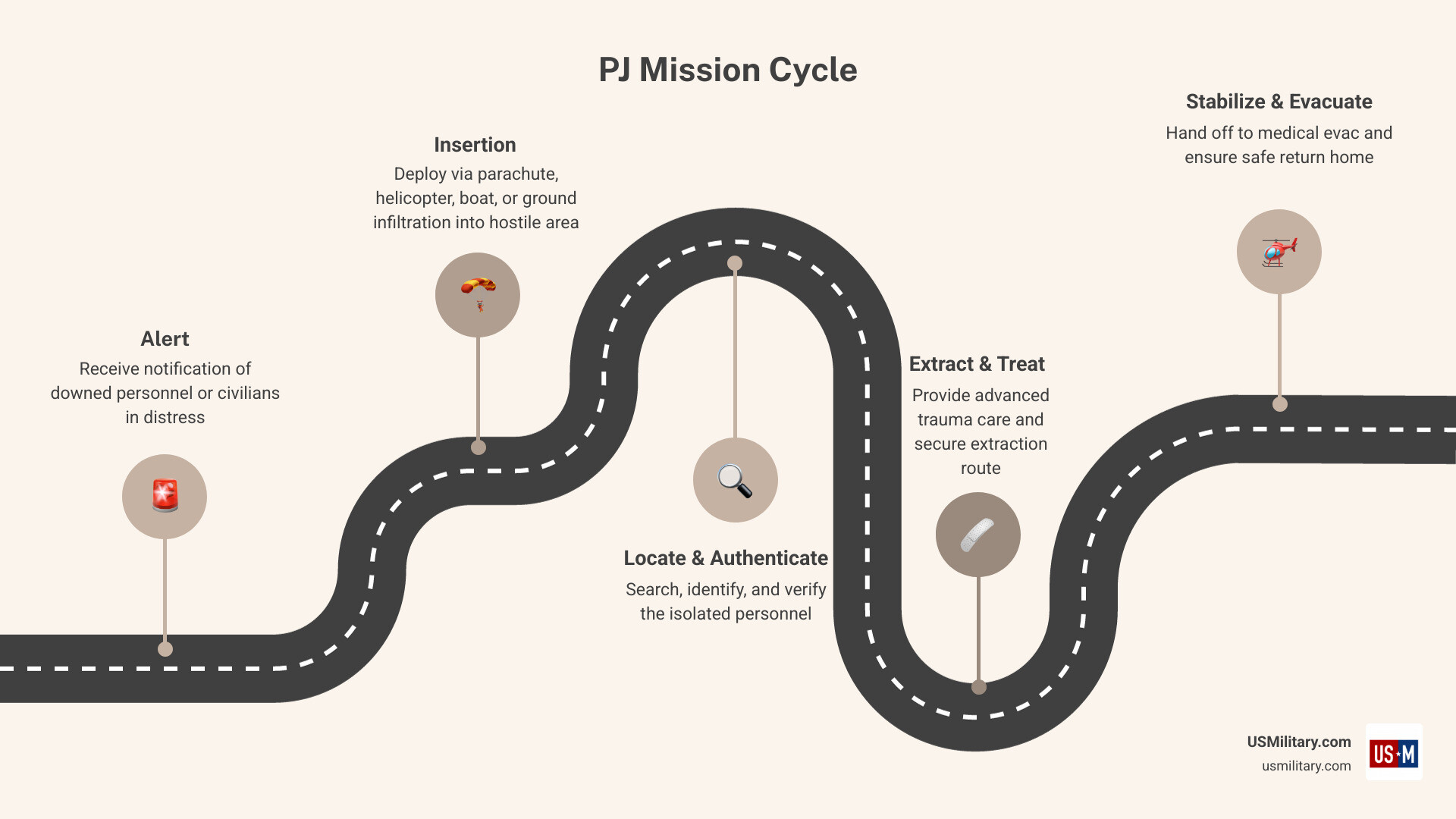
To truly understand Who Are The Air Force’s Pararescuemen (PJs), you have to look past the gear and the Hollywood image. At their core, PJs are the Department of Defense’s only elite force specifically organized, trained, and equipped to conduct full-spectrum Personnel Recovery (PR). While other special operations units might perform rescues as a secondary mission, for a PJ, it is the primary reason they exist.
The term “PJ” stands for Pararescue Jumper, a nickname that dates back to the early days of the service. Today, they are officially known as Pararescuemen. Their mission is often referred to as Combat Search and Rescue (CSAR). Whether a pilot is shot down behind enemy lines or a soldier is severely wounded in a remote mountain pass, the PJs are the ones who go in to get them.
The culture of the career field is built on the Pararescue Creed, which emphasizes self-sacrifice. Their motto, “That Others May Live,” isn’t just a catchy phrase; it’s a promise. This dedication is why Pararescue Apprentices In The Us Air Force Save Lives in situations where others simply cannot reach the victim.
You can identify these warriors by their distinctive maroon beret. They also share a unique tradition known as “Green Feet.” This stems from the Vietnam era, where the CH-3E and HH-3E “Jolly Green Giant” helicopters would leave temporary impressions in the grass. Today, many PJs have small green feet tattooed on their person as a symbol of their heritage. For those looking to join, SPECIAL TACTICS PARARESCUE offers one of the most rewarding and challenging paths in the military.
Specialized Skills of Who Are The Air Force’s Pararescuemen (PJs)
The versatility of a PJ is unmatched. Because they never know where a rescue might take them, they must be masters of every domain:
- Medical Expertise: Every PJ is a certified National Registry EMT-Paramedic. They provide Enlisted Air Force Medical Careers with a combat twist, performing life-saving surgeries and trauma care under fire. This makes them one of the Two Medical Careers To Pursue In The Us Air Force if you want to be on the front lines.
- Combat Diving: They are trained in open and closed-circuit diving, capable of conducting subsurface searches and recoveries at depths of up to 130 feet.
- Airborne Operations: PJs are experts in both Static Line and Military Free Fall (HALO/HAHO) jumping. They can drop into the middle of the ocean or onto a tiny mountain ledge in total darkness.
- Technical Rescue: They master high-angle rope rescues, extrication from mangled aircraft, and survival in arctic, desert, and jungle environments.
- Small Unit Tactics: Make no mistake—they are warriors. They are proficient in advanced weaponry and small unit tactics to defend themselves and their patients during an extraction.
Leadership and Units of Who Are The Air Force’s Pararescuemen (PJs)
While PJs are an enlisted force, they are led by Combat Rescue Officers (CROs). CROs undergo nearly identical physical training to ensure they can lead from the front, though their primary focus is mission planning and command. Understanding the relationship between these roles is key to understanding What Are The Different Air Force Ranks An Easy To Understand Breakdown.
PJs are typically assigned to two types of units:
- Special Tactics Squadrons (STS): Part of Air Force Special Operations Command (AFSOC). These PJs often embed with Navy SEALs or Army Special Forces to provide dedicated medical and rescue support for high-stakes missions.
- Rescue Squadrons (RQS): Part of Air Combat Command (ACC). These “Guardian Angel” squadrons are the backbone of conventional CSAR, utilizing HH-60G Pave Hawk helicopters and HC-130J Combat King II aircraft.
Whether in the Active Duty, Air National Guard, or Air Force Reserve, a PJ’s career involves constant growth. You can learn more about From Airman To Nco Understanding Your Rank Progression In A 6 Year Air Force Enlistment to see how these specialists move into leadership roles.
The Rigorous Training Pipeline and Requirements
Becoming a PJ is widely considered one of the hardest feats in the U.S. military. The training pipeline, often nicknamed “Superman School,” lasts approximately two years and has a staggering 80% attrition rate. Most candidates don’t quit because of a lack of strength; they quit because the mental pressure is relentless.
The journey begins with Joining The Airforce and heading to Basic Military Training, but the real test starts at Special Warfare Assessment & Selection (A&S). Here, instructors push candidates to their physical and psychological limits to see who has the grit to stay calm when things go wrong.
✉ Get updates like this in your inbox
Weekly VA benefit changes, pay updates, and money tips for service members, veterans, and military families. Free, no spam.
The Initial Fitness Test (IFT) and Prerequisites
To even get a contract, you must pass the Initial Fitness Test. While the minimums get you in the door, they rarely get you through the course. We recommend aiming for the “Competitive” scores listed above.
Beyond fitness, prerequisites include:
- U.S. Citizenship.
- A high school diploma or GED.
- Qualifying ASVAB scores (General score of 49 or higher).
- The ability to obtain a Secret security clearance.
- Normal color vision.
If you are ready to start this journey, the first step is to Join The Air Force through a Special Warfare recruiter.
Major Training Courses and Milestones
The pipeline is a series of specialized schools designed to build a multi-capable airman:
- Special Warfare Prep & Selection: The foundational “gut check.”
- Pre-Dive & Combat Diver Course: Five weeks of intense water confidence and SCUBA training.
- US Army Airborne School: Learning the basics of static-line parachuting.
- Military Free Fall School: Mastering high-altitude parachute jumps.
- SERE Training: Survival, Evasion, Resistance, and Escape training for hostile environments.
- Paramedic Course: 39 weeks of medical training to become a nationally registered paramedic. This is where you learn to manage a Us Air Force Medical Equipment Career in the field.
- Pararescue Apprentice Course: The final 22-week “capstone” where all skills—shooting, jumping, diving, and medicine—are integrated into realistic mission scenarios.
History, Heroism, and Notable Decorations
The history of Who Are The Air Force’s Pararescuemen (PJs) is a saga of incredible bravery. The program traces its roots back to World War II. In 1943, in the China-Burma-India theater, a C-46 transport plane crashed in a remote jungle. A group of volunteers, including a flight surgeon, parachuted in to treat the 20 survivors. This jump is widely considered the birth of Pararescue.
By 1946, the Air Rescue Service was officially formed. During the Korean War, PJs evacuated over 8,000 casualties and rescued nearly 1,000 personnel from behind enemy lines. However, it was the Vietnam War that truly defined the “PJ” legacy. During that conflict, Pararescuemen earned more Air Force Crosses than any other career field.
Since the Global War on Terror began, PJs have been busier than ever. With over 12,000 combat missions since 9/11, they remain the most highly decorated enlisted force in the Air Force. For a deeper dive into their official history, you can check the Pararescue Fact Sheet.
Highly Decorated Warriors and Famous PJs
The list of heroic PJs is long, but a few names stand out as legends in the community:
- A1C William H. Pitsenbarger: During the Vietnam War, “Pits” stayed on the ground to defend and treat wounded soldiers despite having multiple chances to leave on a rescue hoist. He was posthumously awarded the Medal of Honor.
- SrA Jason Cunningham: During the Battle of Roberts Ridge in Afghanistan (2002), Cunningham remained in the line of fire to move and treat wounded Rangers. He was awarded the Air Force Cross posthumously.
- CMSgt Duane Hackney: One of the most decorated airmen in history, Hackney received over 70 individual awards, including the Air Force Cross, for his actions in Vietnam.
These stories of valor are why Pararescue is consistently ranked among the Best Air Force Jobs 2025.
Beyond the Battlefield: NASA and Disaster Response
The mission of Who Are The Air Force’s Pararescuemen (PJs) extends far beyond combat. Because of their unique ability to deploy into the middle of the ocean, they have been a critical part of the U.S. space program since its inception. PJs are tasked with recovering astronauts after water landings, providing immediate medical care as soon as the capsule hits the waves.
They are also the nation’s premier “first responders” for major natural disasters. During Hurricane Katrina, PJs were credited with saving thousands of lives by hoisting people off rooftops in flooded areas. Their skills in Military Search And Rescue Careers make them invaluable during floods, earthquakes, and hurricanes.
Even in these humanitarian roles, the medical administration skills they learn are vital. You can see how this overlaps with other fields in Air Force Medical Administration Careers.
Frequently Asked Questions about Pararescuemen
What does the PJ motto ‘These Things We Do, That Others May Live’ signify?
The motto signifies the core philosophy of self-sacrifice. It means that a PJ is willing to risk their own life—and put their own comforts aside—to ensure that a fellow service member or civilian makes it home to their family. It is a commitment to the mission of rescue above all else.
How long is the Air Force Pararescue training pipeline?
The pipeline typically takes about two years to complete. This includes the initial assessment and selection, various specialized schools (dive, airborne, SERE), and nearly a year of intensive paramedic and recovery specialist training.
What is the difference between a PJ and a Combat Rescue Officer (CRO)?
The primary difference is their role and rank. PJs are enlisted specialists who perform the hands-on medical and rescue tasks. CROs are commissioned officers who lead the teams, plan the missions, and manage the broader Personnel Recovery strategy. Both undergo the same grueling physical selection process.
Conclusion
At USMilitary.com, we believe that understanding the roles of our elite forces is the first step toward a successful military career or a deeper appreciation for those who serve. Who Are The Air Force’s Pararescuemen (PJs) represents the pinnacle of the Air Force Special Warfare community. They are a rare breed of warrior-medics who live by a creed of selfless service.
Whether they are jumping into a combat zone to save a pilot or hoisting a civilian out of floodwaters, PJs exemplify the very best of the U.S. Air Force. If you’re interested in pursuing this elite career path, or if you simply want to learn more about how the military is structured, you can View all military ranks in order to see where these heroes fit into the bigger picture.
These things they do, that others may live.
Free for Service Members & Veterans
Get the military benefits intel no one tells you about.
Weekly updates on VA benefits, pay changes, and money tips — free for service members and veterans.
No spam. Unsubscribe anytime. Your info is never shared.