Understanding the Officer Age Landscape in Today’s Military
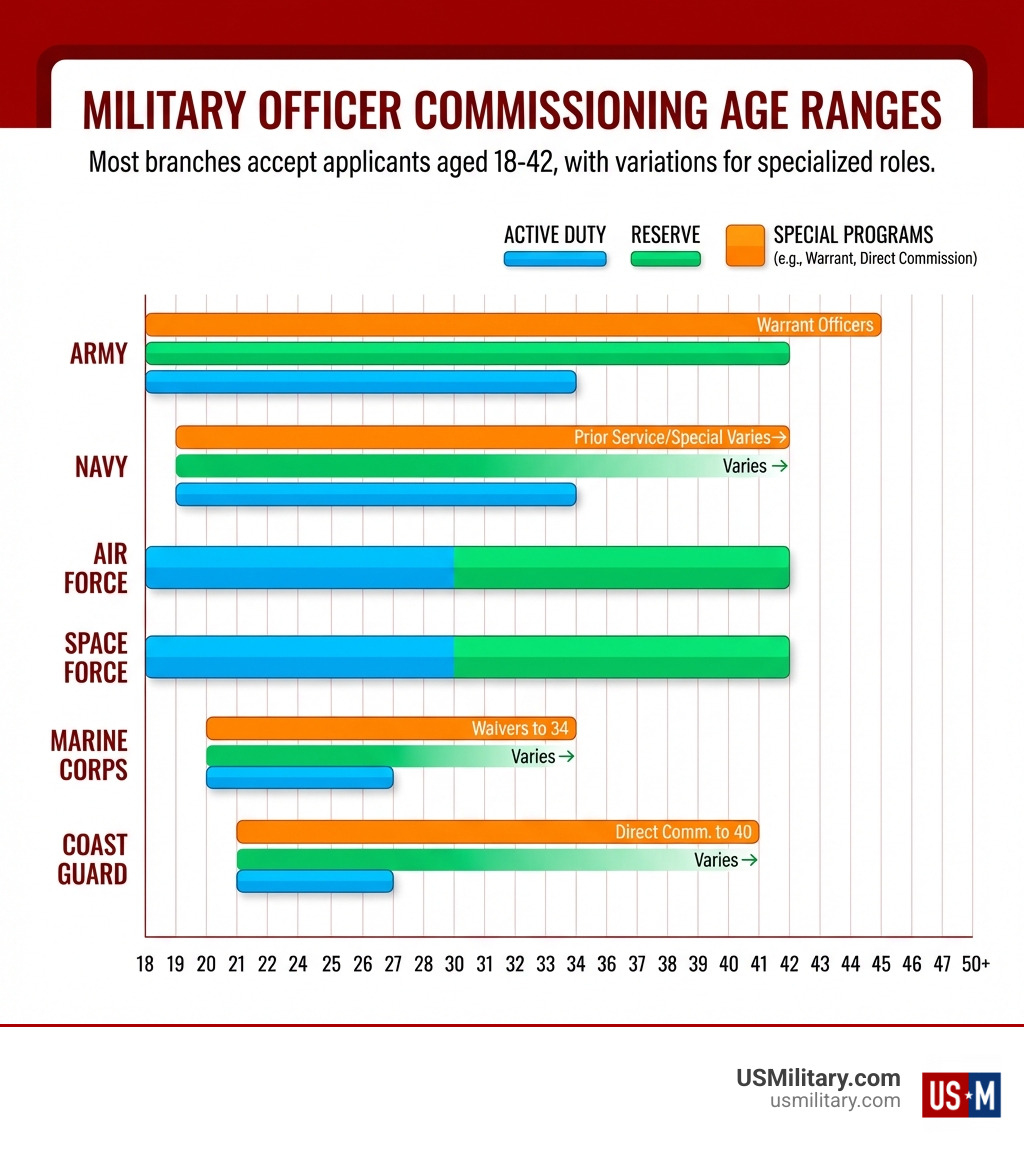
The age limit for officer in military service varies significantly by branch, but generally ranges from 18 to 42 years old at the time of commissioning, with specific exceptions for specialized roles and prior service members.
Quick Answer: Officer Age Limits by Branch
| Branch | Active Duty Officers | Reserve Officers | Special Notes |
|---|---|---|---|
| Army | 18-34 | Up to 42 | Warrant Officers: up to 46 |
| Navy | 19-34 | Varies by program | Prior service may adjust limits |
| Air Force | 18-42 | 18-42 | Recent increase from 39 |
| Space Force | 18-42 | 18-42 | Follows Air Force guidelines |
| Marine Corps | 20-28 | Varies | Waivers rarely exceed 34 |
| Coast Guard | 21-28 | Varies | Direct Commission: up to 40 |
As Michael Jordan once said, “If you can’t stop thinking about it, don’t stop working for it.” Many people dream of military leadership but worry they’ve missed their window. The truth? Age limits are more flexible than you might think.
The military values experience, maturity, and life skills—qualities that often come with age. A 30-year-old with a degree and professional experience might actually be more competitive than a 22-year-old fresh out of college. Medical doctors, lawyers, chaplains, and other specialists can commission well into their late 30s or even early 40s.
Age requirements differ dramatically between:
- Active duty and reserve components (reserve officers often have higher age limits)
- Different commissioning programs (service academies vs. Officer Candidate School)
- Specialized career fields (medical, legal, and religious professionals)
- Prior military service (enlisted-to-officer programs adjust age calculations)
The landscape has evolved recently too. The Air Force and Space Force raised their maximum age to 42 in response to recruiting challenges, making them the most age-flexible branches for officer candidates.
Whether you’re a college senior, a mid-career professional, or a prior enlisted service member eyeing commission, understanding these nuances is crucial. Let’s break down exactly what each branch requires and where you might still have opportunities.
What is the Age Limit for Officer in Military by Branch?
When we talk about the age limit for officer in military service, it’s important to recognize that each branch of the U.S. Armed Forces—Army, Navy, Air Force, Marine Corps, Coast Guard, and Space Force—sets its own specific guidelines. These limits can also vary depending on whether you’re applying for active duty or the reserves, and through which commissioning program.

Army Officer Age Limits
For those aspiring to lead in the Army, Active Duty Officers must typically be between 18 and 34 years old at commissioning. The Army Reserve and Army National Guard offer more flexibility, with a general age limit of under 42. These reserve components have specific age limits based on officer grade and specialty, offering pathways for a wider age range. For Officer Candidate School (OCS) in the Army Reserve, the maximum age is under 40. For those aiming for a Warrant Officer role, which requires technical expertise, the maximum age is higher, generally under 46.
Navy Officer Age Limits
The Navy’s requirements for officers also have their own nuances. Generally, to become a commissioned officer in the Navy, you must be at least 19 years old and less than 34 at the time of commissioning for many programs. The good news is that the maximum age limit for Navy officer candidates may be adjusted for prior service members, acknowledging the valuable experience they bring. For highly specialized roles, such as officers entering the Navy SEAL program, the age limit can be extended significantly, with a recent change allowing officers to enter up to age 42.
Air Force and Space Force Officer Age Limits
The Air Force and the newly established Space Force have recently demonstrated significant flexibility regarding their officer age limits. Previously, the maximum age was 39, but a notable policy change means that active-duty Air Force and Space Force applicants can now join up to the age of 42. This makes them among the most age-flexible branches for commissioning. This adjustment aims to attract a broader pool of talent and allows more individuals to complete a full 20 years of service before mandatory retirement.
Marine Corps Officer Age Limits
The Marine Corps, known for its rigorous standards, maintains some of the strictest age requirements. Applicants for programs like the Platoon Leaders Class (PLC) and Officer Candidate Classes must generally be between 20 and 28 years old at commissioning. While waivers for exceptionally qualified applicants may be considered, they are rare and typically do not extend beyond age 34. This emphasis on youth reflects the branch’s unique and physically demanding mission.
Coast Guard Officer Age Limits
The Coast Guard also offers opportunities for officers with specific age parameters. The typical age limit for officer in military roles within the Coast Guard is between 21 and 28 years old for commissioned officers. However, the Coast Guard recognizes the value of specialized skills. For its Direct Commission Officer (DCO) program, which is for professionals with specific expertise, the age cutoff can extend up to 40 years old.
Officer vs. Enlisted: A Tale of Two Timelines
When considering the military, the two primary pathways are enlisted personnel and commissioned officers. While both are vital, they have different entry requirements, responsibilities, and, crucially, age limits.
How Officer Age Requirements Compare to Enlisted
Generally, the age limit for officer in military service is more stringent than for enlisted personnel, reflecting their different roles. Officers are leaders and managers, which is why they are almost universally required to have a bachelor’s degree. Enlisted personnel, who form the bulk of the workforce, typically need a high school diploma or GED.
Here’s a quick comparison:
| Branch | Max Enlisted Age | Max Officer Age (General) | Notes |
|---|---|---|---|
| Army | 35 | 34 (Active Duty), 40 (OCS), 42 (Reserve) | Enlisted range 17-35 |
| Navy | 41 | 34 (General), 42 (SEALs) | Enlisted range 17-41 |
| Air Force | 42 | 42 | Both recently increased, enlisted range 17-42 |
| Space Force | 42 | 42 | Both recently increased, enlisted range 17-42 |
| Marine Corps | 28 | 28 (General), 34 (Waiver) | Enlisted range 17-28 |
| Coast Guard | 42 | 28 (General), 40 (DCO) | Enlisted max 42, but varies by rate |
The selection process for officers is also often more competitive due to fewer positions. Candidates are expected to be highly qualified and exceed minimum physical standards. As fitness author and former Navy SEAL Stew Smith advises, entering any military training with minimum physical standards is not a recipe for success, and this is especially true for aspiring officers.
Age Limits for Officer Commissioning Programs
Becoming an officer involves one of several pathways, each with its own age considerations:
Service Academies (e.g., West Point, Naval Academy): These are the most restrictive, requiring applicants to be at least 17 and not yet 23 on July 1st of their entry year.
✉ Get updates like this in your inbox
Weekly VA benefit changes, pay updates, and money tips for service members, veterans, and military families. Free, no spam.
Reserve Officer Training Corps (ROTC): Offered at colleges nationwide, ROTC programs generally follow the commissioning age limits of their respective branches. For example, Air Force ROTC candidates must be able to commission by age 42.
Officer Candidate School (OCS) / Officer Training School (OTS): Designed for college graduates, these programs have higher age limits than service academies. The maximum age varies by branch, from 28 in the Marine Corps and Coast Guard to 42 in the Air Force and Space Force.
Direct Commission (DC) Programs: These are for professionals like doctors, lawyers, and chaplains. DC programs have the highest age limits, often extending into the late 30s or 40s, as the military seeks to bring in civilian expertise.
Waivers, Special Roles, and Prior Service
While the military sets clear age guidelines, the system has built-in flexibility through waivers, special considerations for certain roles, and adjustments for prior military service. These mechanisms acknowledge that leadership potential isn’t tied to a specific birthday.

Are Age Waivers Available for Officer Positions?
Yes, age waivers are available for officer positions, but they are granted on a case-by-case basis for exceptional circumstances. A waiver is more likely if you have unique skills, if the military has a critical need for a specific role, or during periods of recruitment shortfalls. The Marine Corps, for instance, may grant waivers up to age 34 for “exceptionally qualified applicants.” Securing a waiver is a rigorous process, and your best first step is to speak with a recruiter. They can provide current information and guide you through the specific process for your situation.
Understanding the Age Limit for Officer in Military Roles
Some specialized professions are so critical that the military accepts older candidates who bring valuable civilian experience. These direct commission roles often have significantly higher age ceilings:
- Medical Professionals: Doctors, dentists, and nurses are in high demand. Direct commissioning programs often allow them to join well into their 40s, with some wartime provisions allowing for appointments up to age 47.
- Lawyers (JAG Corps) and Chaplains: Legal and religious professionals can also commission directly at older ages, typically into their late 30s or early 40s, as their prior experience is highly valued.
- Cyber and Technical Specialties: As warfare evolves, experts in fields like cyber security and engineering are increasingly sought. Direct commission programs for these roles may also offer higher age limits to attract seasoned professionals.
This pattern is clear: when specific professional experience is paramount, the age limit for officer in military service becomes much more flexible.
How Prior Service Impacts the Age Limit for Officer in Military
Previous military service, especially for enlisted members, can significantly improve eligibility for an officer commission by extending the age limit. The military highly values the discipline and leadership gained through prior service.
- Adjusted Age: Many branches allow prior active-duty service time to be subtracted from your current age, effectively lowering your age for eligibility purposes.
- 20-Year Career Goal: The focus is often on whether a candidate can complete 20 years of creditable service before the mandatory retirement age (typically 62). The Air Force, for example, requires prior service applicants to meet this condition or request a waiver.
- Enlisted-to-Officer Programs: Programs like the Army’s Green to Gold are designed for qualified enlisted soldiers and have age guidelines that account for their existing military experience.
The Legal Framework: From Commissioning to Retirement
Beyond individual branch policies, the age limit for officer in military service is governed by federal laws and Department of Defense (DoD) policies. These frameworks establish the foundational rules for who can become an officer and when they must retire, ensuring consistency across the Armed Forces.
Federal Laws Dictating Officer Age Requirements
Federal laws, primarily in Title 10 of the U.S. Code, establish the foundational rules for military officers. These laws set the minimum commissioning age at 18 and grant Service Secretaries the authority to define specific qualifications for their respective branches. The Department of Defense (DoD) then issues policies that create a baseline for standards like age, fitness, and character across all services. While individual branches customize their age limits, they must all operate within this federal framework.
Joining Age vs. Mandatory Retirement Age
It’s crucial to distinguish between the commissioning age and the mandatory retirement age. While commissioning ages dictate when you can start your officer career, retirement ages determine when it must end.
- Mandatory Retirement Age: For most officers (grades O-1 through O-6), the mandatory retirement age is 62, as outlined in 10 U.S. Code § 1251. For general and flag officers (O-7 and above), it is generally 64, per 10 U.S. Code § 1253.
- Deferments: The President or Secretary of Defense can defer retirement for certain high-ranking officers. Deferments are also possible for some specialists, like health professionals, if it is in the best interest of the military.
- The 20-Year Service Requirement: Many commissioning age limits are designed to allow an officer to complete a full 20 years of active service before reaching mandatory retirement. For example, commissioning at age 42 still allows for a 20-year career before the retirement age of 62. This ensures the military gets a full return on its investment in an officer’s training.
These age limits are a critical part of personnel management, ensuring a steady flow of new talent while allowing experienced leaders to serve for substantial careers.
Frequently Asked Questions about Officer Age Limits
We know that understanding the nuances of military age requirements can be complex, so we’ve compiled some of the most common questions we hear regarding the age limit for officer in military service.
What happens if I am older than the maximum age limit?
If you are older than the maximum age limit, several potential avenues remain. You can pursue an age waiver, which is granted on a case-by-case basis for exceptionally qualified candidates or to fill critical needs. Another option is to explore direct commission programs for specialized fields like medicine, law, or religion, which often have much higher age limits. The Reserve and National Guard also typically offer more flexible age requirements than active duty. Your best course of action is to speak with an officer recruiter who can provide the most current information on these options.
Do Warrant Officers have different age limits?
Yes, Warrant Officers typically have different age limits. They are highly skilled technical experts who bridge the gap between the enlisted and commissioned officer corps. Because their roles require extensive experience, their age limits are often higher. For example, in the Army Reserve, the maximum age for a new Warrant Officer is under 46, which is higher than the limit for its OCS program. Each branch with Warrant Officers (Army, Navy, Marine Corps, and Coast Guard) has its own specific guidelines.
How have officer age limits changed over time?
The age limit for officer in military service is not static; it evolves in response to recruitment needs and policy changes. We’ve seen significant shifts recently, as the military adapts to modern challenges:
- Response to Recruitment Needs: When facing recruiting shortfalls, the military often adjusts age limits to broaden the applicant pool. The recent decision by the Air Force and Space Force to raise their maximum officer age to 42 is a prime example.
- Policy Alignment: These increases also align with Department of Defense policy, allowing more individuals to serve a full 20-year career before the mandatory retirement age of 62.
- Broader Trends: Other branches have shown similar flexibility. The Navy and Coast Guard recently raised their maximum enlistment ages to 41 and 42, respectively. While focused on enlisted personnel, this reflects a wider trend toward flexibility that can also influence officer programs.
Historically, age limits have always fluctuated, becoming more lenient during times of national crisis and stricter during peacetime.
Conclusion
Navigating the age limit for officer in military service can seem like a daunting task, but as we’ve explored, it’s a dynamic landscape with more flexibility than many realize. While each branch has its own specific requirements, from the Marine Corps’ stricter 20-28 range to the Air Force and Space Force’s more generous 42, there are consistent themes.
Age is just one factor among many. Your educational background (a bachelor’s degree is almost always required for commissioning), leadership potential, physical fitness, and moral character are equally, if not more, important. For those with specialized skills or prior military experience, the door to an officer career often remains open well beyond the typical age cutoffs.
If you’re passionate about leading and serving, don’t let a number on your birth certificate be the sole determinant. Investigate the direct commission programs, inquire about waivers, and always, always speak with a recruiter. They are your best resource for understanding the most current regulations and finding the path that’s right for you. Your dream of leading in the U.S. military might be closer than you think!
For more information on military age requirements, explore our comprehensive resources at USMilitary.com.
Free for Service Members & Veterans
Get the military benefits intel no one tells you about.
Weekly updates on VA benefits, pay changes, and money tips — free for service members and veterans.
No spam. Unsubscribe anytime. Your info is never shared.


