Where Navy SEALs Train Following BUD/S And Once On The Teams.
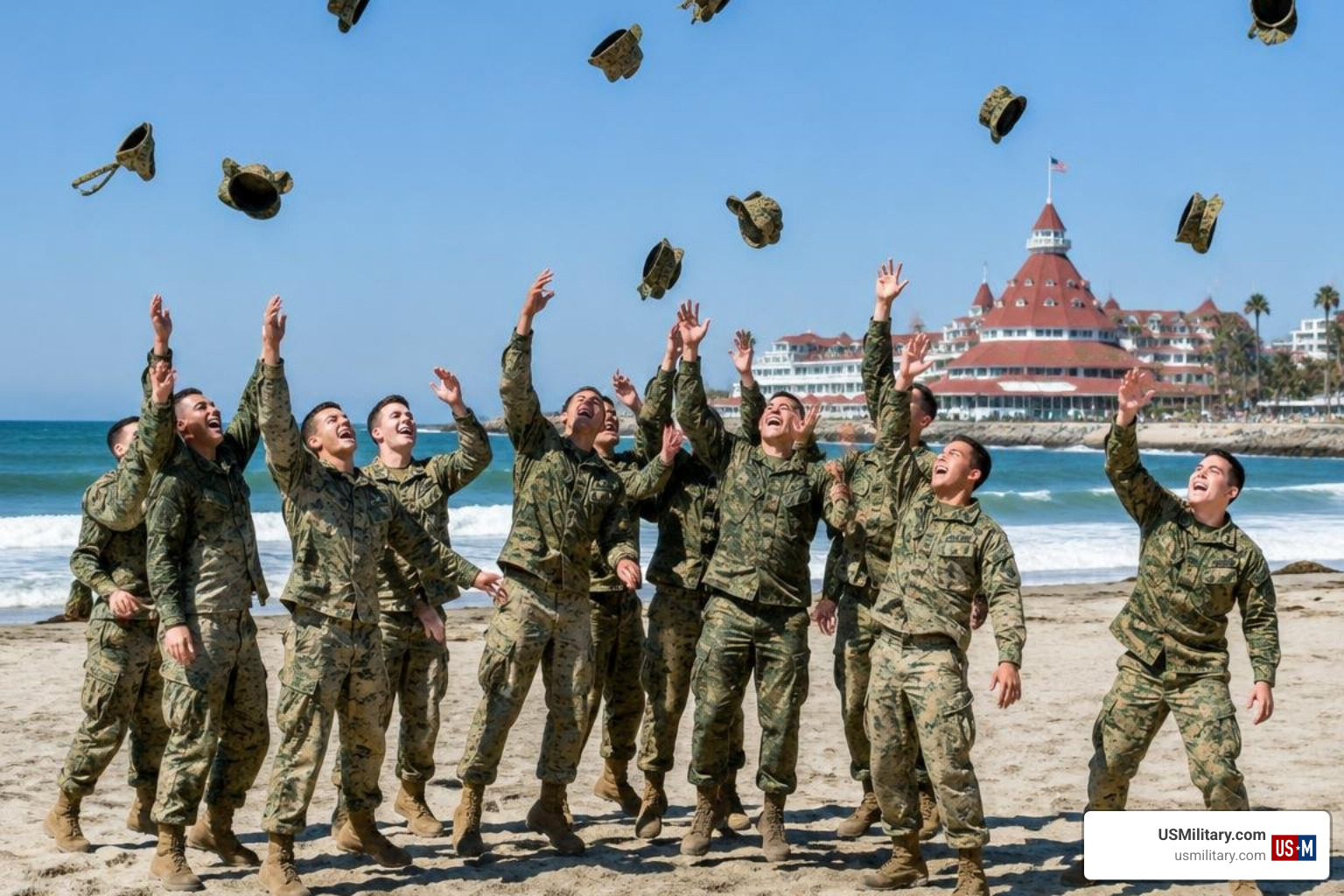
After BUD/S, graduates attend parachute training and SEAL Qualification Training (SQT). Completing SQT earns them the SEAL Trident. This guide covers 10 post-BUD/S programs: Basic Airborne School, SQT, SERE, cold-weather training in Kodiak, NSW Sniper School, the Special Operations Combat Medic Course, advanced breacher training, Joint Terminal Attack Controller training, Military Freefall School, and language courses.
These are not a ranking by attendance; public enrollment figures are not available. Some training is part of the path to qualification, while later specialty courses depend on a SEAL’s role and team needs.
I’m Larry Fowler, BUD/S Class 89 and publisher of USMilitary.com, where I’ve covered military career paths and veterans’ issues since 2007. In 10 Schools That Navy SEALs Most Attend After Graduating BUD/S, I’ll separate the essential training from the specialty options that may follow.
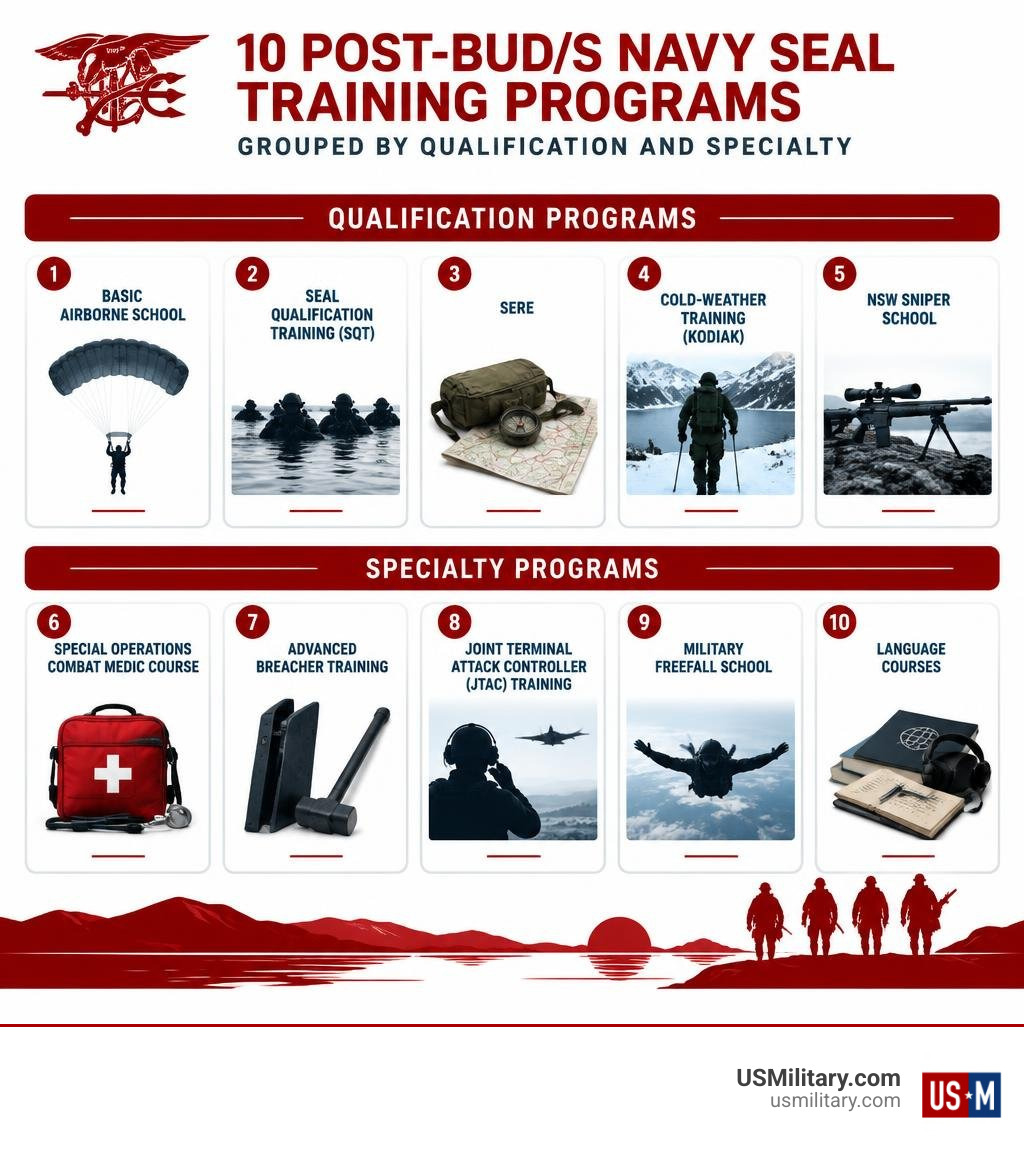
Simple 10 Schools That Navy SEALs Most Attend After Graduating BUD/S glossary:
- Navy SEALs BUD/S Training Requirements
- What is Navy SEAL Training 3 Phases And WHy is it so tough
- A Day In The Life Of A Navy SEAL Operator
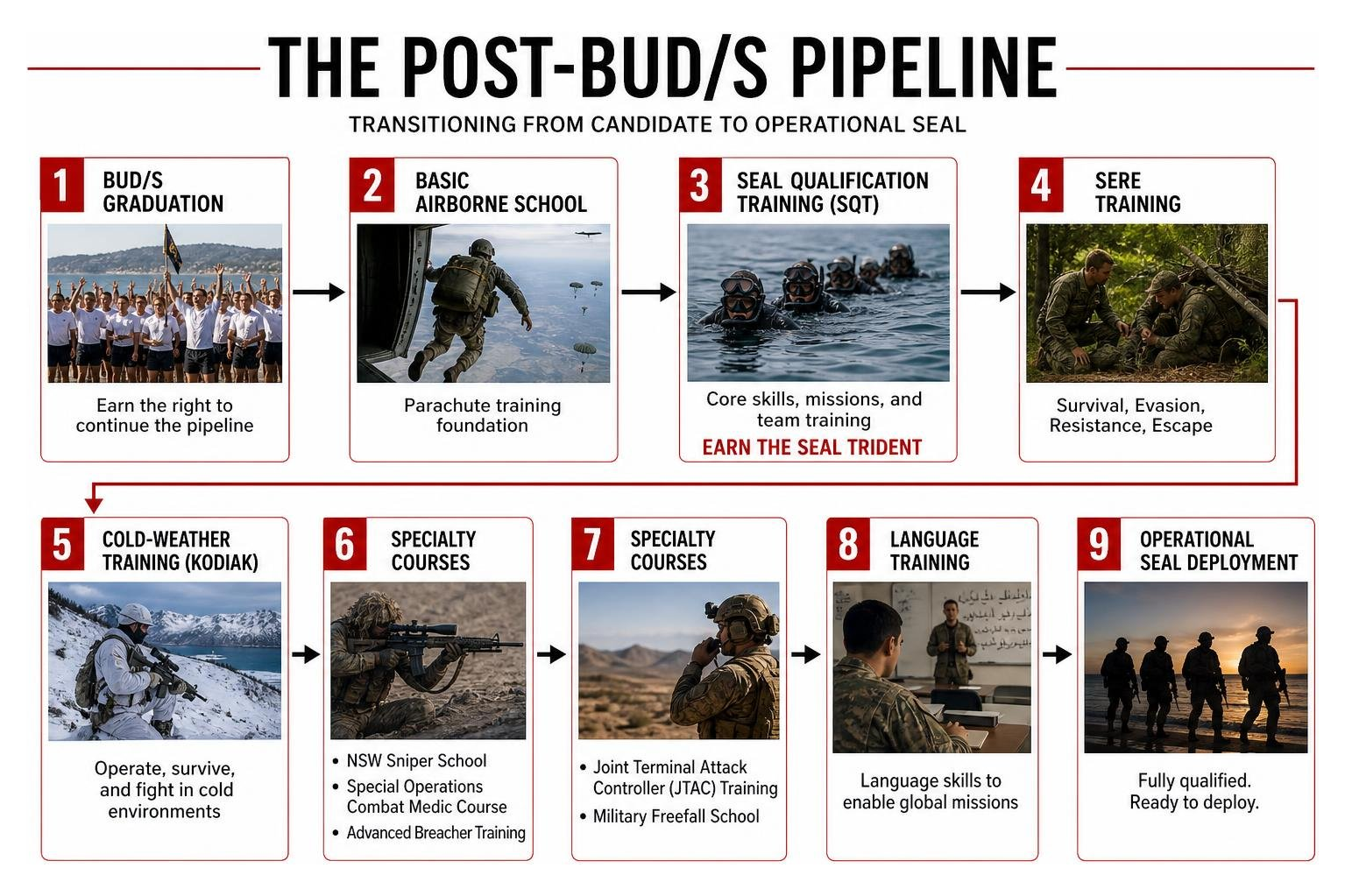
The Post-BUD/S Pipeline: Transitioning from Candidate to Operator
Surviving Basic Underwater Demolition/SEAL (BUD/S) training is one of the most celebrated achievements in the United States Armed Forces. The bone-chilling ocean swims, grueling log PT sessions, and sleep-deprived crucible of Hell Week weed out roughly 70% to 85% of hopefuls. Yet, when a class gathers on the berm at Naval Amphibious Base Coronado to celebrate finishing the 3 phases of Navy SEAL training, they haven’t earned the coveted Special Warfare insignia just yet.
Graduating BUD/S transitions a student from a basic candidate to a probationary Special Warfare Operator (SO). The entire pipeline from civilian contract signing to pinning on the Trident has an overall completion rate of approximately 9.5%. The subsequent pipeline is designed to turn disciplined, water-competent athletes into lethal, autonomous tactical operators who can operate across maritime, desert, urban, and sub-zero environments.
The traditions surrounding BUD/S completion are deeply historic. As seen during major milestones and BUD/S graduation traditions and legacy ceremonies, newly minted graduates carry forward decades of Naval Special Warfare (NSW) heritage. But right after shaking hands with the leadership, they pack their bags for the next phase of formal military schooling.
Enlisted vs. Officer Training Pathways After BUD/S
While both enlisted sailors and commissioned officers endure the exact same physical evolutions side-by-side during BUD/S, their administrative pipelines and career responsibilities diverge as they move through advanced tactical schooling.
Entry numbers illustrate how selective the officer path truly is:
- Enlisted Candidates: Roughly 700–800 enlisted sailors enter the NSW pipeline annually through direct enlistment contracts or fleet conversions.
- SEAL Officers: Only 70 to 80 officer candidates are selected each year across all commissioning sources, including the United States Naval Academy (USNA), Navy ROTC, and Officer Candidate School (OCS).
Understanding these officer tracks ties directly into the rigorous Navy SEAL requirements and selection standards enforced during SEAL Officer Assessment and Selection (SOAS). Service academy midshipmen often wait 11 to 22 months between commissioning and their BUD/S start date, while OCS graduates typically wait 8 to 12 months. Official public tallies of Naval Academy SEAL officer data remain closely guarded for operational security, but USNA remains a primary pipeline for NSW leadership.
Following BUD/S and SQT, junior officers attend the Junior Officer Training Course (JOTC) alongside advanced tactical blocks. While enlisted operators master vital technical proficiencies—such as point-man tracking, communications, or heavy weapons—officers focus on mission planning, operational risk assessment, Rules of Engagement (ROE), and leading a SEAL platoon through high-stakes combat environments.
10 Schools That Navy SEALs Most Attend After Graduating BUD/S
To give you a clear overview of where these operators go, the table below highlights the 10 most common post-BUD/S schools, their geographic locations, durations, and primary skill areas.
| School / Course Name | Primary Location | Typical Duration | Training Focus | Mandatory vs. Specialty |
|---|---|---|---|---|
| 1. Army Basic Airborne School | Fort Moore, GA | 3 Weeks | Static-Line Parachuting | Mandatory for Pipeline |
| 2. SEAL Qualification Training (SQT) | Coronado, CA / Little Creek, VA | 26 Weeks | Core Tactical Maritime Warfare | Mandatory for Trident |
| 3. SERE School (Level C) | Warner Springs, CA / Rangeley, ME | 3 Weeks | Survival, Evasion, Resistance, Escape | Mandatory for Pipeline |
| 4. Cold Weather Maritime School | Kodiak, AK | 3–4 Weeks | Arctic Tactics & Cold-Water Survival | Mandatory / Core NSW |
| 5. NSW Sniper Course | Camp Pendleton, CA / Crane, IN | 10–12 Weeks | Precision Marksmanship & Stalking | Specialty Course |
| 6. Special Operations Combat Medic (SOCM) | Fort Liberty, NC | 36 Weeks | Trauma Medicine & Prolonged Field Care | Specialty Course |
| 7. NSW Advanced Breacher Course | Coronado, CA / Regional Ranges | 4–6 Weeks | Explosive, Mechanical & Thermal Breaching | Specialty Course |
| 8. Joint Terminal Attack Controller (JTAC) | Nellis AFB, NV / Coronado, CA | 4–6 Weeks | Close Air Support & Terminal Guidance | Specialty Course |
| 9. Military Freefall (MFF) School | Yuma, AZ / Jamul, CA | 4–5 Weeks | High-Altitude Parachuting (HALO/HAHO) | Core / Team Specialty |
| 10. Defense Language Institute (DLI) | Monterey, CA / Washington, D.C. | 24–64 Weeks | Foreign Language & Cultural Immersion | Specialty Course |
Foundational Qualification: Core Schools Every Operator Attends
Before an operator can deploy to an active SEAL Team, they must complete several mandatory foundational schools that transition them from an amphibious trainee to a mission-capable commando.
1. U.S. Army Basic Airborne School (Fort Moore, GA)
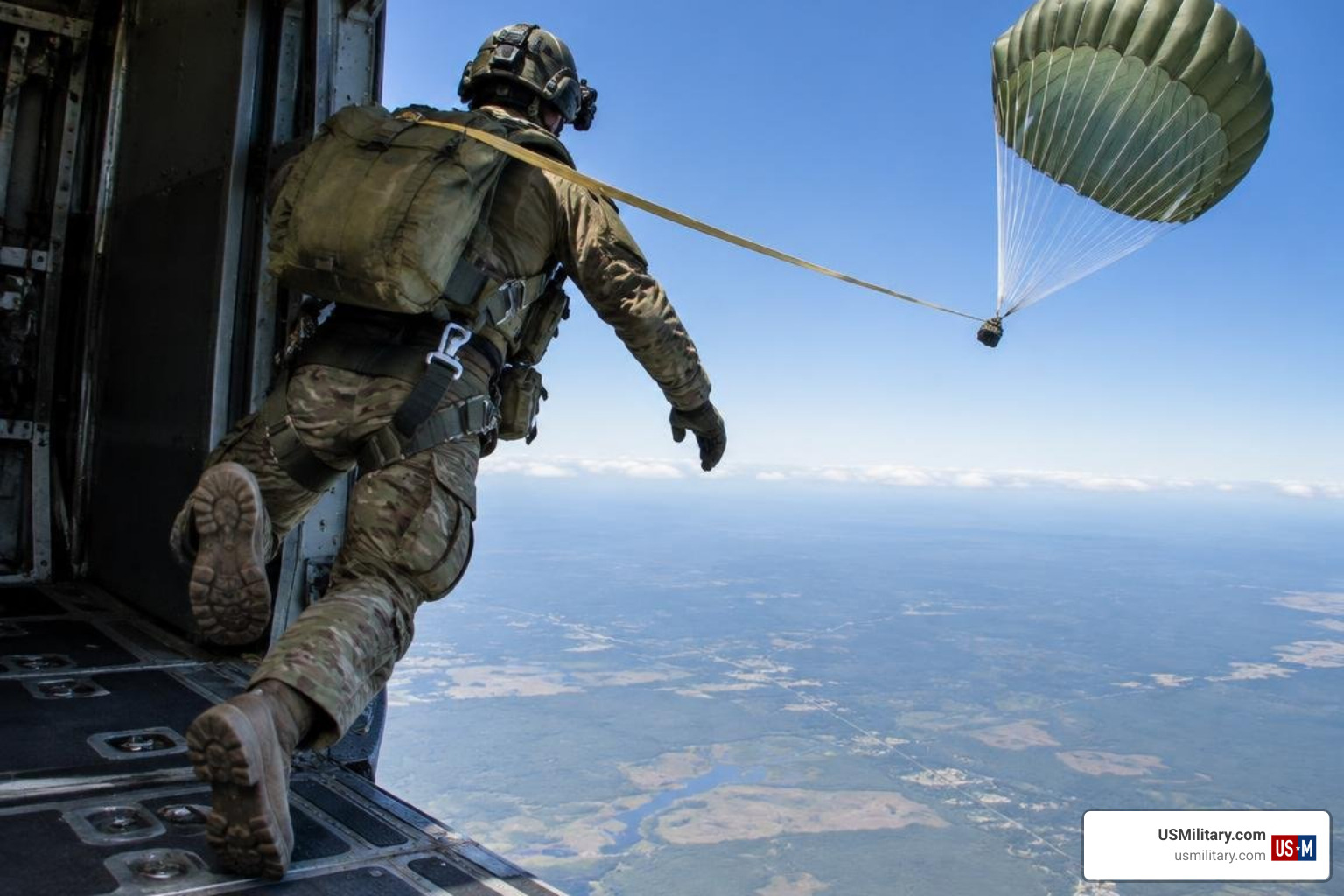
Immediately after BUD/S, operators travel to Fort Moore (formerly Fort Benning), Georgia, to complete the 3-week basic parachuting course. Here, students master static-line jump operations from aircraft like the C-130 and C-17. The course covers ground training, tower training, and five qualifying parachute jumps—including a night jump and a mass tactical jump with combat equipment.
✉ Get updates like this in your inbox
Weekly VA benefit changes, pay updates, and money tips for service members, veterans, and military families. Free, no spam.
2. SEAL Qualification Training (SQT) (Coronado, CA & Little Creek, VA)
SQT is the premier 26-week qualification course run by Naval Special Warfare Center. This comprehensive program transforms candidates into tactical warfighters through advanced weapons training, close-quarters combat (CQC), overland navigation, maritime communications, advanced combat swimming, and demolition operations. Graduating SQT is the milestone where students earn Navy Enlisted Classification (NEC) 5326 and are awarded the SEAL Trident.
3. Survival, Evasion, Resistance, and Escape (SERE Level C)
Every SEAL candidate must survive the high-stress environment of Survival, Evasion, Resistance, and Escape (SERE) training. Held at Naval Air Station North Island’s detachment in Warner Springs, California (SERE West), or Portsmouth, Maine (SERE East), this 3-week course teaches evasion techniques, wilderness survival, resistance to interrogation under the Geneva Convention, and code-of-conduct principles in prisoner-of-war scenarios.
4. NSW Cold Weather Maritime Training (Kodiak, AK)
Operating out of the Naval Special Warfare Detachment in Kodiak, Alaska, operators spend nearly a month mastering sub-zero survival and arctic tactical warfare. SEALs learn cold-weather navigation, cross-country skiing, snowshoe patrol tactics, ice-diving insertion, and survival swimming in freezing waters. This phase ensures teams can operate in polar and mountainous terrain without succumbing to hypothermia or frostbite.
Advanced Tactical Specializations: Specialty Schools Post-Trident
Once assigned to a SEAL Team, operators enter Individual Specialty Training (IST) where they earn specialized team billets.
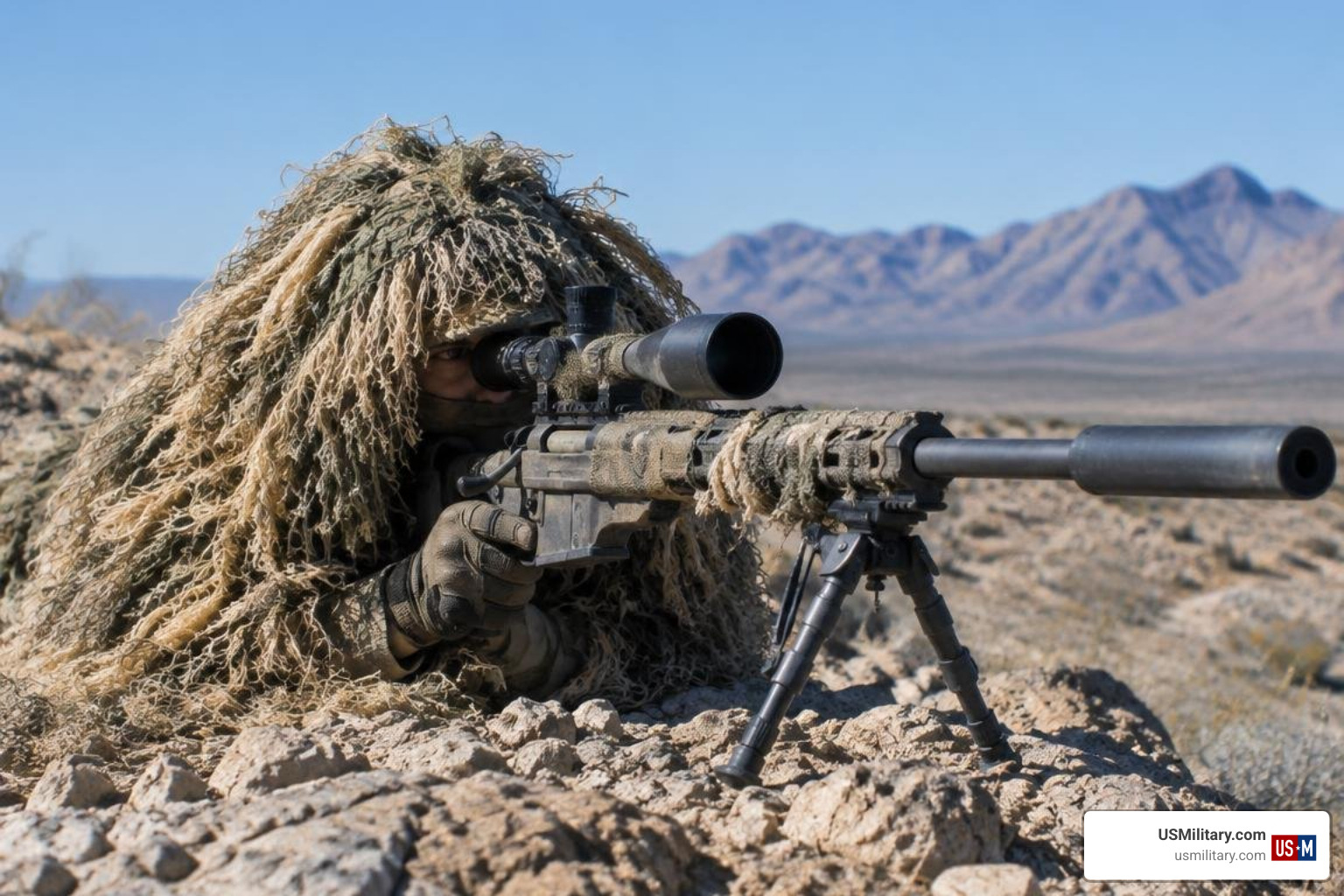
5. Naval Special Warfare Sniper School
One of the most mentally taxing schools in the military, the NSW Sniper Course spans 10 to 12 weeks. Operators learn advanced ballistics, long-range marksmanship out past 1,000 yards, hide-site construction, field craft, camouflage, and photo-reconnaissance. SEAL snipers are trained not just to take precision shots, but to serve as the clandestine eyes and ears of a strike element.
6. Special Operations Combat Medic (SOCM) Course
Conducted at the Joint Special Operations Medical Training Center (JSOMTC) at Fort Liberty, North Carolina, SOCM is a rigorous 36-week program. SEAL medics learn combat trauma management, emergency surgical airway procedures, chest tube placement, pharmacology, and prolonged field care in austere environments. Medics routinely save lives during tactical evacuations when standard medical facilities are hours away.
7. NSW Advanced Breacher Course
Breachers are the operators responsible for getting a assault element inside a barricaded compound, ship compartment, or fortress. Over 4 to 6 weeks, students learn the physics of explosive energetics, calculated blast charges, ballistic breaching, and mechanical and exothermic torch breaching to defeat hardened steel doors and structural barriers safely and swiftly.
8. Joint Terminal Attack Controller (JTAC) Course
NSW JTACs are certified forward air controllers who guide close air support (CAS) strikes. Over 4 to 6 weeks, operators learn to communicate with attack aircraft, coordinate fixed-wing and rotary-wing assets, deconflict airspace, and direct precision-guided munitions onto enemy targets in close proximity to friendly forces.
9. Military Freefall (MFF) Parachutist School
Conducted at the U.S. Army John F. Kennedy Special Warfare Center facility in Yuma, Arizona, or civilian wind-tunnel and drop-zone contractors in Southern California, this 4-to-5-week course teaches High Altitude-Low Opening (HALO) and High Altitude-High Opening (HAHO) jumps. Operators jump from altitudes up to 30,000 feet with night vision goggles, oxygen masks, and heavy combat rucksacks to infiltrate hostile territory silently.
10. Defense Language Institute (DLI) & Language Training
Depending on a SEAL Team’s geographic area of responsibility (AOR), operators attend intensive foreign language training lasting anywhere from 24 to 64 weeks. Headquartered in Monterey, California, with satellite hubs, DLI trains SEALs in critical languages such as Arabic, Russian, Tagalog, and Spanish to facilitate foreign internal defense (FID), partner-force advisory missions, and cultural intelligence gathering. These advanced qualifications also serve as building blocks for candidates seeking Tier One DEVGRU advanced requirements later in their careers.
How Specialty Schools Align with SEAL Deployment Workup Cycles
A SEAL does not simply attend schools at random. Every course aligns with the team’s pre-deployment workup cycle, known as the Fleet Readiness Training Plan (FRTP). An operational SEAL Team follows an 18-to-24-month training cycle divided into distinct blocks before departing for a 6-month deployment.
The pre-deployment cycle is structured into three main 6-month phases:
- Individual Specialty Training (IST): During this first 6-month window, the troop’s operators disperse across the country to attend the individual schools listed above (Sniper, SOCM, Breacher, JTAC, MFF, Language).
- Unit Level Training (ULT): The troop and subordinate platoons reunite for 6 months of collective training in core operational areas: small unit tactics, land warfare, close-quarters combat (CQC), visit, board, search, and seizure (VBSS), combat swimming, and over-the-beach reconnaissance.
- Task Group Level Training (TGLT): In the final 6 months before deployment, the SEAL troop integrates with supporting assets including Special Warfare Combatant-craft Crewmen (SWCC), Explosive Ordnance Disposal (EOD) techs, tactical intelligence analysts, and military working dog teams during complex certification exercises.
To see how individual operational cycles fit into a broader Naval Special Warfare career, review our guide on how to navigate the Navy SEAL career path.
Frequently Asked Questions About Post-BUD/S SEAL Training
Does graduating from BUD/S officially make you a Navy SEAL?
No. Graduating BUD/S is a massive milestone, but candidates are designated as student operators. A sailor officially becomes a Navy SEAL and receives the Special Warfare Operator (SO) rating only after completing Basic Airborne School, SERE School, and the entire 26-week SEAL Qualification Training (SQT) curriculum, culminating in the formal pinning of the Trident insignia.
Which post-BUD/S school is considered the most difficult?
In terms of academic intensity, length, and cognitive load, the Special Operations Combat Medic (SOCM) Course is widely regarded as the most demanding post-BUD/S program. Medics must master trauma pharmacology, minor field surgery, and emergency diagnostics under strict time limits. For pure tactical precision and high attrition, NSW Sniper School is considered equally unforgiving.
How are SEALs selected for advanced specialty courses like Sniper or Medic?
Course allocations are based on platoon leadership recommendations, team billet requirements, and an operator’s demonstrated aptitude. Medical and technical communication billets heavily evaluate strict Navy SEAL entrance and testing requirements including General Technical (GT) and line scores from the Armed Services Vocational Aptitude Battery (ASVAB).
Conclusion
The road to becoming an elite special operator doesn’t end when you leave the beaches of Coronado—it begins there. The foundational and advanced tactical schools that follow BUD/S ensure that every SEAL possesses the specialized medical, airborne, marksmanship, and breaching skills necessary to succeed in any clime and place. Continuous tactical education is what keeps Naval Special Warfare at the leading edge of American national defense.
For prospective recruits, active-duty service members, and veterans exploring military career options, benefits, and VA resources, USMilitary.com is your central hub for reliable information. Explore our comprehensive Navy SEALs career guide to learn more about the training, standards, and life inside Naval Special Warfare.
Free for Service Members & Veterans
Get the military benefits intel no one tells you about.
Weekly updates on VA benefits, pay changes, and money tips — free for service members and veterans.
No spam. Unsubscribe anytime. Your info is never shared.


