The Complete Guide to Military Bases in the United States

The military bases in the United States form the backbone of American national defense — a vast network of installations spanning every state, U.S. territory, and dozens of countries worldwide.
Here’s a quick snapshot of what you need to know:
| Category | Key Facts |
|---|---|
| Total domestic installations | Hundreds across all 50 states and territories |
| Overseas bases | At least 128 as of July 2024 |
| Branches operating bases | Army, Navy, Marine Corps, Air Force, Space Force, Coast Guard |
| Largest overseas base | Camp Humphreys, South Korea |
| Notable domestic bases | Fort Cavazos TX, Naval Station Norfolk VA, Camp Lejeune NC, Camp Pendleton CA |
| Joint bases | 14+ shared multi-service installations |
Whether you’re considering enlisting, preparing for a PCS move, or simply trying to understand where U.S. forces are stationed — knowing the layout of America’s military installations matters.
These bases do far more than house troops. They drive local economies, support families, enable global deployments, and project American power across the globe. Some installations, like Marine Corps Base Camp Lejeune in North Carolina, generate nearly $3 billion in annual commerce alone.
I’m Larry Fowler, publisher of USMilitary.com — and since 2007, I’ve helped hundreds of thousands of service members and veterans navigate military bases in the United States and the benefits tied to them. In the sections below, I’ll walk you through everything you need to know, from the largest Army installations to overseas deployments and community resources.
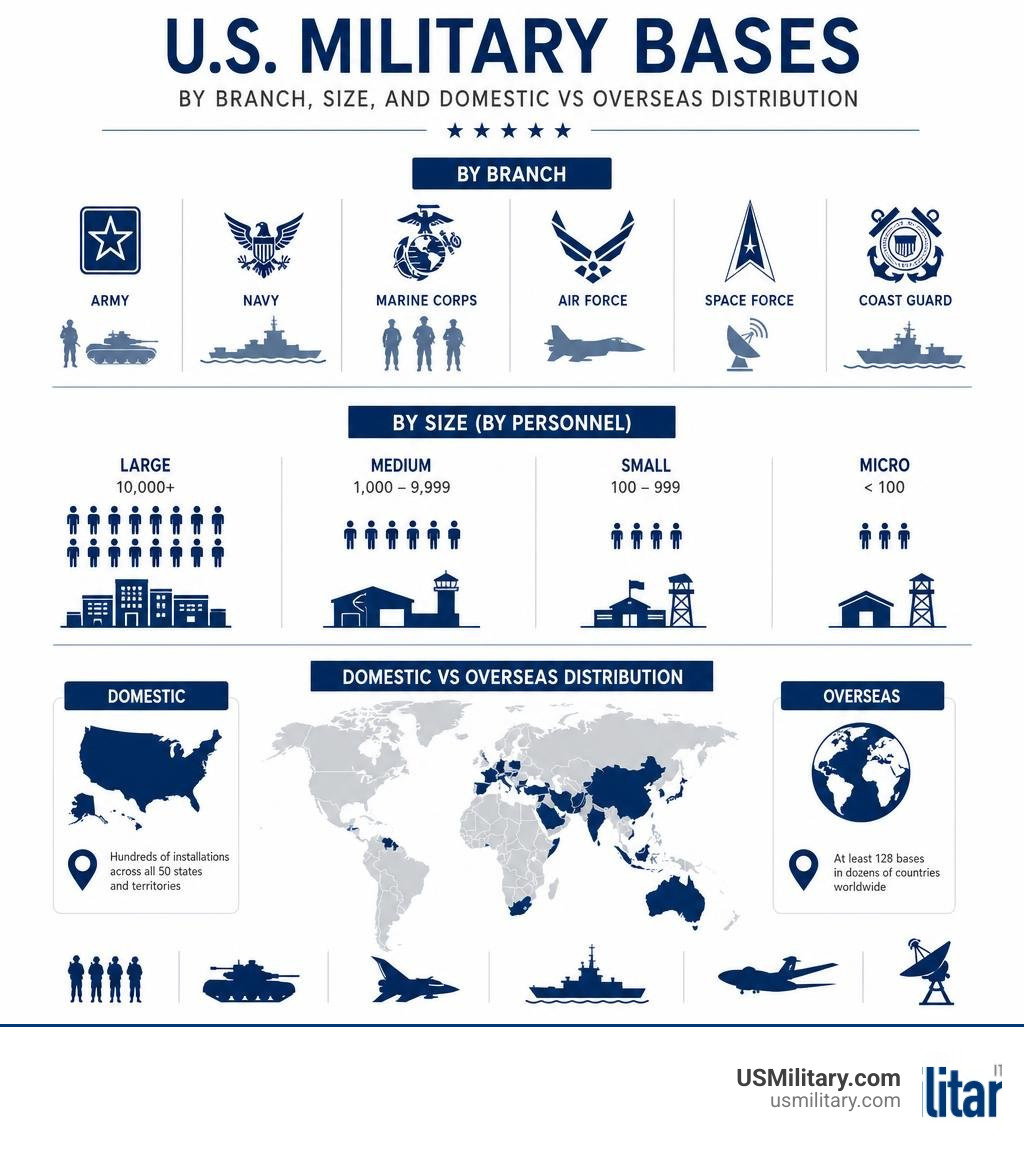
Understanding Military Bases in United States
To truly understand military bases in the United States, we must first look at how they are legally defined and managed. Under U.S. statutory law, a military installation is defined as any base, camp, post, station, yard, center, or other activity under the jurisdiction or operational control of the Secretary of a military department or the Secretary of Defense (DoD).
These installations are divided into two primary geographic categories:
- CONUS (Continental United States): Bases located within the 48 contiguous states and Washington, D.C.
- OCONUS (Outside Continental United States): Bases located in Alaska, Hawaii, U.S. territories (like Guam and Puerto Rico), and foreign host nations.
Over the decades, the landscape of these bases has shifted dramatically through the Base Realignment and Closure (BRAC) process. BRAC is a federally mandated system designed to increase operational efficiency by closing outdated or redundant bases and realigning resources to meet modern threats. While BRAC rounds can cause temporary economic anxiety in local communities, they ensure our military footprint remains agile, cost-effective, and strategically aligned.
If you are a service member planning your next move, or a family member trying to locate a base near your hometown, you can use our comprehensive tool to Find Military Bases Near Me to locate nearby installations and access local resources.
Categorizing Military Bases in United States
Not all military installations serve the same purpose. To keep our forces organized and ready, the Department of Defense categorizes domestic US Military Bases into three primary functional types:
- Service-Specific Bases: These are traditional installations operated entirely by a single branch of service to support its unique mission. For example, an Army post like Fort Campbell focuses heavily on ground and air assault maneuvers, while a Navy station focuses on fleet maintenance and maritime operations.
- Joint Bases: Created during BRAC rounds to streamline operations and cut costs, joint bases merge the management of adjacent installations from different branches. A single “lead” service handles the civil engineering, security, and administrative tasks for the entire combined facility. Examples include Joint Base Lewis-McChord and Joint Base McGuire-Dix-Lakehurst.
- Training and Specialized Facilities: These installations focus strictly on preparing personnel for the rigors of service. This category includes boot camps, specialized technical schools, and massive live-fire training ranges.
Domestic vs. Overseas (OCONUS) Installations
While domestic bases serve as the primary hubs for training, equipment maintenance, and family support, overseas (OCONUS) bases are all about rapid global response and deterrence.
As of July 2024, the United States maintained at least 128 military bases outside its national territory. Many of these are located in NATO allied nations, Japan, and South Korea. These foreign installations allow the U.S. to project power, protect international trade routes, and honor mutual defense treaties with global partners.
The differences between domestic and foreign bases are stark:
- Camp Humphreys (South Korea): This massive installation is the largest overseas U.S. military base by area. It operates like a self-contained American city in the heart of South Korea, hosting tens of thousands of active-duty troops, civilian contractors, and military families.
- Domestic Powerhouses: In contrast, domestic installations like those highlighted in our guide to Army Bases in Alaska focus heavily on cold-weather training, strategic missile defense, and maintaining domestic readiness.
Major Army and Joint Bases Across the Nation
The U.S. Army operates some of the largest and most populated military installations in the world. These massive posts are designed to train, equip, and deploy entire divisions of combat-ready soldiers at a moment’s notice.

Two of the most historically significant Army posts are Fort Campbell and Fort Cavazos (formerly known as Fort Hood).
- Fort Cavazos (Texas): Spanning over 335 square miles across Bell and Coryell counties, this base is a legendary armored training ground. It is the Largest Military Base in the US by population, supporting a massive community of active-duty soldiers, family members, and civilian personnel. To explore more about the military footprint in the Lone Star State, check out our resource on Army Bases in Texas.
- Fort Campbell (Kentucky/Tennessee): Spanning the border of Kentucky and Tennessee, Fort Campbell is a highly strategic hub. It is home to the legendary 101st Airborne Division (Air Assault), the world’s only air assault division.
Key Army Training and Deployment Hubs
Ground combat readiness requires massive amounts of space. The Army relies on its largest domestic bases to conduct realistic, large-scale combat exercises. Below are five of the largest Army and multi-service installations by acreage and population in the country:
- Fort Cavazos (Texas): Spanning over 214,000 acres, it supports heavy armored division training.
- Fort Liberty (formerly Fort Bragg, North Carolina): The historic home of the Airborne and Special Operations forces.
- Joint Base Lewis-McChord (Washington): A premier West Coast joint training and mobilization hub.
- Fort Bliss (Texas/New Mexico): Boasts the largest contiguous tract of open airspace and training land in the continental U.S.
- Fort Sill (Oklahoma): The historic home of the U.S. Army Field Artillery School. You can read more about this historic installation in our guide to Military Bases in Oklahoma.
These training hubs are designed to replicate modern battlefield environments, ensuring that when our soldiers deploy, they do so with a distinct tactical advantage.
Joint Bases and Multi-Service Operations
Joint bases represent the modern, collaborative face of the U.S. military. By combining resources, different branches can train together, mirroring how they actually fight on the modern battlefield.
✉ Get updates like this in your inbox
Weekly VA benefit changes, pay updates, and money tips for service members, veterans, and military families. Free, no spam.
- Joint Base McGuire-Dix-Lakehurst (New Jersey): This is the DoD’s only tri-service joint base, combining Navy, Army, and Air Force installations. It is a critical East Coast mobilization hub. For a closer look at this and other facilities in the state, see our breakdown of Military Bases in New Jersey.
- Joint Base Pearl Harbor-Hickam (Hawaii): Combining a historic naval station and an air force base, this joint installation is the nerve center for maritime and aerial operations across the vast Pacific theater.
Prominent Air Force and Space Force Installations
The U.S. Air Force and U.S. Space Force operate highly specialized installations designed to maintain air superiority, global mobility, strategic nuclear deterrence, and orbital security. Many of these bases are located in the American West, where vast open skies and remote terrain allow for safe flight testing and satellite operations. If you want to explore these high-tech centers, we have put together a comprehensive look at Military Bases in Colorado.
Two of the most prominent Air Force installations in the southern United States include:
- Davis-Monthan Air Force Base: Located in Tucson, Arizona, this base is famous for hosting the 355th Wing and the massive aircraft “Boneyard,” where thousands of retired military aircraft are stored, preserved, or salvaged for parts.
- Eglin Air Force Base: Located in the Florida panhandle, Eglin is the crown jewel of Air Force Materiel Command, serving as a massive research, development, and testing ground for cutting-edge air-delivered weapons.
Air Force Military Bases in United States and Their Missions
Air Force bases generally focus on three primary mission sets: flight testing, global air mobility, and strategic combat operations.
- Edwards Air Force Base: Located in the California desert, Edwards is the historic home of flight testing. It is where the sound barrier was first broken and where the space shuttle frequently landed. Because of its national security testing operations, the airspace around Edwards is strictly controlled, and unauthorized drone flights are strictly prohibited.
- Travis Air Force Base: Known as the “Gateway to the Pacific,” Travis AFB handles more cargo and passenger traffic than any other military air terminal in the United States, making it the undisputed heart of global military logistics.
- Strategic Deterrence Hubs: Bases located in the northern tier of the country, such as those listed in our directory of Military Bases in Montana, are responsible for maintaining and safeguarding the nation’s land-based Intercontinental Ballistic Missile (ICBM) silos.
Space Force and High-Tech Defense Centers
Established to protect U.S. interests in orbit, the U.S. Space Force operates a growing network of specialized bases. These installations focus on satellite communications, missile warning systems, and space surveillance.
- Buckley Space Force Base (Colorado): Located in Aurora, Colorado, Buckley is responsible for operating global infrared surveillance satellites that detect missile launches worldwide in real-time.
- High-Tech Radar Stations: The Space Force also relies on remote radar tracking stations, including those located in the northern plains. You can learn more about these critical radar operations in our guide to Military Bases in North Dakota.
Key Navy and Marine Corps Bases
The U.S. Navy and Marine Corps operate hand-in-hand to project amphibious power, secure global sea lanes, and maintain maritime readiness. Their installations are strategically situated along America’s coastlines to facilitate rapid deployment to any corner of the globe. If you are interested in coastal installations, you can explore our resources on the Military Base in Florida.
Two of the Marine Corps’ most critical training installations are:
- Camp Lejeune: Located in Jacksonville, North Carolina, Camp Lejeune is the “Home of Expeditionary Forces in Readiness.” It spans 156,000 acres, features 11 miles of beach for amphibious operations, and hosts 80 live-fire ranges.
- Camp Pendleton: Situated in Southern California, Camp Pendleton is the Corps’ premier West Coast training facility, offering vast terrain and coastline for sea-to-shore maneuvers.
Naval Station Norfolk and East Coast Fleet Support
Located in Hampton Roads, Virginia, Naval Station Norfolk is the largest naval station in the world. It serves as the primary homeport for the U.S. Navy’s Atlantic Fleet, supporting dozens of guided-missile destroyers, submarines, and massive nuclear-powered aircraft carriers.
Naval Station Norfolk acts as a massive logistics and operational engine, ensuring that carrier strike groups are fully manned, provisioned, and repaired before deploying across the Atlantic and Mediterranean. Its proximity to other strategic installations, such as those highlighted in Military Bases in Maryland, creates a highly concentrated shield of maritime security along the Eastern Seaboard.
Marine Corps Base Camp Pendleton and West Coast Readiness
On the West Coast, Marine Corps Base Camp Pendleton serves as the primary training and mobilization ground for the I Marine Expeditionary Force (I MEF).
- Vast Training Terrain: Camp Pendleton encompasses more than 125,000 acres of Southern California terrain, including 17 miles of undeveloped coastline. This unique geography allows Marines to conduct realistic amphibious landing exercises directly from naval vessels.
- An Economic Powerhouse: Beyond its tactical importance, Camp Pendleton has been the largest employer in North San Diego County for over 60 years, hosting a daytime population of approximately 70,000 military and civilian personnel. To see where Pendleton ranks among other massive installations, check out our list of the Top 10 Military Bases in the United States.
Economic and Community Impact of Military Installations
U.S. military bases are not isolated fortresses; they are massive economic engines that breathe life into their surrounding civilian communities. The financial footprint of a major base is felt through direct military payrolls, defense contracts awarded to local businesses, and the construction of off-base housing, retail centers, and schools.
For instance, installations like those found in our guide to Military Bases in Alabama bring billions of dollars in federal funding to the state, supporting thousands of civilian defense jobs in engineering, aerospace, and logistics.
To put this economic power into perspective, let’s compare the financial impacts of three major domestic bases:
| Military Installation | Branch | Estimated Annual Economic Impact | Key Economic Drivers |
|---|---|---|---|
| Camp Lejeune (NC) | Marine Corps | ~$3 Billion | Local payrolls, construction, defense contracts |
| Camp Pendleton (CA) | Marine Corps | ~$4.2 Billion | Tourism, local retail, defense manufacturing, housing |
| Fort Cavazos (TX) | Army | ~$5+ Billion | Armored vehicle maintenance, local commerce, military retail |
PCS Move
PCSing? You May Be Able to Buy Instead of Rent
Eligible service members can use a VA loan to buy near their next duty station with no down payment. See if you qualify.
USMilitary.com may be compensated when you request quotes from lenders through this link.
Frequently Asked Questions about U.S. Military Bases
What is the largest military base in the United States?
The title of “largest military base” depends on whether you measure by population or physical acreage.
- By Population: Fort Cavazos (formerly Fort Hood) in Texas and Fort Liberty (formerly Fort Bragg) in North Carolina are the most populated bases, each supporting communities of well over 100,000 active-duty personnel, family members, and civilian employees. You can explore these massive Texas hubs in our guide to Find Texas Military Bases.
- By Acreage: White Sands Missile Range in New Mexico is the largest military installation by land area, encompassing over 2.2 million acres of highly restricted testing ground.
How many U.S. military bases are located overseas?
The United States maintains at least 128 military bases in foreign countries. The highest concentrations of these bases are located in Germany, Japan, and South Korea (home to Camp Humphreys, the largest overseas base by area). These installations are critical for rapid global deployment and maintaining strong alliances with international partners. For service members looking at unique domestic basing options outside the continental U.S., check out our guide to Military Bases in Alaska.
What security and support services are available on these bases?
U.S. military bases are designed to be self-sustaining communities. Most major installations feature:
- Base Security: Strictly controlled access gates, military police patrols, and secure perimeter fencing.
- Support Services: Commissaries (tax-free grocery stores), Navy/Air Force Exchanges (department stores), medical clinics, and Morale, Welfare, and Recreation (MWR) programs.
- Family Resources: On-base housing, DOD-run schools, child care centers, and youth sports programs.
To see how these services are managed in the Midwest, explore our overview of Military Bases in Illinois.
Conclusion
The military bases in the United States represent a monumental investment in our nation’s security, our service members, and our local communities. From the armored training fields of Texas to the high-tech satellite tracking stations of Colorado, these installations keep our nation safe and our forces ready.
At USMilitary.com, we are proud to serve as your ultimate resource for military information. Whether you are looking to explore military career paths, understand your military retirement benefits, or navigate the VA loan process for your next PCS move, we are here to help. We encourage you to explore our extensive guides, keep up with the latest military news, and take full advantage of the resources available to you and your family.
Free for Service Members & Veterans
Get the military benefits intel no one tells you about.
Weekly updates on VA benefits, pay changes, and money tips — free for service members and veterans.
No spam. Unsubscribe anytime. Your info is never shared.


