Why Air Force Enlistment Bonuses Are Reaching Record Highs
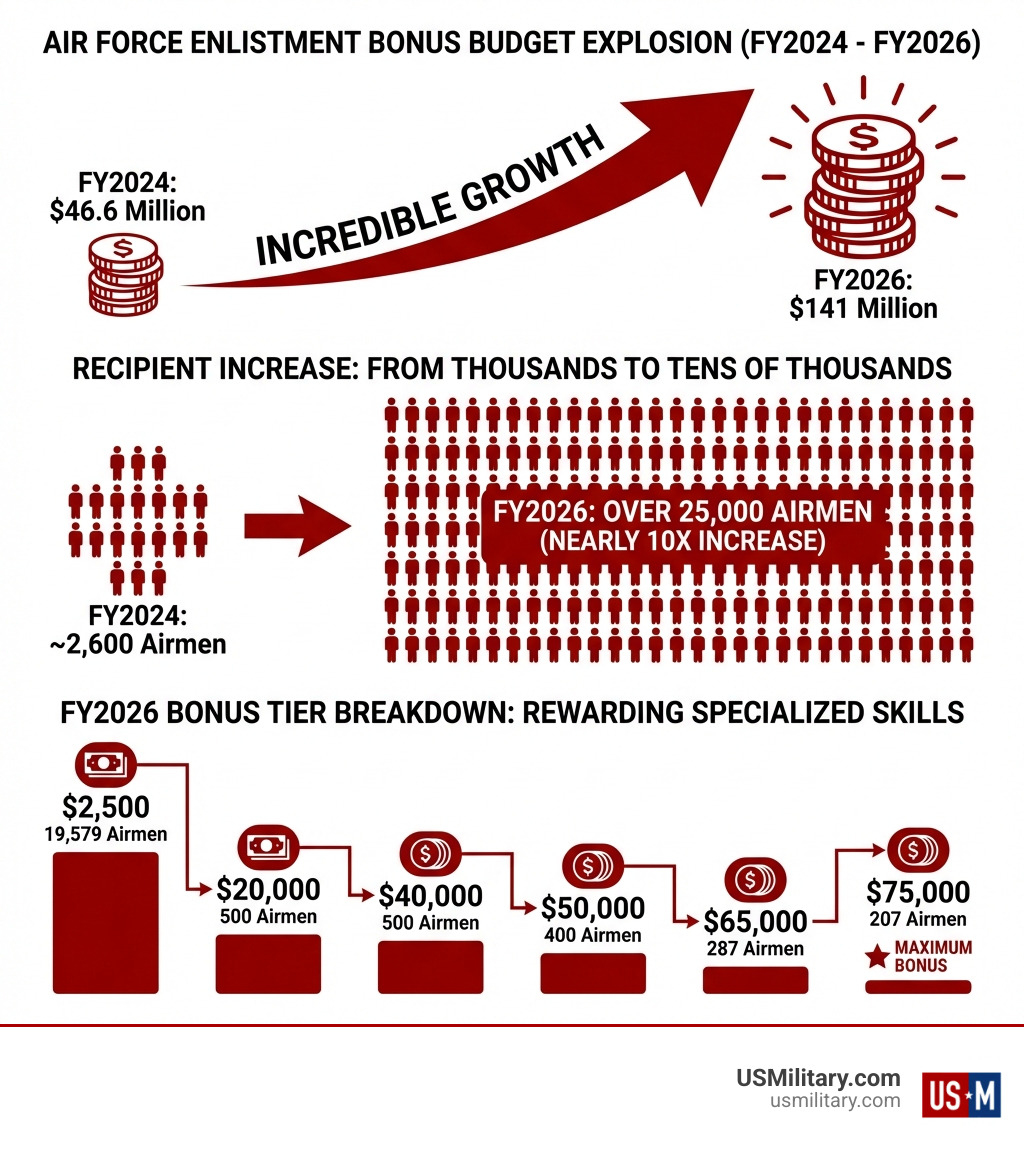
Air Force enlistment bonus amounts have skyrocketed, with the service planning to award bonuses to over 25,000 airmen in fiscal 2026—nearly 10 times the number from the previous year. The Air Force is requesting nearly $141 million for these bonuses, a massive increase from $46.6 million in fiscal 2025, reflecting an urgent need to fill specialized roles. If you’re considering joining, here’s what you need to know:
Quick Answer: Air Force Enlistment Bonus Eligibility
- Maximum bonus: Up to $75,000 for hardest-to-fill skills
- Basic requirements: High school diploma/GED, no prior service, U.S. citizenship
- Minimum commitment: 2 years (higher bonuses require 4-6 year contracts)
- Top bonus fields: Special Warfare, Cyber Security, Cryptologic Language Analysis, EOD
- When you get paid: After completing BMT, Technical School, and 30 days at first duty station
- Tax status: Yes, bonuses are taxable income
The bonus structure is tiered. While 207 individuals will get the maximum $75,000 bonus, approximately 19,579 airmen will receive $2,500. Other tiers include $65,000 (287 airmen) and $50,000 (400 airmen). Your bonus depends on your chosen career, contract length, and the Air Force’s needs.
I’m Larry Fowler, publisher of the USMilitary.com Network. Since 2007, I’ve helped potential recruits steer Air Force enlistment bonus programs. This guide breaks down how to qualify for and receive these record-breaking incentives.
The Air Force’s New Wave of Enlistment Incentives
The Air Force is making significant moves to attract top talent for highly specialized fields by tripling its spending on incentives. The goal is to strategically fill roles in critical areas like cyber, space, and special warfare. This investment is detailed in the service’s budget request, which you can review here: The service is requesting nearly $141 million for FY26.
The primary vehicle for these incentives is the Initial Enlistment Bonus (IEB) program, designed to encourage enlistment for four or six years in specific military specialties. This helps the Air Force get a better return on its extensive training investment by securing longer commitments from recruits with technical abilities.
The Space Force is also following suit, seeking to more than triple its enlistment bonus budget to $13 million in fiscal 2026. It plans to award bonuses to 550 Guardians, up from 100 in fiscal 2025, highlighting a shared need for skilled personnel. This shift in strategy across services reflects the challenges of recruiting in a competitive job market. To learn more about how the Air Force operates today, check out Air Force Service in the Modern World.
Top-Tier Bonus Career Fields
Higher Air Force enlistment bonuses are reserved for roles that are difficult to fill, require extensive training, or involve a high degree of risk. These are the positions where the Air Force needs to incentivize recruits to maintain its operational edge.

The highest bonuses, up to $75,000, target “hardest-to-fill skills.” These include:
- Special Warfare: Elite operators like Pararescue, Combat Control, and TACP who perform dangerous missions. Learn more about The Toughest Warriors: What Are Air Force Special Forces?.
- Cyber Systems Security: Airmen who protect critical networks and systems from digital threats.
- Cryptologic Language Analysis: Specialists who interpret foreign communications for intelligence gathering. Explore related careers like the Electronic Intelligence Exploitation Apprentice Job in the USAF.
- Explosive Ordnance Disposal (EOD): Bomb technicians who detect, disarm, and dispose of explosive threats.
- Survival, Evasion, Resistance, and Escape (SERE) Specialists: Experts who train personnel to survive in hostile environments.
- Missile and Space Systems: Roles involving the operation and maintenance of increasingly critical missile and space systems.
These vital career fields require a unique blend of intelligence and specialized training, and the bonuses serve as a powerful incentive for these challenging paths.
Understanding the Bonus Tiers
The enlistment bonus structure is tiered to address specific recruitment needs. While the maximum is an impressive $75,000 for “hardest-to-fill skills,” many other bonuses are available.
The specific amount you qualify for depends on your chosen career, contract length, and current Air Force manning needs. Longer commitments, such as six-year contracts, typically open up higher bonus potential, as this maximizes the Air Force’s return on its training investment. Beyond bonuses, there are many other 4 Great Reasons to Join the US Air Force.
Are You Eligible for an Air Force Enlistment Bonus?
Navigating the eligibility requirements for an Air Force enlistment bonus can feel complex, but certain foundational criteria are consistent. Think of these as the basic checkboxes you need to tick before considering the bonus tiers.
Here are the general requirements for receiving an Air Force enlistment bonus:
- No Prior Military Service: These bonuses are generally for new recruits. If you have prior service, different bonus programs may apply.
- High School Diploma or Equivalent: You must possess a high school diploma, completion certificate, or a GED.
- ASVAB Scores: You’ll need qualifying scores on the Armed Services Vocational Aptitude Battery (ASVAB) for both enlistment and specific career fields.
- U.S. Citizenship: Enlistment in the U.S. Air Force typically requires U.S. citizenship.
- Service Commitment: You must agree to serve for a specified period. Higher bonuses almost always require longer contracts (four or six years).
- Initial Enlistee Status: You cannot have previously received an enlistment bonus.
- Job-Specific Qualifications: Each career field has its own requirements, such as physical standards, security clearance eligibility, or specific aptitudes.
The Air Force enlistment bonus is a monetary incentive authorized by law to encourage enlistment. You can explore the detailed regulations in the Official DoD bonus authorization. Always consult with an Air Force recruiter for the most current and personalized information, as bonus programs can change.
The Commitment: How Contract Length Affects Your Bonus
The length of your service commitment is often directly proportional to the size of your Air Force enlistment bonus. This is a strategic decision by the Air Force to get the best return on its significant investment in training.
While a bonus is possible with a two-year obligation, the real incentives kick in with four or six-year contracts, which are typically required for the highest bonus tiers (up to $75,000). Longer contracts are preferred because they help offset extensive training costs, sustain a force of skilled personnel, and allow Airmen to gain valuable experience. A longer commitment ensures the Air Force benefits from your developed expertise in roles like a US Air Force Pavement and Construction Apprentice. A willingness to commit to a longer service period, especially in a high-demand field, can significantly increase your bonus potential.
What to Know About the Air Force Enlistment Bonus Payout
So, you’ve signed on the dotted line for a fantastic Air Force enlistment bonus. Now the big question: when do you actually get the money? The disbursement of your bonus isn’t usually a single, immediate lump sum, though that can happen. It often involves a structured payout plan tied to completing your initial training.
Here’s a breakdown of how Air Force enlistment bonuses are typically disbursed:
- Initial Payment After Technical Training: For the regular Air Force, bonuses are often awarded in halves. The first increment is generally paid after you successfully complete your technical training (both BMT and your specific technical school).
- Subsequent Payments: The remaining portion of your bonus is then typically paid out over the remainder of your enlistment contract, often in annual installments.
- Lump Sum Possibility: Some bonuses may be paid in one lump sum after you complete training and have been at your first duty station for 30 days. This varies by career and the terms of your bonus agreement, so always clarify with your recruiter.
- Timeline: Generally, you can expect payment after completing all training and arriving at your first duty station. This ensures you’ve met the initial commitments for which the bonus was offered.
It’s important to keep in mind that these bonuses are tied to your service. If you don’t complete the enlistment contract for which a bonus was paid, or if you lose a required clearance or qualification, you may have to pay back a prorated portion of the bonus.
Beyond the bonus itself, the Air Force offers numerous other financial and educational benefits. For instance, the education tuition assistance program can help you pursue higher education while serving. Find more about this valuable benefit at Air Force Education Tuition Assistance.
Beyond Active Duty: Guard and Reserve Bonuses
While much of the excitement around Air Force enlistment bonuses often centers on active duty, it’s essential not to overlook the significant incentives offered by the Air National Guard (ANG) and the Air Force Reserve. These components provide flexible service options while still offering competitive bonuses to attract and retain skilled personnel. The bonus structures and payout methods can differ, so let’s break them down.
Here’s a general comparison of how bonuses stack up across the Active Duty Air Force, Air National Guard, and Air Force Reserve:
| Component | Max Enlistment/Accession Bonus | Payout Method | Typical Commitment |
|---|---|---|---|
| Active Duty Air Force | Up to $75,000 | Half after tech training, rest over contract (or lump sum depending on career) | 4-6 years |
| Air National Guard | Up to $50,000 (sign-on), Up to $60,000 (re-enlistment/prior service) | Equal annual payments over 5 years after tech training | 6 years |
| Air Force Reserve | Up to $20,000 (accession/affiliation) | Lump sum (for retention/affiliation) | 3-4 years |
Air National Guard (ANG) Bonuses:
The ANG offers compelling incentives for both new recruits and those with prior service. Future Airmen can receive sign-on bonuses up to $50,000 upon entering the Air National Guard. For current ANG members, reenlistment bonuses can go up to $60,000. Even individuals who have previously served in the armed forces or are joining from active duty Air Force can be eligible for bonuses up to $60,000 when they affiliate with the ANG.
A key difference lies in the payout method. The Air National Guard typically pays bonuses out in equal payments in a year-over-year cycle for 5 years. This process starts when the member completes technical training. For example, if you’re awarded a $50,000 bonus upon entering the ANG, you’ll receive the first increment of $10,000 approximately two months after completing technical training, and then $10,000 annually thereafter until the bonus is fully paid.
Air Force Reserve Bonuses:
The Air Force Reserve has also significantly boosted its incentive programs to attract both officers and enlisted personnel. For fiscal year 2025, they’ve increased their Officer and Enlisted Incentive Bonus Program, targeting critical skills and offering variable contract year options.
- Officer Accession Bonus: The Reserve offers an officer accession bonus of up to $20,000 for both non-prior service and prior service members. This is for individuals accepting a commission or appointment as an officer.
- Officer Affiliation Bonus: Officers making the move from the regular Air Force or the Inactive Ready Reserve (IRR) to the Air Force Reserve can receive an affiliation bonus of up to $20,000.
- Enlisted Accession Bonus: Similar to officers, the Reserve offers an enlisted accession bonus of up to $20,000 for both non-prior service and prior service members.
- Enlisted Affiliation Bonus: Airmen transferring from the regular Air Force or the IRR to the Air Force Reserve may be eligible for an affiliation bonus of up to $20,000, often paid as a lump sum upfront for a four-year contract, especially in critical skills.
- Retention Bonuses: The Reserve also offers retention bonuses. Eligible Airmen (E5 through E7, with 5-11 years of service) in one of the 52 enlisted critical skills can receive a lump-sum, paid-up-front bonus of $15,000 for a three-year contract. Those in non-critical skills may be eligible for $10,000 for a three-year contract.
These bonuses are designed to meet the unique manning needs of the Guard and Reserve, ensuring these vital components maintain their strength and specialized capabilities. For more detailed and up-to-date information on Air Force Reserve bonuses, we recommend checking out More on Air Force Reserve bonuses.
Frequently Asked Questions about Air Force Bonuses
We know that understanding Air Force enlistment bonuses can bring up a lot of questions. We’ve gathered some of the most common inquiries to provide clear, concise answers based on the latest information.
How are Air Force enlistment bonuses paid out?
The payment structure for an Air Force enlistment bonus depends on whether you’re joining Active Duty or the Air National Guard (ANG), and sometimes on the specific career field.
- Active Duty Disbursement: For Active Duty Air Force, bonuses are typically awarded in two main parts. The first half is generally paid out after you successfully complete your technical training. The remaining half is then disbursed over the remainder of your enlistment contract, often in annual installments. However, for some careers, the bonus might be paid in a single lump sum after you complete all your training and have served 30 days at your first duty station. It’s always best to confirm the exact payment schedule for your specific bonus with your recruiter.
- Air National Guard Payout: The Air National Guard has a more standardized approach. If you receive an ANG bonus, it will usually be paid out in equal annual installments over a five-year cycle. This process begins after you complete your technical training. For example, a $50,000 ANG bonus would typically be paid as $10,000 approximately two months after tech training, and then $10,000 each year for the next four years.
In both cases, bonuses are tied to the fulfillment of your service obligation. If you don’t complete your contract or lose required qualifications, you may be required to pay back a prorated portion of the bonus.
Are Air Force enlistment bonuses taxable?
Yes, this is an important point that often surprises new recruits: Air Force enlistment bonuses are indeed considered taxable income. This means that both federal and, in most cases, state taxes will be withheld from your bonus payments.
The exact tax rate can vary depending on your total income, filing status, and state of residence. While it might seem like a bummer, even after taxes, a bonus can provide a significant financial boost as you begin your military career. It’s always a good idea to factor potential taxes into your financial planning when anticipating a bonus.
Can I be eligible for multiple bonuses?
This is a great question, and the answer is yes, sometimes! Depending on your eligibility and the specific needs of the Air Force, you can potentially be eligible for multiple bonuses. However, there are limitations.
- Set Limits: There’s usually a cumulative cap on the total amount of bonuses an individual can receive. For instance, the enlistment bonus for a designated military skill or the cumulative amount of enlistment bonuses to any individual must not exceed $50,000 for a minimum two-year service obligation. While the Air Force is offering up to $75,000 for certain roles, this likely falls under a different bonus category or a longer commitment structure that bypasses the standard $50,000 cumulative limit for basic enlistment bonuses.
- Component Differences: The rules for combining bonuses can also differ between Active Duty, the Air National Guard, and the Air Force Reserve. For example, officers in the Reserve might be eligible for both an accession bonus and an affiliation bonus.
- Recruiter Consultation is Key: Because the specific combinations and limitations can be complex and are subject to change, your best course of action is always to discuss this directly with an Air Force recruiter. They can provide you with the most accurate and up-to-date information based on your unique qualifications and the current bonus programs available. Don’t be shy about asking every question you have!
Conclusion
The current landscape for Air Force enlistment bonuses presents an unparalleled opportunity for individuals looking to serve their country and gain a significant financial head start. With the Air Force tripling its spending and targeting over 25,000 new Airmen for bonuses in fiscal year 2026, it’s clear that the service is making a strategic investment in securing top talent for its most critical roles.
From the staggering $75,000 maximum bonuses for specialists in cyber, space, and special warfare to the comprehensive incentives offered by the Air National Guard and Air Force Reserve, these programs are designed to attract, train, and retain the best. We’ve explored the eligibility requirements, the impact of contract length on your bonus potential, and how these payments are disbursed, ensuring you have a clear understanding of what to expect.
While the financial incentives are a fantastic benefit, they come with a commitment. The Air Force invests heavily in your training and development, and your service helps maintain our nation’s security and technological superiority. If you’re ready to open up your potential, start on a challenging and rewarding career, and potentially receive a substantial Air Force enlistment bonus, now is an excellent time to explore your options.
For personalized guidance and to take the next step, we encourage you to connect with a recruiter. They can provide you with the most current information custom to your specific situation. You can easily Find an Air Force Recruiter Near Me through our resources. Additionally, to dig deeper into the structure of military life and the journey ahead, you can Learn more about Air Force enlisted ranks and career paths. Your future in the Air Force could be waiting!
Free for Service Members & Veterans
Get the military benefits intel no one tells you about.
Weekly updates on VA benefits, pay changes, and money tips — free for service members and veterans.
No spam. Unsubscribe anytime. Your info is never shared.



More Than 90% Of Clients Have Increased Ratings! Why Settle For Less Than You Deserve? Expert Priority Help With Your VA Claim Today! Free Evaluation Call!
The mission of Veteran Services United is to support veterans in filing and winning disability claims by offering expert guidance, advocacy, and personalized assistance. Through dedicated service, Veteran Services United empowers veterans to secure the benefits they have earned, ensuring they receive the care and support they deserve.