US Military Ranks, From Lowest to Highest

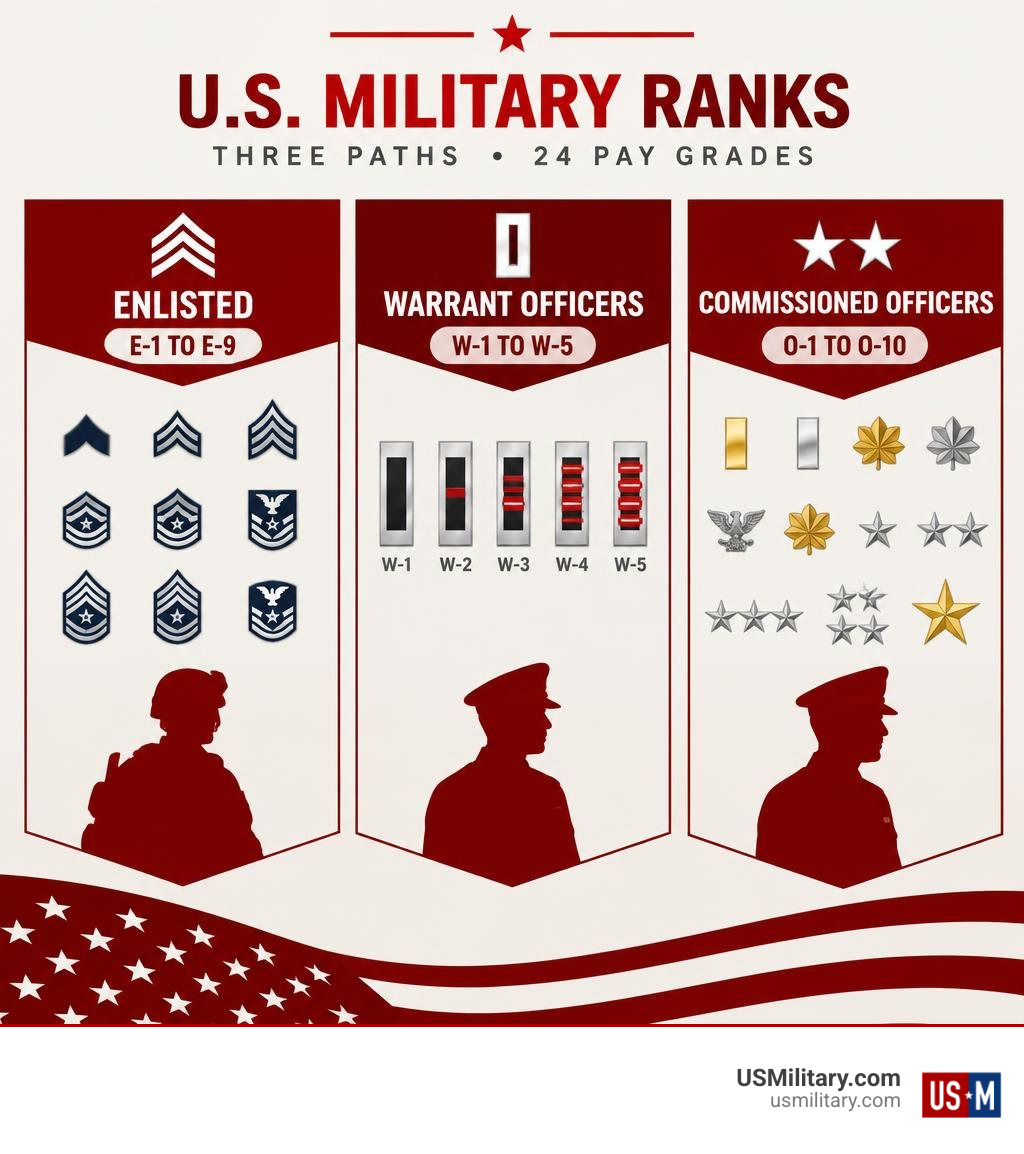
U.S. military ranks follow three paths: enlisted members (E-1 to E-9), warrant officers (W-1 to W-5), and commissioned officers (O-1 to O-10). Enlisted members carry out missions and lead teams. Warrant officers are technical experts who outrank enlisted members. Commissioned officers lead units and plan operations. Within each path, a higher number means a higher pay grade.
The six branches share these pay grades, but not always the same rank names. A Marine Corps captain is an O-3; a Navy captain is an O-6. That is why branch and pay grade together give you the clearest picture of where someone fits.
I’m Larry Fowler, publisher of the USMilitary.com Network. Since 2007, I’ve helped share military career information with service members and veterans, including guides that make US military ranks easier to understand.
Understanding the Three Tiers of Military Rank Structure
Federal law establishes the operational foundation of our armed forces under Title 10 of the U.S. Code. This statutory framework divides all service personnel into three distinct tiers: enlisted members, warrant officers, and commissioned officers. Together, these tiers span 24 standardized pay grades across all branches, supporting an organized chain of command from entry-level recruits to four-star flag officers.
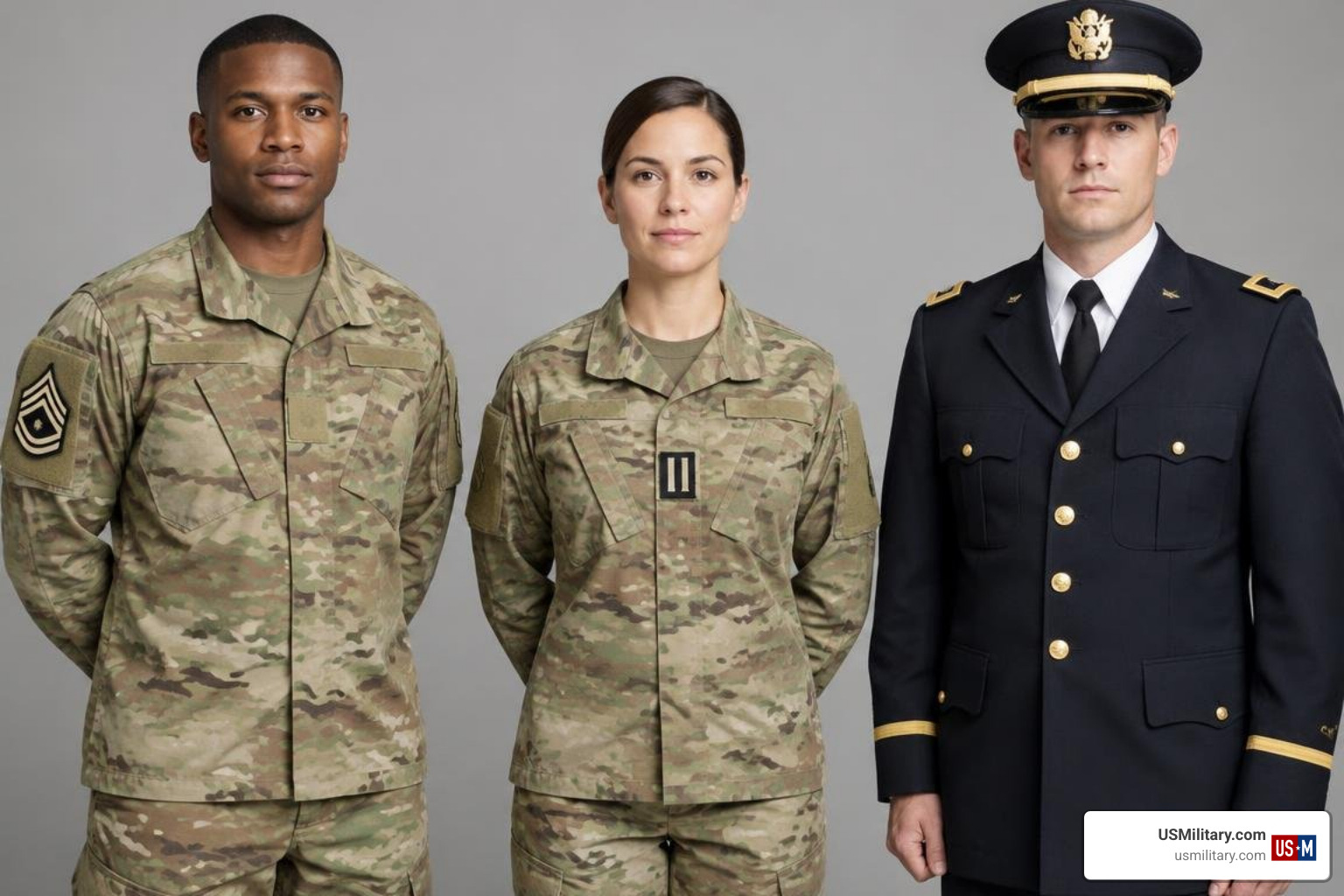
Each tier fulfills a distinct role in executing national defense strategy. To understand compensation and career advancement across these levels, review our guide to active duty military pay and benefits.
Enlisted US Military Ranks: Structure, Insignia, and Duties
Enlisted personnel make up the foundation of the armed services, accounting for roughly four out of every five service members. The enlisted progression spans pay grades E-1 through E-9 and is divided into three tiers:
- Junior Enlisted (E-1 to E-4): Service members in these entry grades focus on mastering their occupational specialties and executing daily tasks. In the Air Force, for instance, early development begins as an Airman Basic before advancing through our guide to the Air Force’s third rank (Airman First Class). Achieving E-4 marks a significant milestone for Senior Airmen and Specialists, who take on greater technical responsibility before stepping into supervisory roles.
- Noncommissioned Officers (E-5 to E-6): Noncommissioned officers (NCOs) manage small teams, squads, and work centers. They bridge the gap between strategic command and frontline execution. Mastering the responsibilities of an E-6 Staff Sergeant involves balancing technical proficiency, operational safety, and mentorship for junior personnel.
- Senior Noncommissioned Officers (E-7 to E-9): Senior NCOs handle major administrative, operational, and tactical responsibilities at the company, battalion, squadron, and fleet levels. Managing the daily duties of a Master Sergeant or First Sergeant demands deep expertise in logistics, troop welfare, and mission readiness. At the top of the enlisted ladder, senior advisors like the Sergeant Major of the Army or Master Chief Petty Officer of the Navy advise service chiefs on force-wide enlisted policy.
Enlisted insignia rely on chevrons, arcs (rockers), and service-specific specialty marks. For deeper background on design evolution, consult this historical overview of rank insignia.
Warrant Officer Ranks: Technical Experts and Leaders
Warrant officers (W-1 to W-5) are highly specialized subject-matter experts who operate between the senior enlisted and commissioned officer tiers. Rather than rotating through broad command assignments, warrant officers maintain focus within specific career fields such as tactical aviation, network defense, electronic warfare, and intelligence analysis.
A key rule of military protocol is that every warrant officer outranks every enlisted member, including senior personnel like the Sergeant Major of the Army.
Warrant Officer 1 (WO1) ranks are appointed via a warrant from the service secretary. Upon advancement to Chief Warrant Officer 2 (CW2) through Chief Warrant Officer 5 (CW5), they receive a presidential commission and hold the same legal commissioning status as traditional officers. The Army, Navy, Marine Corps, and Coast Guard have long relied on warrant officers. The Air Force reinstated its warrant officer program in 2024 to strengthen specialized technical pipelines in cyber and information technology fields.
Commissioned Officer US Military Ranks: Command and Strategy
Commissioned officers hold presidential commissions confirmed by the Senate, charging them with unit command, strategic planning, and operational leadership. Officer ranks run from O-1 through O-10 across three tiers:
- Company Grade Officers (O-1 to O-3): Second Lieutenants, First Lieutenants, and Captains (or Ensigns and Lieutenants in the sea services) lead small units such as platoons and companies. Navigating the career path of an Air Force Captain requires mastering tactical command while developing long-term administrative skills.
- Field Grade Officers (O-4 to O-6): Majors, Lieutenant Colonels, and Colonels (Lieutenant Commanders, Commanders, and Captains in the sea services) command battalions, squadrons, brigades, and naval vessels. Advancing to Lieutenant Colonel requires completing advanced joint staff education and demonstrating leadership across broad operational commands.
- General and Flag Officers (O-7 to O-10): Brigadier Generals, Major Generals, Lieutenant Generals, and Generals (and their equivalent Admirals) oversee regional commands, major installations, numbered air forces, fleets, and service-wide headquarters elements.
For step-by-step career path insights, read our military officer career progression guide or review the official US Army rank structure for branch-specific details.
Complete Breakdown of US Military Ranks by Branch and Pay Grade
The table below outlines how rank titles correspond across all six military services by standardized pay grade.
| Pay Grade | U.S. Army | U.S. Navy | U.S. Air Force | U.S. Marine Corps | U.S. Coast Guard | U.S. Space Force |
|---|---|---|---|---|---|---|
| E-1 | Private | Seaman Recruit | Airman Basic | Private | Seaman Recruit | Specialist 1 |
| E-2 | Private (PV2) | Seaman Apprentice | Airman | Private First Class | Seaman Apprentice | Specialist 2 |
| E-3 | Private First Class | Seaman | Airman First Class | Lance Corporal | Seaman | Specialist 3 |
| E-4 | Specialist / Corporal | Petty Officer 3rd Class | Senior Airman | Corporal | Petty Officer 3rd Class | Specialist 4 |
| E-5 | Sergeant | Petty Officer 2nd Class | Staff Sergeant | Sergeant | Petty Officer 2nd Class | Sergeant |
| E-6 | Staff Sergeant | Petty Officer 1st Class | Technical Sergeant | Staff Sergeant | Petty Officer 1st Class | Technical Sergeant |
| E-7 | Sergeant First Class | Chief Petty Officer | Master Sergeant | Gunnery Sergeant | Chief Petty Officer | Master Sergeant |
| E-8 | Master Sgt. / First Sgt. | Senior Chief Petty Officer | Senior Master Sergeant | Master Sgt. / First Sgt. | Senior Chief Petty Officer | Senior Master Sergeant |
| E-9 | Sgt. Major / Command Sgt. Major | Master Chief Petty Officer | Chief Master Sergeant | Master Gunnery Sgt. / Sgt. Major | Master Chief Petty Officer | Chief Master Sergeant |
| W-1 | Warrant Officer 1 | Warrant Officer 1 | Warrant Officer 1 | Warrant Officer 1 | Warrant Officer 1 | None |
| W-2 | Chief Warrant Officer 2 | Chief Warrant Officer 2 | Chief Warrant Officer 2 | Chief Warrant Officer 2 | Chief Warrant Officer 2 | None |
| W-3 | Chief Warrant Officer 3 | Chief Warrant Officer 3 | Chief Warrant Officer 3 | Chief Warrant Officer 3 | Chief Warrant Officer 3 | None |
| W-4 | Chief Warrant Officer 4 | Chief Warrant Officer 4 | Chief Warrant Officer 4 | Chief Warrant Officer 4 | Chief Warrant Officer 4 | None |
| W-5 | Chief Warrant Officer 5 | Chief Warrant Officer 5 | Chief Warrant Officer 5 | Chief Warrant Officer 5 | Chief Warrant Officer 5 | None |
| O-1 | Second Lieutenant | Ensign | Second Lieutenant | Second Lieutenant | Ensign | Second Lieutenant |
| O-2 | First Lieutenant | Lieutenant Junior Grade | First Lieutenant | First Lieutenant | Lieutenant Junior Grade | First Lieutenant |
| O-3 | Captain | Lieutenant | Captain | Captain | Lieutenant | Captain |
| O-4 | Major | Lieutenant Commander | Major | Major | Lieutenant Commander | Major |
| O-5 | Lieutenant Colonel | Commander | Lieutenant Colonel | Lieutenant Colonel | Commander | Lieutenant Colonel |
| O-6 | Colonel | Captain | Colonel | Colonel | Captain | Colonel |
| O-7 | Brigadier General | Rear Admiral (lower half) | Brigadier General | Brigadier General | Rear Admiral (lower half) | Brigadier General |
| O-8 | Major General | Rear Admiral | Major General | Major General | Rear Admiral | Major General |
| O-9 | Lieutenant General | Vice Admiral | Lieutenant General | Lieutenant General | Vice Admiral | Lieutenant General |
| O-10 | General | Admiral | General | General | Admiral | General |
For service-specific variations and terminology, check out our different Air Force ranks breakdown.
Pay Grade vs. Rank: Resolving Cross-Branch Differences
Pay grades are administrative labels created by the Department of Defense to standardize compensation under federal pay tables. A rank title, on the other hand, reflects a service member’s specific level of leadership and authority within their branch.
This distinction explains common cross-branch naming differences:
- The Captain Difference: An Army, Marine Corps, Air Force, or Space Force Captain is an O-3 company-grade officer who typically commands 60 to 200 troops. A Navy or Coast Guard Captain is an O-6 field-grade officer equivalent to a military Colonel, often commanding an aircraft carrier, cruiser, or major naval installation.
- E-4 Specialist vs. Corporal: In the U.S. Army, both Specialists (SPC) and Corporals (CPL) share the E-4 pay grade. However, a Corporal is a noncommissioned officer with formal leadership authority over junior troops, whereas a Specialist is recognized for technical proficiency without frontline NCO command duties.
- Dual Tracks at E-8 and E-9: In the Army, Air Force, and Marine Corps, senior pay grades split into distinct tracks. At E-8, an Army Master Sergeant serves as a senior technical and staff specialist, while a First Sergeant serves as the senior enlisted leader managing company-level discipline and morale. At E-9, a Sergeant Major focuses on staff operations, while a Command Sergeant Major advises unit commanders across entire battalions, brigades, and divisions.
Promotion Requirements, Timelines, and 2026 Pay Structure
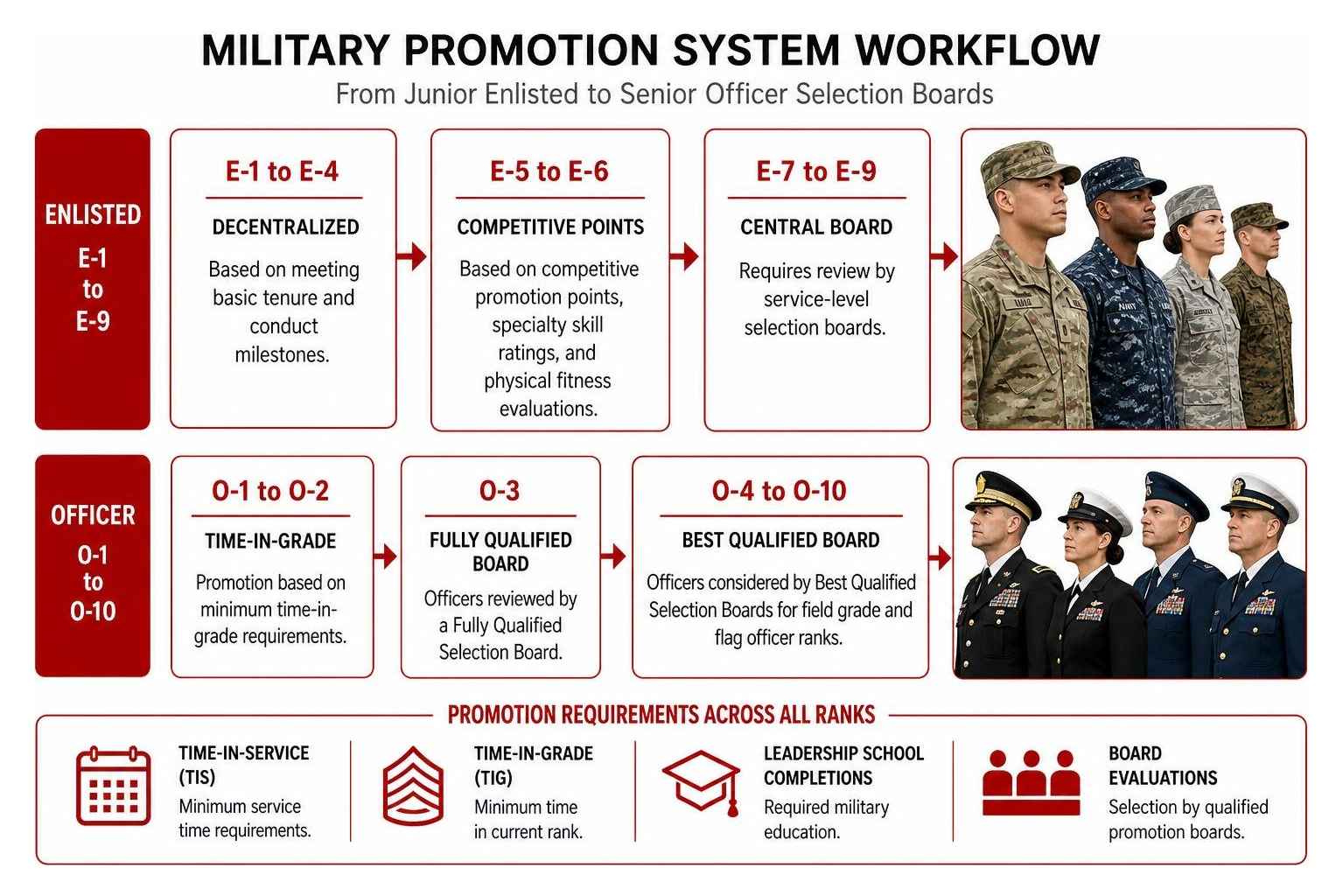
Advancement through military ranks is governed by minimum Time-in-Service (TIS), Time-in-Grade (TIG), leadership school completions, and board evaluations.
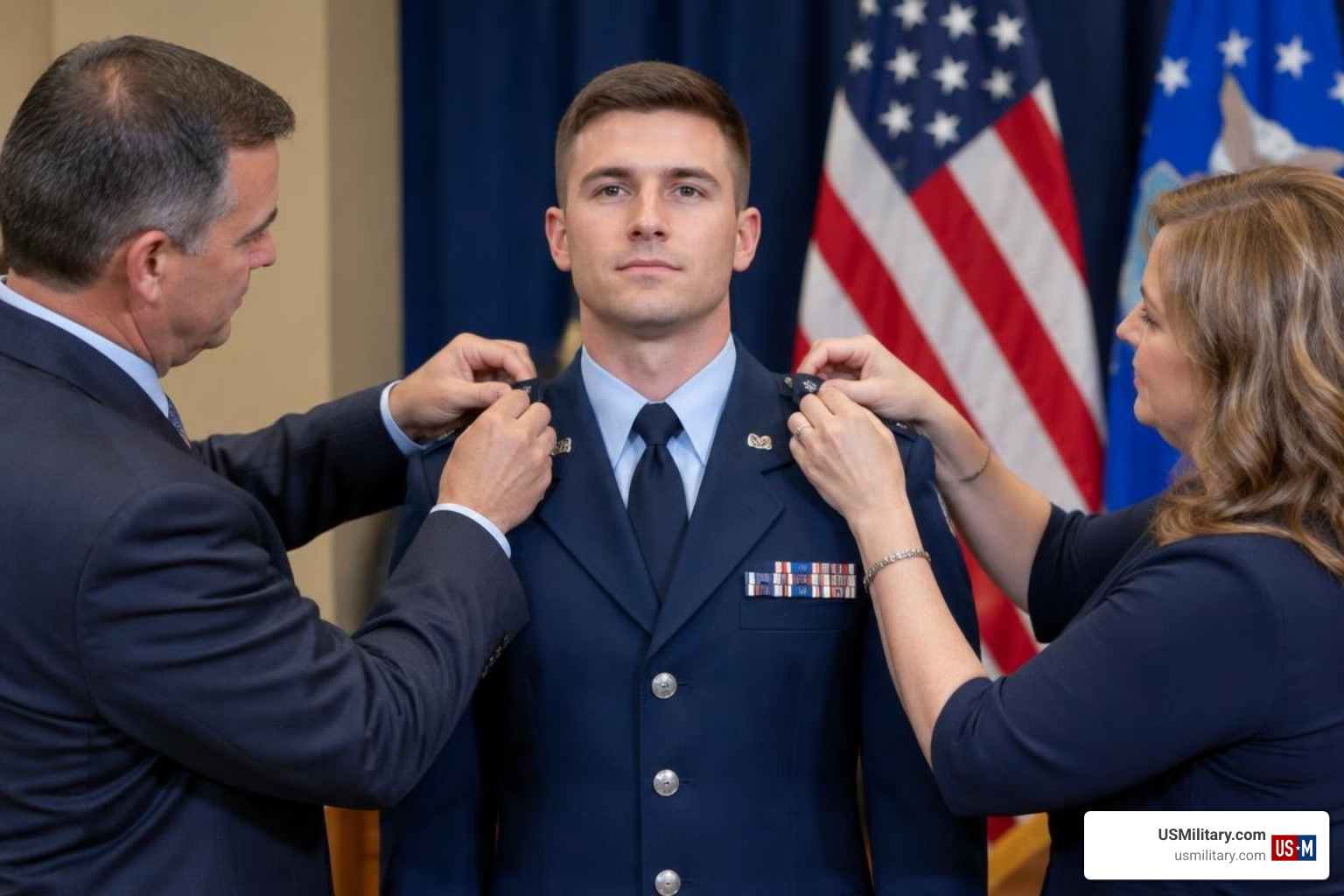
Enlisted promotions from E-1 to E-4 are primarily decentralized and based on meeting basic tenure and conduct milestones. Advancement to E-5 and E-6 relies on competitive promotion point systems, specialty skill ratings, and physical fitness evaluations. To understand this progression, review our guide to enlisted rank progression timeline benchmarks. Promotion to E-7, E-8, and E-9 is centralized, requiring review by service-level selection boards.
Military base pay increased by 3.8% across all grades. Under this schedule, an E-5 Sergeant with four to six years of service earns between $3,343 and $4,422 in monthly base pay, excluding tax-free allowances for housing (BAH) and subsistence (BAS). At the executive level, general and flag officer base pay is capped by federal statute at Executive Schedule Level II, which limits monthly base earnings to $18,999.90. To widen recruitment pipelines, the Army raised its maximum enlistment age to 42.
Military Etiquette: How to Properly Address and Identify Ranks
Military protocol requires clear forms of address to maintain discipline and professional courtesy across all branches:
- Enlisted Personnel: Army, Marine Corps, and Air Force NCOs are addressed by their formal title (e.g., “Sergeant,” “Staff Sergeant,” or “First Sergeant”). In the Navy and Coast Guard, petty officers are addressed by their specific rate and rank (e.g., “Petty Officer Smith” or “Chief Davis”).
- Warrant Officers: Warrant officers in all branches are addressed as “Mr. [Last Name],” “Ms. [Last Name],” or informally as “Chief.”
- Commissioned Officers: Officers are addressed by their specific rank title (e.g., “Lieutenant,” “Captain,” “Colonel,” or “Admiral”) or by using “Sir” or “Ma’am.” Enlisted members and junior officers render hand salutes to senior commissioned and warrant officers when outdoors in uniform.
Rank insignia use consistent visual symbols across services:
- Chevrons and Arcs: Pointed chevrons and lower arcs (rockers) indicate enlisted and NCO leadership levels across ground and aviation branches.
- Bars: A single gold bar marks an O-1 (Second Lieutenant/Ensign), a single silver bar marks an O-2 (First Lieutenant/Lieutenant JG), and two connected silver bars mark an O-3 (Captain/Navy Lieutenant). Warrant officer insignia use single bars accented with branch-colored enamel blocks.
- Oak Leaves: A gold oak leaf signifies an O-4 (Major/Lieutenant Commander), while a silver oak leaf represents an O-5 (Lieutenant Colonel/Commander).
- Eagles and Stars: A silver spread eagle indicates an O-6 (Colonel/Navy Captain). Silver five-pointed stars signify general and flag officer ranks, scaling from one star (Brigadier General/Rear Admiral Lower Half) to four stars (General/Admiral).
Frequently Asked Questions About US Military Ranks
What is the highest rank possible in the US military?
The highest active-duty rank in the U.S. Armed Forces is the four-star grade of General or Admiral (O-10). Five-star ranks—General of the Army, Fleet Admiral, and General of the Air Force—are special wartime ranks authorized only by Congress during major conflicts.
Only five officers have held the rank of General of the Army: George C. Marshall, Douglas MacArthur, Dwight D. Eisenhower, Henry H. Arnold, and Omar Bradley. General Bradley was the last surviving five-star officer until his death in 1981.
A unique six-star title, General of the Armies of the United States, was historically conferred upon John J. Pershing and posthumously awarded to George Washington and Ulysses S. Grant to ensure no officer outranks them.
What is the difference between a pay grade and a rank title?
A pay grade is a standard administrative category (E-1 through E-9, W-1 through W-5, and O-1 through O-10) used across all military branches to determine uniform basic pay and benefits.
A rank title is the formal, service-specific name given to a military position (such as Master Gunnery Sergeant, Petty Officer First Class, or Lieutenant Colonel). Rank titles reflect specific command roles, traditions, and operational responsibilities within each branch.
How do warrant officers fit into the military hierarchy?
Warrant officers occupy a specialized technical tier between senior enlisted personnel and commissioned officers. Every warrant officer legally outranks all enlisted service members. While commissioned officers manage overall unit strategy and personnel, warrant officers serve as technical experts who advise commanders and lead critical missions in fields like aviation, cyber defense, and intelligence operations.
Conclusion
Understanding the structure of military ranks clarifies how leadership, pay, and operational authority align across all branches of service. Whether you are tracking promotion goals as an active-duty service member or reviewing career pathways before enlistment, knowing these pay grades helps you plan your service effectively.
To compare service missions, enlistment options, and career opportunities across every branch, explore our complete guide to branches of the military. You can also visit USMilitary.com for detailed resources on VA home loan benefits, military disability ratings, and career transitions.
Free for Service Members & Veterans
Get the military benefits intel no one tells you about.
Weekly updates on VA benefits, pay changes, and money tips — free for service members and veterans.
No spam. Unsubscribe anytime. Your info is never shared.



Leave a Reply