What Senior Airman Duties Actually Look Like — and What Comes Next
Senior Airman duties cover a specific and important stretch of your Air Force career — the point where you shift from just learning the job to actually owning it and helping others learn it too.
Here’s a quick breakdown of what Senior Airmen are expected to do:
- Perform technical tasks in your Air Force Specialty Code (AFSC) with minimal supervision
- Train and mentor junior enlisted Airmen (E-1 through E-3)
- Enforce standards and help build team cohesion within your unit
- Develop supervisory and leadership skills in preparation for the NCO tier
- Complete Airman Leadership School (ALS) before promotion to Staff Sergeant (E-5)
- Maintain full readiness — physical, medical, financial, and family
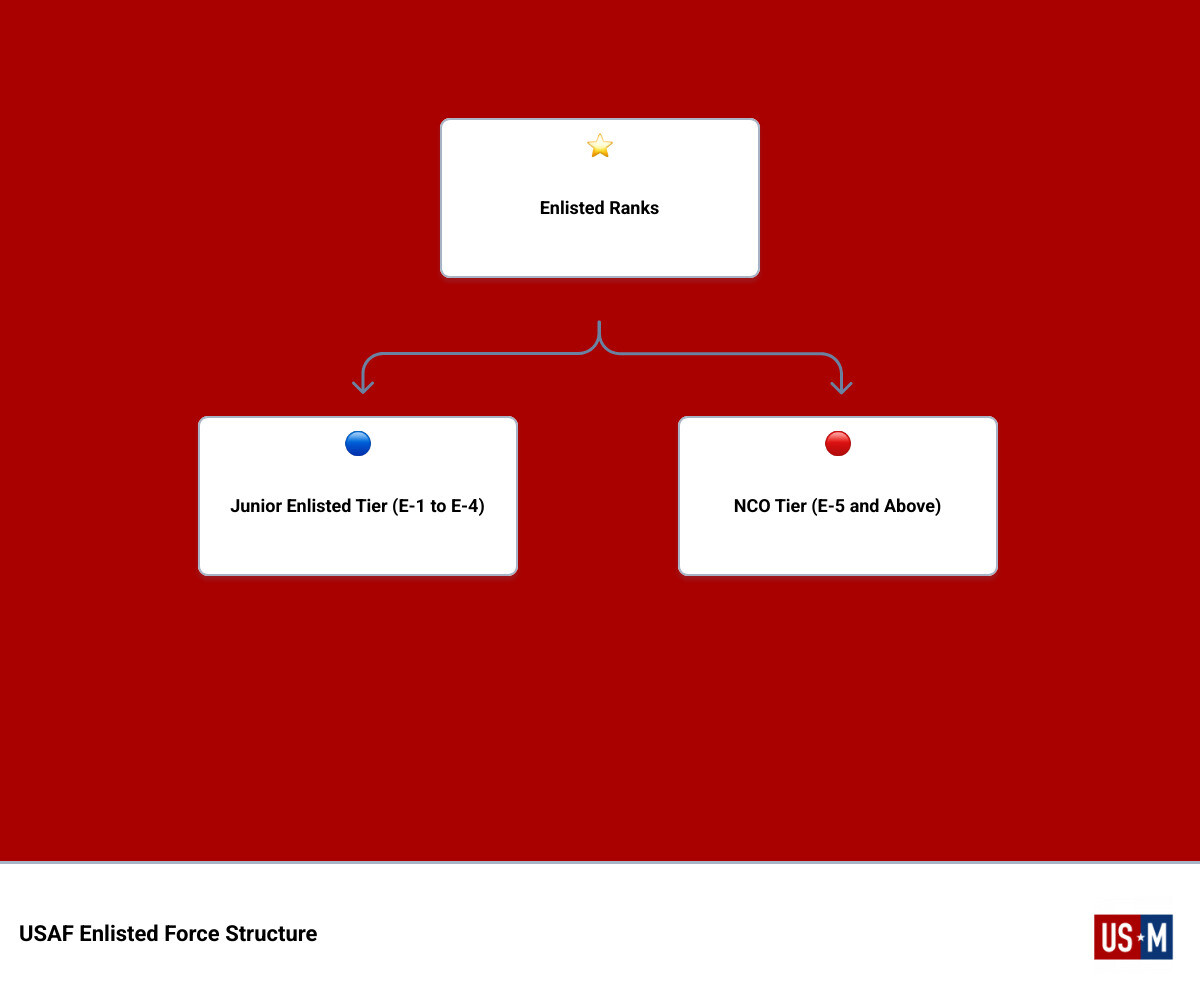
Senior Airman (SrA) is the E-4 pay grade, the fourth enlisted rank in the U.S. Air Force. It sits above Airman First Class (E-3) and just below Staff Sergeant (E-5). You’re still in the Junior Enlisted tier — but you’re the top of it.
This rank is a transition point. You’re no longer just absorbing information. You’re expected to produce results, develop others, and start acting like the NCO you’re working toward becoming.
As the Chief Master Sergeant of the Air Force has put it: “To wear the uniform of the United States Air Force is to take on a calling far greater than a job.” That calling becomes more real — and more demanding — at the SrA level.
I’m Larry Fowler, publisher of USMilitary.com, and I’ve spent years helping active-duty service members and veterans navigate complex military career questions — including everything related to Senior Airman duties and Air Force enlisted progression. Read on for a complete guide to what this rank means for your career and how to make the most of it.
Quick Senior Airman duties definitions:
Understanding the Role of a Senior Airman (E-4)

When we talk about the Senior Airman duties, we are looking at the “Tactical Level” of leadership. In the Air Force, the enlisted force is divided into three distinct tiers: Junior Enlisted, Non-Commissioned Officers (NCOs), and Senior NCOs. As a Senior Airman, you are at the pinnacle of the Junior Enlisted tier.
You are no longer the “new person” on the flight line or in the office. You have moved past the apprentice stage and are now considered a skilled technician. This means you are expected to know your job well enough to perform it with very little oversight. But it’s not just about turning wrenches or coding software; it’s about the shift toward mentorship. You are the bridge between the brand-new Airmen (E-1 to E-3) and the NCOs who run the shop.
For more info about Air Force enlisted ranks, it is helpful to see how the Air Force views your progress. While an Airman First Class is still learning the ropes, a Senior Airman is expected to be a “journeyman.” You are the “fuel to our daily missions,” as the Air National Guard often describes the junior enlisted force.
The Junior Enlisted vs. NCO Responsibility Gap
| Feature | Junior Enlisted (SrA) | Non-Commissioned Officer (SSgt) |
|---|---|---|
| Primary Focus | Technical Proficiency & Learning | Leading People & Managing Resources |
| Supervision | Limited (Post-ALS) | Official Rater/Supervisor |
| Authority | Derived from Expertise | Derived from UCMJ & Title 10 |
| PME Requirement | ALS (to promote) | NCO Academy (to promote) |
Position in the Enlisted Force Structure
The progression from Airman First Class (A1C) to Senior Airman usually happens after 36 months of Time in Service (TIS) and 20 months of Time in Grade (TIG). This isn’t just a pay bump; it’s a preparation phase for Staff Sergeant.
According to the “Brown Book” (The Enlisted Force Structure handbook), Senior Airmen must “encompass previous junior enlisted requirements to perform as skilled technicians and become well-versed trainers.” You are also expected to live by the Airman’s Creed and the Core Values: Integrity First, Service Before Self, and Excellence in All We Do. If you find sources on Senior Airman roles, you’ll see a consistent theme: this is the rank where you prove you have the “Warrior Ethos” required to lead others in combat or garrison.
Core Senior Airman Duties and Responsibilities
The day-to-day Senior Airman duties vary depending on your career field, but the underlying expectations are universal. You are responsible for mission execution. Whether you are in Security Forces guarding a perimeter or in a medical clinic assisting a surgeon, your technical proficiency is the foundation of the unit’s success.
You are also a “standards enforcer.” If you see a junior Airman with a uniform violation or performing a task unsafely, it is your job to correct it. This builds team cohesion. When everyone follows the same high standards, the unit functions like a well-oiled machine. For details on US Air Force enlisted occupations, you can see how these standards apply across different specialties.
Technical Proficiency and Training Others as part of Senior Airman duties
As a Senior Airman, you are likely working toward or have already achieved your 5-skill level (Journeyman). This makes you an essential On-the-Job Training (OJT) trainer. You are often the person who actually teaches the new Airmen how to do the job in the real world, beyond what they learned in technical school.
For example, in Air Force enlisted weather apprentice roles, a Senior Airman might be responsible for monitoring complex radar systems and then teaching a brand-new Airman how to interpret that data. Your work center productivity depends on your ability to maintain equipment and ensure that the “new guys” aren’t breaking it.
Developing Leadership and Senior Airman duties in Supervision
Leadership isn’t a switch you flip when you put on Staff Sergeant stripes; it’s a muscle you build as a Senior Airman. You will begin developing supervisory skills by leading small teams on specific tasks.
In enlisted Air Force medical career paths, a Senior Airman might lead a small team of technicians to set up a mobile clinic. This requires problem-solving and creating feedback loops. You give a task, you check the progress, and you provide constructive feedback. Once you complete Airman Leadership School (ALS), you may even be appointed as an official supervisor for a junior Airman, which is a huge milestone in your career.
The Path to Promotion: Timelines and Requirements
Moving from E-4 to E-5 is one of the most significant jumps in the military. While promotion to Senior Airman is mostly based on TIS and TIG (36 months TIS/20 months TIG or 28 months TIG), moving to Staff Sergeant requires you to compete.
You will need to participate in the Weighted Airman Promotion System (WAPS). This system awards points based on:
- Your Enlisted Performance Reports (EPRs)
- Specialty Knowledge Tests (SKT)
- Professional Airman Examination (PFE)
- Medals and awards
- Time in Grade and Time in Service
Senior Airman Below-the-Zone (BTZ)
If you are an absolute rockstar, you don’t have to wait for the standard timeline. The Air Force has a program called “Below-the-Zone” (BTZ). This allows outstanding Airmen First Class to promote to Senior Airman six months early.
It is a highly competitive process. Only about 15% of eligible Airmen are selected. You’ll usually have to appear before a Central Evaluation Board where senior NCOs review your performance records, your community involvement, and your “whole person” concept. Winning BTZ is a massive “attaboy” that sets you up for a fast-track career.
Mandatory Professional Military Education (PME)
You cannot become a Staff Sergeant without completing Airman Leadership School (ALS). This is a five-week curriculum designed to transform you from a technician into a supervisor.
In ALS, you’ll learn about:
- Military professionalism
- Combat leadership
- Effective communication (writing and speaking)
- Unit management
For those looking into Air Force enlisted education programs, ALS is just the beginning. It grants you the official supervisory authority you need to lead Airmen. If you have 3-6 years of TIS and no projected promotion, you can still attend ALS to broaden your skills.
Readiness and Special Developmental Opportunities
A major part of Senior Airman duties is maintaining “Individual Medical Readiness” (IMR). This means your dental, immunizations, and physicals must be up to date at all times. If the balloon goes up tonight, you need to be ready to deploy.
But readiness isn’t just medical. It’s also about:
- Financial Fitness: Managing your pay and avoiding debt.
- Mental and Spiritual Health: Using the Comprehensive Airman Fitness (CAF) model.
- Family Care Plans: Ensuring your dependents are taken care of if you are deployed.
There are many Air Force enlisted options and benefits designed to help you stay ready, from financial planning classes to family support centers.
Special Duty Assignments for E-4s
While many special duties (like being a First Sergeant or a Courier) require you to be an NCO, there are still great opportunities for Senior Airmen. You can volunteer for:
- Recruiter Assistant Program (RAP): Help recruiters in your hometown.
- Base Honor Guard: Represent the Air Force at ceremonies and funerals.
- Post-ALS Supervision: Gaining experience as a rater before you even sew on E-5.
Checking the AMS (Assignment Management System) under “EQUAL Opportunities” is the best way to find these. Some Airmen use these roles for “career broadening” to see a different side of the Air Force beyond their primary AFSC. For more on these perks, check out Air Force enlistment benefits.
Historical Evolution: From Sergeant to Senior Airman
The rank of Senior Airman hasn’t always looked the way it does today. It was officially established on December 30, 1975. Before that, the E-4 pay grade was a bit confusing.
From 1976 until 1991, the Air Force had a “split” E-4 tier. You could be a Senior Airman (a non-NCO) or a Sergeant (often called a “Buck Sergeant”). The Buck Sergeant was an NCO, wore the same stripes, but had a silver star in the middle of the chevron instead of a blue one.
In 1991, the Air Force abolished the Sergeant rank to streamline the force. The last Buck Sergeant left the service in 1998. Today, the Air Force and Space Force are the only branches where NCO status doesn’t start until E-5. This change was made to ensure that by the time an Airman becomes an NCO, they have significantly more experience and training.
Frequently Asked Questions about Senior Airman Duties
Can a Senior Airman supervise other Airmen?
Yes, but usually only after completing Airman Leadership School (ALS). Once you graduate ALS, you are qualified to be a rater and an official supervisor. Even before ALS, a Senior Airman may be put in charge of a work detail or a specific task where they “supervise” the execution of the mission, but they won’t handle the administrative paperwork (like EPRs) until they finish school.
What is the difference between a Senior Airman and a Sergeant?
Historically, a Sergeant (E-4) was an NCO, while a Senior Airman was not. Today, the “Sergeant” rank at E-4 no longer exists in the Air Force. The main difference now is between an E-4 (Senior Airman) and an E-5 (Staff Sergeant). The Staff Sergeant is a Non-Commissioned Officer with legal authority under the UCMJ to give orders and manage subordinates’ careers.
How long does it take to reach the rank of Senior Airman?
On average, it takes about three years of active-duty service. The standard requirement is 36 months Time in Service and 20 months Time in Grade as an E-3. However, if you promote “Below-the-Zone,” you can reach it in about two and a half years. Some people who enlist with college credits or JROTC experience start as an E-3, which puts them on a faster track to E-4.
Conclusion
At USMilitary.com, we know that the transition to Senior Airman is one of the most exciting times in a military career. You’ve moved past the “newbie” phase and are becoming a true professional. Your Senior Airman duties are the foundation upon which your future as an NCO will be built.
By focusing on technical excellence, seeking out mentorship opportunities, and staying “mission ready,” you ensure that you aren’t just holding a rank — you’re leading the way. Whether you plan to make the Air Force a 20-year career or transition to the civilian world after your first enlistment, the leadership skills you develop as an E-4 will serve you for a lifetime.
If you’re ready to learn more about your path forward, explore more about Air Force Enlisted Ranks and keep pushing toward that next set of stripes. Integrity, Service, and Excellence aren’t just words; they are the standard you live by every day. Keep climbing.
Free for Service Members & Veterans
Get the military benefits intel no one tells you about.
Weekly updates on VA benefits, pay changes, and money tips — free for service members and veterans.
No spam. Unsubscribe anytime. Your info is never shared.


