Understanding Your VA 100 Disability Pay 2026 Benefits
VA 100 disability pay 2026 represents the highest level of monthly compensation the Department of Veterans Affairs provides to veterans with service-connected disabilities. For 2026, the base monthly rate increased to $3,938.58 for a veteran with no dependents, reflecting a 2.8% Cost-of-Living Adjustment (COLA) that took effect December 1, 2025.
Quick Answer: 2026 VA 100% Disability Pay Rates
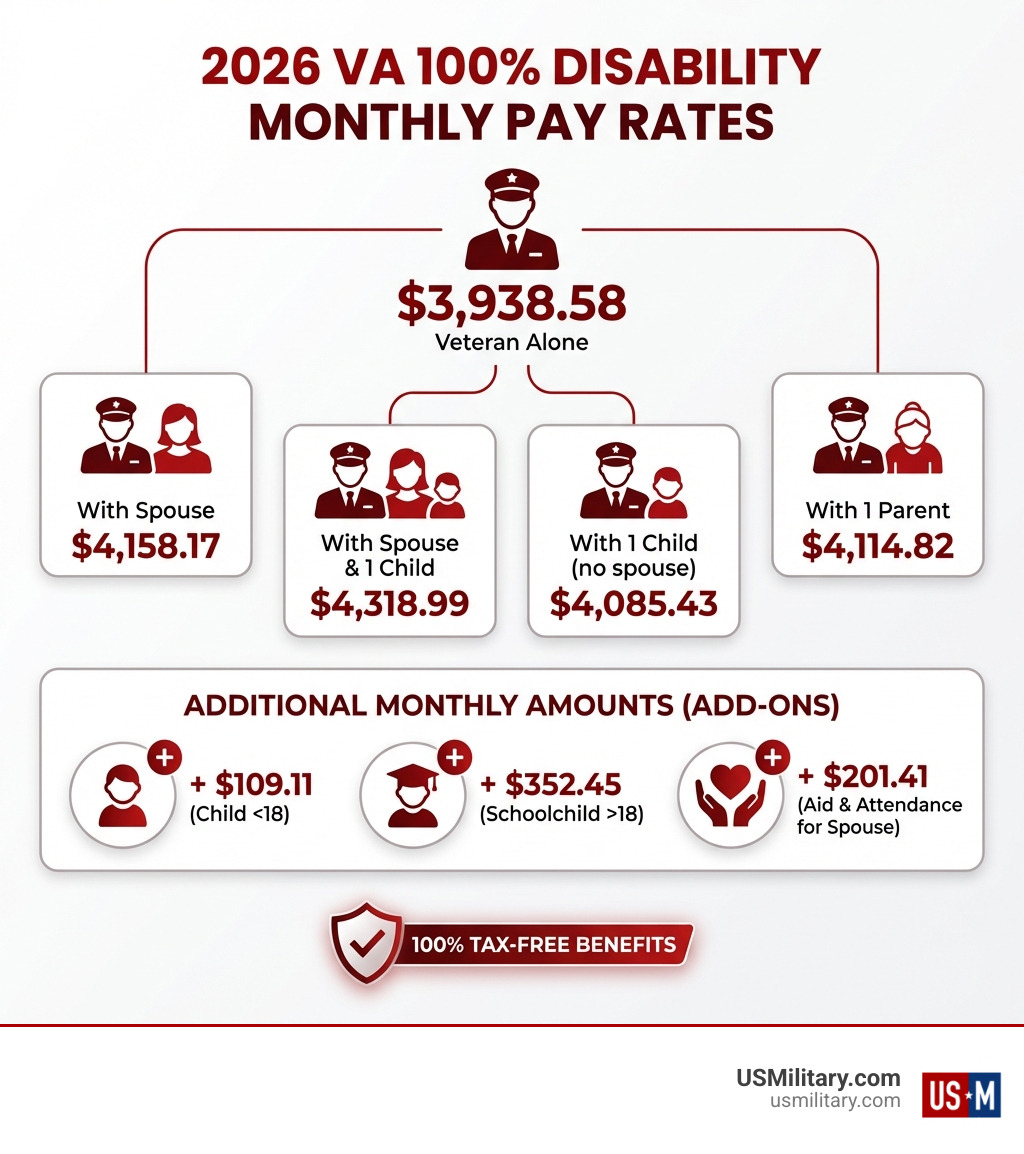
- Veteran Alone: $3,938.58/month
- Veteran with Spouse: $4,158.17/month
- Veteran with Spouse and 1 Child: $4,318.99/month
- Veteran with 1 Child (no spouse): $4,085.43/month
- Veteran with 1 Parent: $4,114.82/month
- Additional Child Under 18: +$109.11/month
- Additional Schoolchild Over 18: +$352.45/month
- Aid & Attendance for Spouse: +$201.41/month
These payments are 100% tax-free at both federal and state levels. Veterans with dependents or special circumstances like Aid and Attendance needs receive significantly higher monthly compensation.
If you’re a veteran with a 100% disability rating—or you’re working toward achieving one—understanding these rates and what factors can increase your monthly pay is crucial for maximizing your earned benefits. This guide cuts through the confusion around proposed changes, explains how to calculate your exact payment, and shows you the fastest paths to securing the full compensation you’ve earned through your service.
I’m Larry Fowler, publisher of the USMilitary.com Network, where I’ve been helping veterans steer VA 100 disability pay 2026 rates and benefits since 2007. My network has provided critical benefits information to hundreds of thousands of active military members and veterans, ensuring they understand exactly what they’ve earned.
Easy va 100 disability pay 2026 glossary:
Your Complete Guide to VA 100 Disability Pay 2026
For veterans with a 100% disability rating, understanding your exact monthly compensation for 2026 is paramount. This section details the specific amounts you can expect, including how the annual Cost-of-Living Adjustment (COLA) impacts your payment. These rates are designed to provide financial stability for those whose lives have been significantly impacted by service-connected conditions.
Official VA 100 Disability Pay 2026 Rates and Charts
The Department of Veterans Affairs (VA) regularly updates its disability compensation rates to ensure they keep pace with economic changes. For 2026, the rates reflect a 2.8% Cost-of-Living Adjustment (COLA), which became effective on December 1, 2025. This means that the monthly VA disability pay for a 100% rating in 2026 will be as follows, depending on your dependent status:
| Dependent Status | Monthly Compensation (2026) |
|---|---|
| Veteran Alone | $3,938.58 |
| Veteran with Spouse | $4,158.17 |
| Veteran with Spouse and One Parent | $4,334.41 |
| Veteran with Spouse and Two Parents | $4,510.65 |
| Veteran with One Parent | $4,114.82 |
| Veteran with Two Parents | $4,291.06 |
| Veteran with One Child | $4,085.43 |
| Veteran with Spouse and One Child | $4,318.99 |
| Veteran with Spouse, Child, and One Parent | $4,495.23 |
| Veteran with Spouse, Child, and Two Parents | $4,671.47 |
| Veteran with Child and One Parent | $4,261.67 |
| Veteran with Child and Two Parents | $4,437.91 |
| Additional Amounts | |
| Each Additional Child Under Age 18 | $109.11 |
| Each Additional Schoolchild Over Age 18 | $352.45 |
| Additional Monthly Amount for an Aid and Attendance Spouse | $201.41 |
These figures represent the exact monthly VA disability pay for a 100% rating in 2026, demonstrating how significantly dependents can impact your total compensation. We encourage you to review the official tables for all disability ratings directly from the VA to understand the full scope of benefits. You can find these rates here: View the official VA compensation rates.
How the 2026 COLA Increase is Calculated
The 2026 Cost-of-Living Adjustment (COLA) plays a crucial role in ensuring that the purchasing power of your VA disability benefits keeps up with inflation. We are required by law to match the percentage of cost-of-living adjustments made to Social Security benefits. For 2026, this adjustment is a 2.8% increase.
This COLA is determined by the Social Security Administration (SSA) based on changes in the Consumer Price Index for Urban Wage Earners and Clerical Workers (CPI-W). The SSA typically announces the official COLA in mid-October of the preceding year. Once announced, the VA implements this increase, and the new rates become effective on December 1st, with payments reflecting the adjustment appearing in your January checks.
The purpose of COLA is straightforward: it helps protect your benefits from being eroded by inflation. Without these annual adjustments, the value of your monthly payments would decrease over time, making it harder to cover essential expenses. This automatic annual adjustment means you don’t need to take any action to receive the increased amount; it will simply be reflected in your payments. For the latest information directly from the source, you can visit the SSA’s website: Get the latest COLA information from the SSA.
Factors That Increase Your Monthly 100% VA Pay
While a 100% disability rating provides a substantial base, there are several factors that can further increase your monthly tax-free compensation. Understanding these additions is essential for maximizing the benefits you’ve earned through your service.
Adding Dependents to Your VA Disability Claim

One of the most significant ways to increase your va 100 disability pay 2026 is by adding eligible dependents to your claim. The VA recognizes that veterans with families have greater financial responsibilities, and provides additional compensation for a:
- Spouse: Your husband or wife.
- Dependent Children: This includes children under 18, or children between 18 and 23 who are attending school.
- Dependent Parents: If you provide more than 50% of their financial support.
As shown in the rate table above, the difference can be substantial. For example, a veteran with a 100% rating alone receives $3,938.58, but with a spouse and one child, that jumps to $4,318.99. We encourage all eligible veterans to ensure their dependents are accurately listed with the VA.
To add dependents, you’ll generally need to submit VA Form 21-526EZ, or update your information through the VA’s online portal. Make sure to provide all necessary documentation, such as marriage certificates, birth certificates, and proof of school enrollment for older children, to avoid delays.
Special Monthly Compensation (SMC) and Aid & Attendance
Beyond the basic disability rates, the VA offers additional tax-free payments for specific, severe disabilities or circumstances. These are known as Special Monthly Compensation (SMC) and Aid and Attendance (A&A) benefits.
Special Monthly Compensation (SMC) is provided to veterans who have lost or lost the use of specific organs or extremities as a result of their service. It can also apply to other severe conditions, such as:
- Loss of a hand or foot
- Blindness or severe visual impairment
- Deafness
- Loss of use of reproductive organs
- Paralysis
- Being housebound
SMC is paid in addition to your regular monthly disability compensation and has various rates depending on the specific combination of conditions. These rates are designed to account for the increased needs and challenges associated with such severe impairments. You can learn more about the specific rates and eligibility for SMC here: Special Monthly Compensation (SMC).
Aid and Attendance (A&A) benefits are a type of SMC that provide additional payment for veterans or their surviving spouses who require the aid of another person to perform daily activities, or who are bedridden, patients in a nursing home, or severely sight-impaired. Similarly, Housebound benefits are available if you are substantially confined to your home due to your service-connected disability.
For a veteran with a 100% disability rating, an additional monthly amount for an Aid and Attendance spouse is $201.41 in 2026. This extra payment helps offset the costs of in-home care or assisted living, providing much-needed financial relief for families managing these challenges. If you or your spouse meet these criteria, we strongly advise exploring these benefits.
Understanding How to Achieve and Maintain a 100% Rating
Achieving a 100% disability rating can be a life-changing event, providing significant financial security. There are primarily two paths to reaching this level of compensation: through a schedular rating or via Individual Unemployability (TDIU).
Schedular Rating vs. TDIU: Two Paths to 100% Pay
When we talk about a 100% disability rating, we’re usually referring to a 100% Schedular Rating. This means that your service-connected conditions, either individually or combined through “VA Math” (which we’ll discuss next), meet the criteria outlined in the VA’s Schedule for Rating Disabilities (VASRD) for a 100% impairment level. Many veterans with a 100% schedular rating are also deemed Permanent and Total (P&T), meaning their conditions are not expected to improve and will not be subject to routine re-evaluation.
However, not all veterans whose conditions prevent them from working will have a schedular rating that adds up to 100%. This is where Total Disability based on Individual Unemployability (TDIU) comes in. TDIU is a benefit that allows the VA to pay you at the 100% disability rate, even if your combined schedular rating is less than 100% (typically 60% for a single disability or a combined rating of 70% with at least one disability rated 40%).
The key to TDIU is your inability to work. If your service-connected conditions make it impossible for you to maintain substantially gainful employment, the VA will compensate you at the 100% rate. This is an incredibly important benefit for veterans whose disabilities severely limit their earning capacity. It ensures that those who cannot work due to their service are not penalized for having a lower “paper” rating. You can find more detailed information on TDIU here: Total Disability based on Individual Unemployability (TDIU).
“VA Math”: How Multiple Disabilities Combine for a 100% Rating

One of the most common sources of confusion for veterans is how the VA calculates combined disability ratings, often referred to as “VA Math.” It’s not simple addition, and understanding this system is crucial if you have multiple service-connected conditions that contribute to your overall rating.
The VA’s combined rating system works by taking percentages of percentages. Instead of directly adding disability ratings, the VA calculates the impairment to your overall “efficiency” or “ability to function.” Here’s the basic idea:
- Start with 100% efficiency.
- Rate the most severe disability first. Let’s say you have a 50% disability. This leaves you 50% efficient (100% – 50% = 50%).
- Rate the next most severe disability against the remaining efficiency. If your next disability is 30%, the VA calculates 30% of your remaining 50% efficiency. So, 30% of 50% is 15%.
- Add this new impairment to your initial impairment. Your total impairment is now 50% + 15% = 65%. This means you are 65% disabled, or 35% efficient.
- Continue this process for all service-connected disabilities.
Once all disabilities are combined, the final percentage is rounded to the nearest 10%. For example, a combined rating of 65% would round up to 70%, while 64% would round down to 60%.
Let’s illustrate with an example from our research: If a veteran has ratings of 50%, 50%, 20%, and 20%, the combined rating is actually 80%, not 140%. This is why “VA Math” can be so counter-intuitive!
We understand that this system can be complex, and we’ve seen many veterans get frustrated by it. Fortunately, the VA provides resources to help explain this calculation. You can find more details directly from the VA on their compensation rates page: VA’s explanation of combined ratings.
Proposed 2026 Changes: Separating Fact from Fiction
In veteran benefits, discussions about potential changes can often lead to rumors and anxiety. It’s vital to separate what is actually happening from speculation. This section clarifies what is being proposed versus what is current law, helping you stay informed with official facts.
CBO Budget Options Explained (Not Law)
You might have heard discussions online or through various channels about potential “cuts” to VA benefits, especially concerning 2026. Many of these discussions stem from budget options published by the Congressional Budget Office (CBO). CBO budget options are not law. They are simply proposals that lawmakers could consider to reduce federal spending or increase revenue. For any of these options to become law, Congress would need to pass legislation, which is a lengthy and uncertain process.
Some of the CBO options that have sparked concern include:
- Means-testing VA disability compensation: A proposal suggesting that eligibility or payment could be reduced based on household income, with the CBO describing a threshold of $135,000 (excluding disability income) beginning in January 2026.
- Requiring a 30%+ rating to receive compensation: This proposal would mean veterans with 0%, 10%, or 20% ratings (and future claimants) would need at least a 30% rating for compensation, effective January 2026.
- 30% reduction at age 67 for new recipients: A proposal stating that veterans who start receiving disability compensation in 2026 or later would have their payments reduced by 30% at age 67.
- Ending or limiting TDIU at age 67: This proposal suggests that Individual Unemployability (TDIU) payments could end at age 67, effective January 2026, with alternatives for broad application or only to new IU recipients.
- Potential taxation of VA disability compensation: While VA disability compensation is currently tax-free, a CBO option has been floated to include it in taxable income. Again, this is not law and would require an act of Congress.
It’s important to reiterate: these are budget options, not enacted legislation. The VA leadership, including Secretary Collins, has publicly addressed these rumors, reassuring veterans that benefits cuts are not currently happening. We will always keep you informed of any official changes that become law.
Potential Future Changes to VA Rating Schedules
Beyond CBO budget options, the VA itself periodically reviews and proposes updates to its Schedule for Rating Disabilities (VASRD), which outlines how various conditions are rated. These proposed changes, while not “cuts” to benefits, could impact how future claims are evaluated and potentially lead to lower ratings for certain conditions for new applicants.
The VA has proposed updates to the VASRD for several common conditions:
- Sleep Apnea: Proposed changes to the sleep apnea rating criteria would focus on treatment responsiveness rather than just the requirement for a CPAP machine. This could mean that if your sleep apnea is effectively managed with treatment, your rating might be lower than the current 50% for CPAP use.
- Tinnitus: Proposed changes aim to rate tinnitus as a symptom of an underlying condition rather than a standalone condition, which could affect its compensability as a primary condition.
- Mental Health: Changes to mental health rating criteria are proposed to use a more holistic, functional approach, considering the veteran’s overall social and occupational impairment.
It is critical to remember that these proposed changes affect future claims. Veterans who already have established ratings, especially 100% P&T ratings, have significant protections and due process rights before any reduction can occur. The VA cannot arbitrarily reduce an existing rating without clear evidence of improvement and following specific legal procedures.
We recommend staying informed through official VA channels. If you have an existing claim or are considering filing, understanding these potential future changes can help you prepare your documentation and strategy.
Frequently Asked Questions about VA 100 Disability Pay 2026
We know you have questions, and we’re here to provide clear, concise answers about your va 100 disability pay 2026.
Is the va 100 disability pay 2026 taxable?
No, absolutely not. Your VA disability compensation, including va 100 disability pay 2026, is a tax-free benefit at both the federal and state levels. This means you do not pay income tax on these payments. While a CBO option to tax benefits has been discussed, it is not law and would require an act of Congress to change. As it stands, your disability pay remains a non-taxable income source.
Can the VA reduce a 100% permanent and total (P&T) rating?
It is extremely rare for the VA to reduce a 100% permanent and total (P&T) rating. These ratings are considered highly protected. Generally, the VA would only consider reducing a P&T rating in cases of fraud or if there’s clear and undeniable evidence that the veteran’s condition has dramatically improved to the point where it no longer warrants a 100% rating, and this improvement is shown to be sustained. Veterans with P&T ratings have significant due process rights, meaning the VA must follow strict procedures and provide ample opportunity for the veteran to respond before any reduction could occur. For most veterans with P&T ratings, the worry of reduction is minimal.
What is the difference between a 100% rating and TDIU?
This is a great question and a common point of confusion. The core difference lies in how the 100% compensation level is achieved:
- 100% Schedular Rating: This means a veteran’s service-connected conditions, when evaluated by the VA’s Schedule for Rating Disabilities (VASRD) and combined using “VA Math,” result in an overall disability percentage of 100%. This rating reflects the severity of their medical conditions according to the VA’s diagnostic codes and criteria.
- Total Disability based on Individual Unemployability (TDIU): This is a benefit that allows the VA to pay a veteran at the 100% disability rate, even if their combined schedular rating is less than 100% (e.g., 70% or 80%). The critical factor for TDIU is that the veteran’s service-connected disabilities prevent them from maintaining substantially gainful employment. While their medical rating might be lower, their inability to work due to those disabilities qualifies them for the 100% pay rate.
So, while both lead to the same monthly compensation, a 100% schedular rating is based purely on the severity of conditions, whereas TDIU is based on the impact of those conditions on a veteran’s ability to earn a living. You can find more information about TDIU here: Total Disability based on Individual Unemployability (TDIU).
Conclusion: Securing Your 2026 VA Benefits
As we’ve explored, understanding your va 100 disability pay 2026 is about much more than just a single number. It’s about recognizing the comprehensive system designed to support you and your family. We’ve seen that the 2.8% COLA for 2026 is confirmed, ensuring your benefits keep pace with inflation. We’ve also highlighted how crucial dependents and special benefits like SMC and Aid & Attendance can be in significantly increasing your monthly compensation.
While discussions about potential changes from the CBO or updates to rating schedules exist, these are not law. Your existing benefits, especially a 100% P&T rating, are protected by due process. The most important thing you can do is stay informed through official sources like USMilitary.com and the VA’s website, and proactively manage your benefits by ensuring all your dependents are listed and that you’re pursuing all eligible special compensation.
Your service has earned you these benefits, and we are committed to helping you steer the system to secure every dollar you deserve. We’re here to help you confidently look towards the future, knowing your benefits are understood and optimized.
For a deeper dive into all the benefits available to you as a disabled veteran, we invite you to explore our comprehensive resources: Learn more about all your disabled veteran benefits.
Free for Service Members & Veterans
Get the military benefits intel no one tells you about.
Weekly updates on VA benefits, pay changes, and money tips — free for service members and veterans.
No spam. Unsubscribe anytime. Your info is never shared.


