
VA Senior Benefits: A Quick Overview
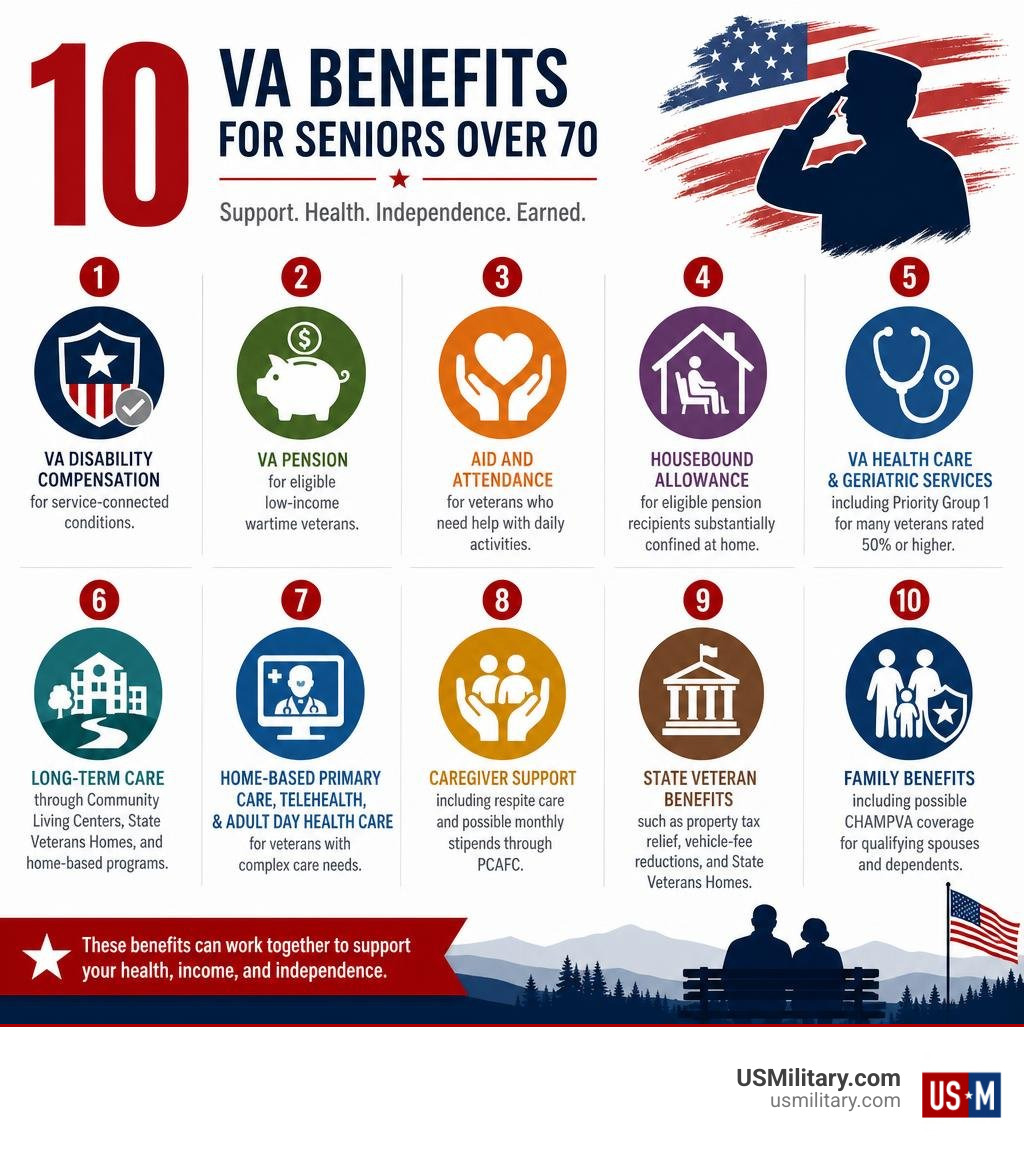
Top 10 VA benefits for seniors over 70 can include monthly disability pay, a needs-based VA Pension, Aid and Attendance, VA health care, long-term care, caregiver support, and valuable state tax breaks. Age alone does not unlock every program, but veterans age 65 and older may meet the age requirement for VA Pension, while disability ratings, income, wartime service, health needs, and state rules determine many other benefits.
- VA Disability Compensation for service-connected conditions.
- VA Pension for eligible low-income wartime veterans.
- Aid and Attendance for veterans who need help with daily activities.
- Housebound allowance for eligible pension recipients substantially confined at home.
- VA health care and geriatric services, including Priority Group 1 for many veterans rated 50% or higher.
- Long-term care through Community Living Centers, State Veterans Homes, and home-based programs.
- Home-Based Primary Care, telehealth, and adult day health care for veterans with complex care needs.
- Caregiver support, including respite care and possible monthly stipends through PCAFC.
- State veteran benefits, such as property tax relief, vehicle-fee reductions, and State Veterans Homes.
- Family benefits, including possible CHAMPVA coverage for qualifying spouses and dependents.
For perspective, the American Community Survey counted more than 18.2 million U.S. veterans age 65 or older. For seniors and their families, the most important step is understanding that these benefits can often work together: VA health care can be used alongside Aid and Attendance, for example, while state benefits may add another layer of support.
I am Larry Fowler, publisher of the USMilitary.com Network since 2007, where I have followed VA disability, pension, and Aid and Attendance trends for veterans and their families. This guide to the Top 10 VA benefits for seniors over 70 breaks down the options that may help aging veterans protect their health, income, and independence.
Learn more about Top 10 VA benefits for seniors over 70:
- VA Veteran Benefits
- veteran benefits
- Maximizing 100 Percent Disabled Veteran Benefits
Understanding how Department of Veterans Affairs benefits function in retirement can transform a senior veteran’s quality of life. Many former service members assume that if they did not apply for benefits immediately upon discharge, they lost their chance. Fortunately, that is a misconception. Aging veterans over age 70 can access non-service-connected pensions, increased disability compensation due to worsening conditions, long-term care support, and specialized geriatric care. Below, we break down these high-value opportunities into clear, accessible categories.
Top 10 VA Benefits for Seniors Over 70: Financial Compensation and Pensions
Financial stability is a primary concern for aging veterans. The VA provides two distinct monthly tax-free cash payment systems: VA Disability Compensation and the VA Pension.
1. VA Disability Compensation: This is monthly, tax-free financial compensation paid to veterans with injuries or illness connected to active service. Disability pay is not based on income or age. If a senior veteran’s service-connected condition has worsened over time, they can file for an increased rating at any age. In 2026, a veteran rated at 70% disability receives $1,808.45 per month without dependents, while a veteran rated at 100% disability receives approximately $3,938.58 per month. Additional pay is provided for spouses, children, or dependent parents. To explore complete rate tables, see our guide on 2026 VA Disability Rates Everything You Need to Know.
2. VA Pension for Wartime Veterans: Unlike disability compensation, the VA Pension is a needs-based benefit available to low-income wartime veterans who are 65 or older, or permanently disabled. You do not need a service-connected injury to qualify, but you must have served during an officially designated period of war (such as WWII, the Korean War, the Vietnam War, or the Gulf War) with an honorable discharge.
| Benefit Feature | VA Disability Compensation | VA Pension |
|---|---|---|
| Service Connection Required? | Yes | No (Wartime service required) |
| Income & Asset Limits? | None (Not income-tested) | Yes (Strict net worth and income thresholds) |
| Age Requirement? | None | Automatically meets age requirement at 65+ |
| 2026 Rate Highlights | $1,808.45/mo (70%); $3,938.58/mo (100%) | Supplemental income up to MAPR threshold |
| Tax Status | 100% Tax-Free | 100% Tax-Free |
Top 10 VA Benefits for Seniors Over 70: Aid & Attendance and Housebound Benefits
For seniors over 70 who require physical help with daily living or are restricted to their living spaces, two supplemental pension allowances offer substantial financial relief.
3. Aid and Attendance (A&A): Aid and Attendance is an enhanced pension allowance added to the basic monthly VA Pension payout. It provides additional monthly funds to veterans who require the personal assistance of another person for everyday Activities of Daily Living (ADLs)—such as bathing, dressing, eating, managing medication, or transferring out of bed. It also applies if a veteran is bedridden, resides in a nursing facility due to physical or cognitive impairment (like dementia), or has severe visual field limitations (corrected visual acuity of 5/200 or less, or a visual field of 5 degrees or less). In 2026, maximum Aid & Attendance rates can pay up to $2,424 per month for a single veteran and $2,874 per month for a married veteran. Read our detailed VA Aid and Attendance Complete Guide and check Aid and Attendance Benefits Eligibility for specific qualification rules.
4. Housebound Allowance: If a senior veteran receives a VA Pension and has a single permanent disability rated at 100% that confines them substantially to their home premises (or has a 100% rating plus a secondary 60% rating), they can receive a Housebound allowance. This adds approximately $330 or more per month to the standard pension rate. A veteran cannot receive both Aid & Attendance and Housebound allowances simultaneously; the VA automatically awards whichever rate yields the higher monthly payout.
Priority Group 1 VA Health Care and Geriatric Coverage
5. Priority Group 1 Health Care & Geriatrics: Enrolling in the VA health care system opens access to specialized senior care. The VA categorizes enrolled veterans into 8 Priority Groups. Veterans with a service-connected rating of 50% or higher (or those deemed unemployable) are assigned to Priority Group 1.

Priority Group 1 veterans enjoy complete coverage for inpatient and outpatient care, preventive checkups, specialist care, and medical supplies without paying any copayments. In addition, the VA provides specialized geriatric medicine tailored for aging bodies, including memory clinics, outpatient geriatric evaluation teams, and low-vision rehabilitation. Review official government details via the Elderly Veterans Guidance.
VA Long-Term Care, Community Living Centers, and State Homes
6. Long-Term and Extended Care Services: Long-term care needs increase significantly after age 70. The VA offers extensive long-term care programs across several settings:
- Community Living Centers (CLCs): VA-owned skilled nursing facilities offering 24/7 care, rehabilitation, and memory support.
- State Veterans Homes: Owned and operated by individual state governments, these facilities are certified and subsidized by the VA. Entry requirements and costs vary by state.
- Assisted Living and Community Nursing Homes: The VA contracts with non-VA nursing homes to deliver care near a veteran’s family.
If you are evaluating options for assisted living facilities, follow our step-by-step breakdown on How to Get VA Aid for Assisted Living in 5 Simple Steps and explore our complete guide on Assisted Living for Veterans.
Caregiver Support Stipends (PCAFC) and Respite Relief
7. Caregiver Support Programs: Family members who care for senior veterans spend countless hours making sure their loved ones remain safe. The VA offers two key tracks under the Caregiver Support Program:
- Program of Comprehensive Assistance for Family Caregivers (PCAFC): Designed for eligible veterans with a service-connected disability rating of 70% or higher. Approved primary family caregivers can receive a direct, tax-free monthly stipend (often ranging between $1,750 and $3,000+ per month depending on location and tier), access to CHAMPVA healthcare, mental health counseling, and travel reimbursement.
- Program of General Caregiver Support Services (PGCSS): Available to caregivers of all veterans enrolled in VA health care. Includes caregiver training, peer mentoring, and up to 30 days per calendar year of Respite Care to give unpaid family caregivers necessary breaks.

To learn more about qualifying for family assistance, consult our VA Caregiver Support Program guide.
Home-Based Primary Care, CHAMPVA, Property Tax Exemptions, and Home Loans
8. Home-Based Primary Care and Telehealth: For veterans over 70 with chronic medical conditions who struggle to travel to clinics, Home-Based Primary Care brings healthcare professionals directly to the residence. A clinical team—including doctors, nurses, physical therapists, and social workers—manages care right at home. Telehealth appointments further minimize travel stress.
9. CHAMPVA Health Insurance for Dependents: The Civilian Health and Medical Program of the Department of Veterans Affairs (CHAMPVA) is a health benefits program that shares the cost of covered healthcare services for eligible spouses and surviving dependents (such as spouses of veterans with 100% permanent and total service-connected disabilities). CHAMPVA has no monthly premium and carries a low $50 annual individual deductible, covering 75% of allowable medical costs up to an out-of-pocket maximum.
10. State Benefits and VA Home Loans:
- State Property Tax Exemptions: Many states offer dramatic real estate tax relief for senior disabled veterans. Roughly 22 states (such as Texas and Florida) offer a 100% property tax exemption on primary residences for veterans with a 100% Permanent & Total (P&T) disability rating.
- VA Home Loan Guarantee & Fee Waiver: Senior veterans looking to refinance or buy a home can leverage the VA Home Loan program, which requires $0 down payment and no private mortgage insurance (PMI). Furthermore, veterans receiving VA disability compensation are completely exempt from paying the VA loan funding fee. Learn how to secure your Certificate of Eligibility with our guide on VA Home Loan Benefits Getting Your COE and review this comprehensive 70% Disability Benefits Overview.
Navigating Eligibility: Pension Look-Back Period and Dual Benefits
Understanding how VA Pension rules operate is essential when planning financial moves after age 70. Unlike VA Disability Compensation, the VA Pension program is subject to net worth limits ($163,699 in late 2025/2026, which excludes your primary residence, one vehicle, and basic personal items).
To prevent applicants from giving away assets simply to qualify for needs-based payments, Congress established a 36-month asset transfer look-back period.
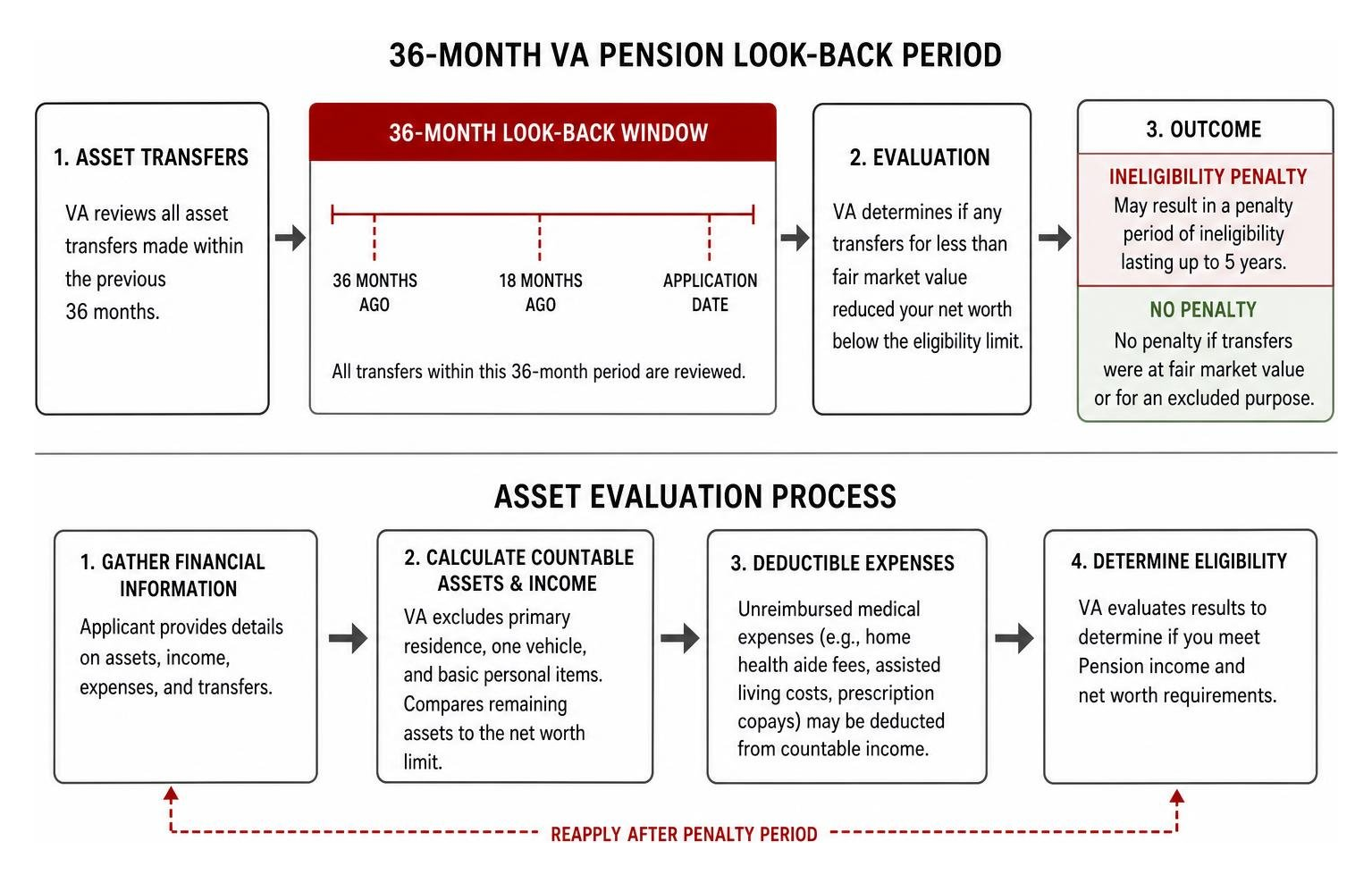
When you submit a VA Pension application, the VA reviews all asset transfers made within the previous 36 months (3 years). If you transferred assets below fair market value that reduced your overall net worth below the eligibility limit, the VA may assess a penalty period of ineligibility lasting up to 5 years.
However, senior veterans can deduct unreimbursed out-of-pocket medical expenses (such as home health aide fees, assisted living costs, or prescription copays) from their countable income, which helps bring income levels within qualifying limits.
How Senior Veterans Over 70 Can Apply for VA Benefits
Filing a claim for VA benefits after age 70 can feel overwhelming, but utilizing proper application channels and organizing documents speeds up processing time.
Required Documents Checklist
Before filing, gather the following paperwork:
- Discharge Papers: Official military separation documents (DD214 or discharge certificate).
- Medical Documentation: Detailed treatment records from private doctors or VA medical centers showing diagnoses and limitations.
- Financial Statements: Bank statements, income records, and asset details (required for needs-based VA Pension claims).
- Specialized Forms:
- VA Form 21-526EZ: Application for Disability Compensation and Related Compensation Benefits.
- VA Form 21P-527EZ: Application for Pension.
- VA Form 21-2680: Examination for Housebound Status or Permanent Need for Regular Aid and Attendance (completed by an attending physician).
- VA Form 10-10EZ: Application for Health Benefits.
Application Channels
- Online: File directly on VA.gov or eBenefits.
- Accredited VSOs: Work with an accredited Veteran Service Officer (VSO) through organizations like the DAV, VFW, or American Legion. VSOs offer professional assistance completely free of charge.
- By Mail: Send completed applications to the VA Claims Intake Center in Janesville, WI.
- In-Person or Phone: Visit a local VA Regional Office, contact assigned regional Outreach Coordinators, or call toll-free at 800-698-2411.
Frequently Asked Questions About Senior Veteran Benefits
Can a senior veteran over 70 receive both VA health care and Aid & Attendance simultaneously?
Yes. VA Health Care and Aid & Attendance are independent programs. Enrolling in VA Health Care allows a senior veteran to receive medical treatment at VA facilities, while Aid & Attendance provides a tax-free cash allowance added to a VA Pension to help pay for home health aides, assisted living, or nursing care.
What is the difference between VA Disability Compensation and VA Pension for seniors?
VA Disability Compensation is awarded for injuries, conditions, or illnesses connected to active military service. It is paid regardless of your personal savings or retirement income.
VA Pension is a needs-based safety net reserved for low-income veterans who served during a designated wartime era. It does not require a service-connected injury, but it evaluates household income and net worth.
How does the 36-month look-back period affect VA Pension eligibility?
The 36-month look-back rule allows the VA to inspect financial transfers made within the 3 years preceding a pension application. If you gifted or sold assets below fair market value to drop below the net worth limit ($163,699), the VA calculates a penalty period during which pension payments are delayed.
Transfers made prior to the 36-month window are not penalized.
Conclusion
Maximizing the Top 10 VA benefits for seniors over 70 can mean the difference between financial stress and a secure, comfortable retirement. From non-service-connected pensions and Aid & Attendance allowances to free Priority Group 1 health care and tax exemptions, these military programs honor your years of military service.
At USMilitary.com, we are dedicated to helping our nation’s military members, veterans, and family caregivers find the resources they deserve. Take time to review your medical records, check state tax laws, and consult an accredited VSO or regional coordinator to submit your claims. For complete military guidance, explore our comprehensive U.S. Veteran Benefits Guide.
Free for Service Members & Veterans
Get the military benefits intel no one tells you about.
Weekly updates on VA benefits, pay changes, and money tips — free for service members and veterans.
No spam. Unsubscribe anytime. Your info is never shared.


Leave a Reply