Who Qualifies for a VA Home Loan? A Quick Answer

VA home loan eligibility requirements are based on three core factors: your military service history, your discharge status, and your ability to meet basic financial standards set by your lender.
Here is a quick summary of who qualifies:
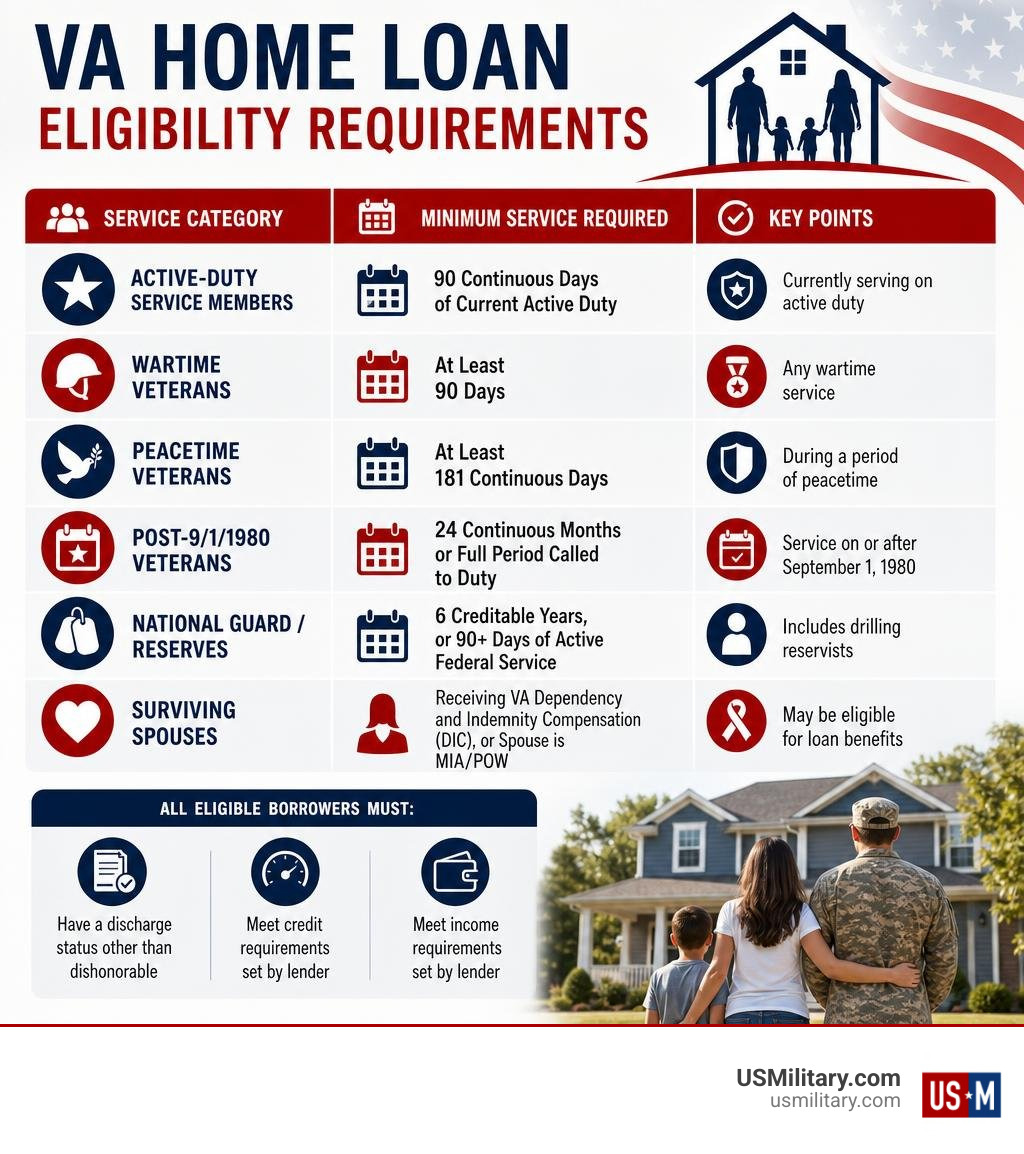
| Category | Basic Requirement |
|---|---|
| Active-duty service members | 90 continuous days of current active duty |
| Wartime veterans | At least 90 days of active service |
| Peacetime veterans | At least 181 continuous days of active service |
| Post-9/1/1980 veterans | 24 continuous months or full period called to duty |
| National Guard / Reserves | 6 creditable years, or 90+ days of active federal service |
| Surviving spouses | Receiving VA Dependency and Indemnity Compensation (DIC), or spouse is MIA/POW |
All eligible borrowers must also have a discharge status other than dishonorable, and must meet credit and income requirements set by their lender.
The VA home loan is one of the most powerful benefits available to American service members — offering zero down payment, no private mortgage insurance, and competitive interest rates. Yet many veterans and service members never use it simply because they are unsure whether they qualify.
That confusion is understandable. Eligibility rules vary by service era, branch, and personal circumstances. But the good news is: more people qualify than they realize.
I’m Larry Fowler, publisher of the USMilitary.com Network since 2007, and I’ve spent nearly two decades helping veterans and service members navigate complex VA benefits — including VA home loan eligibility requirements. In this guide, I’ll walk you through everything you need to know, clearly and simply.
VA Home Loan
See If You Qualify for a $0-Down VA Loan
Check your VA loan eligibility in a few minutes. It's free, with no obligation.
Understanding VA Home Loan Eligibility Requirements

When we talk about VA home loan eligibility requirements, we are looking at a system designed to reward military service. The Department of Veterans Affairs does not actually hand you the cash for your mortgage. Instead, they act as a financial co-signer. By guaranteeing a portion of the loan—typically 25% of the loan amount up to the conforming loan limits set by the Federal Housing Finance Agency (FHFA)—the VA gives private lenders the confidence to offer you incredible terms.
To tap into this benefit, you must first establish that you meet the baseline service criteria. The VA determines eligibility based on when you served, how long you served, and the nature of your discharge. These parameters are outlined in detail on the official Eligibility For VA Home Loan Programs | Veterans Affairs website.
If you do not meet the standard service lengths, do not panic just yet. The VA has built several exceptions into the program to protect those whose service was cut short through no fault of their own. Let’s break down these requirements so you can see exactly where you stand.
Service Era and VA Home Loan Eligibility Requirements
Your minimum active-duty service requirement is heavily dependent on the era in which you served. The VA divides service history into specific wartime and peacetime eras, each with its own set of rules.
Here is how the service eras break down under the standard How to Qualify for a VA Home Loan guidelines:
- The Gulf War Era (August 2, 1990, to Present): If you served during this period, you must have completed at least 24 continuous months of active duty, or the full period (at least 90 days) for which you were called or ordered to active duty. If you are currently on active duty, you qualify after 90 continuous days of service.
- Post-Vietnam Era (May 8, 1975, to August 31, 1980): For this peacetime window, the requirement is 181 continuous days of active duty.
- The Vietnam War Era (August 5, 1964, to May 7, 19 Vietnam era): If you served during this wartime era, you need at least 90 total days of active duty service. For those who served in the Republic of Vietnam, the era starts slightly earlier on February 28, 1961.
- Earlier Wartime Eras (WWII and Korean War): Veterans of these eras generally need a minimum of 90 total days of active duty service.
Meeting these day counts is the first major step. If you served in multiple eras or have a break in service, your requirements may adjust, but the core principle remains: wartime service generally requires fewer days (90 days) than peacetime service (181 days).
National Guard and Reserve Service Criteria
For a long time, members of the National Guard and Selected Reserves faced a much steeper hill to climb to earn their VA home loan benefits. Historically, you had to complete six creditable years of service to qualify. While that six-year rule is still a valid pathway, the rules have expanded significantly.
Today, National Guard and Reserve members can qualify much faster if they are called to active duty. Specifically, if you have at least 90 days of active service—including at least 30 consecutive days under Title 32 orders—you meet the service requirements. This change has opened the door for thousands of Guard members who deployed for state-side missions, disaster relief, or Covid-19 response efforts.
If you are qualifying under the traditional six-year rule, you must have served honorably in the Selected Reserve or National Guard, participated in weekend drills and annual training, and maintained your “creditable” status. You will need to show proof of this service, typically via an NGB Form 22 (for National Guard) or a Retirement Points Statement (for Reserves).
Surviving Spouse Eligibility Pathways
The VA home loan benefit is not just for the veterans themselves; it is also designed to support the families of those who made the ultimate sacrifice. Surviving spouses can establish eligibility for a VA loan under very specific circumstances.
You may qualify for a Certificate of Eligibility (COE) as a surviving spouse if:
- You are the unremarried spouse of a veteran who died in service or from a service-connected disability.
- You are the spouse of an active-duty service member who is currently listed as Missing in Action (MIA) or captured as a Prisoner of War (POW) for at least 90 days (though this eligibility is limited to a one-time use).
- You are a surviving spouse receiving Dependency and Indemnity Compensation (DIC) benefits.
There are also important rules regarding remarriage. Historically, remarrying disqualified a surviving spouse. However, under current guidelines, if you remarry on or after age 57, and after December 16, 2003, you can still maintain your eligibility. To apply, surviving spouses must submit VA Form 26-1817 (Request for Determination of Loan Guaranty Eligibility) along with the veteran’s DD Form 214 and death certificate.
Discharge Exceptions and Character of Service
To use the VA home loan benefit, your discharge from the military must be under conditions “other than dishonorable.” This means honorable, general, and under honorable conditions discharges are fully acceptable.
But what happens if you received an “Other Than Honorable” (OTH) or bad conduct discharge? While these statuses make qualifying much harder, they are not automatic permanent roadblocks. You have two primary options:
- Request a Character of Discharge Review: You can ask the VA to review your service records to determine if your service can be considered “honorable” for VA benefit purposes, regardless of the discharge code on your DD Form 214.
- Apply for a Discharge Upgrade: You can petition your military branch’s Discharge Review Board to have your discharge upgraded.
Additionally, if you were discharged before meeting the minimum service day requirements, you may still qualify if you were separated for one of these approved reasons:
- An early out or convenience of the government (must have completed at least 20 months of a 2-year enlistment).
- Hardship.
- An involuntary Reduction in Force (RIF).
- Certain medical conditions.
- A service-connected disability.
If you fall into any of these categories, the VA will review your specific separation codes to verify your eligibility.
How to Obtain and Verify Your Certificate of Eligibility (COE)

Once you believe you meet the service requirements, the next step is to prove it. The Certificate of Eligibility (COE) is the official document issued by the VA that tells a lender, “Yes, this person has earned the VA home loan benefit, and here is how much entitlement they have available.”
✉ Get updates like this in your inbox
Weekly VA benefit changes, pay updates, and money tips for service members, veterans, and military families. Free, no spam.
You do not need to have your COE in hand before you start talking to a lender or shopping for a home. In fact, we often recommend starting the process with a VA-approved lender because they have access to an online system called Web LGY. Through this system, lenders can pull your COE in a matter of seconds using just your Social Security Number and Date of Birth.
According to VA data, nearly all COE requests are now processed electronically, and about two-thirds of them are issued immediately. If your records are complete in the VA database, your lender can get your certificate while you are on the phone. If there is a gap in the records, you will need to submit supporting documentation. You can learn more about this process via the Certificate of Eligibility – VA Home Loans portal.
Required Documentation by Service Branch
If the VA cannot instantly verify your service, you must provide physical proof. The documents required depend entirely on your service status and branch:
- Veterans: You must provide a copy of your DD Form 214 (specifically Copy 4, which shows the character of service in Item 24 and the narrative reason for separation in Item 28).
- Active-Duty Service Members: Since you don’t have a DD Form 214 yet, you must provide a current statement of service. This letter must be signed by, or by direction of, your commander, adjutant, or personnel officer. It must show your full name, Social Security Number, date of birth, the date you entered active duty, and verify that you have no lost time.
- National Guard: You need your NGB Form 22 (Report of Separation and Record of Service) for each period of Guard service, or a statement of service if you are currently serving.
- Selected Reserves: You must provide a copy of your latest Retirement Points Statement (often called a DA Form 5016 or equivalent) and proof of honorable service.
Gathering these documents early prevents delays when you are ready to make an offer on a home. For a complete checklist of what your specific situation requires, check out our guide on VA Home Loan Qualifications.
Steps to Apply for Your COE
If you prefer not to use a lender to pull your COE, or if you simply want to see your entitlement status beforehand, you can apply for it yourself. There are three ways to do this:
- Apply Online: Go to the official VA.gov website and log into your account (using ID.me or Login.gov credentials). Navigate to the housing assistance section and apply for your COE electronically. This is the fastest self-service option.
- Lender-Assisted: As mentioned, let your mortgage lender do the heavy lifting. They will submit the request through the secure Web LGY portal.
- Apply by Mail: You can print out VA Form 26-1880 (Request for a Certificate of Eligibility) and mail it, along with photocopies of your proof of service, to the Atlanta Eligibility Center. Be warned: mailing your application is the slowest method and can take several weeks to process.
Financial Underwriting: Credit, Income, and Debt Guidelines
Having a valid COE in your hand means you are eligible for a VA loan, but it does not mean you are approved for one. The VA establishes the framework for the program, but private banks, credit unions, and mortgage companies are the ones risking their capital. Therefore, you must also pass the lender’s financial underwriting.
Lenders look at your credit history, income stability, and overall debt load to ensure you can comfortably afford the monthly payments. Understanding these financial guidelines is just as critical as understanding the service requirements. For a deep dive into what a VA loan actually is and how it functions, read our comprehensive VA Home Loan Definition page.
Financial and Credit VA Home Loan Eligibility Requirements
One of the biggest myths about VA loans is that the government requires a perfect credit score. In reality, the VA itself does not set a minimum credit score requirement. Instead, they instruct lenders to look at your entire financial profile.
However, to protect themselves from default, most private lenders impose their own “overlays,” which are additional requirements on top of the VA’s baseline rules. Most lenders typically require a 620 FICO credit score to obtain VA loan financing, though some specialized lenders may go lower if you have strong compensating factors.
In addition to your credit score, lenders will evaluate:
- Income Stability: You must show a stable, reliable source of income that is expected to continue for at least three years. This is verified using W-2s, tax returns, and recent pay stubs.
- Debt-to-Income (DTI) Ratio: Your DTI is the percentage of your gross monthly income that goes toward paying debts (including your future mortgage, credit cards, auto loans, and student loans). While the VA’s benchmark DTI ratio is 41%, they do not cap it. If your DTI is over 41%, you can still get approved if you meet strict residual income guidelines.
Understanding Residual Income Guidelines
If there is one financial metric that is unique and vital to the VA loan program, it is residual income. In fact, the VA values residual income much more than the standard DTI ratio.
Residual income is the amount of discretionary cash you have left over each month after paying all of your major expenses, including your new mortgage payment, property taxes, home insurance, maintenance, and all personal debts. The VA wants to ensure that after you pay for your housing, you still have enough money to buy groceries, put gas in the car, buy clothes for your kids, and live comfortably.
The VA’s residual income requirements are highly detailed and vary based on two main factors:
- Your Family Size: A family of four requires more residual income than a single homebuyer.
- Your Geographic Region: The US is split into four regions (Northeast, Midwest, South, and West), each with different cost-of-living standards.
For example, a family of four in the South might need $1,003 in residual monthly income, while the same family in the Northeast might need $1,025. By enforcing these guidelines, the VA loan program has historically maintained one of the lowest foreclosure rates of any mortgage product on the market.
VA Loan Guaranty vs. FHA Mortgage Insurance
To understand why the VA loan is such a spectacular deal, it helps to compare it to its closest government-backed sibling: the FHA loan.
| Feature | VA Loan | FHA Loan |
|---|---|---|
| Down Payment | 0% (For 74% of buyers in FY2024) | Minimum 3.5% |
| Monthly Mortgage Insurance | None | Required for the life of the loan |
| Government Guaranty | Typically 25% of the loan amount | Insures 100% of the loan for the lender |
| Upfront Fees | One-time Funding Fee (can be rolled into loan) | Upfront Mortgage Insurance Premium (UFMIP) |
| Funding Fee Waiver | Yes (For service-connected disabilities) | No waivers available |
Because the VA guarantees 25% of the loan, lenders do not require you to buy monthly Private Mortgage Insurance (PMI). On an FHA or conventional loan with less than 20% down, that monthly insurance premium can easily add $100 to $300 to your monthly payment. Over a 30-year mortgage, saving that money keeps tens of thousands of dollars in your pocket.
VA Home Loan
See If You Qualify for a $0-Down VA Loan
Check your VA loan eligibility in a few minutes. It's free, with no obligation.
Frequently Asked Questions About VA Loans
Can I reuse my VA loan benefit more than once?
Yes! The VA home loan is a lifetime benefit. You do not lose it just because you used it once. You can restore your full entitlement under several conditions:
- Sell and Pay Off: If you sell the home purchased with your prior VA loan and pay off the mortgage in full, your entitlement is completely restored.
- One-Time Restoration: If you pay off your VA loan in full but want to keep the property (perhaps as a rental), you can request a one-time restoration of entitlement to buy a new primary residence.
- Assumptions: If an eligible veteran assumes your VA loan and substitutes their own entitlement for yours, your entitlement is freed up. You can read more about how this works on our VA Assumable Loan page.
To find out more about the limits of reusing this benefit, check out How Many Times Can You Use a VA Loan?.
Is a down payment required for a VA loan?
No down payment is required for borrowers with full entitlement. In fact, 74% of VA loan purchasers in FY2024 did not make a down payment.
However, you can choose to make a down payment if you wish. Doing so can lower your monthly payments and reduce the upfront VA Funding Fee. The funding fee is a one-time charge applied to VA loans to keep the program running for future generations, but it is entirely waived for veterans with service-connected disabilities, Purple Heart recipients, and qualifying surviving spouses.
What happens if I default on my VA loan?
If you fall on hard times and struggle to make your payments, the VA has some of the strongest loss mitigation programs in the country. They employ dedicated loan technicians who work directly with you and your servicer to find alternatives to foreclosure, such as loan modifications, repayment plans, or forbearance.
In recent years, the VA even launched a temporary partial claim program to assist veterans who fell behind during times of economic hardship. If a foreclosure does occur, it will impact your remaining entitlement. To restore your entitlement in the future, you must repay the amount the government lost on the guaranty.
Conclusion
Navigating VA home loan eligibility requirements can feel overwhelming, but the reward is well worth the effort. By understanding your service era requirements, securing your Certificate of Eligibility, and preparing your finances, you can unlock a mortgage benefit that has helped millions of military families achieve the dream of homeownership.
At USMilitary.com, we are committed to being your central hub for military resources, financial planning, and career guidance. Whether you are analyzing Air Force Enlisted Ranks or preparing to buy your first home, we are here to support you every step of the way.
Are you ready to take the next step on your homebuying journey? We highly recommend starting with our step-by-step guide: From Service to Sanctuary: How to Apply for Your VA Home Loan. For more resources and expert military guidance, visit us today at USMilitary.com.
(And if you are looking for personal inspiration as you transition through life’s major milestones, check out the powerful book Dare to Live Greatly to help guide your path.)
Free for Service Members & Veterans
Get the military benefits intel no one tells you about.
Weekly updates on VA benefits, pay changes, and money tips — free for service members and veterans.
No spam. Unsubscribe anytime. Your info is never shared.