What VA Disability Rating Charts Tell You About Your Monthly Pay
VA Disability Rating Charts are the official tables that show exactly how much tax-free money you receive each month based on the severity of your service-connected condition.
Here’s a quick look at the 2026 monthly rates by rating level:
| VA Disability Rating | Monthly Payment (Veteran Alone) |
|---|---|
| 10% | $180.42 |
| 20% | $356.66 |
| 30% | $552.47 |
| 50% | $1,075.16 |
| 70% | $1,759.19 |
| 100% | $3,938.58 |
A few key facts to know upfront:
- Ratings run from 0% to 100%, in 10% increments
- 10% and 20% ratings pay a flat rate — dependents don’t increase it
- 30% or higher unlocks extra pay for spouses, children, and parents
- Multiple disabilities are not simply added together — the VA uses a special formula called “VA Math”
- Payments are completely tax-free at the federal level
- Rates increased 2.8% in 2026, effective December 1, 2025
These charts are the foundation of understanding what you’ve earned — and whether you may be leaving money on the table.
I’m Larry Fowler, publisher of USMilitary.com and a longtime resource for veterans navigating VA Disability Rating Charts and benefit trends since 2007. In the sections ahead, I’ll walk you through exactly how these charts work, how to calculate combined ratings, and how to make sure your rating reflects the true impact of your service.
Understanding VA Disability Rating Charts and “VA Math”
When you look at VA Disability Rating Charts, the first thing you might notice is that 10% plus 10% does not equal 20%. In the Department of Veterans Affairs, this is affectionately (or sometimes frustratingly) known as “VA Math.”
The VA uses the Whole Person Theory to determine your level of disability. The idea is simple: a person can never be more than 100% disabled. When the VA evaluates multiple conditions, they don’t add the percentages together. Instead, they determine how much of your “whole self” is already disabled and then take a percentage of what is left.
The Combined Ratings Table
To make this easier, the VA provides a Table I-Combined Ratings Table which acts as a lookup tool for these calculations. You can also find more details on our VA Disability Pay Tables page.
Here is how the math actually works:
- Order your disabilities: Start with your highest rating first.
- Calculate the remaining efficiency: If you have a 50% disability, you are 50% “efficient” (100% – 50%).
- Apply the next rating: If your second disability is 30%, the VA takes 30% of your remaining 50% efficiency. 30% of 50 is 15.
- Combine them: 50% + 15% = 65%.
- Round: The VA rounds the final number to the nearest 10%. Since 65 ends in a 5, it rounds up to 70%.
As noted in the About Disability Ratings | Veterans Affairs guide, two 10% disabilities combine to 19%, which the VA then rounds down to a 20% pay grade (wait, no—19% rounds to 20%). Actually, 19% rounds to 20% because any number ending in 5 through 9 rounds up, while 1 through 4 rounds down.

2026 VA Disability Compensation Rates and COLA Increases
Every year, the VA adjusts compensation rates to keep up with inflation. This is known as the Cost-of-Living Adjustment (COLA). For 2026, veterans saw a 2.8% COLA increase, which officially went into effect on December 1, 2025. This ensures that your VA Disability Rates 2026 maintain their purchasing power as the cost of groceries, housing, and fuel rises.
By law, these increases must match the percentage used by the Social Security Administration. You can find the full breakdown of these updates on our 2025 VA Disability Rates Increase resource.
According to the Current Veterans Disability Compensation Rates, a veteran with a 100% rating and no dependents will receive $3,938.58 monthly starting in 2026. This is a significant jump from previous years and highlights the importance of staying updated on annual changes.
How Dependents Impact Your VA Disability Rating Charts Pay
One of the most common questions we get at USMilitary.com is: “Do my kids or spouse change my check amount?” The answer depends entirely on your rating.
If your combined rating is 10% or 20%, your monthly payment is a fixed amount. The VA does not provide additional compensation for dependents at these lower levels. However, once you hit a 30% minimum rating, the VA Disability Rates increase based on who you support.
✉ Get updates like this in your inbox
Weekly VA benefit changes, pay updates, and money tips for service members, veterans, and military families. Free, no spam.
Eligible dependents include:
- Legal Spouses: Including those in same-sex marriages.
- Children under 18: Biological, adopted, or step-children.
- School-age children (18-23): As long as they are unmarried and enrolled in a VA-approved school.
- Dependent Parents: If their income and net worth are below a certain limit.
You can see the specific dollar amounts for these additions on our Veteran Disability Rates page.
Additional Pay for Aid and Attendance and Special Circumstances
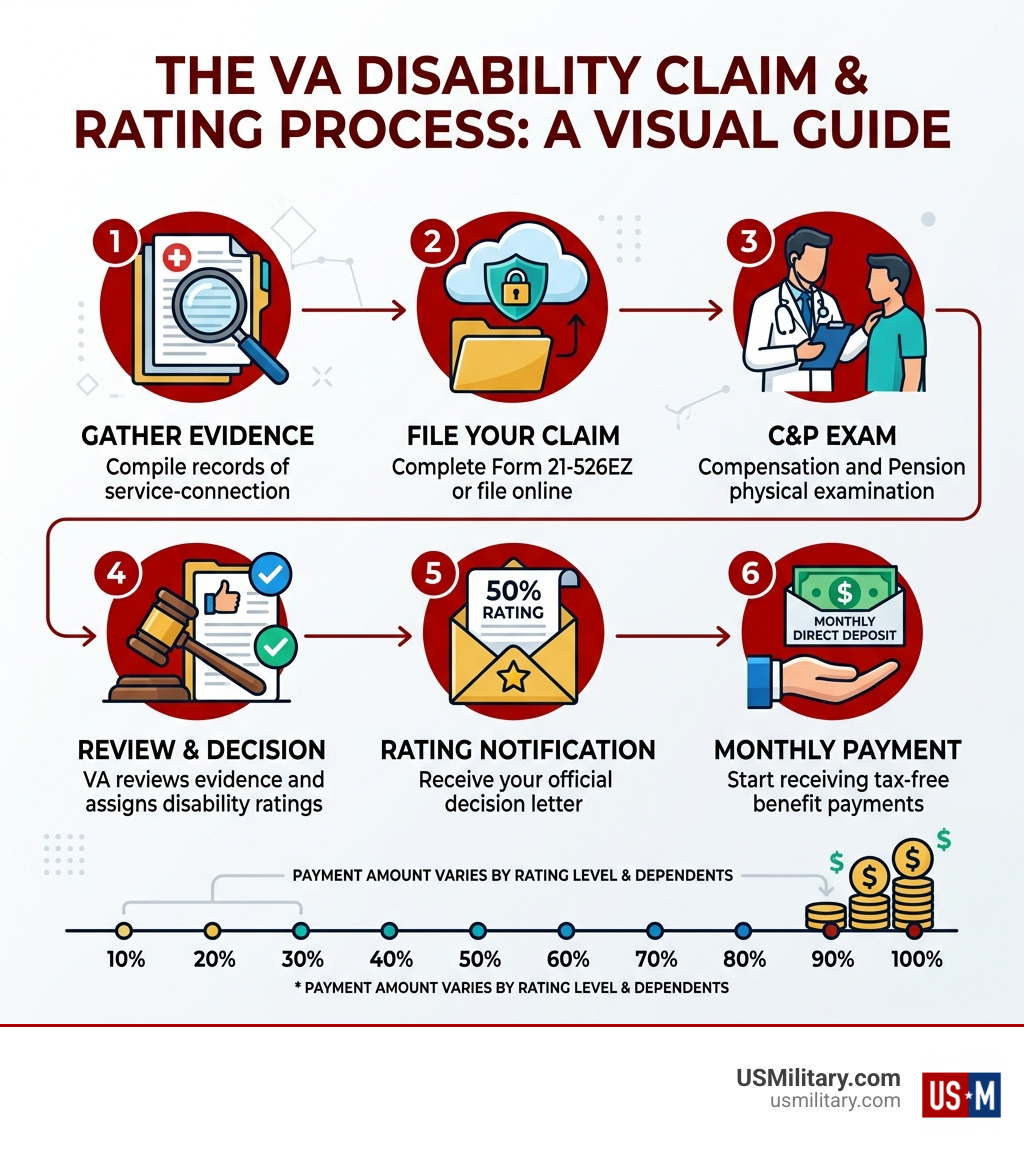
In some cases, the standard VA Disability Rating Charts don’t tell the whole story. If you or your spouse requires the “Aid and Attendance” of another person to perform daily activities (like bathing, dressing, or feeding), you may be eligible for Special Monthly Compensation (SMC).
For example, at the 100% rating level, having a spouse who requires Aid and Attendance adds $201.41 to your monthly check. There are also severe disability premiums for veterans who have suffered the loss of use of a limb or have specific combinations of high-rated disabilities. We dive deeper into these “added amounts” on our VA Disability Rates 4 guide.
Common Conditions and the VA Rating Schedule
The VA doesn’t just guess at percentages. They follow a massive legal document called the VA Schedule for Rating Disabilities (VASRD), found in Title 38 CFR Part 4. This schedule uses diagnostic codes to assign ratings based on medical evidence.
Some of the Top 10 Most Common VA Disability Claims include:
- Tinnitus: Usually rated at a flat 10%.
- Knee Pain: Rated based on range of motion.
- Post-Traumatic Stress Disorder (PTSD): Rated at 0, 10, 30, 50, 70, or 100%.
- Back Pain: Often rated between 10% and 40% depending on the stiffness of the spine. You can find more on VA Disability for Back Pain here.
Whether you are dealing with a Chronic Headache VA Disability Rating or respiratory issues, the key is the C&P (Compensation and Pension) exam. This is where a doctor evaluates your symptoms against the VASRD criteria.
Navigating VA Disability Rating Charts for Secondary Conditions
Often, one service-connected injury leads to another. These are called secondary conditions. For instance, many veterans find that their service-connected PTSD leads to Sleep Apnea, or that medication for back pain causes GERD.
To get these rated, you typically need a Nexus Letter. This is a document from a medical provider that “links” your secondary condition to your primary service-connected disability. We provide extensive resources on how to obtain a Nexus Letter for your VA Claim and why it is the “missing link” for many successful appeals.
Even if you have a pre-existing condition that was worsened by your service, you can still receive compensation for the “level of aggravation.” For example, if you entered the military with a 10% hearing loss that worsened to 30% because of your MOS, the VA may grant you a 20% rating for that aggravation.
How to Increase Your Rating and Qualify for TDIU
If your conditions prevent you from maintaining “substantially gainful employment,” but your combined rating hasn’t reached 100% yet, you might qualify for Total Disability based on Individual Unemployability (TDIU).
TDIU allows the VA to pay you at the 100% rate even if your math only adds up to 60% or 70%. To qualify, you generally need:
- One service-connected disability rated at at least 60%, OR
- Two or more disabilities with a combined rating of at least 70%, with at least one disability rated at 40% or more.
If you feel your current rating is too low, you can file to Increase your VA Disability Rating. This often involves submitting new medical evidence or a VA Reconsideration Form if you disagree with a recent decision. If your VA Claim is Denied, don’t lose heart—many veterans succeed on appeal by providing a stronger Nexus Letter or additional buddy statements.
Frequently Asked Questions about VA Disability Ratings
How long does it take to process a VA disability claim?
As of late 2025, the average processing time for a VA disability claim is approximately 85 days. However, this can vary wildly based on the complexity of your claim. To speed things up, we recommend filing a “Fully Developed Claim” (FDC), where you submit all medical records and nexus letters upfront. You can look for Signs Your Disability Claim Will Be Approved to help manage the waiting period anxiety. For more tips, check out our guide on Easy VA Disability Claims.
Is VA disability compensation taxable?
The short answer is no. VA Disability is not taxable at the federal level. You do not need to report it as income to the IRS. Additionally, many states offer property tax exemptions or other tax breaks for disabled veterans. Knowing your VA Pay Dates can also help you budget this tax-free income effectively.
What is the difference between individual and combined ratings?
An individual rating is the percentage assigned to a single diagnostic code (like 30% for a foot injury). Your combined rating is the final number reached after putting all those individual ratings through the “VA Math” ringer.
One important factor in this calculation is the Bilateral Factor. If you have disabilities affecting both arms, both legs, or paired skeletal muscles, the VA adds a 10% “bonus” to those ratings before combining them with the rest of your conditions. This can often be the boost needed to move from a 90% to a 100% total rating. You can learn more about how these are weighed during Veteran Benefits Evaluations.
Conclusion
Navigating VA Disability Rating Charts can feel like learning a second language, but it’s a language every veteran should speak. Whether you are just starting your claim or looking to increase a rating that no longer reflects your health, understanding “VA Math” and the 2026 COLA increases is the first step toward securing your future.
At USMilitary.com, our mission is to provide the most accurate, nonbiased information to help you maximize the benefits you earned through your service. Don’t leave your hard-earned compensation to chance. Explore our full VA Disability Rating Charts 2025 guide and take control of your benefits today.
Free for Service Members & Veterans
Get the military benefits intel no one tells you about.
Weekly updates on VA benefits, pay changes, and money tips — free for service members and veterans.
No spam. Unsubscribe anytime. Your info is never shared.


