Which Is Better For Active Military & Veterans: VA Loan vs Conventional Loan?

A VA loan vs conventional loan: side by side comparison comes down to a few key differences that can save — or cost — you tens of thousands of dollars over the life of your mortgage.
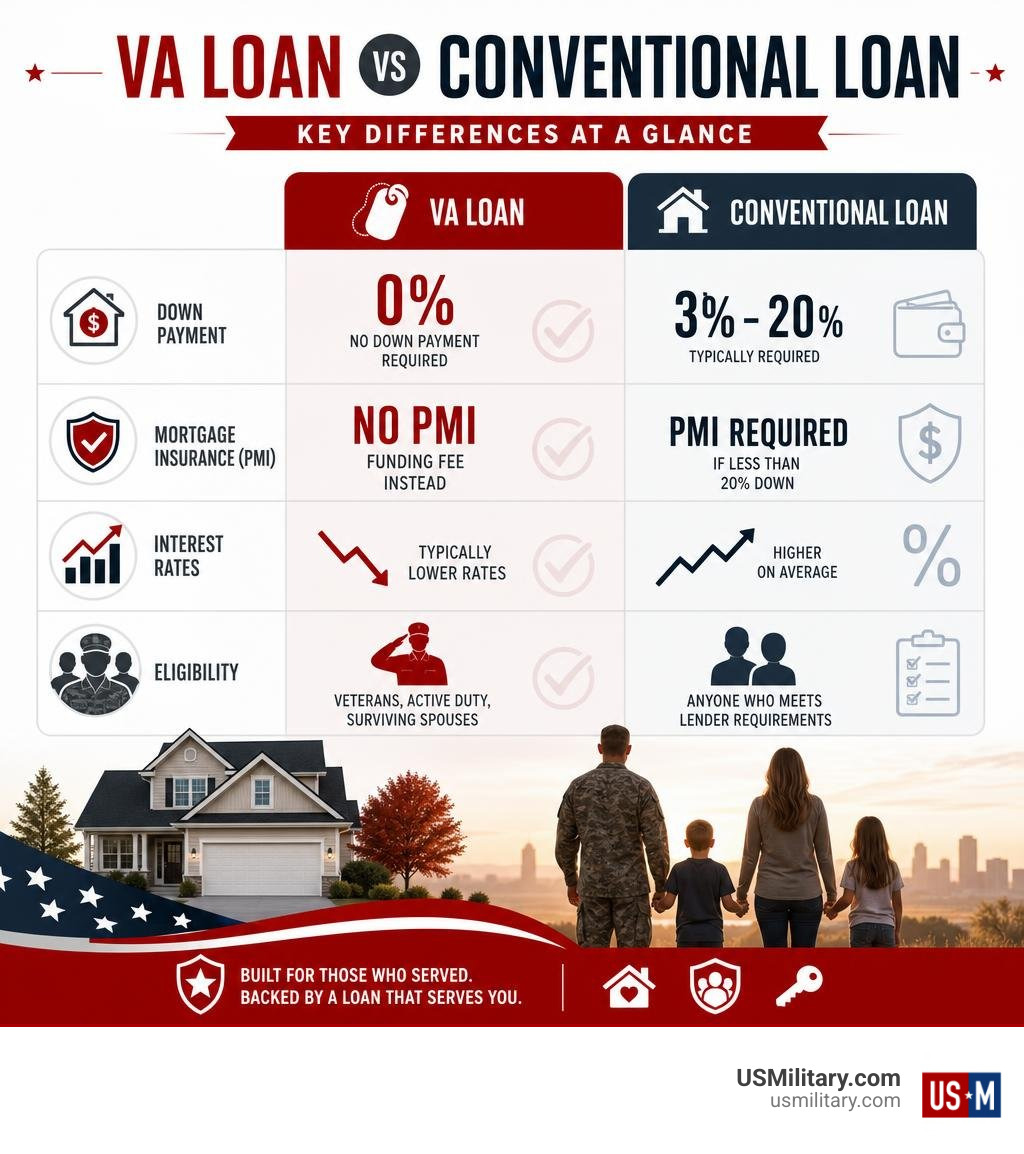
Here’s a quick look at how they stack up:
| Feature | VA Loan | Conventional Loan |
|---|---|---|
| Who can apply | Veterans, active duty, surviving spouses | Anyone who meets lender requirements |
| Down payment | 0% | 3% – 20% |
| Mortgage insurance | None (funding fee instead) | Required if less than 20% down |
| Average interest rate (2024) | ~0.47% lower than conventional | Higher on average |
| Credit score minimum | 620 (lender overlay, no VA minimum) | 620+ |
| Property types | Primary residence only | Primary, second home, investment |
| One-time fee | VA funding fee (1.25% – 3.3%) | None |
| Loan limit (2026) | No limit (with full entitlement) | $832,750 in most counties |
For most eligible veterans and service members, the VA loan wins on cost. But the right choice depends on your down payment, credit score, and what you’re buying.
In 2024, over 4.75 million conventional loans were originated compared to roughly 490,000 VA loans — yet VA loans consistently offered lower rates and required no down payment. That gap represents a major opportunity many eligible borrowers leave on the table.
I’m Larry Fowler, publisher of USMilitary.com and a long-time advocate for military financial education — including helping veterans navigate decisions like the VA loan vs conventional loan side-by-side comparison. Since 2007, I’ve helped millions of active-duty members and veterans cut through confusing benefit information to make smarter financial choices. Let’s break down exactly what you need to know.
VA Home Purchase
$0 Down. No PMI. It's Your Earned Benefit.
Eligible veterans and service members can buy a home with no down payment and no private mortgage insurance.
VA Loan vs Conventional Loan: Side-by-Side Comparison
When we look at the 2026 housing market, choosing the right mortgage is one of the most critical financial decisions you will ever make. While the vast majority of U.S. home buyers default to conventional financing simply because it is the standard, military-conforming buyers have access to what is arguably the most powerful wealth-building tool in real estate: the VA home loan.
To put this in perspective, over 4,750,000 conventional loans were originated in 2024 compared to around 490,000 VA loans. This massive volume difference isn’t because conventional loans are inherently better; rather, it is because conventional loans are open to the general public, whereas VA loans are an exclusive benefit earned through military service.
For those who qualify, comparing these two programs side-by-side reveals a stark contrast. Conventional loans are structured around risk mitigation for private lenders, requiring down payments and private mortgage insurance (PMI) to offset the risk of borrower default. VA loans, on the other hand, are backed by the federal government. This government guaranty allows lenders to extend exceptionally favorable terms—including zero down payment and no monthly mortgage insurance—to those who have served.
If you are ready to explore your options, working with the Best Lenders for VA Home Loans can help you secure the ideal terms for your situation. When analyzing a VA loan vs conventional loan: side by side comparison, it is helpful to look at both programs as distinct paths. To help you decide, we can weigh the opinions of consumer advocates in guides like VA vs. conventional loans: Which mortgage is right for you? and VA Loans Vs. Conventional Loans: What’s The Difference? | Bankrate to find the exact sweet spot for your wallet.
Eligibility, Credit, and Income Requirements
Understanding how lenders evaluate your financial profile is the first step in the homebuying journey. Both loan programs have strict underwriting standards, but they measure your financial stability and debt-to-income (DTI) ratio through very different lenses.
Eligibility Requirements for a VA Loan vs Conventional Loan: Side-by-Side Comparison
The most fundamental difference between these two programs is who can actually apply.
To obtain a VA loan, you must prove your military connection by securing a Certificate of Eligibility (COE). This document verifies that you meet the minimum service requirements established by the Department of Veterans Affairs. Generally, eligibility is extended to:
- Active-duty service members who have served at least 90 continuous days.
- Veterans who meet specific service length requirements depending on the era in which they served.
- National Guard and Reserve members.
- Surviving spouses of service members who died in the line of duty or from a service-connected disability.
If you meet these requirements, you can access the full suite of VA Loans benefits.
Conversely, conventional loans have no military service requirement. They are open to any civilian borrower who meets standard conforming loan guidelines set by Fannie Mae and Freddie Mac. As detailed in the VA vs Conventional Loan | Housentia analysis, conventional loans rely entirely on financial qualification rather than service-based eligibility.
Credit Score and Debt-to-Income (DTI) Ratios
When it comes to credit score minimums and DTI ratios, the VA loan program is famously more flexible.
Technically, the Department of Veterans Affairs does not set a minimum credit score requirement. Instead, individual mortgage lenders establish their own minimum standards, known as “lender overlays.” Most VA lenders set their benchmark credit score at 620, though some will go down to 580 or even lower if there are strong compensating factors.
Conventional loans also typically require a minimum credit score of 620. However, the key difference lies in how credit scores affect your pricing. On a conventional loan, a credit score below 740 will result in higher interest rates and significantly more expensive monthly PMI premiums. On a VA loan, the rate pricing remains highly competitive even for borrowers with scores in the mid-600s. To secure the absolute lowest rate possible, check out our guide on How to Get the Best VA Home Loan Rate.
The DTI ratio—which measures your monthly debt payments against your gross monthly income—is another area of contrast. Conventional lenders prefer a DTI ratio of 36% or lower, though they may allow up to 45% or 50% for borrowers with excellent credit and large down payments.
The VA loan program uses a flexible 41% benchmark but relies heavily on a unique metric called the residual income method. Residual income is the amount of money you have left over each month after paying all major living expenses, including your mortgage, taxes, insurance, and estimated utility costs. If your residual income is strong, VA underwriting is highly permissive of DTIs well over 45%. You can read more about how these qualifying factors differ in the comparison of Conventional vs FHA vs VA Loan: How to Pick the Right Mortgage | SwitchWize .
Down Payments and Mortgage Insurance Costs

For most buyers, the biggest hurdle to homeownership is the upfront cash required to close. This is where the VA loan vs conventional loan: side by side comparison highlights the massive financial advantage of military benefits.
Down Payment Requirements for a VA Loan vs Conventional Loan: Side-by-Side Comparison
The headline benefit of the VA loan is its zero down payment requirement. Qualified military buyers can purchase a home with 100% financing, keeping their hard-earned cash in their pockets for moving expenses, home furnishings, or emergency savings.
Conventional loans require a minimum down payment of 3% for first-time homebuyers and 5% for repeat buyers. While 3% to 5% might sound small, let’s look at the math in the real world.
The average home sale price in Q2 of 2023 was $503,000. Under a conventional loan program, a borrower putting down 5% would have to bring $25,150 just for the down payment, plus thousands more in closing costs. A VA buyer purchasing the exact same home could do so with $0 down. To run your own scenarios and see how down payments affect your monthly payment, try our VA Loan Payment Calculator.
Private Mortgage Insurance (PMI) vs. the VA Funding Fee
On a conventional loan, if you put down less than 20%, you are required to pay Private Mortgage Insurance (PMI). PMI protects the lender if you default on your loan. It does not protect you. Depending on your credit score and down payment amount, PMI can add anywhere from $100 to over $300 to your monthly mortgage payment. This monthly fee persists until you build 20% equity in your home and successfully petition your lender to remove it.
VA loans never require monthly mortgage insurance. This represents a massive monthly savings opportunity. Instead of monthly PMI, the VA program charges a one-time, upfront cost known as the VA funding fee.
The funding fee is a percentage of the loan amount, ranging from 1.25% to 3.3%, depending on your down payment size and whether it is your first time using the benefit. For a first-time buyer putting zero down, the funding fee is typically 2.15%.
The best part? This fee can be rolled directly into the loan balance, meaning you still do not need to bring cash to closing. Furthermore, veterans with a service-connected disability rating of 10% or higher, Purple Heart recipients, and eligible surviving spouses are completely exempt from paying the funding fee. For more details on these exemptions, refer to our comprehensive guide on VA Loans or check the side-by-side cost breakdowns in VA Loans vs Conventional Loans – Veterans United .
Interest Rates, Property Standards, and Loan Limits

Beyond the initial purchase requirements, the long-term cost of your home is heavily dictated by your interest rate, property condition, and structural rules.
Interest Rate Trends in 2026
Historically, VA loans have held the lowest average 30-year fixed rate on the market for the last six consecutive years. This trend remains strong in 2026.
Because the federal government guarantees a portion of the loan, lenders take on significantly less risk. They pass these savings on to borrowers in the form of lower interest rates. In fact, VA loan rates were 0.47% lower on average than conventional rates in 2024.
Over a 30-year term on a $400,000 mortgage, a rate difference of nearly half a percent can save you more than $40,000 in interest alone. To stay updated on how to capitalize on these spreads, read How to Get the Best VA Home Loan Rate and review the cost-benefit analysis in VA Loans vs Conventional Loans: Which Costs Less in 2026 .
Minimum Property Requirements (MPRs) and Appraisals
One area where some buyers experience friction is the appraisal process. Both loans require an appraisal to establish the home’s fair market value, but VA appraisals include an extra layer of scrutiny known as Minimum Property Requirements (MPRs).
The VA appraisal is designed to ensure the home is safe, sanitary, and structurally sound. VA appraisers look closely at critical items like:
- Heating and electrical systems.
- Roofing integrity (must have remaining life).
- Safe drinking water and proper sewage disposal.
- Absence of wood-destroying insects (termites).
- Lead-based paint and dry rot.
If a home fails to meet these MPRs, the repairs must be completed before the loan can close. While this protects veterans from buying “money pits,” it does make VA loans less suitable for distressed fixer-uppers. Conventional appraisals are much more flexible regarding minor cosmetic or non-structural property conditions. If you want a smooth, hassle-free path to closing, check out our guide on securing VA Home Loans with No Stress.
Property Types, Loan Limits, and Assumability
The rules governing how you use your property and how you can transfer your loan down the road differ substantially between these two programs.
- Property Types: VA loans are strictly reserved for primary residences. You must intend to occupy the home within 60 days of closing. You cannot use a VA loan to buy a dedicated vacation home or a straight investment rental. However, you can use a VA loan to purchase a 2-to-4-unit multi-family property, provided you live in one of the units (a strategy often called “house hacking”). Conventional loans are highly flexible, allowing you to purchase primary residences, second homes, and pure investment properties.
- Loan Limits: As of 2026, the standard conforming loan limit for conventional loans is $832,750 in most counties. If you need to borrow more, you must look into jumbo loans, which carry stricter qualification rules. For VA loans, there are no statutory loan limits for borrowers with full VA entitlement. You can borrow as much as a lender is willing to extend to you without needing a down payment.
- Assumability: VA loans are fully assumable. This means that if you sell your home, the buyer can take over your existing mortgage rate and terms—even if they are a civilian (though they must qualify through the lender). In a high-rate environment, having an assumable VA loan with a low rate is an incredibly valuable selling feature. Conventional loans are almost never assumable. If you’re wondering how these rules impact your long-term benefits, explore How Long Can I Use a VA Loan?.
VA Home Purchase
$0 Down. No PMI. It's Your Earned Benefit.
Eligible veterans and service members can buy a home with no down payment and no private mortgage insurance.
Frequently Asked Questions about VA and Conventional Loans
Navigating the mortgage landscape can raise plenty of questions. Here are some of the most common inquiries we receive from military home buyers.
For most eligible military members, yes—but not in every single scenario.
The VA loan is almost always the clear winner if you are putting less than 20% down because it eliminates monthly PMI and offers lower interest rates. However, if you plan to put 20% or more down, have an exceptional credit score (740+), and want to avoid the one-time VA funding fee entirely, a conventional loan might be highly competitive. It is always wise to compare both loan estimates side-by-side to determine which program delivers the lowest lifetime cost for your specific financial situation.
No, you cannot use a VA loan to purchase a vacation home or an investment property directly. The VA program requires you to certify that you will occupy the property as your primary residence.
However, you can buy a multi-unit property (up to four units) with a VA loan, live in one unit, and rent out the other three. Additionally, if you live in a home purchased with a VA loan for at least one year and later decide to move, you can keep the home, convert it into a rental property, and potentially use your remaining entitlement to buy a new primary residence.
In highly competitive seller’s markets, there is sometimes a misconception that conventional loans are preferable because they are perceived to close faster and have less stringent appraisal guidelines.
As of February 2025, the average time to close for a conventional purchase loan was 43 days, while VA loans typically close in 40 to 50 days—making the actual timeline difference negligible. Working with an experienced real estate agent who knows how to educate listing sellers on the strength of a VA loan can easily overcome any outdated market perceptions.
Conclusion
When we evaluate a VA loan vs conventional loan: side by side comparison, the data consistently points to one conclusion: for the vast majority of eligible military members, veterans, and surviving spouses, the VA loan is an unmatched financial benefit. It breaks down the barriers to homeownership by eliminating the down payment and monthly mortgage insurance, while routinely offering the lowest interest rates on the market.
However, your homebuying journey is unique. Your credit score, cash reserves, and long-term investment goals all play a role in determining the absolute best path forward.
At USMilitary.com, we are dedicated to helping you maximize the benefits you have rightfully earned. To take the next step toward your dream home, explore our specialized resources on VA Home Loans and discover how to leverage your military benefits for long-term wealth. For inspiration on overcoming challenges and striving for excellence in all areas of life, you can also check out Dare to Live Greatly. Let us help you find the perfect mortgage solution today!
Free for Service Members & Veterans
Get the military benefits intel no one tells you about.
Weekly updates on VA benefits, pay changes, and money tips — free for service members and veterans.
No spam. Unsubscribe anytime. Your info is never shared.


