Understanding 1800 Military Time: Quick Answer
1800 military time means 6:00 PM in standard 12-hour format. Here’s what you need to know:
- 1800 in military time = 6:00 PM in regular time
- How to convert: Subtract 12 from 18 to get 6, then add PM
- How to say it: “Eighteen hundred hours”
- What it represents: The 18th hour of a 24-hour day that starts at midnight (0000)
If you’re considering military service, transitioning from active duty, or working in fields like healthcare or aviation, understanding military time is essential. The 24-hour clock system eliminates confusion between morning and afternoon hours—there’s no need to specify AM or PM when you use military time.
Why does this matter? In critical situations, precision saves lives. When a nurse administers medication at 1800 hours versus 0600 hours (6:00 AM), that 12-hour difference is crucial. The same clarity applies to military operations, emergency services, and aviation scheduling.
The conversion process is actually simpler than most people think. For any military time from 1300 to 2359, you just subtract 12 from the hour and add PM. For times from 0000 to 1159, the hours stay the same with AM added. Once you understand this basic pattern, you’ll never second-guess a military time again.
I’m Larry Fowler, publisher of the USMilitary.com Network, and since 2007 I’ve helped thousands of service members and veterans steer military life—including mastering 1800 military time and the entire 24-hour clock system. Whether you’re preparing for basic training or transitioning to civilian careers that use military time, this guide will give you the confidence to read and convert any military time instantly.
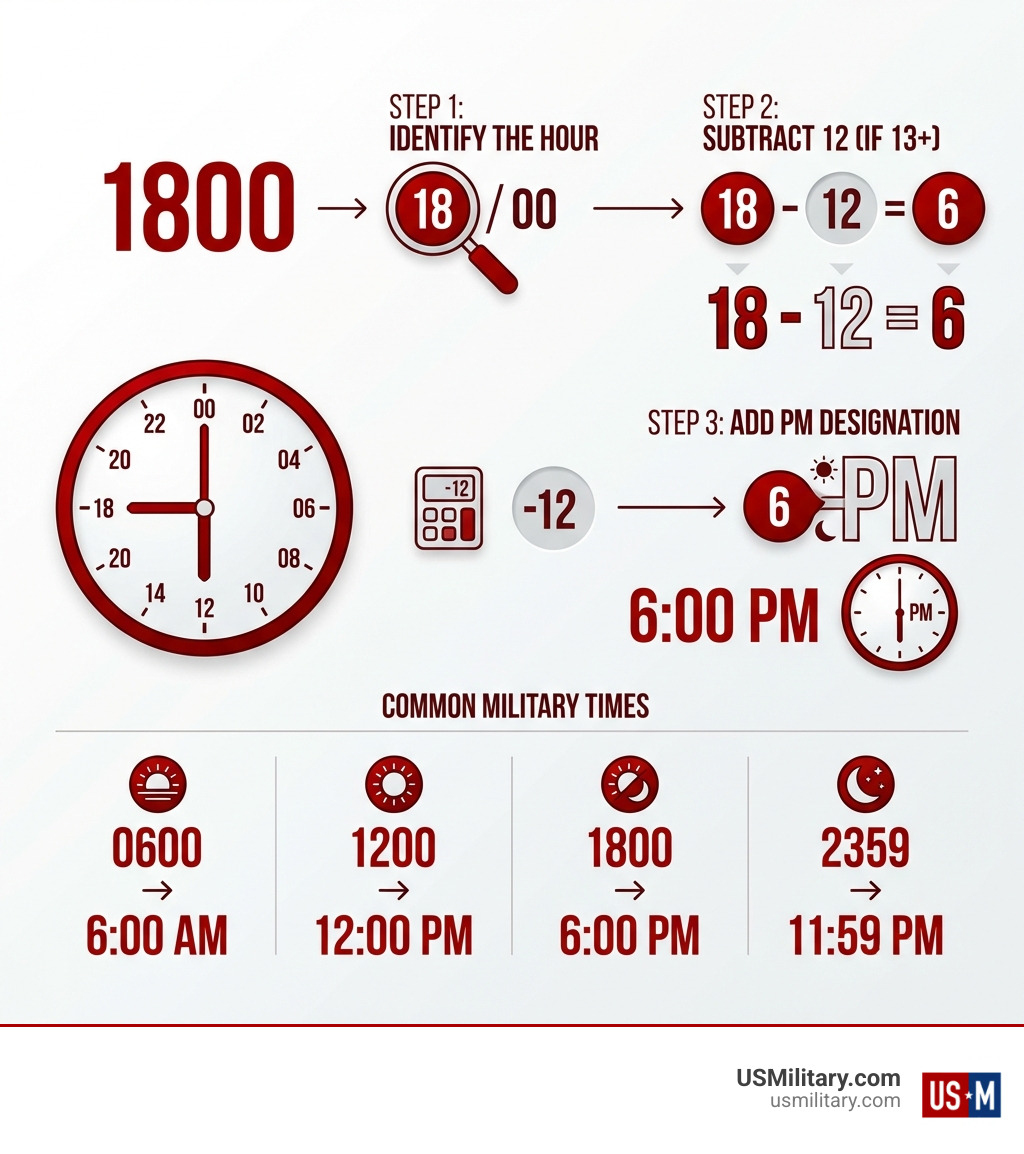
Simple guide to 1800 military time:
How to Convert 1800 Military Time to Standard Time
Converting military time to the standard 12-hour format might seem daunting at first glance, but it’s remarkably straightforward once you grasp the basic principles. The goal is to translate the 24-hour cycle into the familiar AM/PM structure we use in daily civilian life. For 1800 military time, the process is especially simple, acting as a perfect example to help you master the conversion.
 -12 -> 6:00 PM) – 1800 military time”/>
At its core, military time operates on a continuous 24-hour cycle, starting from midnight (0000) and running through to 2359 (one minute before the next midnight). This eliminates the need for AM or PM designations, which can be a source of confusion in critical environments. When converting to standard time, we essentially “reset” the clock after noon. The hours from 0000 to 1200 generally correspond to AM and noon, while hours from 1300 onwards convert to PM by subtracting 12.
Let’s break down the conversion of 1800 military time and other similar times into an easy-to-follow, three-step method.
The 3-Step Conversion Method
This method is your go-to for converting any military time from 1300 to 2359 into standard 12-hour time.
Step 1: Check the Hour
First, look at the first two digits of the military time, which represent the hour. For 1800 military time, the hour is 18. If this number is 13 or greater, you’ll need to perform a subtraction to get your standard time. If it’s 12 or less, the process is slightly different, which we’ll cover in more detail later. Since 18 is greater than 12, we proceed to Step 2.
Step 2: Subtract 12
This is the core of the conversion for afternoon and evening hours. Take the hour you identified in Step 1 and subtract 12 from it.
For 1800 military time: 18 – 12 = 6.
This gives you the corresponding hour in the 12-hour format.
Step 3: Add PM
Because we subtracted 12, it indicates that the time falls into the afternoon or evening. Therefore, you add “PM” to your result.
For our example, 6 becomes 6 PM.
So, 1800 military time converts directly to 6:00 PM.
What about the minutes? The great news is that minutes in military time (the last two digits) remain exactly the same during conversion. For instance, if you had 1830 military time, you would follow the same steps for the hour (18 – 12 = 6) and keep the minutes (30), resulting in 6:30 PM. This consistency makes converting minutes incredibly simple.
What Does 1800 Military Time Mean?
As we’ve just learned, 1800 military time means 6:00 PM in standard 12-hour time. It represents the eighteenth hour of the 24-hour day. The day begins at 0000 (midnight) and progresses continuously. So, 1800 marks the point when 18 full hours have passed since the start of the day.
This time falls squarely in the evening, making it a crucial part of our daily routines. The beauty of military time is its absolute clarity: there’s no ambiguity about whether 6 o’clock refers to morning or evening. When you see 1800, you know it’s evening, plain and simple. This precision is invaluable in fields where errors can have significant consequences.
Understanding this 24-hour cycle is fundamental. For example, if you’re looking at What is 1600 in military time?, you’d apply the same logic: 16 – 12 = 4, so 1600 military time is 4:00 PM. The system is consistent and logical once you get the hang of it.
How to Say 1800 in Military Time
While converting military time is one thing, knowing how to pronounce it correctly is another important aspect, especially if you’re interacting with those who use it regularly. For 1800 military time, the standard pronunciation is “eighteen hundred hours.”
Let’s break down the pronunciation rules:
- Hours with “hundred”: For times that are on the hour (meaning the last two digits are “00”), you say the hour followed by “hundred hours.”
- 1800 military time is pronounced “eighteen hundred hours.”
- 0600 is “zero six hundred hours” or “oh six hundred hours.”
- 1000 is “ten hundred hours.”
- Hours with minutes: If there are minutes involved, you state the hour first, then the minutes.
- 1830 would be “eighteen thirty hours.”
- 0745 would be “zero seven forty-five hours” or “oh seven forty-five hours.”
- Leading zeros: When the hour is less than 10, it’s common to say “zero” or “oh” before the hour. For example, 0100 is “zero one hundred hours” or “oh one hundred hours.” While “one hundred hours” is understood, including the leading zero in pronunciation adds to the clarity and formality often required in military communications.
This clear, unambiguous pronunciation further reduces the chance of miscommunication, which is exactly why the military, emergency services, and other critical industries adopted this system.
Why Military Time is Used and Who Uses It
The widespread adoption of military time, also known as the 24-hour clock, isn’t just a quirk; it’s a testament to its practical benefits, particularly in situations where precision and clarity are paramount.
Imagine a scenario where a critical instruction is given to “meet at 7 o’clock.” Without context, that could mean 7 AM or 7 PM—a 12-hour difference that could have dire consequences in a military operation or a medical emergency. Military time eliminates this ambiguity entirely. There’s no AM or PM; every hour of the day has a unique four-digit designation, from 0000 to 2359. This ensures that everyone involved is literally on the same clock, reducing the potential for errors and enhancing operational efficiency.
The system’s design makes time interval calculations simpler as well. Instead of juggling AM/PM conversions, you can directly calculate the duration between two military times. This straightforward approach is vital for planning, coordination, and record-keeping in high-stakes environments.
✉ Get updates like this in your inbox
Weekly VA benefit changes, pay updates, and money tips for service members, veterans, and military families. Free, no spam.
The History and Origin of the 24-Hour Clock
The concept of a 24-hour clock isn’t new; historical evidence suggests its use in various forms for centuries. However, its modern standardization and widespread adoption gained significant traction in the 19th and 20th centuries. The need for a universal, unambiguous time system became increasingly apparent with the advent of faster global communication and transportation.
The United States military, recognizing the critical need for precision, officially adopted the 24-hour clock system in the 20th century. The U.S. Navy began using it in 1920, and the U.S. Army followed suit in 1942, during the height of World War II. This adoption was driven by the necessity for clear, consistent communication among allied forces operating across different time zones and in complex, fast-moving scenarios.
Beyond the military, the 24-hour clock is widely recognized and encouraged by international standards, such as the ISO 8601 international standard. This standard aims to provide a clear way to communicate date and time internationally, further solidifying the 24-hour clock’s role as a global norm for precise timekeeping. As noted by Wikipedia: 24 hour clock, it’s the most commonly used interval notation worldwide.
Professions That Rely on Military Time
While the name “military time” suggests its primary users, many other professions and industries have adopted the 24-hour clock system due to its inherent clarity and precision. These fields often involve critical operations, international coordination, or situations where even a small misunderstanding of time could have serious consequences.
Here are some of the key professions and industries that commonly use military time:
- Military Branches: Naturally, all branches of the U.S. armed forces—Army, Navy, Marines, Air Force, and Coast Guard—rely on the 24-hour clock. This ensures seamless coordination during missions, training, and daily operations, regardless of location or time zone.
- Aviation: Pilots, air traffic controllers, and ground crews globally use the 24-hour clock (often referred to as Zulu time or UTC) to standardize flight schedules, communicate clearances, and track aircraft movements. This eliminates any confusion that could arise from AM/PM in different time zones.
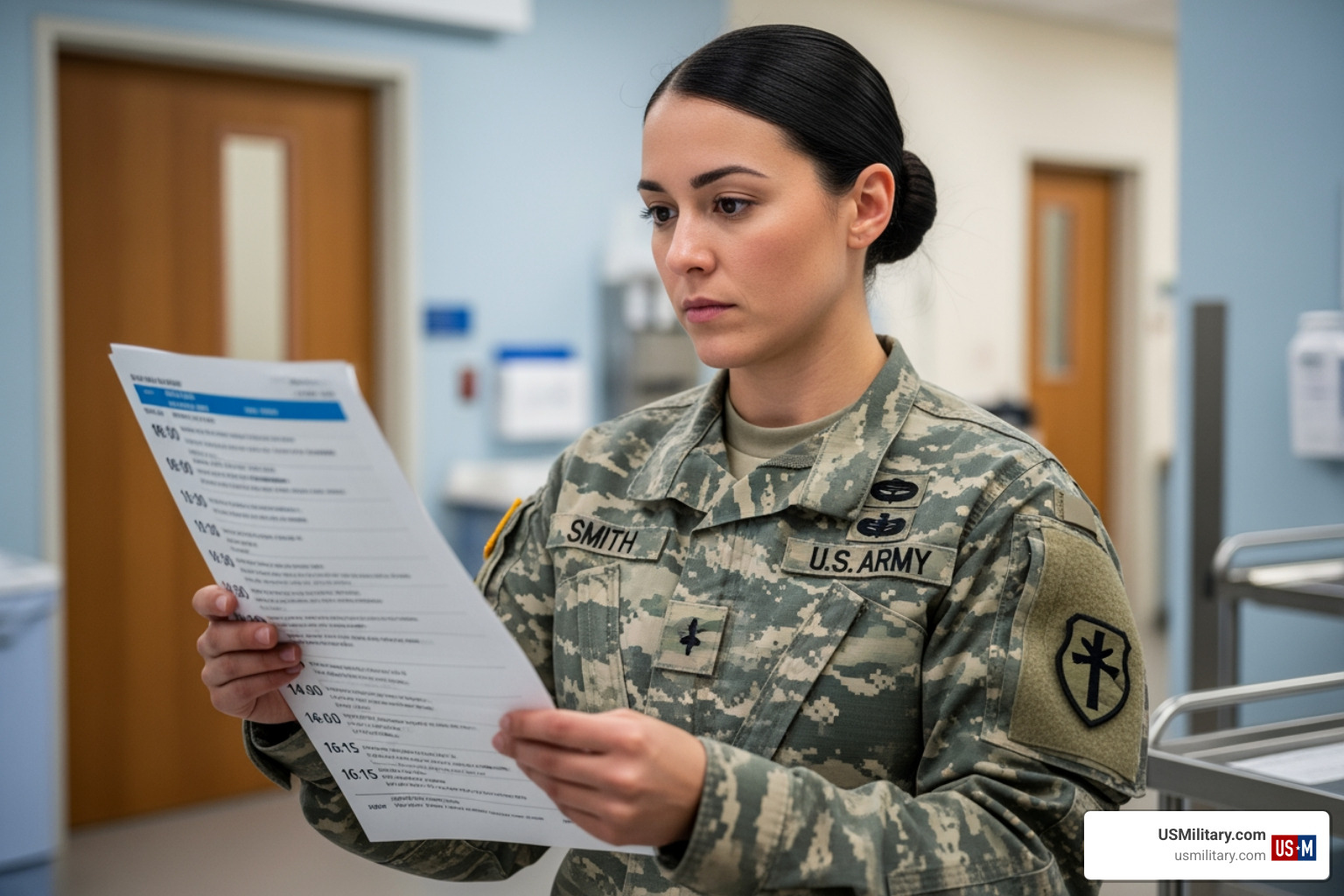
- Healthcare: Hospitals and other medical facilities frequently use military time for scheduling appointments, administering medications, tracking patient care, and documenting events. This precision helps prevent medication errors (e.g., 0700 vs. 1900 for a dose) and improves record-keeping, ensuring patient safety. Nurses and doctors often refer to it as “hospital time.”
- Emergency Services: Police, fire departments, and paramedics use the 24-hour clock for dispatch, incident reporting, and coordinating responses. Clear communication of time is vital when every second counts.
- Computing and Technology: Most computer systems operate internally on a 24-hour clock, often using Unix time or UTC. This simplifies programming, data logging, and synchronization across networks, especially in global systems.
- Logistics and Transportation: Industries involved in shipping, railway operations, and large-scale logistics often use the 24-hour clock for scheduling, tracking, and coordinating complex movements of goods and personnel.
- Meteorology and Astronomy: Scientists in these fields use the 24-hour clock to maintain consistency in observations and data recording, which are often shared internationally.
For veterans transitioning to civilian life, many of these fields offer rewarding career paths where their familiarity with military time can be a significant asset. Resources like Jobs for Veterans and military highlight opportunities where your military experience, including timekeeping practices, is highly valued.
Mastering Military Time: Key Rules and Conventions
Beyond simply converting 1800 military time, truly mastering the 24-hour clock involves understanding its underlying rules and conventions. This system is designed for clarity and precision, but it does have specific nuances that differentiate it from the standard 12-hour clock.
| Military Time | Standard Time | Notes |
|---|---|---|
| 0000 | 12:00 AM | Midnight, start of new day |
| 0100 | 1:00 AM | “Oh one hundred hours” |
| 0600 | 6:00 AM | “Oh six hundred hours” |
| 1200 | 12:00 PM | Noon |
| 1300 | 1:00 PM | “Thirteen hundred hours” (13 – 12 = 1 PM) |
| 1800 | 6:00 PM | “Eighteen hundred hours” (18 – 12 = 6 PM) |
| 2359 | 11:59 PM | Last minute of the day |
This table clearly illustrates the format differences, showing how military time avoids colons and AM/PM suffixes, relying instead on a continuous numbering system.
Key Differences Between Military and Standard Time
The fundamental difference lies in how a day is divided and represented:
- Cycle Length: Standard time uses a 12-hour cycle, repeating twice a day (AM for morning, PM for afternoon/evening). Military time uses a single, continuous 24-hour cycle, from 0000 to 2359.
- AM/PM Designations: Standard time relies on “AM” (Ante Meridiem, before midday) and “PM” (Post Meridiem, after midday) to distinguish between the first and second halves of the day. Military time completely eliminates these, as each hour has a unique number. This is why 1800 military time is unambiguously 6 PM.
- Four-Digit Format: Military time is always written with four digits. The first two digits represent the hour, and the last two represent the minutes. For example, 7:00 AM is 0700, and 7:30 PM is 1930. Often, a colon is omitted in military communications (e.g., 1800 instead of 18:00), making it a more compact notation.
- Clarity and Ambiguity: The primary advantage of military time is its complete lack of ambiguity. “7 o’clock” in standard time can be 7 AM or 7 PM. In military time, 0700 is always 7 AM, and 1900 is always 7 PM. This makes it ideal for critical operations where misinterpretation of time can be costly. For another example, consider What is 1300 in military time?. It’s 1:00 PM, no questions asked.
Special Rules: Midnight (0000 vs. 2400)
Midnight is often a point of confusion in both standard and military time. In standard time, 12:00 AM can sometimes be tricky to differentiate from 12:00 PM (noon). Military time aims for clarity, but even here, midnight has two common representations:
- 0000 (Zero Hundred Hours): This is the most common representation for midnight, particularly on digital displays and for indicating the start of a new day. When a new day begins, the clock rolls over from 2359 to 0000. For example, a shift starting at midnight on Monday would be “0000 Monday.”
- 2400 (Twenty-Four Hundred Hours): This designation is sometimes used to refer to the end of a day. For instance, a period ending at midnight on Monday could be “2400 Monday,” explicitly meaning the very last moment of Monday. However, it’s less common in general usage and often avoided to prevent confusion with the start of the next day (0000). Many digital clocks and systems default to 0000.
In most contexts, especially when scheduling or referring to the beginning of an event, 0000 is preferred. When in doubt, 0000 is the safer bet for midnight.
Common Mistakes to Avoid
Even with a system designed for clarity, a few common pitfalls can trip up beginners (and sometimes even seasoned users!). Being aware of these can help you avoid errors:
- Forgetting to Subtract 12 for PM Hours: This is the most frequent mistake. Any hour from 1300 to 2359 requires you to subtract 12 to get the standard PM equivalent. Forgetting this means you’d think 1800 military time is 18:00 PM, which isn’t a thing in standard time.
- Confusing 1200 (Noon) and 0000 (Midnight): While 0000 is midnight (12:00 AM), 1200 is noon (12:00 PM). These are distinct and critical. A common mistake is to apply the “subtract 12” rule to 1200, which would incorrectly yield 00 PM. Just remember: 1200 is noon, 0000 is midnight.
- Incorrect Pronunciation: Saying “eighteen hundred” for 1800 is correct. Saying “one thousand eight hundred” is technically understandable but not the conventional military pronunciation. Similarly, avoid adding “AM” or “PM” when speaking military time; the 24-hour nature makes it redundant.
- Adding a Colon Where It Doesn’t Belong: While 24-hour clock displays often use a colon (e.g., 18:00), official military time, especially in written communications or specific protocols, often omits it (e.g., 1800). Be mindful of the context. For our general understanding and conversion purposes, 1800 is the standard format.
- Daylight Saving Time (DST) Confusion: Military time itself does not change with Daylight Saving Time. The numbers (0000-2359) remain consistent. However, when converting to or from local standard time, you must account for whether DST is in effect. If your local standard time has shifted, your conversion from a fixed military time will reflect that shift. This is less a mistake in military time and more a mistake in applying the conversion to the current local time.
By keeping these points in mind, you’ll steer military time with confidence and accuracy!
Frequently Asked Questions about Military Time
It’s natural to have questions when delving into a new time system. Here are some of the most common inquiries we receive about military time, along with clear, concise answers to help solidify your understanding.
How do minutes work in military time?
One of the easiest aspects of military time is how minutes are handled: they work exactly the same as in standard time! The last two digits of any military time (e.g., the “00” in 1800 military time) represent the minutes past the hour, ranging from 00 to 59.
There’s no conversion needed for minutes. If a time is 1830, the “30” means 30 minutes past the hour. When you convert the hour (18 – 12 = 6), you simply attach the minutes: 6:30 PM.
When speaking, you state the hour then the minutes. So, 1830 is pronounced “eighteen thirty hours.” Simple, right? This consistency helps maintain clarity and reduces any potential for error.
Is the 24-hour clock the same as military time?
These terms are often used interchangeably, and for most practical purposes, they refer to the same 24-hour timekeeping system. However, there can be subtle differences in specific formatting and pronunciation conventions:
- 24-Hour Clock: This is the general term for a time system where the day runs from 00:00 to 23:59. It is widely used around the world and often includes a colon to separate hours and minutes (e.g., 18:00).
- Military Time: This term specifically refers to the 24-hour clock system as adopted by military forces and related organizations (like emergency services and aviation). Military time often omits the colon (e.g., 1800) and has specific pronunciation guidelines (e.g., “eighteen hundred hours”). It emphasizes a strict four-digit format, often with leading zeros for single-digit hours (e.g., 0600).
So, while all military time is 24-hour time, not all 24-hour time strictly adheres to the “military” conventions of no colons and specific pronunciations. The underlying numerical system is identical. The ISO 8601 international standard encourages the use of the 24-hour clock format for clear international communication, aligning with the principles behind military time.
Where can I find a reliable military time converter?
While we always encourage learning the manual conversion steps for a deeper understanding and to build confidence, there are many reliable resources and tools available for military time conversion:
- Online Converters: Numerous websites offer free military time converters. These tools allow you to input a time in either standard or military format and instantly receive the conversion. A good example is the Military Time Converter which provides a quick and easy way to check your conversions.
- Smartphone Settings: Most smartphones allow you to change your device’s clock display to the 24-hour format. This is an excellent way to immerse yourself and get accustomed to seeing time in military format daily. Many apps also offer dedicated time conversion utilities.
- Conversion Charts: Printable charts that list 12-hour times alongside their 24-hour equivalents are very helpful. You can often find these online or create your own as a quick reference guide.
- Practice: The most reliable “converter” is your own brain! Consistent practice with manual conversions will make you proficient over time. Start by converting times you encounter throughout your day, and soon it will become second nature.
For anyone involved with military life, or simply needing to understand precise timekeeping, these tools can be invaluable.
Conclusion
Mastering 1800 military time and the broader 24-hour clock system is a skill that offers immense benefits, extending far beyond the battlefield. As we’ve explored, its core purpose is to eliminate ambiguity, improve precision, and streamline communication in critical environments. From coordinating military operations to ensuring patient safety in healthcare, the clarity of military time is simply best.
We’ve walked through the simple three-step process for converting times like 1800 military time to 6:00 PM, discussed how to pronounce it as “eighteen hundred hours,” and digd into why this system is so crucial for professions ranging from aviation to emergency services. We also clarified common confusions, such as the nuances of midnight and the consistent handling of minutes.
Learning military time is more than just a numerical conversion; it’s about adopting a mindset of discipline and clarity. It’s a skill that can serve you well, whether you’re starting on a military career, transitioning to a civilian role that demands precision, or simply seeking to improve your daily time management.
At USMilitary.com, we are committed to providing comprehensive resources for military members and veterans. Understanding military time is just one piece of the puzzle. We encourage you to continue exploring the wealth of information available to support your journey.
Ready to take the next step in your military journey or learn more about the incredible opportunities and support available? Explore the benefits of military service and find how your dedication and skills can lead to a rewarding future.
Free for Service Members & Veterans
Get the military benefits intel no one tells you about.
Weekly updates on VA benefits, pay changes, and money tips — free for service members and veterans.
No spam. Unsubscribe anytime. Your info is never shared.