The Real VA Disability Appeal Success Rate at a Glance

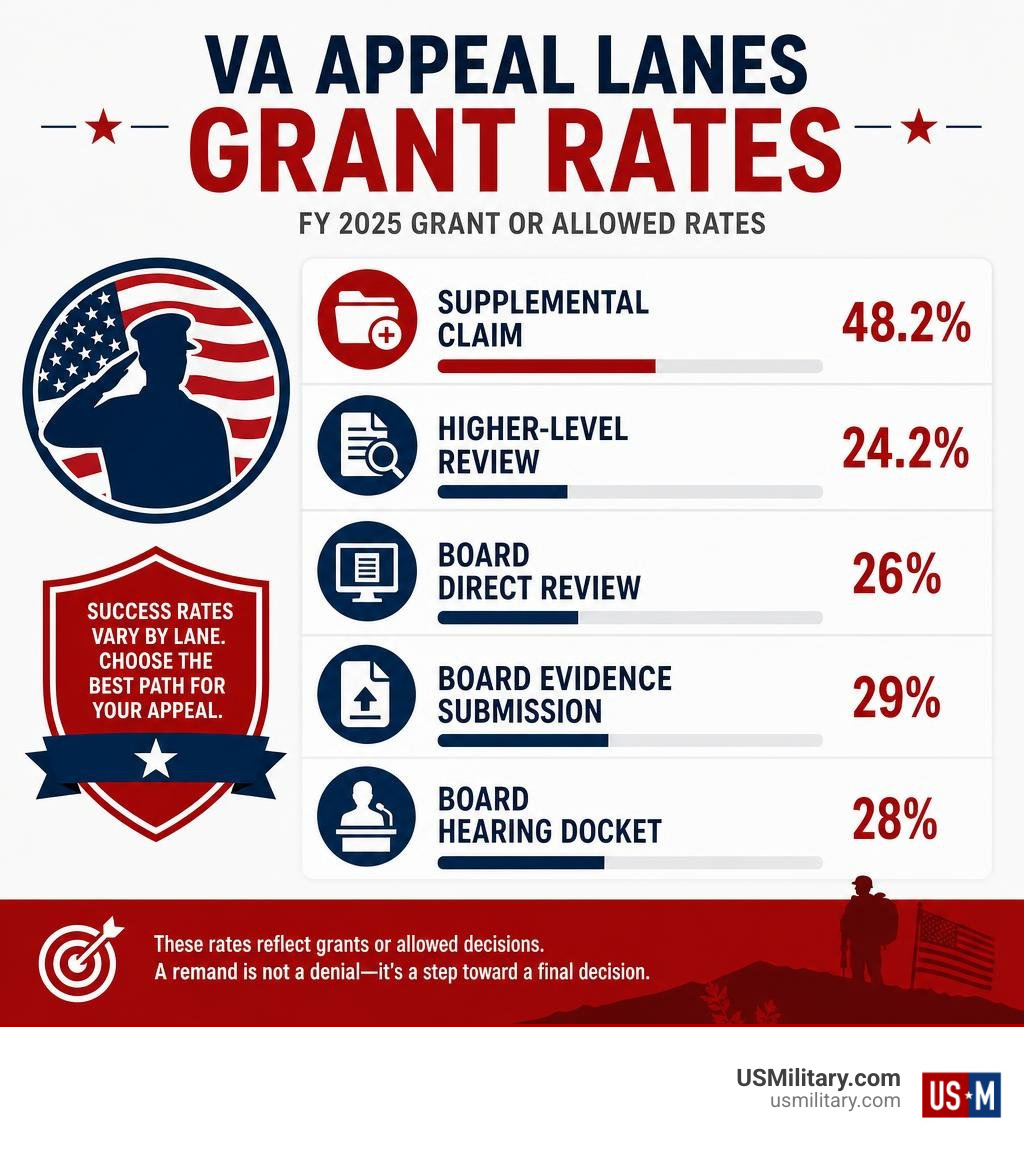
What Is The VA Disability Appeal Success Rate? The short answer is that it depends on the review lane. Recent VA data shows grant rates ranging from about 24% for Higher-Level Reviews to 48% for Supplemental Claims, while Board appeal allowance rates are generally in the mid-to-high 20% range.
| VA review option | Recent grant or allowed rate |
|---|---|
| Supplemental Claim | 48.2% in FY 2025 |
| Higher-Level Review | 24.2% in FY 2025 |
| Board Direct Review | 26% in FY 2025 |
| Board Evidence Submission | 29% in FY 2025 |
| Board Hearing docket | 28% in FY 2025 |
These numbers do not tell the whole story. A grant is a win, but a remand means the VA must do more work on the case before making a final decision. The modern Appeals Modernization Act (AMA) system has generally produced higher grant rates and fewer remands than the older legacy process.
I am Larry Fowler, publisher of the USMilitary.com Network, where I have covered VA benefits and disability trends for veterans since 2007. In this guide to What Is The VA Disability Appeal Success Rate, I will help make the numbers, appeal options, and common terms easier to understand.
What Is The VA Disability Appeal Success Rate Across Appeal Lanes?
When a veteran receives a rating decision with a denial or an unfavorable disability evaluation, the journey is far from over. Under the Appeals Modernization Act (AMA), enacted via Public Law 115-55 and implemented in February 2019, veterans have three main review frameworks administered by the Veterans Benefits Administration (VBA) and the Board of Veterans’ Appeals (BVA).
Understanding What Is The VA Disability Appeal Success Rate requires analyzing outcome metrics lane by lane. Across the entire appeals framework, typical win rates sit between 34% and 38%, but individual lanes display substantial variances depending on whether new evidence can be submitted, how cases are reviewed, and the level of legal scrutiny applied.
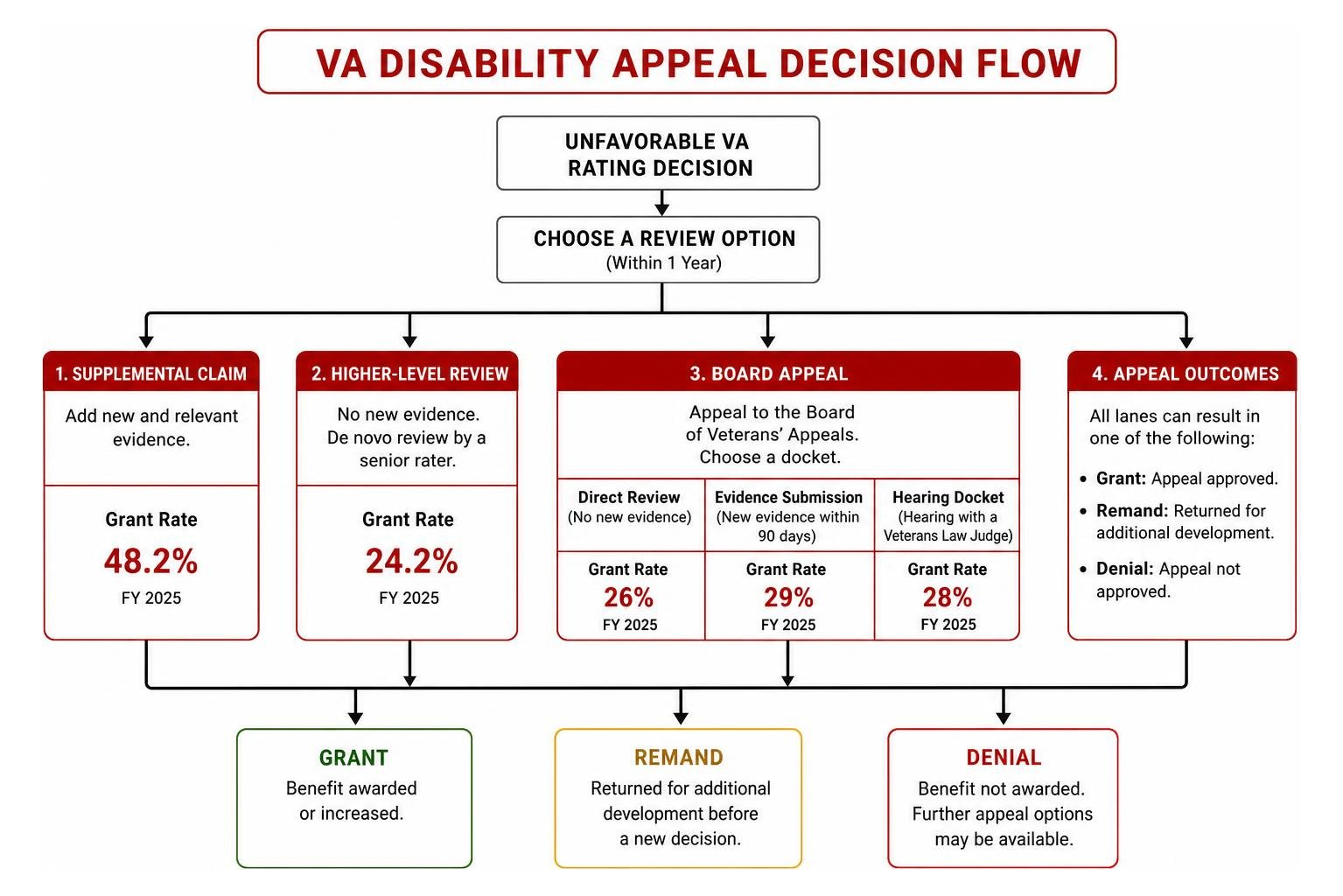
Choosing the correct decision review option is often the deciding factor in whether an appeal succeeds. If you are preparing to challenge a rating decision, learning How to Turn Your VA Denial Into a Winning Appeal is a critical first step toward building a cohesive strategy.
Supplemental Claim Success Rates
The Supplemental Claim lane is consistently the highest-performing review option in the VA system. In Fiscal Year 2025, the Supplemental Claim lane recorded a grant rate of 48.2%, approving 330,209 claims out of 685,669 total submissions. Over recent years, this grant rate peaked at 53.8% in FY 2023 before stabilizing near the 50% mark.
The high success rate of Supplemental Claims is due to its core statutory requirement: submitting “new and relevant” evidence. When a veteran is denied initially, it is usually because of a specific evidentiary defect—such as a missing current medical diagnosis, a lack of an in-service stressor, or the absence of a professional medical nexus linking the disability to military service.
By filing a Supplemental Claim (using VA Form 20-0995), veterans can directly address the specific reasons for denial by attaching independent medical evaluations, doctor nexus letters, private treatment records, or lay witness statements. Because the adjudicator evaluates fresh medical proof that was missing from the original application, the probability of approval increases significantly. Understanding the broader Process for a VA Disability Claim helps veterans recognize when they have obtained sufficient new medical evidence to justify filing a Supplemental Claim.
Higher-Level Review (HLR) Success Rates
The Higher-Level Review (HLR) lane operates under entirely different parameters. In FY 2025, HLR recorded a grant rate of 24.2%, representing 68,853 approved claims out of 283,975 total decisions. While this grant rate is lower than that of Supplemental Claims, it represents steady growth from FY 2019, when the HLR grant rate stood at just 14.5%.
Higher-Level Review is a closed-record process submitted on VA Form 20-0996. Veterans cannot submit any new medical evidence or testimony during an HLR. Instead, a senior adjudicator (a Decision Review Officer) conducts a de novo review of the existing evidence already in the claims file (C-File) to correct factual errors, misapplications of the VA rating schedule, or legal mistakes.
Although the direct grant rate is 24.2%, HLRs frequently uncover VA procedural mistakes known as a “Duty to Assist” (DTA) error. If the senior adjudicator identifies that the VA failed to gather relevant military medical records or provided an inadequate Compensation and Pension (C&P) exam, the HLR converts into a Supplemental Claim lane automatically. The VA then reopens the evidentiary record to fix the error. If you recently received a decision notice stating your VA Claim Denied, reviewing the rationale will tell you whether an HLR or Supplemental Claim is best suited for your circumstances.
HLR is highly efficient from a speed standpoint, reaching a 97.8% compliance rate for its target 125-day processing window in FY 2025.
Board of Veterans’ Appeals (BVA) Success Rates
For veterans who do not achieve a favorable result at the VBA level, the Board of Veterans’ Appeals offers direct judicial review by a Veterans Law Judge (VLJ). Under the AMA, veterans appealing to the Board choose between three distinct dockets:
- Direct Review Docket: Designed for veterans who believe the existing record contains all necessary proof. In FY 2025, the Direct Review docket maintained an allowed (grant) rate of 26%, with an additional 8% allowed with remand, 31% remanded, and 24% denied outright.
- Evidence Submission Docket: Allows veterans to submit new evidence within 90 days of filing VA Form 10182 without requesting a hearing. In FY 2025, this docket achieved the highest Board grant rate at 29%, alongside 12% allowed with remand, 29% remanded, and 17% denied.
- Hearing Docket: Gives veterans an opportunity to testify directly before a Veterans Law Judge. In FY 2025, the Hearing docket recorded a 28% allowance rate, 12% allowed with remand, 25% remanded, and 13% denied.
Navigating the BVA requires a clear understanding of administrative procedures, but as thousands of veterans discover every year, Finding the Board of Veterans Appeals Is Easier Than You Think when you know how the modern dockets are organized.
AMA vs. Legacy Appeals System: How System Modernization Impacts Win Rates

The transition from the old Legacy appeals process to the Appeals Modernization Act (AMA) framework represents one of the most substantial structural shifts in VA claims history. The Legacy system was notorious for long delays, where appeals frequently languished for 7 to 10 years in a endless loop of remands and appeals.
According to the Department of Veterans Affairs Periodic Progress Report on Appeals, the AMA framework consistently yields 8% to 10% higher grant rates and roughly 18% to 21% lower remand rates compared to the Legacy process. Furthermore, non-remanded AMA cases are fully resolved in under two years on average—roughly 5 to 6 years faster than Legacy claims. Data highlights from independent legal analysis show how structural options under the modern system give claimants multiple procedural paths to secure benefits.
What Is The VA Disability Appeal Success Rate for Legacy System Claims?
For claims remaining in the Legacy system (appeals initiated prior to February 19, 2019), overall outcomes remain noticeably lower. Legacy system appeals maintain an overall grant rate of 34.7%.
The primary challenge with Legacy claims is the sheer age of the evidence and the complexity of multi-remand backlogs. Official VA statistics reveal that for Legacy cases returned to the Board following a remand, 52% have been remanded at least twice, and 27% have been remanded three times or more. Through focused administrative efforts, the Board reduced pending Legacy appeals from over 472,000 in late 2017 to under 1,000 active cases by late FY 2024.
What Is The VA Disability Appeal Success Rate with Legal Representation?
One of the most statistically significant factors influencing appeal outcomes is accredited legal representation. Historical and current Board metrics show that veterans represented by accredited attorneys or trained veterans service organization (VSO) representatives achieve far higher win rates than unrepresented claimants.
Historical BVA reports demonstrate a clear trend in appeal outcomes based on representation:
- 2017: 39.49% approval with an attorney vs. 24.42% unrepresented.
- 2018: 44.61% approval with an attorney vs. 27.22% unrepresented.
- 2019: 46.31% approval with an attorney vs. 26.18% unrepresented.
- Legacy System Baseline: 42.1% approval rate for attorney-represented claimants versus 34.7% overall.
Accredited attorneys improve success rates because they understand how to analyze military medical records, identify missing nexus links, cross-examine VA C&P examiners, and write clear legal briefs focused on the rating schedule. Working alongside accredited VA Disability Lawyers helps ensure that appeals are supported by sound medical and legal evidence.
Understanding Remands, Processing Timelines, and Hearing Docket Outcomes

To fully evaluate What Is The VA Disability Appeal Success Rate, veterans must understand that appeal decisions fall into three main categories: Granted, Denied, or Remanded.
A remand is neither a final grant nor an outright denial. Instead, a remand occurs when the Board or a higher review authority determines that the lower-level agency (VBA) made a procedural or evidentiary mistake. When a case is remanded, jurisdiction transfers back to the regional office to gather additional medical records, schedule a new C&P examination, or obtain an independent expert opinion.
Under the AMA, remand rates are significantly lower than under the Legacy system (averaging 25% to 31% across Board dockets compared to over 40-50% historically). However, a remand adds time to the process. It serves as a procedural reset where evidentiary development starts over. Understanding how remands fit into the broader claims journey is fully explained in The Complete Guide to VA Disability Claims.
Hearing Docket Delays vs. Success Rates
Many veterans believe requesting a live hearing before a Veterans Law Judge is the best way to win their appeal. While the Hearing docket offers a solid 28% grant rate, it comes with a major processing delay.
In FY 2024, cases on the Board Hearing docket took an average of 1,089 days to complete, compared to roughly 866 days for the Direct Review docket. Target timelines established by the BVA aim for 365 days for Direct Review, 550 days for Evidence Submission, and 730 days for Hearings, but hearing backlogs remain substantial.
Success rates also vary based on the physical venue selected for the hearing:
- Central Office Hearings (Washington, D.C.): ~34% allowance rate.
- Regional Office Video Hearings: ~26% allowance rate.
- Virtual Tele-Hearings: ~22% allowance rate.
While Central Office hearings yield higher success metrics, the extra wait time can stretch into several years. Legal experts often note that this higher success rate is largely driven by case selection bias—stronger, complex claims represented by legal counsel are more likely to request hearings. In most instances, submitting clear written lay statements and private medical expert reports through the Evidence Submission docket yields a similar success rate without adding multi-year delays.
Strategic Steps to Increase Your Chances of a Successful VA Disability Appeal
Winning a VA appeal requires more than simply re-submitting the original claim and hoping for a better outcome. Veterans can improve their chances by following proven evidentiary strategies.
To build a compelling appeal, focus on these critical evidence elements:
- Comprehensive Medical Nexus Opinions: A written statement from an accredited physician clearly stating that your condition is “at least as likely as not” (50% probability or greater) caused by military service.
- Detailed Lay and Buddy Statements: Personal declarations from service members, friends, or family members describing the specific in-service event or documenting daily functional impairment (e.g., how a back injury restricts sitting, driving, or working).
- Secondary Service Connections: Claiming conditions caused or aggravated by an existing service-connected disability (e.g., sleep apnea or hypertension secondary to service-connected PTSD).
- Independent Medical Evaluations (IMEs): Obtaining private specialist opinions to counter flawed or rushed VA C&P examinations.
Recognizing the key Signs Your Disability Claim Will Be Approved can help you determine whether your appeal record is strong enough to submit. Additional perspective on how cases move through initial decision-makers can be found in discussions like What is the percentage of cases that go through to appeal in front … .
Handling Worsened Service-Connected Conditions
A common error made by veterans is filing a Supplemental Claim appeal when an existing, service-connected condition has simply gotten worse over time.
If your service-connected disability has worsened, you should not file an appeal. An appeal challenges whether the VA’s past decision was correct based on the facts at that time. Instead, you should file a claim for increased disability compensation (VA Form 21-526EZ).
Filing a claim for an increase allows the VA to evaluate your current level of disability under the rating schedule without needing to prove the original rating was erroneous. That for standard appeals, you have exactly one year from the date listed on your Rating Decision notification letter to file a Supplemental Claim, Higher-Level Review, or Board Appeal to preserve your initial effective date and secure full back pay.
Frequently Asked Questions about VA Disability Appeal Success Rates
How long does a VA disability appeal take under the AMA?
Timelines vary significantly based on the review lane selected:
- Higher-Level Review: Target completion is 125 days, with the VA achieving over 97% compliance.
- Supplemental Claim: Generally takes between 120 and 150 days depending on how quickly new evidence is gathered and C&P exams are completed.
- Board Direct Review: Averages 365 to 866 days.
- Board Evidence Submission: Averages 550 days.
- Board Hearing Docket: Averages 730 to 1,089 days.
What is the remand rate for BVA appeals?
Under the Appeals Modernization Act, the BVA remand rate ranges between 25% and 31% depending on the specific docket. Direct Review experiences roughly a 31% remand rate, Evidence Submission sits near 29%, and the Hearing docket records a 25% remand rate. When the Board remands an appeal, jurisdiction shifts to the local VBA regional office to gather additional evidence, conduct new C&P examinations, or resolve duty-to-assist errors.
Can I submit new evidence during a Higher-Level Review?
No. Higher-Level Review is strictly a closed-record review. Decision Review Officers are legally restricted to evaluating only the evidence that was in the C-File on the date the original decision was made. However, you can request an Informal Conference during an HLR to verbally highlight legal or factual errors to the reviewer. If you have new medical records, nexus letters, or test results, you must choose the Supplemental Claim lane instead.
Conclusion
Understanding What Is The VA Disability Appeal Success Rate shows that while a denial can be frustrating, veterans have realistic, effective pathways to win their benefits. Grant rates range from 24.2% for Higher-Level Reviews to 48.2% for Supplemental Claims, and reaching nearly 46% at the Board level with legal representation. Success depends heavily on matching your specific situation to the right review lane.
If your claim contains clear legal or procedural errors, Higher-Level Review offers a fast resolution. If you have new medical diagnoses or nexus letters, a Supplemental Claim provides the highest statistical chance of approval. For complex legal disputes, the Board of Veterans’ Appeals offers direct judicial review.
Do not navigate the complex appeal process alone. Explore our comprehensive resources at the VA Disability Claims Resource Guide, visit our main portal at USMilitary.com, or check out inspiring military leadership reading like Dare to Live Greatly to stay informed, empowered, and prepared throughout your VA benefits journey.
Free for Service Members & Veterans
Get the military benefits intel no one tells you about.
Weekly updates on VA benefits, pay changes, and money tips — free for service members and veterans.
No spam. Unsubscribe anytime. Your info is never shared.


