Why Is the US Army Practicing Digging Mass Graves?
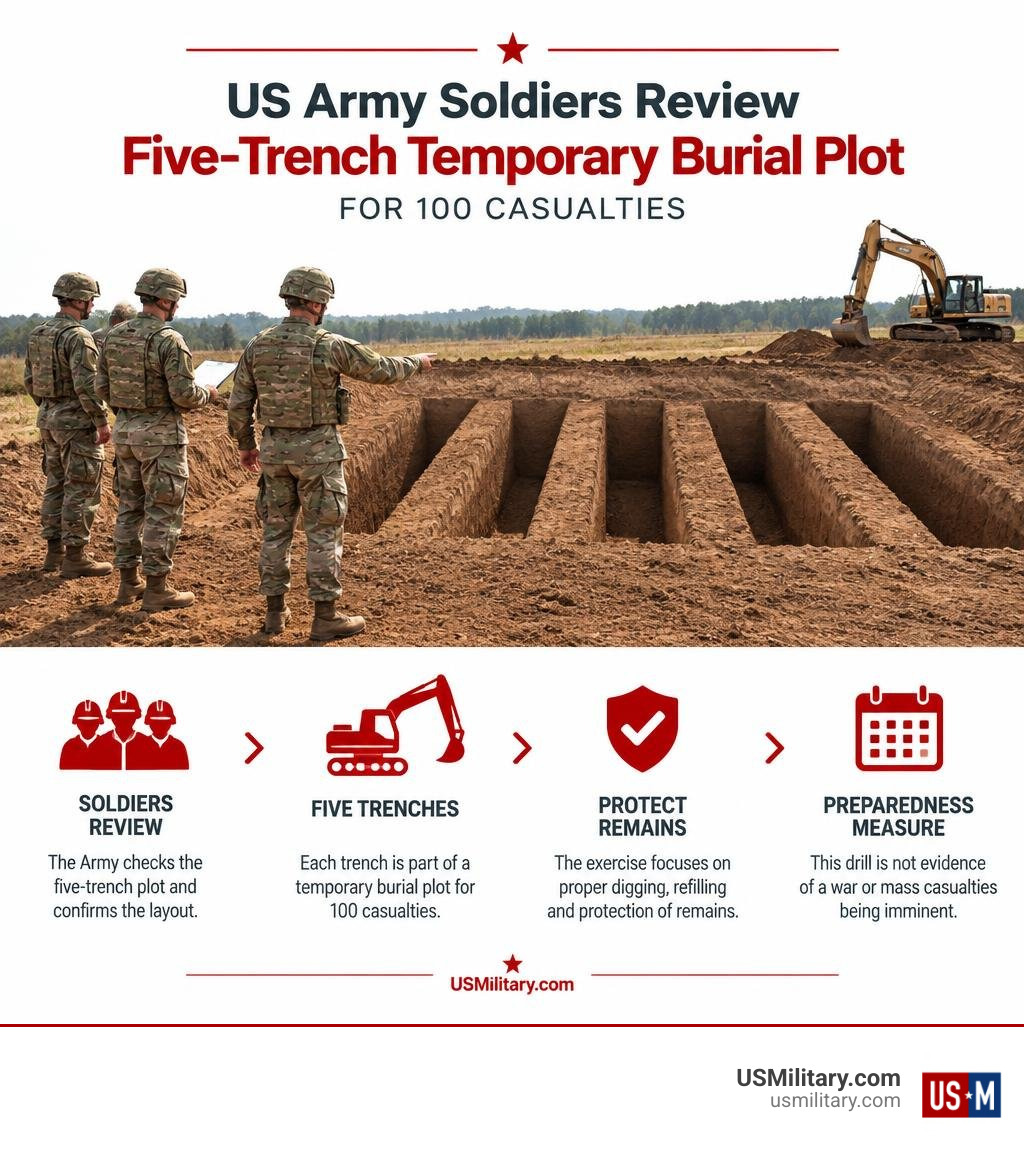
The US Army is practicing temporary battlefield burials in case a future war causes more deaths than it can quickly evacuate. At Fort Bragg, engineers tested how to dig and refill burial trenches while protecting remains for later recovery and identification. The drill is a preparedness measure, not evidence that a war or mass casualties are imminent.
I’m Larry Fowler, a Navy veteran and BUD/S Class 89 graduate. In Why Is US Army Practicing Digging Mass Graves, I’ll explain what the exercise tested and why the Army is revisiting this difficult task.
Glossary for Why Is US Army Practicing Digging Mass Graves:
- Iran war raises worry of a military draft
- US moves airborne troops, Marines as Iran rejects ceasefire, raising ground war potential
- What is the Department of War
Why Is US Army Practicing Digging Mass Graves: Doctrine and Exercise Reality
Rumors online often spread fast whenever the military conducts unusual drills. However, the reality behind these recent headlines comes down to standard military doctrine and engineering validation. During the second phase of an exercise dubbed “Operation Dragon Covenant,” soldiers gathered near the St. Mere Eglise Drop Zone at Fort Bragg, North Carolina.
The joint drill involved specialized units from the 3rd Corps Sustainment Command and the 20th Engineer Brigade. Rather than an improvised drill, it was an official test-of-concept exercise designed to evaluate whether modern earthmoving gear could excavate and backfill temporary plots safely, rapidly, and without causing structural collapse or damage to human remains. As our forces review current military deployments and equipment, preparing for worst-case logistical hurdles remains a vital part of full-spectrum readiness.
Why Is US Army Practicing Digging Mass Graves for Large-Scale Combat Scenarios?
For more than two decades, American service members operated in counterinsurgency environments where our military enjoyed absolute air superiority. When a soldier was killed in action, aeromedical evacuation and swift mortuary affairs transport could reliably carry them home to their loved ones within days.
In a high-intensity fight against a near-peer adversary, that dynamic changes completely. Contested airspaces, electronic warfare, and long-range precision fires could ground cargo aircraft and disrupt supply lines for weeks. Planners must assess realistic casualty estimates for large-scale combat operations (LSCO). When considering how massive our military size is across active, reserve, and guard components, having clear operational doctrine for every theater contingency protects both mission success and the dignity of fallen heroes.
Modern Engineering Tactics and Daily Interment Capacity
Digging trenches by hand is simply not an option in modern high-casualty scenarios. The Fort Bragg exercise proved that heavy machinery alters the equation dramatically:
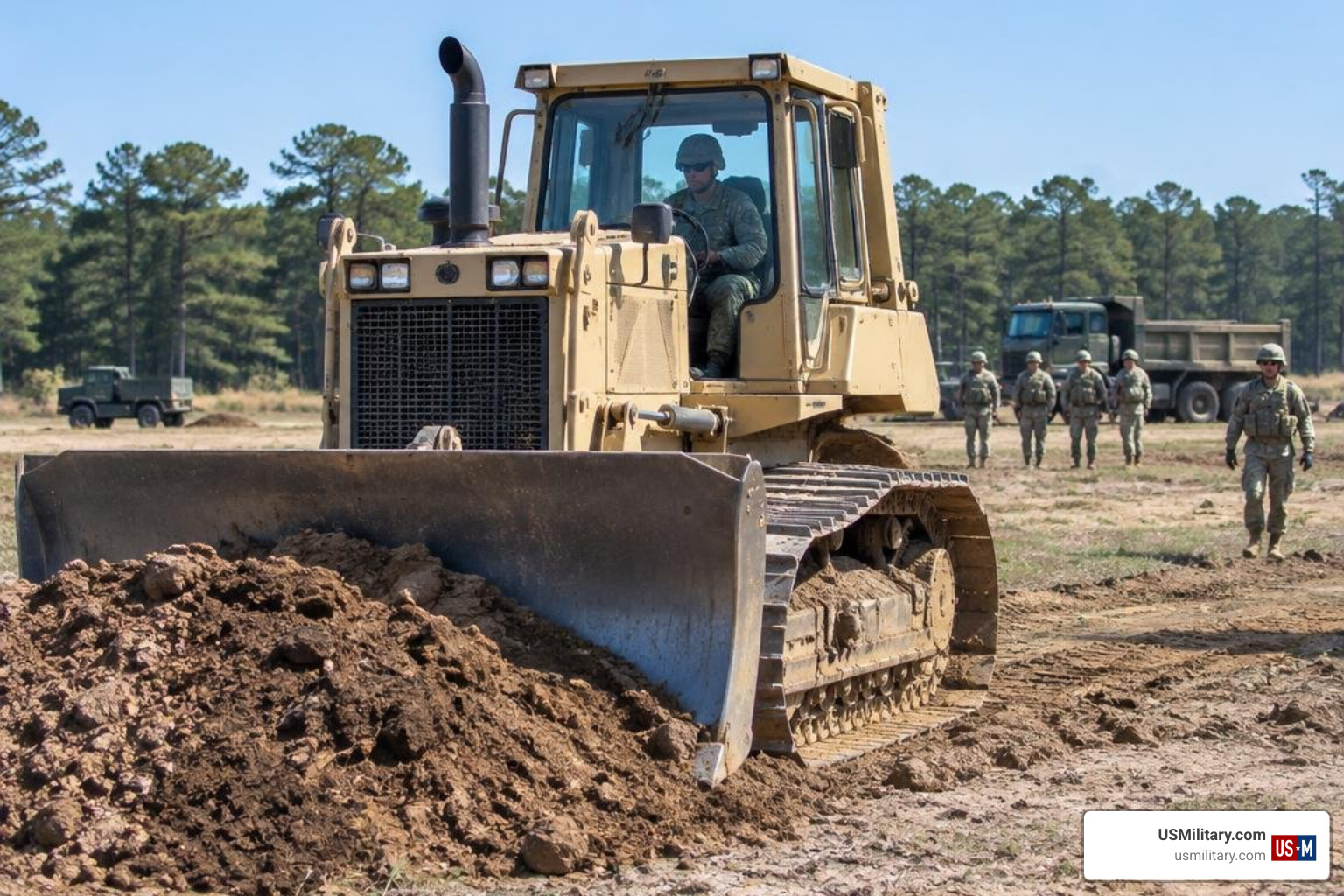
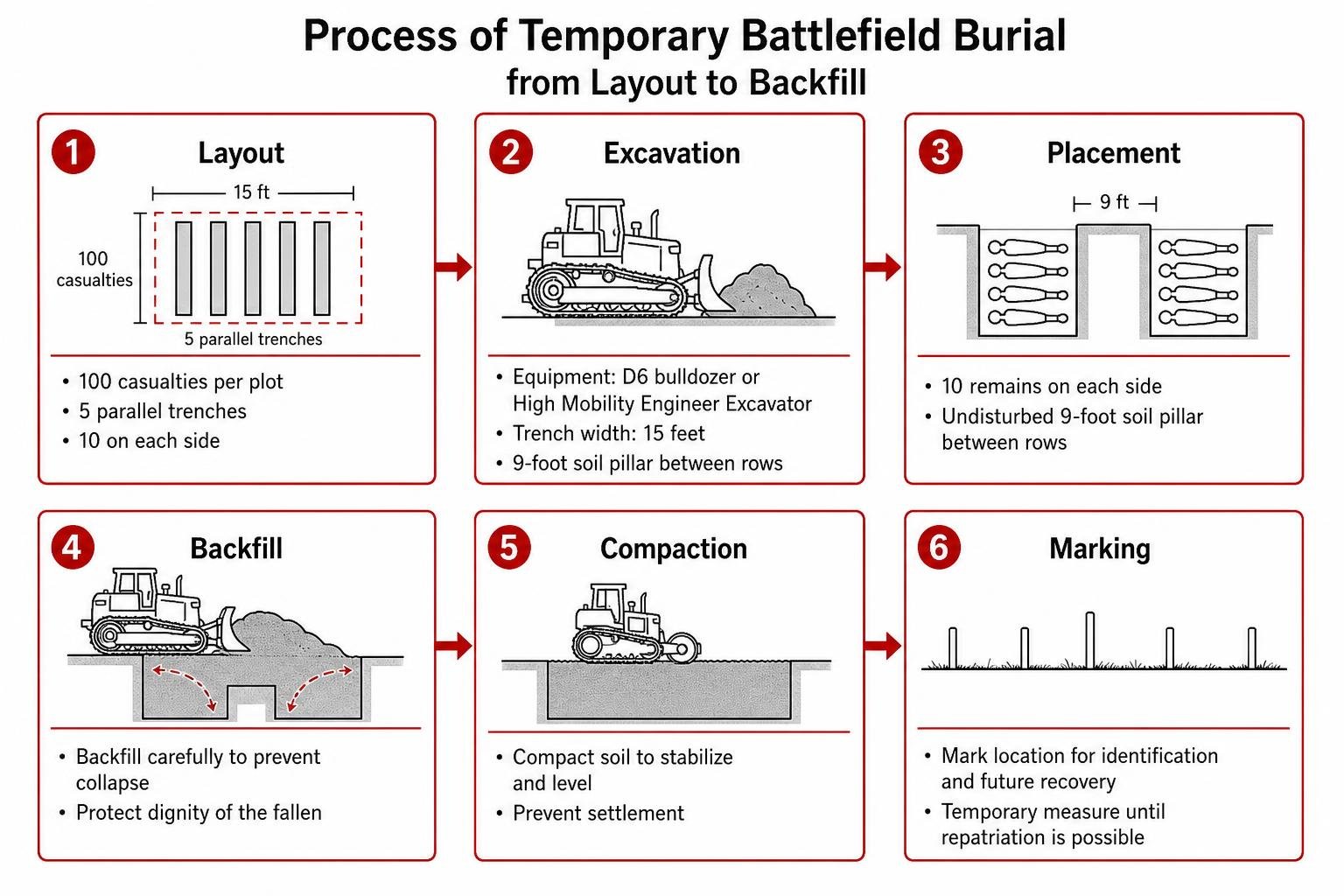
- Equipment Used: Standard militarized D6 bulldozers and High Mobility Engineer Excavators (HMEEs).
- Speed: A single D6 bulldozer crew completed a full 20-remains trench in an average time of just one hour and 15 minutes.
- Daily Output: Operating eight bulldozers and four military excavators, an engineer company can temporarily inter up to 2,400 fallen personnel within 24 hours.
- Doctrinal Changes: Historical guidelines specified narrow corridors, but modern bulldozer tracks required widening each trench to 15 feet while leaving an undisturbed 9-foot soil pillar between rows to prevent cave-ins during backfill operations.
Each standardized temporary plot layout holds 100 casualties arranged across five parallel trenches, with ten soldiers placed on each side.
Strategic Shifts and Historical Precedents of Battlefield Burials
The US military has not conducted large-scale temporary battlefield burials since the Korean War (1950–1953), during which nearly 37,000 American personnel lost their lives. While discussing extreme casualty figures can prompt public debates over whether a military draft will be necessary in a world war, the armed forces must train for hard logistical truths long before any crisis erupts.
| Operational Factor | Global War on Terrorism (GWOT) | Large-Scale Combat Operations (LSCO) |
|---|---|---|
| Airspace Control | Complete US air supremacy | Heavily contested / degraded air access |
| Fatality Timeline | Evacuated home within 24–72 hours | Temporary battlefield burial required |
| Evacuation Method | Direct fixed-wing airlift (C-17 / C-130) | Ground collection and tactical interment |
| Mortuary Protocol | Direct transfer to Dover AFB | In-theater temporary interment & later disinterment |
Why Is US Army Practicing Digging Mass Graves Rather Than Using Direct Air Evacuation?
In a major theater conflict, transportation assets will be prioritized for active combat resupply—delivering ammunition, fuel, blood products, and medical evacuation for the wounded. If ports and airstrips face constant missile threats, mortuary backlogs will occur rapidly. Leaving fallen service members exposed in warm climates creates catastrophic health hazards and invites enemy exploitation.
As detailed in historical analyses of battlefield burials, organized field interments provide a sanitary, secure, and respectful way to safeguard soldiers until frontlines stabilize and systematic repatriation can begin.
Lessons from Past Conflicts and Historic Military Burials
Hurried battlefield burials have created forensic challenges for centuries. For example, Revolutionary War burial recovery research from the 1780 Battle of Camden revealed that shallow, undocumented graves made identifying fallen troops nearly impossible for generations.
Examining the historical origins of the Department of War shows that early American military forces often lacked standardized spatial markers and burial registries. Today’s Army is solving those historical shortcomings by ensuring every temporary plot is GPS-mapped, standardized, and engineered for clean, future exhumations.
Ethical, Religious, and Forensic Protocols in Mass Interments
Speed cannot come at the expense of honor. The exercise at Fort Bragg marked the first time in over 20 years that Army chaplains and religious affairs specialists trained directly alongside combat engineers during temporary battlefield interment drills.
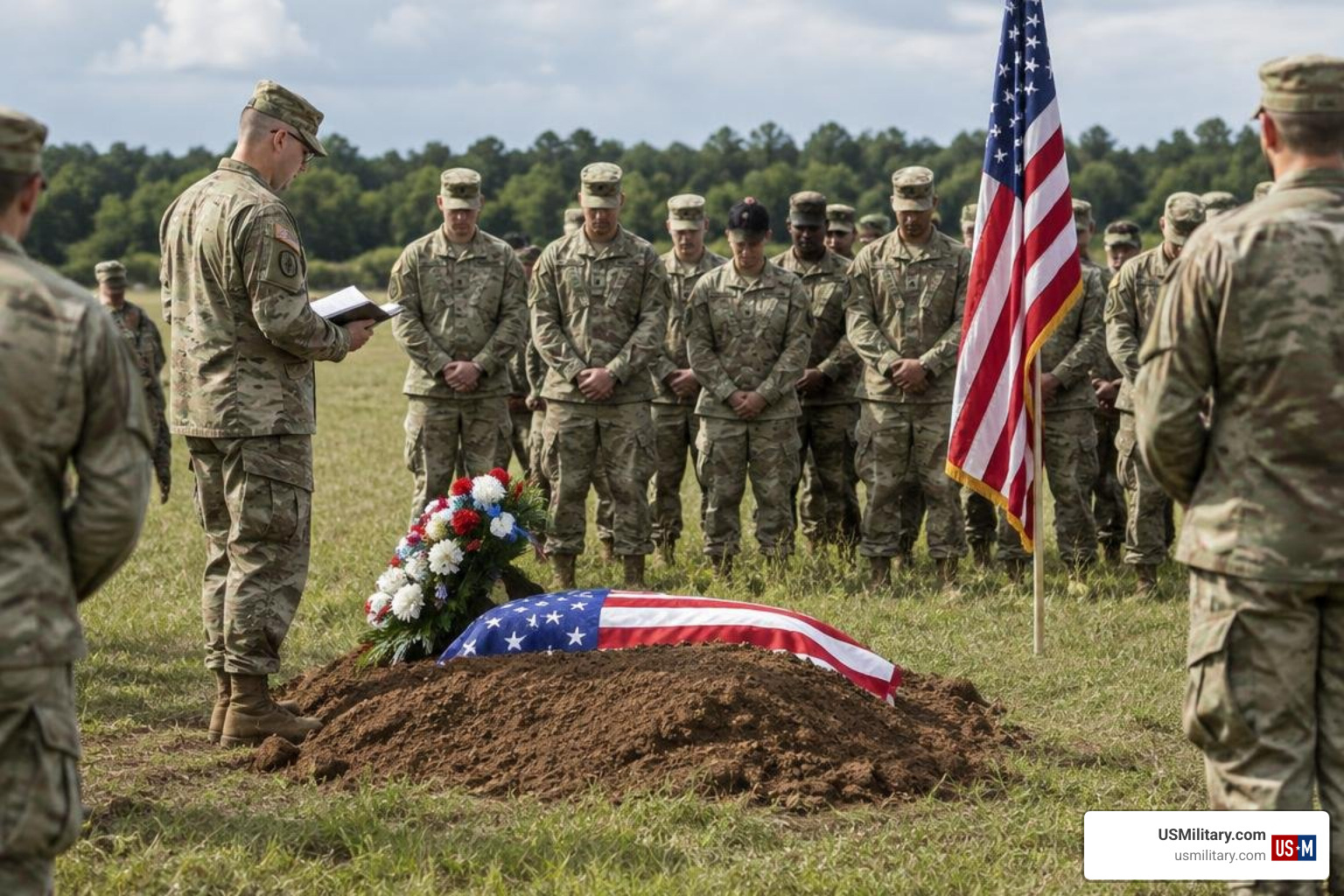
Before any ground was broken, chaplains consulted protocols across diverse faith traditions, performing formal field consecration services. Furthermore, mortuary affairs teams utilized specialized site mapping similar to CERL archaeological burial survey methods to guarantee every individual position is cataloged with forensic precision.
Soil Dynamics and Forensic Remains Preservation
Backfilling a trench with a multi-ton bulldozer presents serious physical challenges. If the soil compresses too forcefully, it risks damaging the remains and destroying identifying personal effects or dental structures.
During the tests, engineers placed simulated skeletal models and sealed water containers into the trenches, testing various soil dynamics like dry sand, clay, and damp loam. Drawing lessons from Fort Bliss forensic grave excavation techniques, the team established exact equipment approach angles and blade heights to insulate remains from direct mechanical crushing during burial.
Frequently Asked Questions About Army Mass Grave Training
When was the last time the US Army conducted large-scale battlefield interments?
The US military has not utilized large-scale temporary battlefield interments since the Korean War in the early 1950s, when combat intensity and rugged terrain made immediate air transport impossible.
How many fallen soldiers can an engineer company inter in 24 hours?
Using eight heavy bulldozers and four High Mobility Engineer Excavators, a single engineer company can respectfully inter up to 2,400 casualties in a 24-hour operational window.
Are temporary battlefield graves meant to be permanent resting places?
No. These sites are strictly designed for temporary containment during active combat. Once the tactical situation permits, specialized mortuary affairs teams disinter the fallen for forensic identification and escort them home for full military honors.
Conclusion
Military preparedness requires training for the harshest aspects of warfare long before they happen. While headlines asking why is the US Army practicing digging mass graves can sound alarming, these exercises show an institutional commitment to leaving no fallen soldier forgotten or unrecovered.
At USMilitary.com, we keep active service members, veterans, and military families informed on critical news, branch career paths, VA disability ratings, and earned benefits. Explore our guides today to stay ahead on all things military.
Free for Service Members & Veterans
Get the military benefits intel no one tells you about.
Weekly updates on VA benefits, pay changes, and money tips — free for service members and veterans.
No spam. Unsubscribe anytime. Your info is never shared.



Leave a Reply