Can Women Register for Selective Service?
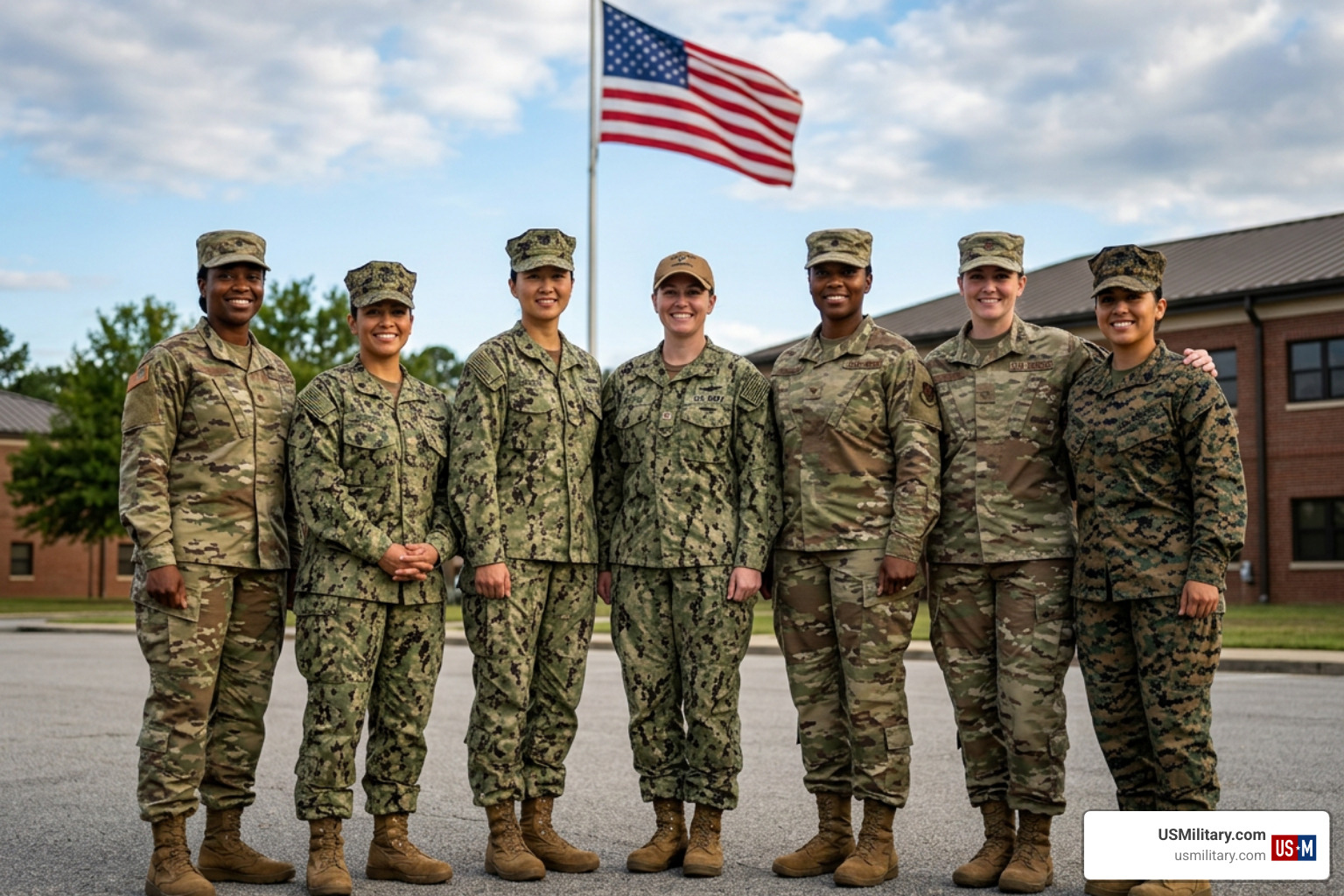
When we look at the incredible contributions of women in our Armed Forces today, it is easy to assume that the path to registration is open to everyone. However, under current federal guidelines, the answer to whether women can register is a definitive “no.”
In fact, women are not just exempt from the requirement—the Selective Service System is legally prohibited from accepting registration applications from female citizens. Even if a woman strongly desires to submit her name to the registry to show her commitment to national defense, the system will reject the application.
This policy often surprises young women who want to be prepared for any national emergency. Under the current framework, the Selective Service System is designed strictly as a database of male citizens and male immigrants. If you are interested in how women can serve, you can read more about the Can Women Get Drafted guidelines.
For those who wonder why the system is built this way, or if a woman could somehow bypass the restriction, the answer lies in the strict administrative code of the Selective Service. As discussed in online forums debating whether a woman could register for Selective Service if she wanted to, the agency’s computer systems and paper processing rules are hardcoded to reject registration attempts from individuals who do not meet the statutory definition of a required registrant.
The Legal Framework: What the Law Says About Women and the Draft

To understand why the draft remains male-only, we have to look at the foundational legislative text. The governing statute is the Military Selective Service Act, which has been on the books for decades.
Section 3(a) of this Act explicitly limits the registration requirement to “every male citizen” and “every other male person residing in the United States” between the ages of 18 and 26. Because the statute specifically uses gender-exclusive language, the Selective Service System has no administrative authority to expand registration to women without an act of Congress.
Historically, this gender-based exclusion was challenged in the courts. The landmark case on this issue is the 1981 Supreme Court ruling in Rostker v. Goldberg. At the time, the Supreme Court ruled that the male-only draft registration was constitutional. The Court’s reasoning was simple: the primary purpose of a draft is to raise combat troops, and because women were excluded from combat roles in 1981, it made legal sense to exclude them from draft registration.
However, the military landscape has changed dramatically since then. In 2013, the Department of Defense began lifting restrictions on women in combat, and by 2015, all combat roles in the U.S. military were opened to women. This major policy shift effectively removed the primary legal justification used in Rostker v. Goldberg.
In February 2019, a federal district judge in Texas ruled that the male-only draft registration was unconstitutional. However, the 5th Circuit Court of Appeals reversed that decision in August 2020, upholding the male-only registration system by stating that it is up to Congress, not the courts, to update the law. To explore this legal history further, check out our guide on how Can Women Be Drafted Into The Military.
To keep things clear, here is a breakdown of who is currently required to register and who is exempt under the Military Selective Service Act:
- Required to Register:
- All male U.S. citizens aged 18 through 25 (including dual citizens living abroad).
- Almost all male immigrants residing in the U.S. aged 18 through 25 (including permanent residents, refugees, asylum seekers, and undocumented immigrants).
- Men with disabilities (though they can seek exemptions from actual service if a draft is enacted).
- Exempt from Registration:
- All individuals assigned female at birth.
- Non-immigrant aliens on valid temporary visas (such as tourists, diplomats, and students).
- Incarcerated or hospitalized men (provided their confinement is continuous from age 18 through 25).
- Active-duty military personnel and students at the military academies (though they must register within 30 days of leaving active duty if they are still under 26).
Transgender Individuals and Selective Service Requirements
One of the most common areas of confusion regarding modern draft registration involves transgender and non-binary individuals. The Selective Service System does not base its registration requirements on an individual’s current gender identity, legal name, or transition status. Instead, the policy is strictly determined by an individual’s sex assigned at birth.
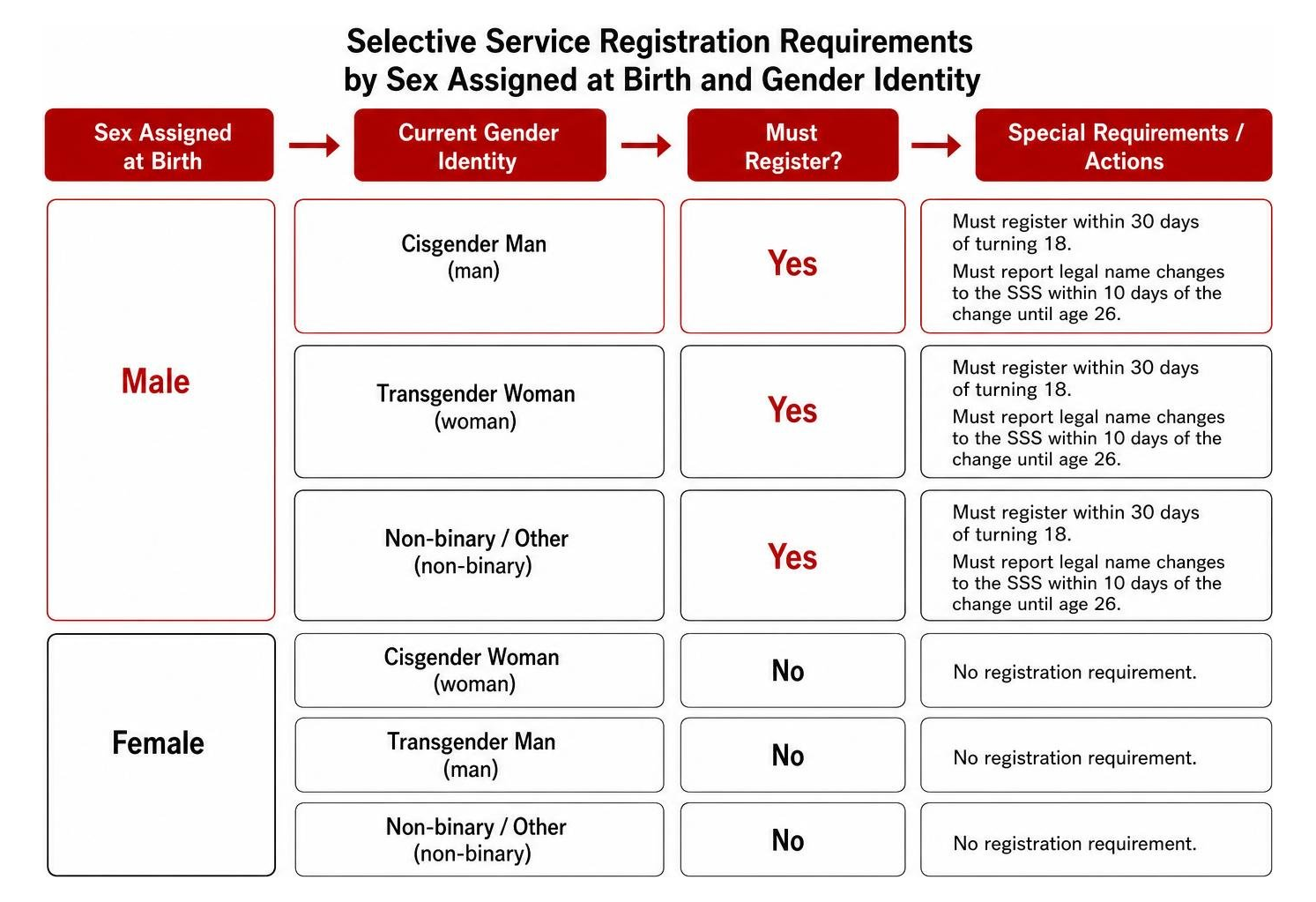
This policy creates distinct rules for transgender women and transgender men:
| Sex Assigned at Birth | Current Gender Identity | Must Register? | Special Requirements / Actions |
|---|---|---|---|
| Male | Transgender Woman | Yes | Must register within 30 days of turning 18. Must report legal name changes to the SSS within 10 days of the change until age 26. |
| Female | Transgender Man | No | Exempt from registration. May need to request a Status Information Letter (SIL) to prove exemption when applying for federal benefits. |
Because transgender women (assigned male at birth) are legally required to register, they must ensure their records are kept up to date. If a transgender woman legally changes her name before her 26th birthday, she is required to notify the Selective Service within 10 days using SSS Form 2 and provide official legal documentation of the name change.
Conversely, transgender men (assigned female at birth) are not required or permitted to register. However, because their legal documents may now list them as male, they are frequently flagged when applying for federal student aid (FAFSA), government jobs, or security clearances.
To resolve this issue without revealing their transgender status to employers or school administrators, they can request a Status Information Letter (SIL) from the Selective Service System. The SIL is a free, official document that states the individual is exempt from the draft. Crucially, the letter protects the applicant’s privacy by stating they are exempt without explaining the specific medical or biological reason why.
✉ Get updates like this in your inbox
Weekly VA benefit changes, pay updates, and money tips for service members, veterans, and military families. Free, no spam.
For more details on how to request an SIL or update your records, you can visit the official Frequently Asked Questions : Selective Service System page.
Legislative Proposals and the Future of the Female Draft

The question of whether women should be required to register for the draft remains a highly debated topic in Washington. In recent years, we have seen significant legislative momentum toward making the Selective Service gender-neutral, though none of these proposals have ultimately become law.
In 2017, Congress established the National Commission on Military, National, and Public Service to study the feasibility and fairness of the draft system. In March 2020, the commission released its final report, concluding that extending registration to women was a “necessary and fair step” that would improve national security by giving the military access to critical skills during a crisis.
Following this recommendation, the House of Representatives passed an amendment to the National Defense Authorization Act (NDAA) in September 2021. The amendment sought to strike the word “Male” from the Military Selective Service Act, requiring all Americans aged 18 to 25 to register. While the change had strong bipartisan support in both the House and Senate Armed Services Committees, it was ultimately dropped from the final bill due to intense political opposition from lawmakers who argued against “drafting our daughters.”
As we look at the defense landscape, we are also approaching a massive administrative transition. Beginning on December 18, 2026, the Selective Service System is scheduled to transition from a self-registration model to an automatic registration system. Under this new framework, eligible individuals will be automatically registered using existing federal databases, such as those maintained by the Social Security Administration and the Department of Motor Vehicles.
While this transition will streamline the process for young men, women will remain completely excluded unless Congress passes specific legislation to change the underlying law. If you want to keep up with these ongoing legislative debates, read the full analysis on the Women Draft US Defense Gender Equality Future page, or check out the latest news updates regarding whether a draft is coming and if women have to sign up.
Frequently Asked Questions About Women and the Draft
Why can women register for selective service forms but not actually be drafted?
Some people notice that the physical registration form, SELECTIVE SERVICE SYSTEM (SSS Form 1), actually contains a checkbox for “Female” under the sex field. This often leads to the question: if women can’t register, why is that checkbox there?
The presence of the female checkbox is primarily an administrative design feature. It allows the Selective Service System to process special categories of registrants if emergency programs are ever activated, and it ensures the paper forms are prepared for any future legislative changes.
However, under normal circumstances, if a female citizen submits SSS Form 1 with the “Female” box checked, the system’s database will flag the application as ineligible and reject the registration.
If the law changes, how can women register for selective service in the future?
If Congress decides to amend the Military Selective Service Act to include women, the registration process would likely be identical to the system currently used by men.
Young women would be required to register within 30 days of their 18th birthday. They would be able to do this easily online at sss.gov in under two minutes, or by filling out a physical form at any U.S. Post Office. Furthermore, with the automatic registration systems set to take effect in late 2026, a legislative change would likely mean that young women would be automatically added to the registry through existing government databases. You can read more about what a gender-neutral draft would look like on our Women Draft page.
Are there any draft penalties or benefits that currently affect women?
Because women are not legally required to register for the Selective Service, they do not face any of the penalties associated with non-compliance.
Young men who fail to register before their 26th birthday face severe, lifelong consequences, including:
- Fines of up to $250,000 and up to 5 years in prison.
- Permanent loss of eligibility for federal student financial aid (FAFSA).
- Ineligibility for federal job training programs and federal employment.
- A permanent block on U.S. citizenship pathways for male immigrants.
Since women are exempt, they have full access to federal student loans, government jobs, and naturalization pathways without ever having to show proof of registration.
However, there is one unique area where women could be drafted under standby emergency plans: the Health Care Personnel Delivery System (HCPDS). This is a specialized standby draft designed to address critical shortages of medical personnel during a national emergency. Unlike the general draft, which is strictly male-only, the HCPDS plans include both male and female health care professionals aged 20 to 54 across 57 distinct medical job categories.
Conclusion
At USMilitary.com, we believe in keeping our community informed about the laws, benefits, and requirements that affect military members, veterans, and their families. While the U.S. military has been a highly successful all-volunteer force since 1973, understanding the rules of the Selective Service is essential for navigating federal benefits and staying legally compliant.
Currently, can women register for selective service? The answer remains a clear no. Women cannot register voluntarily, and they are not required to do so by law. While the debate over gender equality in the draft continues to make headlines in Washington, any actual changes to this policy will require a formal amendment to the Military Selective Service Act by Congress.
If you want to learn more about how conscription works, who gets called first, or how to verify your current registration status, check out our comprehensive guide to the US Military Draft. Whether you are planning a career in the military or just looking for clear answers to complex military questions, we are here to provide the unbiased resources you need.
Free for Service Members & Veterans
Get the military benefits intel no one tells you about.
Weekly updates on VA benefits, pay changes, and money tips — free for service members and veterans.
No spam. Unsubscribe anytime. Your info is never shared.