
Social Security’s 2027 cost-of-living adjustment (COLA) is 3.6%. For the average retired worker, that means about $75 more per month, raising the benefit from $2,095 to $2,170 before deductions. Veterans receiving Social Security get the same percentage increase as other beneficiaries. VA disability compensation and pension rates also rise by the same percentage under federal law.
The increase will appear in Social Security payments starting in January 2027. Your actual dollar gain depends on your benefit amount, and a higher Medicare Part B premium could reduce the amount deposited into your bank account.
I’m Larry Fowler, publisher of USMilitary.com, where I’ve covered VA benefits and issues affecting veterans since 2007. In this guide to Social Security Announces 2027 COLA and how it affects Military Veterans, I’ll explain what changes and what to check on your benefit statements.

Know your Social Security Announces 2027 COLA and how it affects Military Veterans terms:
Overview of the 2027 Social Security COLA Increase
The official declaration from the Social Security Administration marks a key financial turning point for over 76 million Americans, including millions of former service members. The 3.6% bump for 2027 represents the highest rate adjustment in three years, surpassing the 2.8% rate from 2026 and the 2.6% rate in 2025. While it does not reach the historical 8.7% spike seen during the post-pandemic inflation surge of 2023, it reflects persistent price pressures across energy, shelter, and consumer goods.

Every autumn, beneficiaries wait for the official Cost-of-Living Adjustment (COLA) Information to understand how their baseline income will change. For retired soldiers, sailors, airmen, and Marines living on fixed incomes, this adjustment is essential for maintaining household purchasing power.
Inflation Benchmarks and CPI-W Calculation
The Social Security Administration does not pick COLA numbers out of thin air. By law, the adjustment is tied directly to the Consumer Price Index for Urban Wage Earners and Clerical Workers (CPI-W), which is measured by the Bureau of Labor Statistics (BLS).
The calculation follows a strict formula:
- The BLS measures monthly inflation across urban consumer baskets, tracking items like gasoline, food, transportation, and healthcare.
- The SSA examines data from the third quarter of the current calendar year—specifically July, August, and September.
- The average CPI-W for the third quarter of 2026 (which reached 328.746) is compared against the third-quarter average from 2025 (317.265).
- The percentage difference, rounded to the nearest tenth of one percent, determines the COLA.
As reported in AP News coverage on COLA and inflation trends, rising energy prices and persistent grocery inflation during late summer 2026 pushed the index upward, resulting in the final 3.6% figure.
Understanding What Social Security Announces 2027 COLA and how it affects Military Veterans Monthly Checks
The 3.6% boost provides tangible relief, but the exact dollar amount added to each monthly check depends on the benefit category. The average retired worker’s benefit climbs by $75 per month, moving from $2,095 to $2,170.
Disabled veterans receiving Social Security Disability Insurance (SSDI) will see an average increase of $59 per month, taking typical payouts from $1,642 to $1,701. Surviving spouses and widowers will gain an estimated $69 per month, lifting average checks from $1,936 to $2,005.
| Benefit Recipient Category | 2026 Average Monthly Benefit | 2027 Estimated Monthly Benefit (3.6% COLA) | Average Monthly Increase |
|---|---|---|---|
| All Retired Workers | $2,095 | $2,170 | +$75 |
| Disabled Workers (SSDI) | $1,642 | $1,701 | +$59 |
| Widows / Widowers Living Alone | $1,936 | $2,005 | +$69 |
| Retired Couple (Both Receiving) | $3,238 | $3,355 | +$117 |
| SSI Individual Beneficiary | $967 | $1,002 | +$35 |
Social Security Announces 2027 COLA and how it affects Military Veterans
Military retirees and disabled veterans occupy a unique position in federal benefits planning because many receive multiple benefit streams simultaneously. Understanding how the 3.6% rate applies across different programs prevents budgeting surprises.

VA Disability Compensation and Military Retirement Adjustments
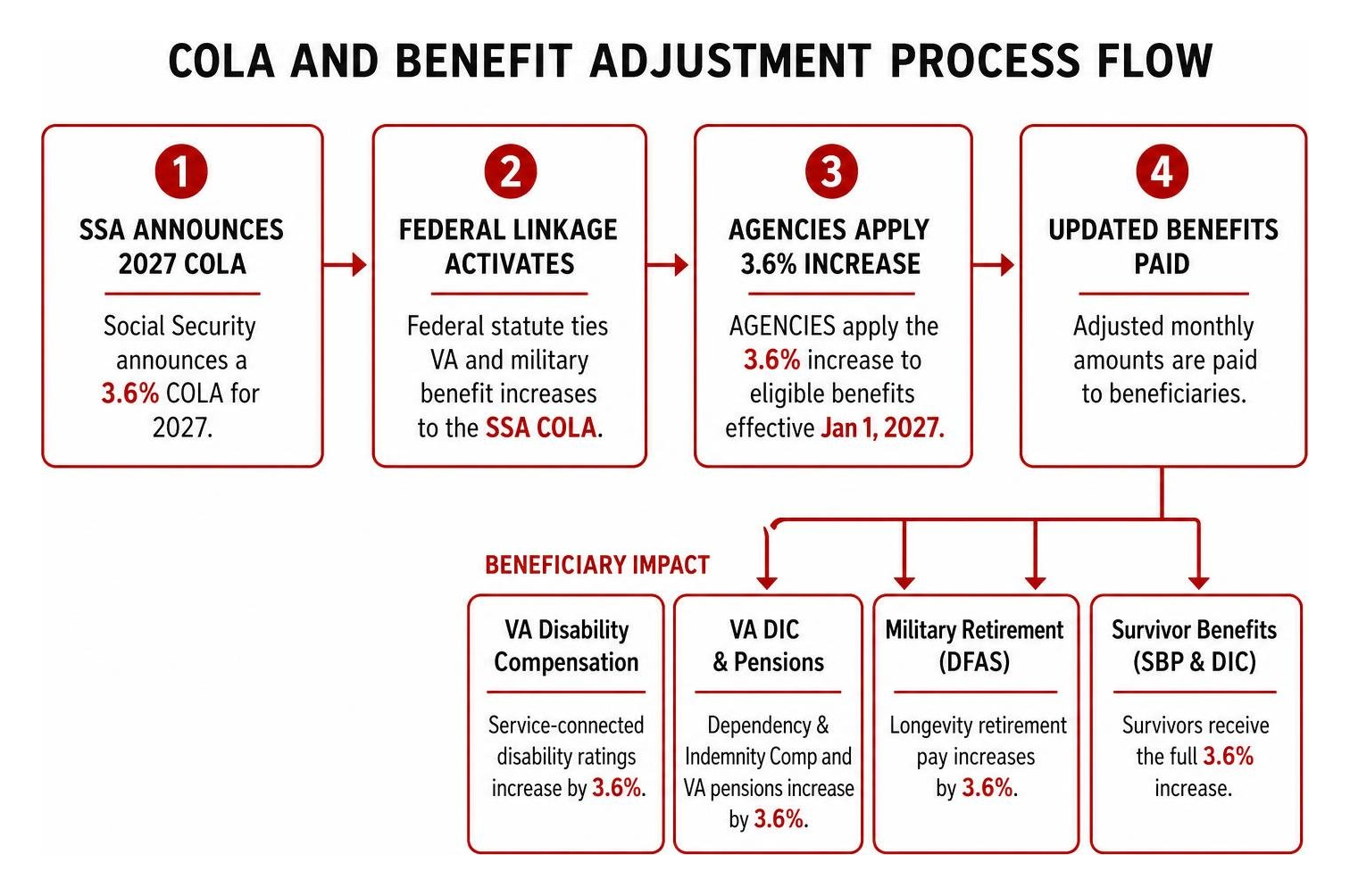
Under federal statute, annual cost-of-living increases for Department of Veterans Affairs (VA) disability compensation, Dependency and Indemnity Compensation (DIC), and VA pensions are tied directly to Social Security’s COLA percentage. When the SSA announces a 3.6% increase, disabled veterans receive that exact same 3.6% boost across their monthly disability ratings.
This statutory parity ensures that your benefits keep pace with inflation regardless of whether you receive compensation for service-connected conditions, non-service-connected pension support, or military longevity retirement through the Defense Finance and Accounting Service (DFAS).
Veterans comparing their current compensation to next year’s numbers can review their 2026 VA disability baseline rates to calculate their exact dollar jump. If you are tracking longevity pay, our breakdowns on military pension eligibility rules and Army retirement pay structures illustrate how career service credits intersect with regular cost-of-living upgrades.
Surviving Spouse and Dependent Benefit Impacts
Surviving military spouses who rely on VA Dependency and Indemnity Compensation (DIC) or the military Survivor Benefit Plan (SBP) will also receive the full 3.6% increase. This adjustment provides meaningful support for surviving spouses managing single-income households amid higher grocery and housing costs.
Navigating survivor claims across federal agencies can be confusing. If you are managing benefits after losing a spouse, consult our surviving spouse benefits navigation guide for step-by-step instructions on coordinating SSA survivor annuities with VA DIC payments.
Financial Rule Changes, Wage Caps, and Medicare Deductions
A COLA announcement changes more than just monthly benefit checks. The SSA also updates several related thresholds, including payroll tax caps, earnings test limits, and credit requirements.
Social Security Taxable Wage Cap and Earnings Test Limits
For veterans working in the civilian sector or serving in the Reserve components, several important thresholds shift on January 1, 2027:
- Maximum Taxable Earnings Cap: The ceiling on wages subject to the 6.2% Social Security payroll tax increases from $184,500 in 2026 to $192,300 in 2027. High-earning veterans will pay Social Security taxes on an additional $7,800 of earned income.
- Retirement Earnings Test (Under Full Retirement Age): Beneficiaries who claim Social Security retirement before reaching their Full Retirement Age (FRA) while continuing to work can earn up to $25,560 in 2027 before benefits are withheld ($1 withheld for every $2 earned above the limit).
- Earnings Test (Year Reaching Full Retirement Age): In the calendar year you reach FRA, the earnings limit rises to $67,920 ($1 withheld for every $3 earned above the limit until your birthday month).
- Social Security Credit Threshold: Workers must earn $1,970 in covered wages to earn one Social Security work credit in 2027, up from $1,890.
Active duty and reserve servicemembers tracking these tax adjustments against incoming military basic pay tables can consult our estimated military pay scale guidelines to see how annual defense authorizations intersect with civilian payroll caps.
Medicare Part B Premium Hikes Offsetting Monthly Raises
While gross benefit checks are increasing by 3.6%, the actual cash arriving in your bank account might be smaller than expected. For most retirees, Medicare Part B premiums are deducted directly from their Social Security checks.
The standard monthly Medicare Part B premium is projected to increase from $202.90 in 2026 to $209.50 in 2027, a jump of roughly $6.60 per month. Additionally, the standard Medicare Part D prescription deductible is projected to climb from $615 to $700.
If your gross Social Security check rises by $75, but your Medicare Part B premium increases by $6.60, your net disposable monthly raise will be roughly $68.40. Beneficiaries can model these offsets using an online 2027 COLA benefit calculator to see their exact take-home pay.
Future Policy Debates and Advocacy Group Concerns
Although a 3.6% increase is the strongest adjustment in three years, senior and veteran advocacy organizations express serious concern over long-term purchasing power.
According to research from The Senior Citizens League, typical retirement benefits have lost approximately 13.7% of their buying power over the last decade, functioning at roughly 86.3 cents on the dollar compared to 2016. Because seniors and disabled veterans spend a disproportionate share of their monthly income on out-of-pocket medical expenses, prescription drugs, heating oil, and fresh food, standard inflation indexes often fail to reflect their true cost of living.
CPI-E vs. Chained CPI Proposals
Policy analysts and veteran organizations continue to debate how cost-of-living adjustments should be calculated moving forward:
- The CPI-E (Consumer Price Index for the Elderly): This proposed index weights healthcare and housing costs more heavily to reflect spending patterns among older adults. Switching to the CPI-E would historically add an estimated 0.15 to 0.2 percentage points to annual COLAs.
- Chained CPI-U: Fiscal reform proposals often suggest switching to Chained CPI, which assumes consumers substitute cheaper goods when prices rise (like buying chicken instead of beef). Adopting Chained CPI would reduce annual COLAs by an estimated 0.3 percentage points, saving federal expenditures while lowering long-term payments to veterans.
- Targeted Bump Provisions: Other legislative proposals suggest adding 1.0 percentage point to the COLA calculation for beneficiaries once they reach age 80 to protect against late-life poverty.
When Social Security Announces 2027 COLA and how it affects Military Veterans Payment Timelines
The 2027 cost-of-living increase follows a structured payment schedule across federal agencies:
- Supplemental Security Income (SSI): Because January 1 is a federal holiday, SSI beneficiaries will receive their increased payment on Thursday, December 31, 2026.
- VA Disability Compensation and Pension: VA checks for December 2026 (paid on December 31, 2026) will reflect the new 3.6% COLA rate.
- Social Security Retirement and SSDI: Standard monthly deposits will arrive on their regular Wednesday cycles throughout January 2027, depending on your birth date (second, third, or fourth Wednesday).
Beneficiaries can verify their personalized adjustment notices online through their personal mySocialSecurity account starting in late November 2026.
Frequently Asked Questions About the 2027 COLA
When will veterans see the 2027 COLA increase reflected in their benefits?
Veterans receiving VA disability compensation and SSI will see the higher payout on December 31, 2026 (since January 1 is a federal holiday). Social Security retirement and SSDI recipients will receive their updated payments on their scheduled January 2027 disbursement dates.
Does the 3.6% COLA automatically apply to VA disability and pension payments?
Yes. Under federal law, Congress mandates that VA disability compensation, Dependency and Indemnity Compensation (DIC), and VA pension rates receive the exact same percentage cost-of-living increase as Social Security benefits. The adjustment is applied automatically; veterans do not need to file an application to receive it.
How does the projected Medicare Part B premium affect my net monthly increase?
Because standard Medicare Part B premiums are deducted directly from Social Security checks, the projected $6.60 monthly premium increase (rising to $209.50) will reduce your gross raise. For example, an average gross benefit increase of $75 results in a net monthly increase of approximately $68.40.
Conclusion
The 2027 Social Security COLA of 3.6% provides a welcome boost for retired service members and disabled veterans managing higher everyday expenses. By boosting average monthly checks by roughly $75 and automatically lifting VA disability compensation rates, this adjustment helps protect your financial foundation against inflation.
Taking control of your post-military financial security means looking at the complete picture—from coordinating dual benefit streams to planning around Medicare Part B deductions and payroll caps. For additional tools, benefits calculators, and transition strategies, explore our comprehensive servicemember financial planning resources and stay informed with USMilitary.com.
Free for Service Members & Veterans
Get the military benefits intel no one tells you about.
Weekly updates on VA benefits, pay changes, and money tips — free for service members and veterans.
No spam. Unsubscribe anytime. Your info is never shared.



More Than 90% Of Clients Have Increased Ratings! Why Settle For Less Than You Deserve? Expert Priority Help With Your VA Claim Today! Free Evaluation Call!
The mission of Veteran Services United is to support veterans in filing and winning disability claims by offering expert guidance, advocacy, and personalized assistance. Through dedicated service, Veteran Services United empowers veterans to secure the benefits they have earned, ensuring they receive the care and support they deserve.
Leave a Reply