Why Aid and Attendance Benefits Matter for Veterans in 2026
Aid and attendance 2026 provides crucial financial support for wartime veterans and their surviving spouses who need help with daily activities.
2026 Quick Facts:
- Maximum monthly benefit: $2,873 (veteran with spouse)
- Net worth limit: $163,699
- Benefit increase: 2.8% COLA adjustment (effective December 1, 2025)
- Basic eligibility: Wartime service + financial need + medical need
| Recipient Type | Monthly Benefit (2026) |
|---|---|
| Single Veteran | $2,424 |
| Veteran with Spouse | $2,873 |
| Surviving Spouse | $1,558 |
If you’re a veteran or surviving spouse struggling with the costs of home care, assisted living, or nursing home expenses, Aid and Attendance (A&A) could provide the financial relief you need. This improved VA Pension benefit offers tax-free monthly payments to help cover these long-term care costs.
The 2026 benefit year brings important updates. The net worth limit increased to $163,699, and monthly benefit amounts rose by 2.8% due to cost-of-living adjustments. These changes affect both your eligibility and the amount you could receive.
Understanding Aid and Attendance can be confusing, as the application requires specific documentation and financial calculations. Many eligible veterans never apply because they don’t know the benefit exists or assume they won’t qualify.
This guide breaks down everything you need to know about Aid and Attendance in 2026, including who qualifies, how much you can receive, and how to avoid common application mistakes. This benefit could make a significant financial difference for your family.
I’m Larry Fowler, publisher of USMilitary.com. Since 2007, I’ve helped thousands of veterans and their families understand and access aid and attendance 2026 benefits, securing the financial support they’ve earned.
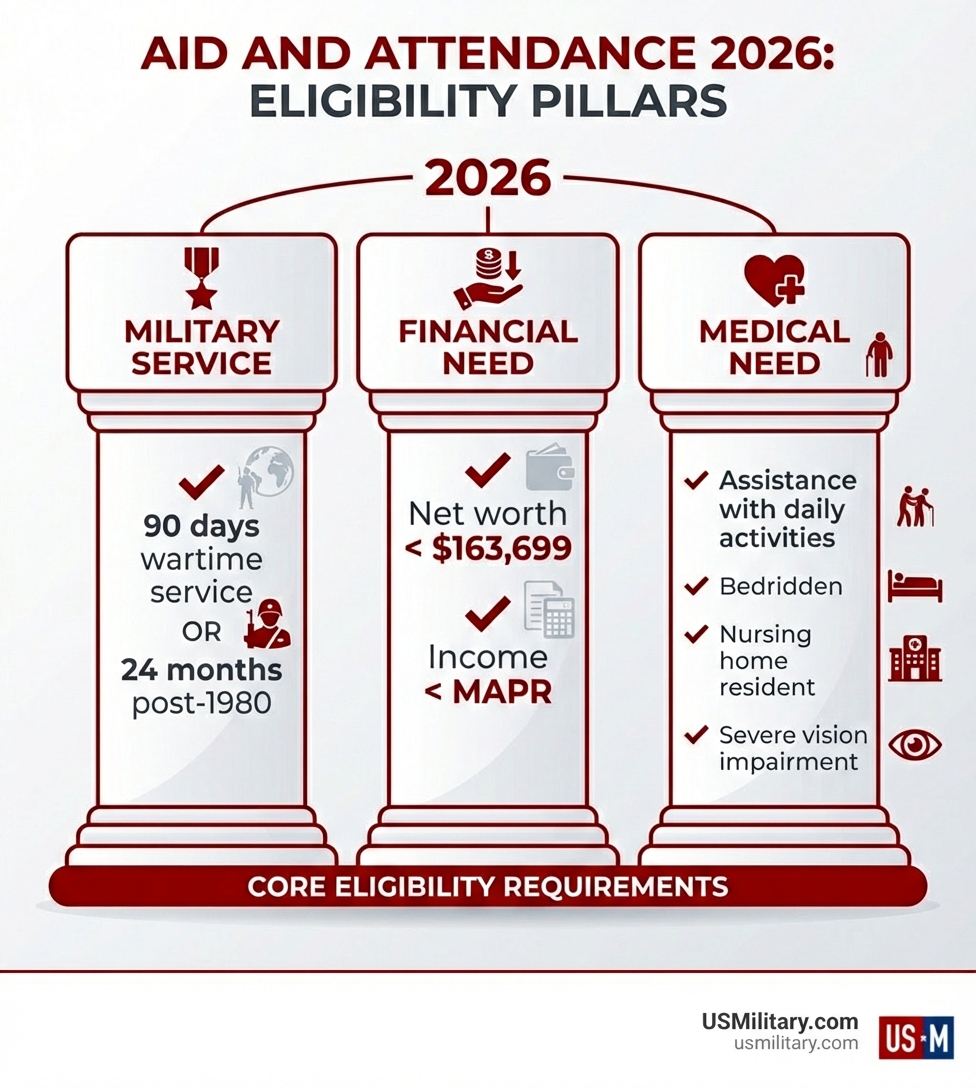
In the infographic above, you can quickly see the three core pillars you must meet for Aid and Attendance 2026: qualifying wartime military service, financial need under the current limits, and a documented medical need for help with daily activities or supervision.
VA Aid and Attendance 2026: Key Updates and Benefit Rates
The Department of Veterans Affairs (VA) Aid and Attendance benefit is a vital resource for many American veterans and their families. As we move into aid and attendance 2026, there are important updates regarding benefit rates and eligibility thresholds, driven by the annual Cost-of-Living Adjustment (COLA).
For the benefit period from December 1, 2025, to November 30, 2026, the VA has adjusted its rates and limits to help beneficiaries keep pace with rising costs. The COLA increase is 2.8%, effective December 1, 2025. However, it’s worth noting that rising Medicare Part B premiums may offset some of this increase for many beneficiaries.
The Aid and Attendance benefit is an improved pension designed to help cover long-term care costs, whether for home care, assisted living, or nursing home care. Many veterans and surviving spouses are unaware these tax-free monthly payments can be used to pay for assisted living, providing much-needed financial relief. For more details, you can read our guide on Understanding Aid and Attendance Tax-Free Income.
2026 Maximum Benefit Amounts
Understanding the maximum monthly benefit amounts, or Maximum Annual Pension Rate (MAPR), is crucial for planning. These rates vary depending on your status and level of care needed.
Here’s a comparison of the projected 2026 MAPR for different statuses, effective from December 1, 2025, to November 30, 2026:
| Recipient Status | Basic Pension (Monthly) | Housebound (Monthly) | Aid & Attendance (Monthly) |
|---|---|---|---|
| Veteran with no spouse or dependent child | $1,453 ($17,440/year) | $1,776 ($21,312/year) | $2,424 ($29,091/year) |
| Veteran with a spouse or dependent child | $1,903 ($22,838/year) | $2,225 ($26,709/year) | $2,873 ($34,486/year) |
| Surviving spouse with no dependent child | $974 ($11,699/year) | $1,191 ($14,296/year) | $1,558 ($18,696/year) |
| Surviving spouse with a dependent child | $1,275 ($15,309/year) | $1,491 ($17,902/year) | $1,858 ($22,302/year) |
| Two Veterans married to each other (one qualifies for A&A) | N/A | N/A | $2,873 ($34,486/year) |
| Two Veterans married to each other (one A&A, one Housebound) | N/A | N/A | $3,195 ($38,350/year) |
| Two Veterans married to each other (both A&A) | N/A | N/A | $3,845 ($46,143/year) |
As shown, the maximum Aid and Attendance benefit for a veteran with a spouse is $2,873 per month, while a single veteran can receive up to $2,424. A surviving spouse can receive up to $1,558. These amounts highlight the significant financial assistance this benefit provides. The presence of dependents increases the MAPR due to higher household needs.
Financial Thresholds: Net Worth and Income Limits
To qualify for aid and attendance 2026, applicants must meet specific financial criteria, including an income test and a net worth limit.
The net worth limit for Veterans Pension benefits from December 1, 2025, to November 30, 2026, is $163,699. This limit applies to the combined net worth of the veteran and their dependents. Your net worth includes your assets and annual income.
Assets include the fair market value of real and personal property you own, minus any mortgages. However, your primary residence, car, and basic household items are generally not counted. For a comprehensive understanding, you can read more about how the VA defines “assets”.
For income, the VA looks at “countable income.” Your yearly family income must be less than the MAPR for your pension rate. A key factor in reducing countable income is Unreimbursed Medical Expenses (UMEs). If your UMEs exceed 5% of the applicable MAPR, they can be deducted from your annual income, which is especially helpful for those with high care costs.
The VA also has a 3-year look-back period for asset transfers. This rule prevents applicants from gifting away assets to meet the net worth limit. Violating this rule could result in a pension ineligibility period of up to five years, so seek professional guidance if you’ve recently transferred assets.
Understanding Your Eligibility for Aid and Attendance
To qualify for aid and attendance 2026, you must meet three core requirements: military service, financial need, and medical need. Each pillar is crucial for a successful application. For a deeper dive, explore our guide on VA Aid and Attendance Qualifications.

Military Service Requirements
Eligibility for VA Aid and Attendance stems from qualifying military service. This benefit is for wartime veterans or their surviving spouses.
Here are the key military service criteria:
- Wartime Service: The veteran must have served at least 90 days of active duty, with at least one day during a designated wartime period.
- Post-9/7/1980 Service: If the veteran entered active duty after September 7, 1980, they generally must have served at least 24 months or the full period for which they were called to active duty, with at least one day during a wartime period.
- Discharge Status: The veteran must have an honorable discharge. A dishonorable discharge disqualifies a veteran from receiving VA pensions.
You can check official VA wartime periods on their website to confirm your eligibility.
Financial Requirements for Aid and Attendance 2026
Applicants must demonstrate financial need by comparing their countable income and net worth against the VA’s limits for aid and attendance 2026.
- Income vs. MAPR: Your countable income must be less than the Maximum Annual Pension Rate (MAPR) for your category. The A&A benefit has a higher MAPR, so many veterans may qualify even if their income is too high for a basic pension.
- Calculating Countable Income: The VA allows you to deduct Unreimbursed Medical Expenses (UMEs) from your gross income. If your UMEs exceed 5% of your MAPR, they can substantially reduce your countable income, often making you financially eligible.
- Net Worth Calculation: As mentioned, your combined assets and annual income must fall below the $163,699 net worth limit for aid and attendance 2026.
- Exclusions: Your primary residence and one vehicle are typically excluded from your net worth calculation.
Medical and Functional Requirements
The “Aid and Attendance” part of the benefit refers to the medical need for assistance with daily living. This is why the improved pension exists: to help those who need consistent care.
To qualify for aid and attendance 2026, you must meet at least one of the following medical conditions:
- Need for Assistance with Activities of Daily Living (ADLs): You require another person’s help to perform personal functions like:
- Bathing
- Dressing
- Eating
- Using the bathroom
- Adjusting prosthetic devices
- Protecting yourself from daily hazards (e.g., due to cognitive impairment)
- Bedridden Status: You are confined to bed due to illness or disability.
- Nursing Home Residency: You are a patient in a nursing home due to mental or physical incapacitation.
- Severe Vision Impairment: Your eyesight is limited to a corrected 5/200 visual acuity or less in both eyes, or you have a concentric contraction of the visual field to 5 degrees or less.
These conditions must be documented by a medical professional, as their report is a critical piece of evidence.
The Application Process: A Step-by-Step Guide
Applying for aid and attendance 2026 can seem daunting, but breaking it down into steps makes it easier. The process involves gathering documents, completing forms, and submitting them to the VA. A complete and accurate application is key to a smoother process.

Required Documentation and Forms
Accuracy and thoroughness are paramount. The VA needs a clear picture of your military service, finances, and medical needs.
Here’s a checklist of key documents you’ll likely need:
- VA Form 21P-527EZ: Application for Veterans Pension.
- VA Form 21P-534EZ: Application for DIC, Survivors Pension, and/or Accrued Benefits (for surviving spouses).
- VA Form 21-2680: Examination for Housebound Status or Permanent Need for Regular Aid and Attendance. Your physician must complete this with detailed medical evidence. You can download VA Form 21-2680 (Examination for Housebound Status).
- VA Form 21-0779: Request for Nursing Home Information in Connection with Claim for Aid and Attendance (if applicable).
- DD-214 (Military Discharge Papers): Verifies military service.
- Marriage Certificate: Confirms marital status for spouse or survivor benefits.
- Medical Records: Additional records supporting your need for care.
- Proof of Medical Expenses: Receipts for all unreimbursed medical expenses.
- Financial Documentation: Statements for all income sources and assets.
How to Apply for Aid and Attendance 2026
Once you’ve gathered your documentation, you can submit your application in several ways:
- Online: Apply for the basic pension online at VA.gov.
- Mail: Send completed forms to the Pension Management Center (PMC) serving your state.
- In-person: Visit a VA regional office for assistance.
- QuickSubmit: Use the VA’s QuickSubmit tool to upload documents online.
Consider using the Fully Developed Claims (FDC) program, where you submit all evidence at once, which can lead to faster processing. For more tips, see our article on How to Speed Up VA Aid and Attendance.
Common Mistakes and How to Avoid Them
A single mistake can cause significant delays or denial. Here are common pitfalls to avoid:
- Incomplete Forms: Ensure every field is filled out. Use “N/A” if a section doesn’t apply.
- Insufficient Medical Evidence: Your physician’s report (VA Form 21-2680) must be detailed and specific about your need for assistance.
- Not Reporting All Income/Assets: The VA requires full financial disclosure. Be transparent and accurate.
- Missing Deadlines: Respond promptly to any VA requests for more information.
- Misunderstanding the Look-Back Rule: Transferring assets within the 3-year look-back period can cause ineligibility. Consult a professional if you’re considering asset transfers.
Seeking assistance from a Veterans Service Organization (VSO) or an accredited claims agent is highly recommended to ensure your aid and attendance 2026 application is accurate and complete.
A&A vs. Other VA Benefits: What’s the Difference?
It can be confusing to understand how Aid and Attendance differs from other VA benefits. Let’s clarify its relationship with Housebound benefits and Special Monthly Compensation (SMC).
Aid & Attendance vs. Housebound Benefits
Both Aid and Attendance and Housebound benefits are improved pensions that provide additional payment to those already receiving a VA pension. They address different levels of medical need, and you cannot receive both at the same time.
- Housebound Criteria: This benefit is for those substantially confined to their home due to a permanent disability. To qualify, you must have a single permanent disability rated as 100% disabling AND be permanently and substantially confined to your home, OR have a single 100% disability AND another disability rated at 60% or more.
- Aid & Attendance Criteria: A&A is for those who need regular help with daily activities (ADLs), are bedridden, in a nursing home, or have severe vision impairment.
Choosing the Higher Benefit: Since you can’t receive both, the VA will award the benefit that provides the higher payment if you qualify for both.
Aid & Attendance Pension vs. Special Monthly Compensation (SMC)
This is another common area of confusion. They provide funds for severe medical needs but come from different VA benefit programs.
- VA Pension (Needs-Based): Aid and Attendance is part of the VA Pension program, which is needs-based. Eligibility depends on your income, net worth, and wartime service. It is not tied to a service-connected disability.
- VA Disability Compensation (Service-Connected): This benefit is for veterans with disabilities from military service. It is not needs-based and is based on the severity of your service-connected disability.
Special Monthly Compensation (SMC): SMC is an additional tax-free benefit for veterans, spouses, and parents with certain severe disabilities. It’s a higher level of disability compensation.
- SMC for Severe Disabilities: SMC is awarded for conditions like loss of a limb or blindness. A specific category, SMC-L, is for veterans who require aid and attendance due to their service-connected conditions.
- Waiving One Benefit for the Other: You cannot receive both a VA Pension with Aid and Attendance AND service-connected payments (including SMC) at the same time. If eligible for both, you must waive one to receive the other. Always choose the benefit that provides the higher monthly payment.
Frequently Asked Questions about Aid and Attendance
We understand you have questions about aid and attendance 2026. Here are answers to some common inquiries.
How long does the VA take to make a decision on a claim?
Processing time for a VA Aid and Attendance claim varies based on case complexity and claim volume. It can range from several months to over a year. Submitting a Fully Developed Claim (FDC), where you provide all necessary evidence upfront, can often expedite the decision. Incomplete applications, however, can lead to significant delays.
Can I receive Aid and Attendance if my income is higher than the basic pension limit?
Yes. This is a common misunderstanding. The Aid and Attendance benefit has a higher Maximum Annual Pension Rate (MAPR) than the basic VA Pension. Crucially, you can deduct Unreimbursed Medical Expenses (UMEs), such as the cost of home care or assisted living. These deductions can lower your “countable income” below the A&A MAPR, making you eligible even if your gross income seems too high. Don’t assume you’re ineligible based on income alone.
Do I have to pay a professional to provide care?
No. The Aid and Attendance benefit is paid based on your need for care, not on whether you are paying a professional. The benefit can be paid even when assistance is provided free of charge by a spouse, relative, or friend. The VA’s concern is that you require the aid of another person, regardless of who provides it.
Conclusion: Securing Your 2026 Benefits
Aid and attendance 2026 is a crucial lifeline for wartime veterans and their surviving spouses facing long-term care costs. The 2026 updates, including the 2.8% COLA adjustment and the $163,699 net worth limit, provide continued financial relief.
Understanding the eligibility criteria—military service, financial need, and medical need—is the first step. This benefit is designed to help cover significant expenses for home care, assisted living, or nursing homes. A successful claim depends on a complete application with proper documentation, like VA Forms 21P-527EZ and 21-2680.
It is also vital to understand how Aid and Attendance differs from other VA benefits, such as Housebound or Special Monthly Compensation, to ensure you pursue the most advantageous option.
We at USMilitary.com are dedicated to helping veterans and their families secure the benefits they’ve earned. The financial relief from aid and attendance 2026 can significantly ease the burden of long-term care, allowing our heroes to live with dignity.
Don’t let complexity deter you. For a comprehensive understanding, get your complete guide to VA Aid and Attendance and take the next step towards securing the support you deserve.
Free for Service Members & Veterans
Get the military benefits intel no one tells you about.
Weekly updates on VA benefits, pay changes, and money tips — free for service members and veterans.
No spam. Unsubscribe anytime. Your info is never shared.


