What Are the Army ASVAB Subtests?
Army ASVAB subtests are the nine (or ten, on the computer version) individual sections of the Armed Services Vocational Aptitude Battery — the test every enlisted soldier must pass before joining the U.S. Army.
Here’s a quick overview of all the subtests:
| Subtest | Abbreviation | What It Measures |
|---|---|---|
| General Science | GS | Biology, chemistry, physics |
| Arithmetic Reasoning | AR | Word problems and math logic |
| Word Knowledge | WK | Vocabulary and word meaning |
| Paragraph Comprehension | PC | Reading and understanding passages |
| Mathematics Knowledge | MK | High school math concepts |
| Electronics Information | EI | Circuits, electricity, electronics |
| Auto & Shop Information | AS | Vehicles, tools, repair |
| Mechanical Comprehension | MC | Mechanical principles and physics |
| Assembling Objects | AO | Spatial reasoning and shapes |
On the computerized version, Auto & Shop Information is split into two separate subtests — making it 10 subtests total.
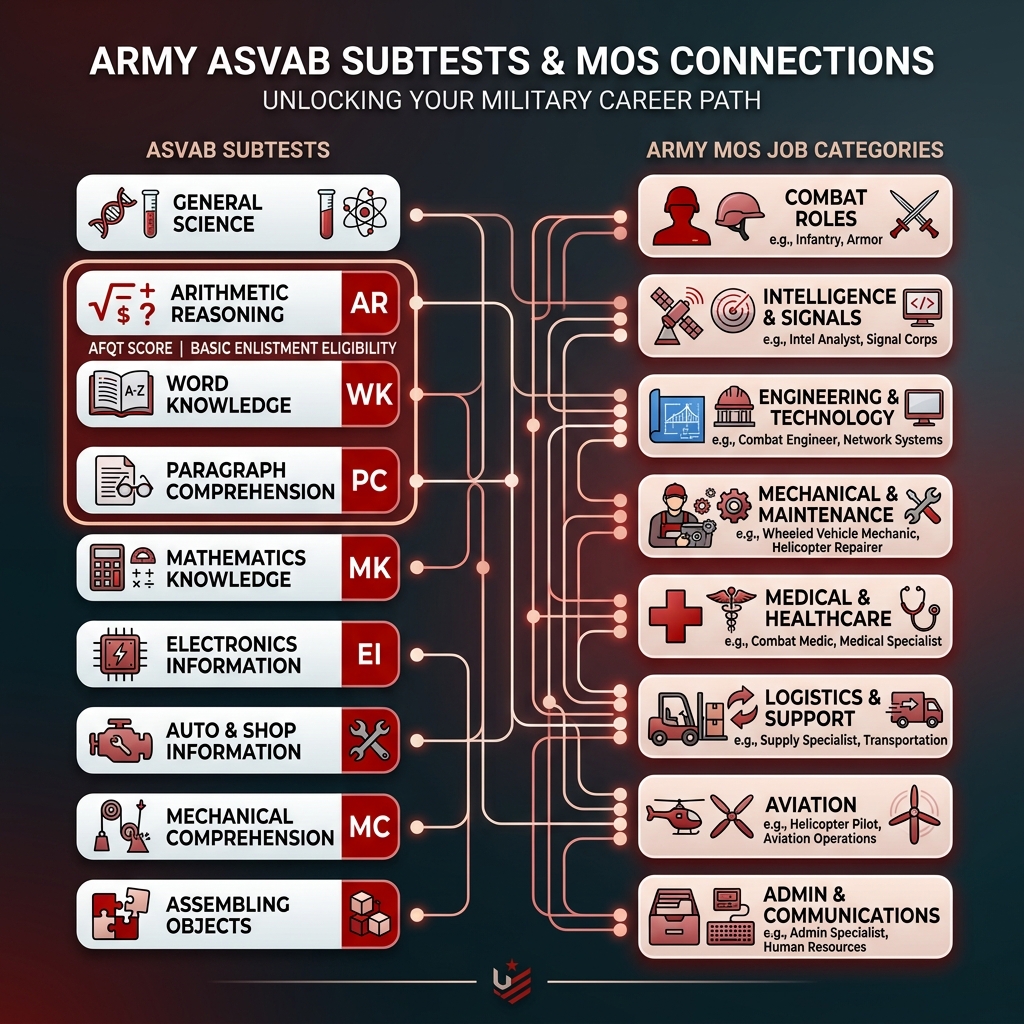
The four most critical subtests for basic enlistment eligibility are AR, WK, PC, and MK — these make up your AFQT score, and you need at least a 31 to qualify for the Army with a high school diploma.
All other subtests shape which Army jobs (MOS) you can qualify for. So your performance across every section genuinely matters for your military career.
I’m Larry Fowler, publisher of the USMilitary.com Network — a platform I’ve run since 2007 to help recruits and veterans navigate everything from VA benefits to Army ASVAB subtests and enlistment requirements. Let’s break down exactly what’s on the test and how it affects your Army career path.
Similar topics to Army ASVAB subtests:
Understanding the Army ASVAB Subtests and Their Purpose
When we talk about the ASVAB, it’s easy to think of it as just another “pass or fail” entrance exam. However, the Armed Services Vocational Aptitude Battery is much more sophisticated than that. Developed and maintained by the Department of Defense, its primary purpose is to identify which recruits have the right “aptitude” or natural talent for specific military roles.
The Army uses these results to ensure that a recruit who is naturally gifted with engines doesn’t end up in a clerical role, and someone with a high aptitude for electronics isn’t assigned to a job that doesn’t utilize those skills. It’s about skill identification and screening to maintain the most effective fighting force in the world. We often see the ASVAB referred to as a “placement test” because it serves as the roadmap for your entire military career.
By taking these military-asvab-placement-tests/, you aren’t just proving you can get into the Army; you are showing the Army where you will shine. Whether you want to be a combat medic, a tank mechanic, or a human resources specialist, your journey starts with these subtests.
Comparing CAT-ASVAB vs. Paper-and-Pencil Formats
Depending on where you take your exam, you will encounter one of two formats: the Computer-Adaptive Test (CAT-ASVAB) or the traditional Paper-and-Pencil (P&P-ASVAB). While both versions cover the same basic material, the experience of taking them is quite different.
About 70 percent of prospective recruits take the CAT-ASVAB. It is usually administered at Military Entrance Processing Stations (MEPS). The paper version is more common at Mobile Examination Test (MET) sites, often located in federal buildings or National Guard armories.
The Computer-Adaptive Advantage
The CAT-ASVAB is “adaptive,” meaning the computer adjusts the difficulty of the questions based on your performance. If you answer a question correctly, the next one will be slightly harder. If you miss one, the next will be easier. This allows the test to pinpoint your ability level much faster than a fixed exam.
Key benefits we’ve observed with the CAT-ASVAB include:
- Efficiency: It takes about half the time of the paper version (averaging 1.5 hours).
- Self-Paced: You can move on to the next subtest as soon as you finish the current one; you don’t have to wait for a group.
- Immediate Scoring: You’ll know how you did almost as soon as you finish.
- Guessing Penalty: Be careful! On the CAT version, guessing wildly can actually hurt your score more than on the paper version because the adaptive algorithm is trying to find your true knowledge level.
Traditional Paper-and-Pencil Testing
The paper version is a “linear” test. Everyone in the room gets the same questions in the same order. It is group-administered, meaning the proctor starts and stops the timer for everyone at once.
- Fixed Timing: You must stay in your seat for the full duration of each section.
- Duration: It typically takes about 3 hours to complete.
- No Guessing Penalty: Unlike the computer version, it is always in your best interest to fill in every bubble on the paper test, even if you are just guessing as the timer runs out.
| Feature | CAT-ASVAB | Paper-and-Pencil |
|---|---|---|
| Total Questions | 145 | 225 |
| Total Time Limit | 154 Minutes | 149 Minutes |
| Administration | Individual / Self-Paced | Group / Proctor-Led |
| Scoring | Immediate | Delayed (mailed/processed) |
Breaking Down the 10 Army ASVAB Subtests

To succeed, we need to look at what each subtest actually asks of you. The Army looks at these scores to build your professional profile. If you’re curious about the types of questions you’ll face, checking out asvab-sample-questions/ is a great way to start.
The Core “Academic” Subtests
These four subtests are the most important for your initial entry.
- Word Knowledge (WK): This measures your vocabulary. You might be asked to find a synonym for a word or identify a word’s meaning based on its use in a short sentence.
- Paragraph Comprehension (PC): You’ll read a short passage and answer questions about it. This tests your ability to pull literal information and implied meanings from text.
- Arithmetic Reasoning (AR): This isn’t just “math”—it’s logic. These are word problems that require you to figure out which mathematical operations (addition, subtraction, etc.) are needed to solve a real-world scenario.
- Mathematics Knowledge (MK): This is more traditional “classroom” math. Expect questions on algebra, geometry, and basic fractions.
The Technical and Science Subtests
These subtests determine your eligibility for specialized jobs.
- General Science (GS): This covers a broad range of high-school level science, including life science, earth science, and physical science.
- Electronics Information (EI): You’ll be tested on your knowledge of electrical currents, circuits, transistors, and basic electronic terminology.
- Auto Information (AI) & Shop Information (SI): On the CAT-ASVAB, these are separate. AI tests your knowledge of automotive systems (engines, cooling, brakes), while SI tests your knowledge of tools (wrenches, hammers, saws) and wood/metal shop practices.
- Mechanical Comprehension (MC): This subtest measures your understanding of physical principles. Think of simple machines like pulleys, levers, and gears. It’s about how things move and how force works.
- Assembling Objects (AO): This is a spatial reasoning test. You might be shown a series of shapes and asked how they would look if they were put together, or you might have to identify which “finished product” matches a set of parts.
Technical Subtests and Job Qualifications
The Army places a heavy emphasis on technical proficiency. For instance, if you want a career in aviation or electronics repair, your scores in Electronics Information and General Science are vital. If you are leaning toward becoming a mechanic or an infantryman, the Auto & Shop and Mechanical Comprehension sections carry significant weight.
The Assembling Objects subtest is particularly interesting because it measures how well you can visualize 3D objects. This is a crucial skill for engineers and technicians who need to read blueprints or technical manuals to assemble complex equipment in the field.
How Scores Determine Enlistment and Job Placement
Once you finish the Army ASVAB subtests, you don’t just get one single score. You get a series of scores that mean different things.
- Standard Scores: Each subtest is given a standard score. Roughly half the population achieves a score of 50 or above. Only about 16 percent score higher than 59.
- Percentile Scores: These compare you to a “norm” group of other test-takers.
- AFQT Score: This is the “big” number that determines if you can join at all.
To get the best results, you should aim to ace-the-asvab-test-and-get-the-best-military-jobs-sample-test/.
Calculating the AFQT for Army ASVAB subtests
The Armed Forces Qualification Test (AFQT) is derived from four specific subtests: Arithmetic Reasoning (AR), Mathematics Knowledge (MK), Word Knowledge (WK), and Paragraph Comprehension (PC).
The formula is: 2VE + AR + MK Where VE (Verbal Expression) is a combination of your WK and PC scores.
The AFQT is reported as a percentile from 1 to 99.
- High School Diploma Holders: Generally need a minimum AFQT of 31.
- GED Holders: Generally need a minimum AFQT of 50.
Recruits who score in the higher categories (Tier I) are often eligible for better enlistment bonuses and a wider variety of job choices.
Army Line Scores and MOS Categories
While the AFQT gets you in the door, “Line Scores” determine which room you get to stay in. The Army combines different subtest scores into ten specific “Line Score” categories to see which Military Occupational Specialty (MOS) you qualify for.
Here are the main Army Line Score categories:
- CL (Clerical): VE + AR + MK. Used for admin and finance jobs.
- CO (Combat): AR + AS + MC. Used for Infantry, Artillery, and Armor.
- EL (Electronics): GS + AR + MK + EI. Used for high-tech repair and signal jobs.
- FA (Field Artillery): AR + MK + MC.
- GM (General Maintenance): GS + AS + MK + EI.
- GT (General Technical): VE + AR. This is often considered the most important line score; many elite jobs or officer programs require a GT of 110 or higher.
- MM (Mechanical Maintenance): AS + MC + EI.
- OF (Operators and Food): VE + AR + AS + MC.
- SC (Surveillance and Communications): VE + AR + AS + MC.
- ST (Skilled Technical): GS + VE + MK + MC.
Strategies to Master the Army ASVAB Subtests
Preparation is the difference between getting the job you want and getting the job the Army “needs” to fill. We recommend starting your preparation at least two months before your test date.
A great first step is to establish a baseline. You can do this by asvab-enlisted-exam-preparation/ and identifying which subjects are your strongest and which need work.
Effective Study Resources for Army ASVAB subtests
Don’t just study hard; study smart. Focus your energy on the subtests that contribute to the AFQT (math and verbal) first, then branch out into the technical areas required for your desired MOS.
- Practice Apps: The U.S. Army offers the “ASVAB Challenge” app for both Apple and Android.
- Recruiter Resources: Your recruiter can provide practice tests and study materials. They want you to succeed because a higher score makes their job easier!
- Future Soldier Preparatory Course: For those who are close but not quite at the required score (scoring between 21-30), the Army offers a 90-day academic track to help you improve your skills and qualify for enlistment.
- Baseline Testing: Use a PiCAT (unproctored test) to see where you stand before heading to MEPS for the official proctored exam.
Retake Policies and Waiting Periods
If you don’t get the score you wanted on the first try, don’t panic. You can retake the ASVAB, but there are strict waiting periods:
- First Retake: You must wait 30 days after your initial test.
- Second Retake: You must wait another 30 days.
- Subsequent Retakes: After the second retake, you must wait six months before trying again.
It is important to note that the Army uses your most recent score, not your highest score. If you retake the test and score lower, that lower score becomes your official record. ASVAB scores are valid for two years.
Frequently Asked Questions about Army ASVAB Subtests
What is the minimum AFQT score for the Army?
For recruits with a high school diploma, the minimum AFQT score is 31. For those with a GED, the minimum is typically 50. However, these requirements can fluctuate based on the Army’s current recruiting needs.
Can I use a calculator on the ASVAB subtests?
No. Calculators are strictly prohibited on all sections of the ASVAB, including the Mathematics Knowledge and Arithmetic Reasoning subtests. You will be provided with scratch paper and a pencil to perform calculations by hand.
What is the PiCAT and how does it differ from the ASVAB?
The PiCAT (Pending Internet Computerized Adaptive Test) is an unproctored version of the ASVAB that you can take from home. It is essentially the same as the CAT-ASVAB but without a proctor watching you. If you take the PiCAT, you must later go to a MEPS or MET site to take a short “Verification Test” (Vtest) to confirm that your scores were legitimate. If the verification test doesn’t match your PiCAT performance, you may be required to take the full ASVAB on the spot.
Conclusion
The Army ASVAB subtests are more than just a hurdle to jump over—they are the foundation of your military career. By understanding the format, mastering the content of each subtest, and strategically preparing for the line scores that matter for your dream job, you put yourself in the driver’s seat of your future.
At USMilitary.com, we are dedicated to providing the resources you need to transition from civilian life to a successful military career. Whether you are looking for study tips, financial planning advice, or news about military benefits, we are here to serve as your central hub.
Ready to take the next step? We recommend you contact a recruiter to schedule your test and start your journey toward serving in the U.S. Army. Your score is just the beginning; the career it unlocks is where the real adventure starts.
Free for Service Members & Veterans
Get the military benefits intel no one tells you about.
Weekly updates on VA benefits, pay changes, and money tips — free for service members and veterans.
No spam. Unsubscribe anytime. Your info is never shared.


