Understanding the Maximum Age to Join the Military
The max age for military service varies significantly depending on which branch you want to join and whether you’re enlisting for active duty, reserve duty, or the National Guard. Here’s what you need to know:
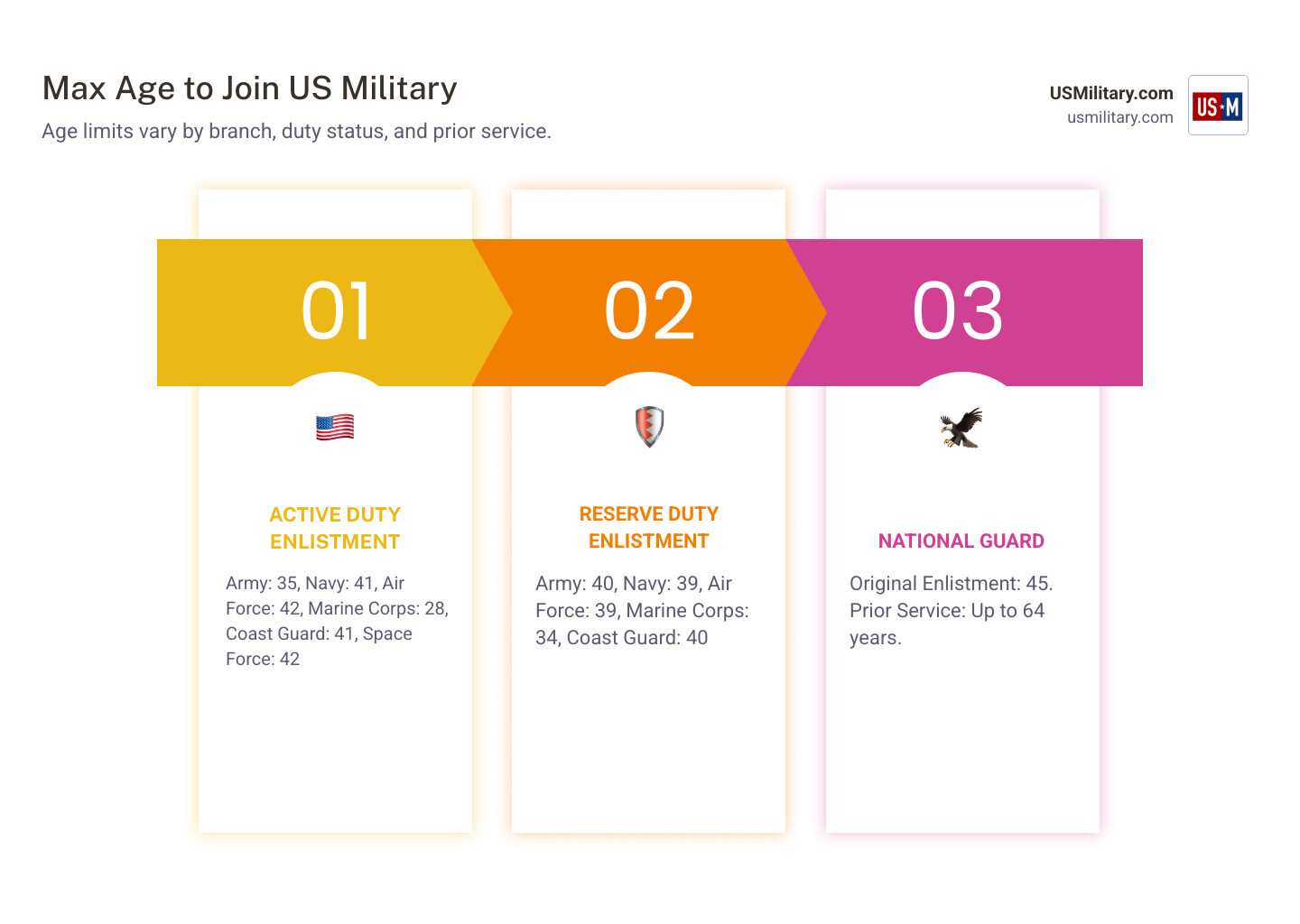
Maximum Age Limits by Branch (Active Duty):
- Army: 35 years old (40 for Reserve)
- Navy: 41 years old (39 for Reserve)
- Air Force: 42 years old (39 for Reserve)
- Marine Corps: 28 years old (34 for Reserve)
- Coast Guard: 41 years old (40 for Reserve)
- Space Force: 42 years old
- National Guard: 45 years old (64 for prior service members)
Key Facts:
- Prior service members can add their years of service to the maximum age
- Waivers may be available on a case-by-case basis
- Officer commissioning has different age limits than enlisted service
- The minimum age for all branches is 17 (with parental consent)
The decision to join the military is time-sensitive, and understanding these age limits is crucial for planning your service. Whether you’re considering a career change at 30, exploring options after college at 25, or wondering if you’ve missed your chance at 40, knowing the exact requirements for each branch can help you make an informed decision.
I’m Larry Fowler, publisher of the USMilitary.com Network, and since 2007 I’ve helped thousands of prospective service members steer military eligibility requirements, including understanding the max age for military service across all branches. My experience working directly with military recruiters has given me unique insight into how these age limits are applied in practice.
Common max age for military service vocab:
US Military Branch Requirements and the Max Age for Military Service
When we talk about the max age for military service, it’s not a one-size-fits-all answer. Each branch of the U.S. military—Army, Navy, Air Force, Marine Corps, Coast Guard, and Space Force—sets its own specific age limits for both active duty and reserve enlistment. These limits are designed to ensure that recruits can meet the physical and mental demands of service, and potentially complete a full career before reaching traditional retirement age.
Historically, the maximum age for military enlistment has seen adjustments based on recruitment needs and evolving Department of Defense policies. For instance, the Air Force and Space Force recently increased their maximum enlistment age to 42, making them the branches with the oldest entry age among the Department of Defense military services. This strategic move aims to allow more Americans the opportunity to serve and potentially complete a full 20-year career that aligns with a retirement age of 62. Similarly, the Navy adjusted its maximum age to 41, and the Coast Guard also set its limit at 41 for active duty.
Let’s break down the current age requirements for each branch:
| Branch | Active Duty Max Age | Reserve Duty Max Age | Additional Notes |
|---|---|---|---|
| Army | 35 | 40 | The Army allows individuals up to 42 years old to enlist with a waiver. |
| Navy | 41 | 39 | The Navy allows individuals up to 41 years old to enlist with a waiver. |
| Air Force | 42 | 38 | |
| Marine Corps | 28 | 34 | The Marine Corps has the lowest maximum age for active duty enlistment. |
| Coast Guard | 41 | 39 | The Coast Guard allows individuals up to 41 years old to enlist with a waiver. |
| Space Force | 42 | N/A |
While these are the general maximums, the minimum age for enlisting in any branch of the military is 17 years old, with parental consent required for those under 18. These guidelines are crucial for anyone considering a military career, as they represent the initial hurdle in a journey of service. For more detailed insights into specific branch requirements, you can visit their official sites: Army, Marine Corps, Navy, Air Force, Coast Guard, and Space Force.
Understanding the Max Age for Military Service Waivers
Sometimes, we encounter individuals who are incredibly eager to serve but find themselves just outside the standard age limits. This is where waivers come into play. A waiver is essentially an exception to a specific eligibility requirement, granted on a case-by-case basis. The Department of Defense Instruction 1304.26 outlines the comprehensive qualification standards for enlistment, appointment, and induction into the Military Services, and within this framework, waivers for age, medical conditions, and other factors can be considered.
For the max age for military service, waivers are most commonly seen in situations involving prior military service. If you’ve previously served, your experience and skills are highly valued, and this can often be a strong factor in securing an age waiver. For example, a former service member with five years of prior service might be able to enlist in the Regular Army at age 47, as their years of prior service can be added to the maximum age of 42 for prior service enlistees. The Army, for instance, allows individuals up to 42 years old to enlist with a waiver, and the Navy allows individuals up to 41 years old.
The decision to grant a waiver is not automatic. It typically involves a “whole person” review, where recruiters and service officials assess your overall qualifications, including your physical fitness, education, character, and any specialized skills you might bring. They want to ensure that even if you’re a bit older, you still possess the adaptability and potential to perform military duties successfully. While waivers can open doors for older recruits, they are not guaranteed and usually require a compelling case. It’s always best to speak directly with a recruiter to understand the specific waiver policies for your desired branch and situation.
Officer Commissioning and the Max Age for Military Service
Becoming a commissioned officer in the U.S. military involves a different set of age requirements compared to enlisted service. Officers are leaders, and the paths to commissioning—such as Officer Candidate School (OCS), Officer Training School (OTS), Reserve Officers’ Training Corps (ROTC), or direct commissioning for professionals—each have their own age caps. These limits are generally designed to ensure officers have a substantial career ahead of them and can contribute effectively to leadership roles for many years.
While the minimum age for officer appointment is typically 18, the maximum age can vary significantly by branch and commissioning source. For example, general age limits for commissioned officers can range from 18-35, but specific branches have their own nuances:
- Army: Typically up to 35 for commissioned officers.
- Navy: Generally up to 29 for commissioned officers, though waivers can extend this.
- Air Force: Often up to 39 for commissioned officers, depending on the program.
- Marine Corps: Usually up to 28 for commissioned officers.
- Coast Guard: Often up to 27 for commissioned officers.
It’s worth noting that critically needed health profession specialties, such as doctors or nurses, often have higher maximum age limits for initial appointment as a Reserve Officer, sometimes not less than 47 years. This flexibility acknowledges the extensive education and experience these professionals bring, regardless of their age.
For those considering the officer route, it’s crucial to understand that competition can be fierce, and standards may be liftd due to fewer officer positions compared to enlisted roles. While age is a factor, your academic achievements, leadership potential, and physical fitness will also be heavily weighed. If you’re passionate about leading, research the specific commissioning programs and their age requirements for the branch that interests you.
National Guard and Reserve Age Limitations
Serving our country doesn’t always mean active duty. The National Guard and various Reserve components offer vital opportunities for military service, often with more flexible age limits that can accommodate a wider range of individuals. These forces play a crucial role in both national defense and domestic emergencies, and their age requirements reflect a blend of readiness needs and the value of experienced personnel.
For individuals looking to join the National Guard, the age limitations are specifically outlined in U.S. Code Title 32, Section 313. For original enlistment, a person must be at least 17 years of age and generally under 45. However, if you’re a former member of the Regular Army, Navy, Air Force, or Marine Corps, your window of opportunity is much larger – you can enlist in the National Guard if you are under 64 years of age. This acknowledges the invaluable experience and training that prior service members bring to the Guard.
Similarly, for reenlistment in the National Guard, the maximum age is also under 64. The age requirements for becoming an officer in the National Guard align with this flexibility; you must be at least 18 years of age and under 64. These provisions highlight the Guard’s commitment to leveraging the skills and dedication of a diverse age group. You can explore the legal specifics of these age limits by reviewing 32 USC 313: Appointments and enlistments: age limitations.

The Reserve components of the Army, Navy, Air Force, Marine Corps, and Coast Guard also have their own age standards, which are established by the Secretary concerned for each military department. While these can vary, they generally tend to be more accommodating than active duty limits, often allowing individuals into their late 30s and even 40s to join or reenlist, especially if they have prior military experience. We encourage you to consult with a recruiter from your desired Reserve component to get the most accurate and up-to-date information on their specific age requirements.
✉ Get updates like this in your inbox
Weekly VA benefit changes, pay updates, and money tips for service members, veterans, and military families. Free, no spam.
Retirement Pay and Service Requirements for Reservists
For those who dedicate years to serving in the Reserve components, understanding the requirements for retired pay is a significant consideration. Unlike active duty, where retirement can come after 20 years of continuous service, Reserve retirement pay has distinct age and service requirements, primarily governed by 10 USC 12731: Age and service requirements.
To be eligible for retired pay from non-regular service, you generally need to meet two primary criteria:
- Age Requirement: You must be at least 60 years of age. This is a fixed age, regardless of how many years of service you’ve accumulated.
- Service Requirement: You must have performed at least 20 years of “qualifying service.” This means earning a certain number of retirement points each year.
A critical nuance for reservists is that the last eight years of your qualifying service must typically have been performed while you were a member of a reserve component category, and not as a member of a regular component (active duty), the Fleet Reserve, or the Fleet Marine Corps Reserve. This ensures that the benefit is truly for non-regular service.
The law also accounts for historical periods, with specific definitions for service during major conflicts like World War I, World War II, the Korean conflict, the Berlin crisis, and the Vietnam era. These historical provisions can impact eligibility for certain reservists who served during those times.
Once you complete the required years of service, the Secretary of your military department is responsible for notifying you within one year. This notification is crucial as it includes important information about your eligibility for retired pay and options for the Survivor Benefit Plan (SBP). The SBP allows eligible service members to provide a continuous stream of income to their beneficiaries after their death, offering peace of mind for their loved ones. Planning for this benefit is a key part of financial readiness for our reservists, ensuring that their dedication to service translates into long-term security.
Global Trends: Conscription and Military Readiness
While our focus at USMilitary.com is on the U.S. Armed Forces, it’s insightful to look at global trends in military service, especially concerning age limits and conscription. The world stage is constantly shifting, and recent events, such as the war in Ukraine and increasing global military expenditure, highlight the importance of military readiness for nations worldwide. In 2023, global military expenditure reached an astounding 2443 billion dollars, a seven percent increase year over year, led by major powers like the U.S., China, and Russia.
This increased focus on defense has led some countries to re-evaluate their military policies, including conscription. For instance, Ukraine recently lowered its conscription age to 25 to bolster its forces, a direct response to ongoing conflict. Other European nations, like Latvia, have reintroduced conscription, while Denmark, Sweden, and Estonia have expanded their national service. Even Germany is reportedly considering reinstating conscription. These changes underscore a growing global concern for military personnel numbers and national defense capabilities.
The implications of these trends are significant for military readiness. As some countries struggle with recruitment, like the U.S. military branches that missed their recruiting goals in fiscal year 2023, the discussion around who can serve and for how long becomes even more critical. The U.S. operates on a voluntary military system, meaning individuals choose to enlist. This contrasts sharply with nations that have compulsory service, where citizens are mandated to serve for a period.
Implications of Enlistment Ages on Recruitment
The ages at which individuals can enlist directly impact a nation’s military readiness and recruitment strategies. For a voluntary force like ours, setting appropriate age limits is a delicate balance. We want to attract motivated, capable individuals who can meet the rigorous demands of military life, while also ensuring a steady flow of recruits to maintain strength and expertise across all branches.
Demographic challenges play a significant role here. For example, a Pentagon determination several years ago found that over three-quarters of young Americans might not be able to join the military if they wanted to, due to factors like obesity, lack of education, or mental health problems. This reality, combined with a highly competitive civilian job market, means that the military must sometimes adjust its policies, including max age for military service, to broaden its recruitment pool.
Enlisting older individuals can bring a wealth of life experience, maturity, and specialized skills to the armed forces. These recruits often have established careers, families, and a deeper understanding of the world, which can be invaluable in certain roles. However, it also presents challenges, particularly regarding physical fitness and the ability to adapt to the military lifestyle alongside younger peers. Our military constantly evaluates these factors to optimize recruitment and maintain a strong, ready force.
Physical and Medical Standards for Older Recruits
Regardless of age, all individuals aspiring to join the U.S. military must meet stringent physical and medical standards. This is a non-negotiable aspect of military service, as the demands of training and deployment require a high level of physical and mental resilience. For older recruits, these standards can sometimes present unique challenges, but they are certainly not impossible.
The journey to military readiness typically begins at a Military Entrance Processing Station (MEPS), where a thorough physical and medical examination takes place. This includes comprehensive checks like blood work, urinalysis, and a detailed physical assessment to ensure you meet the medical standards outlined in Department of Defense Instruction 1304.26. Certain pre-existing medical conditions can be disqualifying, but medical waivers may be available depending on the severity and nature of the condition.
Beyond medical fitness, physical fitness is paramount. All enlistees must pass a physical fitness test (PFT) that assesses endurance, strength, and agility. While the specific components can vary by branch, common elements include push-ups, sit-ups, and a timed run (often 1.5 miles). For older recruits, maintaining peak physical condition can require more dedicated effort and longer recovery times. As one expert noted, focusing on achieving higher scores than the minimum can provide more “wiggle room” due to potentially slower recovery rates. We often advise prospective recruits to go beyond the minimum PT test standards and prepare for the broader physical demands of military life, including longer runs and rucking, and to incorporate recovery and mobility days into their training.
While older recruits might face a steeper climb in terms of physical conditioning, they often bring significant benefits to the force. Their life experience, maturity, and developed problem-solving skills can be invaluable. Adapting to the military lifestyle, which can be a culture shock for anyone, might also be approached with a different perspective by someone with more years under their belt. The military recognizes the value of these diverse contributions, and while the physical bar remains high, it’s always worth exploring your options if you’re committed to serving.
Frequently Asked Questions about Military Age Limits
We understand that navigating military age limits can be complex, and many common questions arise. Here, we address some of the most frequent inquiries we receive about the max age for military service.
What is the absolute oldest age you can join the US military?
The absolute oldest age to join the U.S. military varies by branch and whether you’re enlisting for active duty or reserve service. Currently, the Air Force and Space Force have the highest active duty maximum enlistment age at 42 years old. For the National Guard, if you have prior military service from the Regular Army, Navy, Air Force, or Marine Corps, you can be eligible to enlist up to age 64. However, it’s crucial to remember that these are general guidelines, and factors like waivers, prior service, and specific job requirements can influence individual eligibility.
Can I join the military at 45 with no prior service?
Generally, joining the military at 45 with no prior service is challenging for active duty roles. Most active duty branches have maximum age limits below 45 (e.g., Army 35, Marine Corps 28, Navy 41, Air Force 42, Space Force 42, Coast Guard 41). However, the National Guard allows original enlistment up to age 45, and if you have prior service, that age limit extends significantly. While waivers exist, they are typically granted on a case-by-case basis and are more often considered for individuals with prior service or highly specialized skills. Without prior service, the options for active duty at 45 are extremely limited, but the National Guard might be a possibility.
Does prior service extend the maximum age for reenlistment?
Yes, prior service can significantly extend the maximum age for reenlistment or enlistment into a new component. For instance, if you’re a prior enlisted service member, some branches allow you to subtract your previous years of service from your current age to determine your eligibility. This means if the maximum age for a particular branch is 35, and you served for 5 years, you might effectively be able to enlist up to age 40. Furthermore, for the National Guard, former members of the Regular Army, Navy, Air Force, or Marine Corps can enlist if they are under 64 years of age. This policy recognizes the value of experienced personnel and aims to retain their skills within the force. It’s always best to consult with a recruiter to understand how your specific prior service might impact your age eligibility.
Conclusion
Understanding the max age for military service is a fundamental step for anyone considering a military career. As we’ve explored, these age limits are not arbitrary; they reflect the demanding nature of military life, the need for physical and mental readiness, and the desire to build a force that can serve effectively for years to come. While age limits vary by branch and type of service, opportunities exist across a wide spectrum, often with avenues for waivers or special considerations for prior service members.
At USMilitary.com, we are committed to providing comprehensive resources to help you steer these requirements. Whether you’re considering a career change, looking for a new challenge, or simply curious about the possibilities, knowing your eligibility is key. Don’t let uncertainty hold you back; gather the facts, assess your options, and if you’re ready to serve, take that courageous step. Your window of opportunity might be wider than you think.
For more detailed information on age limits to join the military and other eligibility criteria, visit our dedicated guide: More info about age limits to join the military.
Free for Service Members & Veterans
Get the military benefits intel no one tells you about.
Weekly updates on VA benefits, pay changes, and money tips — free for service members and veterans.
No spam. Unsubscribe anytime. Your info is never shared.