What You Need to Know About Joining the US Military
Joining the US military is one of the biggest decisions you can make — and the process is more straightforward than most people think. Here’s a quick overview of what it takes:
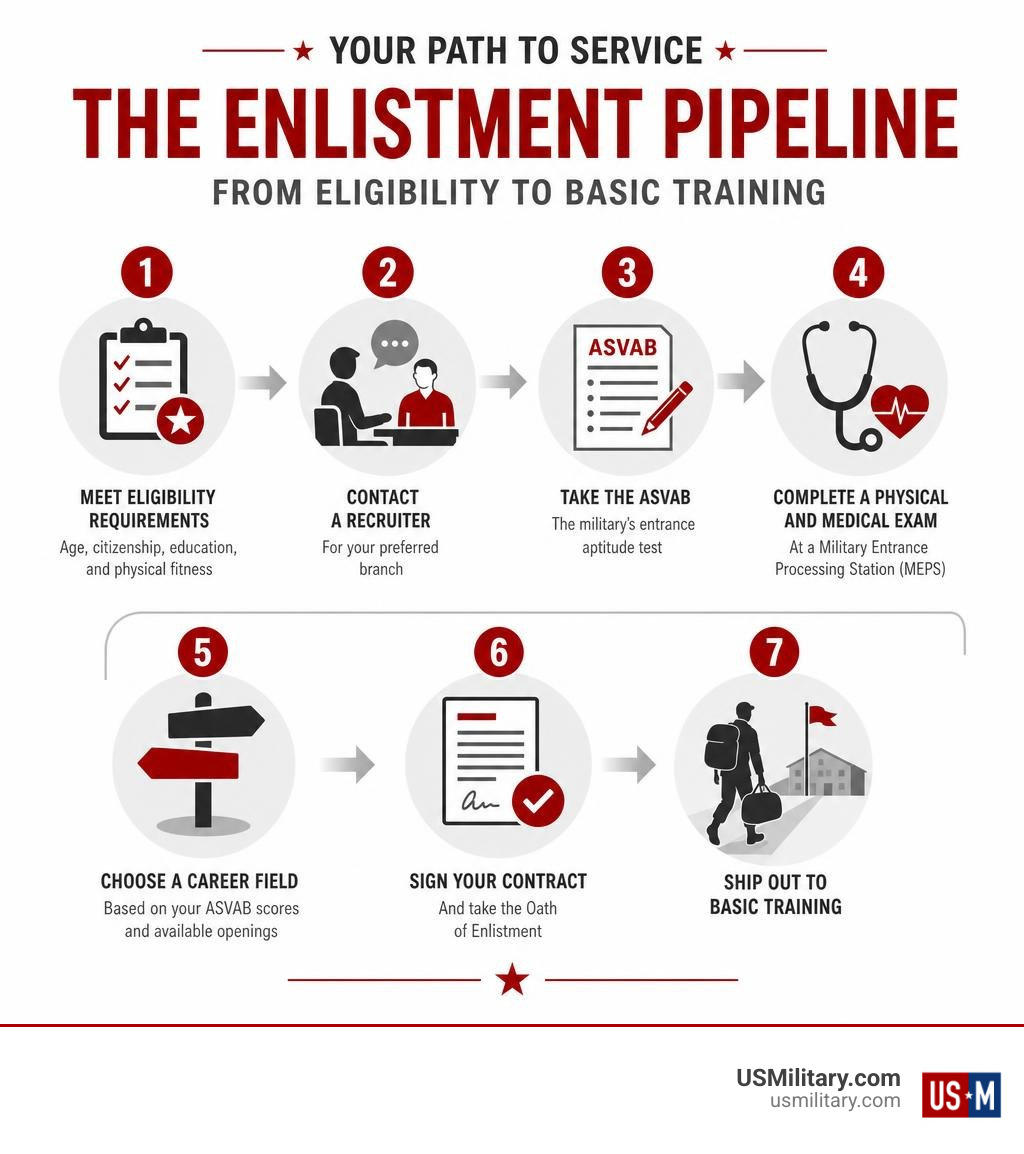
The basic steps to enlist:
- Meet eligibility requirements — age, citizenship, education, and physical fitness
- Contact a recruiter for your preferred branch
- Take the ASVAB — the military’s entrance aptitude test
- Complete a physical and medical exam at a Military Entrance Processing Station (MEPS)
- Choose a career field based on your ASVAB scores and available openings
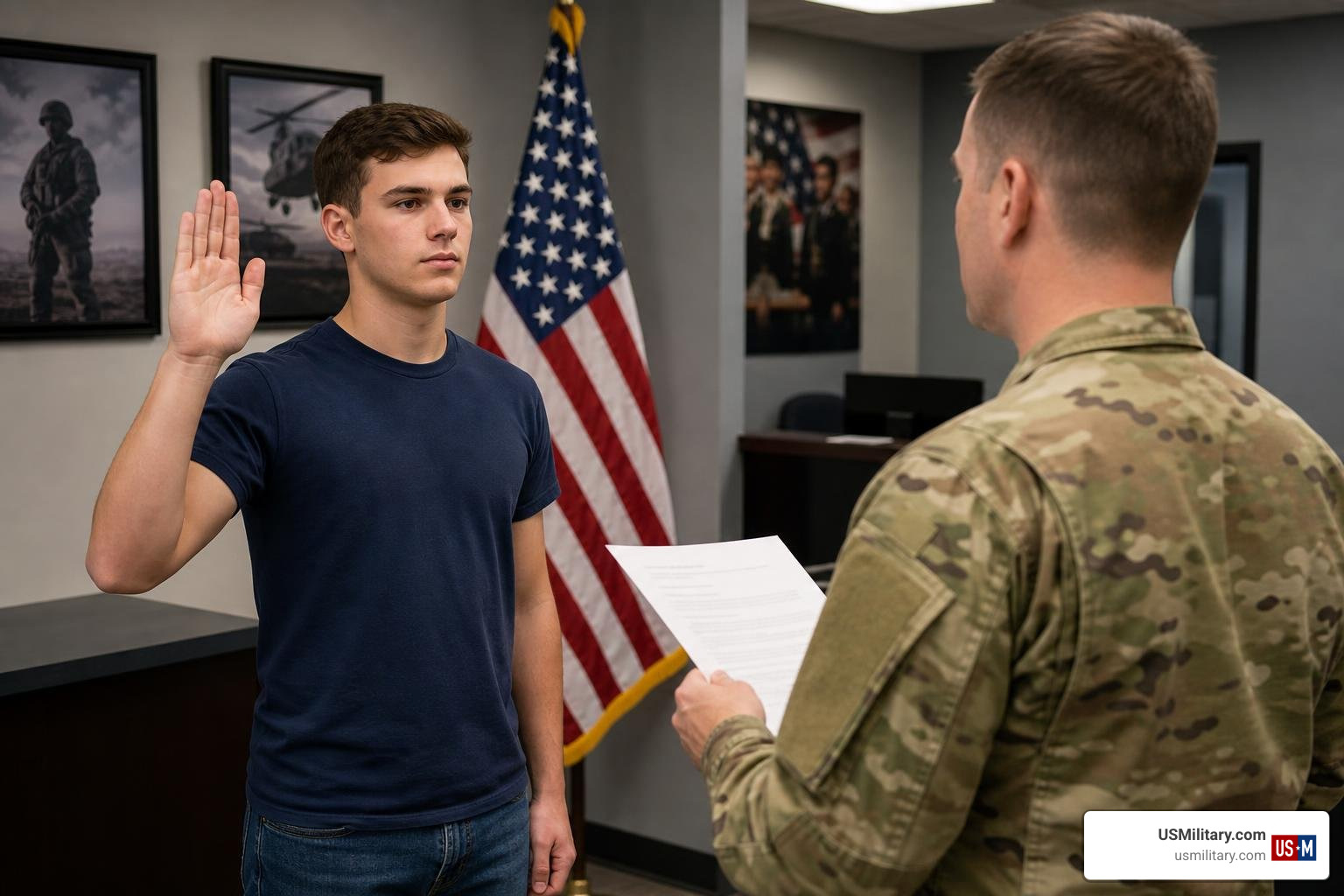
- Sign your contract and take the Oath of Enlistment
- Ship out to Basic Training
Every branch sets its own standards, but all of them share these core steps. Age limits, ASVAB minimums, physical standards, and education requirements vary — so knowing the specifics for your target branch matters.
Waivers exist for many disqualifying factors, including certain medical conditions, legal history, and low ASVAB scores. So even if you’re not sure you qualify, it’s worth exploring your options.
I’m Larry Fowler, publisher of USMilitary.com — I’ve spent nearly two decades helping hundreds of thousands of Americans navigate joining the US military, connecting prospective recruits with the right resources and recruiters across every branch. In this guide, I’ll walk you through everything you need to know to go from curious to enlisted.
Basic Eligibility Requirements for Joining the US Military

Before you start packing your bags for basic training, you must meet the foundational Requirements to join the U.S. military | USAGov. While each branch of the Armed Forces has the flexibility to set its own specific benchmarks, the Department of Defense maintains a baseline of standards for all applicants.
At a minimum, you must meet criteria regarding your age, citizenship status, education level, physical fitness, and medical history. We have compiled a detailed breakdown of these rules in our Ultimate Guide: Requirements to Join US Military 2026 to help you evaluate your initial standing.
Age Limits Across All Branches in 2026
Age limits are one of the most common points of confusion for prospective recruits. Each branch determines its own minimum and maximum age standards for active duty enlistment. Across the board, the absolute minimum age to enlist is 17 with parental consent (or 18 without it).
For a deeper dive into how age impacts your eligibility, you can read The Ultimate Guide to Military Enlistment Ages: Are You Eligible?. The maximum age limits for active duty enlistment vary significantly by branch:
| Military Branch | Minimum Age (With Consent) | Maximum Active Duty Enlistment Age |
|---|---|---|
| U.S. Army | 17 | 35 |
| U.S. Air Force | 17 | 42 |
| U.S. Navy | 17 | 41 |
| U.S. Marine Corps | 17 | 28 |
| U.S. Coast Guard | 17 | 41 |
| U.S. Space Force | 17 | 42 |
It is worth noting that under the Army’s strict regulatory guidelines, specifically outlined in AR 601-210, non-prior service applicants must ship to active duty training before their 35th birthday. However, certain reserve components or specialized roles across the branches may allow older applicants to join, and age waivers are occasionally granted on a case-by-case basis depending on the needs of the service.
Citizenship and Residency Rules for Joining the US Military
You do not necessarily have to be a native-born U.S. citizen to serve in the United States military, but there are strict legal requirements you must satisfy. To enlist, you must either be a U.S. citizen or a non-citizen legally residing in the United States with a valid Permanent Resident Card (commonly known as a Green Card).
Additionally, all non-citizen applicants must be able to speak, read, and write English fluently to ensure safety and clear communication during training and operations. It is important to know that you cannot join the military for the purpose of entering the United States, nor can the military assist you in obtaining a visa.
However, serving your country comes with an incredible benefit for permanent residents: enlisting in the military can dramatically fast-track your path to naturalization. Instead of waiting the standard five years as a Green Card holder, serving on active duty can reduce the residency requirement for becoming a U.S. citizen to as little as one day.
Education and ASVAB Testing When Joining the US Military
Your educational background dictates not only whether you can join, but also what career fields will be open to you. For a comprehensive look at how your schooling shapes your opportunities, check out our Detailed Guide to Military Enlistment in the US.
While a high school diploma is the preferred educational credential, individuals holding a General Educational Development (GED) certificate can still enlist. However, the military limits the number of slots available for GED holders each year. If you have a GED, you can significantly boost your chances of acceptance by earning at least 15 college credits or scoring exceptionally well on the entrance exam.
That entrance exam is the Armed Services Vocational Aptitude Battery (ASVAB). The ASVAB is not an IQ test; rather, it measures your strengths and aptitude in several areas. The exam is broken down into multiple subtests, but your overall eligibility is determined by the Armed Forces Qualification Test (AFQT) score, which is calculated from four critical areas:
- Arithmetic Reasoning
- Mathematics Knowledge
- Word Knowledge
- Paragraph Comprehension
Your score on these sections determines whether you qualify to enlist, while your scores on the other technical sections of the ASVAB determine which of the hundreds of military occupations you are eligible to pursue.
Physical, Medical, and Character Standards

The military is a physically and mentally demanding profession. To ensure that recruits can handle the rigors of service, every applicant must undergo a comprehensive physical, medical, and background screening at a Military Entrance Processing Station (MEPS). These evaluations are strictly governed by standards established by individual branches, the Department of Defense, and federal law. You can review the official Navy medical and physical benchmarks at requirements to get an idea of the baseline expectations.
Army Height and Weight Requirements
Maintaining physical fitness is a requirement that begins before you even sign your contract. The Army, like all branches, has strict height and weight standards that vary based on your age and gender. These standards are designed to ensure that you are within a healthy body fat percentage range.
For example, the weight limits for young adults in the 17-to-20 age bracket are structured as follows:
- Men (Ages 17-20): Must stand between 58 and 80 inches tall, with maximum allowable weights scaling up to 234 pounds depending on height.
- Women (Ages 17-20): Must stand between 58 and 80 inches tall, with an acceptable weight range typically spanning from 119 to 227 pounds depending on height.
If you exceed the weight limit for your height, medical staff at MEPS will perform a body fat assessment (commonly called the “tape test”) to determine your actual body composition. If you still do not meet the standard, you may not be allowed to enlist immediately, but programs exist to help you bridge the gap.
Medical Conditions, Tattoos, and Criminal Records
Your personal background, medical history, and physical appearance are also heavily scrutinized during the enlistment process.
- Medical Conditions (ADHD and Asthma): Chronic medical conditions do not automatically mean you cannot serve, but they do require close evaluation. For example, having ADD or ADHD will generally only prevent you from joining if you have been treated with medication within the past calendar year or if you display obvious, untreated symptoms. Similarly, asthma is only considered a disqualifying condition if you were diagnosed with it after your 13th birthday. In both cases, if you are disqualified at MEPS, you can work with your recruiter to request a medical waiver.
- Tattoo Policies: The military has modernized its tattoo policies to reflect modern culture, but boundaries remain. Tattoos are widely permitted on the arms, legs, and torso. However, highly visible areas like the hands, neck, and behind the ears have strict size and quantity limitations. Tattoos inside the mouth, on the ears, or on the eyelids are completely prohibited. Under no circumstances will the military allow tattoos that contain indecent, sexist, racist, or extremist content.
- Criminal Records: The military places a high premium on character and values. Individuals with a felony conviction or a history of multiple serious convictions are generally barred from enlisting. While waivers are available for minor offenses, certain serious crimes—such as drug trafficking, felony sexual offenses, or multiple DWI/DUI convictions within the past five years—are strictly non-waiverable. If you are currently on probation or parole, you must be fully discharged from those legal obligations before you can apply.
Step-by-Step Guide to Enlisting in the Army and Air Force
If you have decided that active duty service is your path forward, the application process requires careful, step-by-step navigation. The Air Force, for example, offers incredible career fields and enlisting in active duty can yield enlistment bonuses of up to $40,000 depending on your chosen specialty.
To take the first step toward an Air Force career, you can submit an application directly at Apply to Join the Air Force – U.S. Air Force. For a broader look at what the journey entails across all services, read Enlistment Unpacked: A Guide to Joining the US Military.
The Enlisted Pathway
The process of enlisting as a soldier or airman follows a highly structured timeline. Here is what you can expect as you move through the pipeline:
- Recruiter Consultation: Your journey begins with a conversation. You will sit down with a recruiter to discuss your personal goals, educational history, and overall eligibility. This is your opportunity to ask questions about life in the service, benefits, and contract lengths. You can initiate this step for the Army at Be All You Can Be | U.S. Army.
- Aptitude Testing: Next, you will take the ASVAB. Your recruiter will help you schedule this test, which can be taken at a local testing site or directly at MEPS.
- Physical and Medical Exam: You will spend a full day at MEPS, where medical professionals will evaluate your vision, hearing, joint mobility, and overall medical history to ensure you are fit for duty.
- Career Selection: Once you have passed your physical and received your ASVAB scores, you will meet with a service guidance counselor. Together, you will look at available jobs that match your test scores and physical qualifications.
- Signing the Contract and Oath: After choosing your job, you will sign your enlistment contract, which outlines your terms of service, active duty commitment, and any enlistment bonuses. Finally, you will stand before an officer, raise your right hand, and take the Oath of Enlistment.
- Delayed Entry Program (DEP): Most recruits do not ship to basic training immediately. Instead, you will enter the Delayed Entry Program. This period—which can last anywhere from a few weeks to several months—is used to physically condition yourself and prepare for the mental transition to military life.
Future Soldier Preparatory Course and Academic Tracks
What happens if you want to join the Army but fall slightly short of the academic or physical fitness standards? The Army has developed an innovative solution called the Future Soldier Preparatory Course. This 90-day program is designed to help highly motivated applicants improve their minds and bodies before they start Basic Combat Training.
The program is split into two distinct tracks:
- Academic Track: If you scored at least a 21 on the ASVAB but did not quite reach the minimum score required for your desired career field, this track provides intensive academic tutoring to help you retake the exam and raise your score.
- Fitness Track: If you exceed the maximum body fat standards for enlistment, this track provides structured physical training, nutritional education, and lifestyle coaching to help you safely meet Army body composition standards.
This preparatory course highlights the military’s willingness to invest in individuals who display the character and desire to serve, even if they need a little extra preparation to meet the entry criteria.
Enlisted vs. Officer Pathways
When considering joining the US military, one of the most important decisions you will make is whether to join as an enlisted service member or as a commissioned officer. The paths require different levels of education, carry different levels of responsibility, and offer different career trajectories.
To help you decide which route aligns with your long-term goals, we recommend reviewing our comprehensive guides on Joining the Military and weighing the Pros and Cons of Joining the Military.
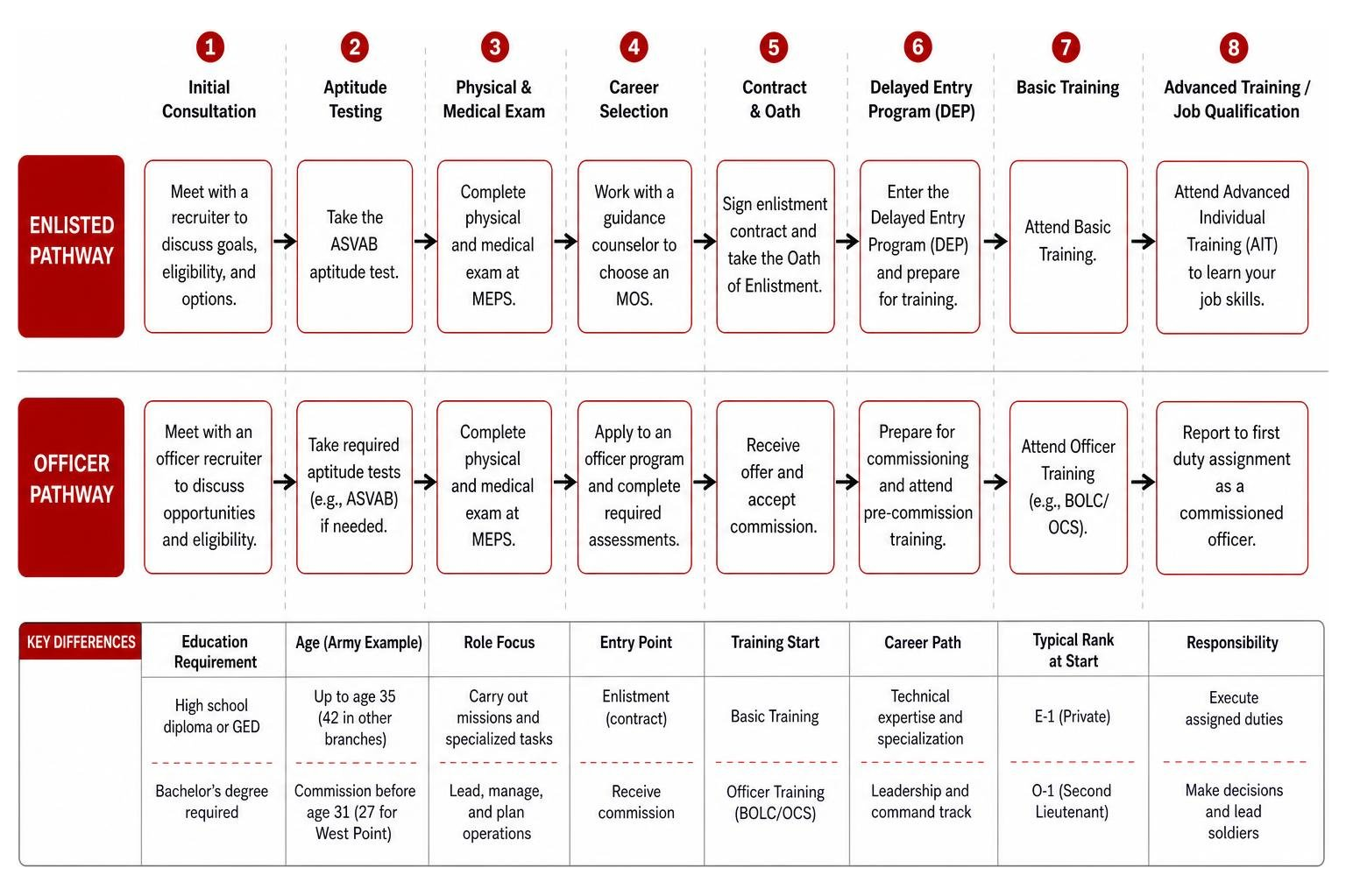
The primary differences between these two tracks include:
- Enlisted Service Members: Enlisted personnel make up the backbone of the military. They are the hands-on specialists who carry out the day-to-day operations, maintenance, and tactical missions of the Armed Forces. The minimum education requirement is a high school diploma or GED. Enlisted members can join up to the age of 35 in the Army (or 42 in other branches, subject to Age Limit to Join the Military).
- Commissioned Officers: Officers are the managers, planners, and leaders of the military. They are responsible for leading troops, planning operations, and making critical decisions. To become an officer, you must possess a four-year bachelor’s degree before you can receive your commission. For example, in the Army, officers must accept their commission before reaching their 31st birthday (or 27th birthday for West Point applicants).
There are four primary ways to earn a commission as a military officer:
- Reserve Officers’ Training Corps (ROTC): A college-based program that allows you to train for leadership while earning your degree, often with the help of merit-based scholarships.
- Service Academies: Highly competitive four-year institutions—such as the U.S. Military Academy at West Point or the U.S. Naval Academy—where students receive a fully funded college education in exchange for a service commitment as an officer upon graduation.
- Officer Candidate School (OCS): A rigorous 12-week training program designed for college graduates who want to transition from civilian life directly into the officer ranks.
- Direct Commission: A pathway reserved for highly trained professionals in specialized fields—such as medicine, law, and divinity—allowing them to enter the military directly as officers to utilize their civilian expertise.
Frequently Asked Questions About Enlisting
Can I join the military with a GED?
Yes, you can absolutely join the military with a GED. However, because high school graduates have a statistically higher rate of completing their initial enlistment contracts, the military prioritizes them over GED holders.
To improve your chances of being accepted with a GED, you should aim to score higher on the ASVAB or earn at least 15 college credits, which will classify you in the same tier as a high school graduate.
How long does the enlistment process take?
The timeline varies wildly from person to person. For most enlisted recruits, the average time between your first meeting with a recruiter and your ship date to basic training is about 30 to 45 days.
However, depending on job availability, background checks, medical waiver processing, and your time spent in the Delayed Entry Program, the entire process can take as little as 5 days or as long as a full year.
Can non-citizens join the US military?
Yes, non-citizens can enlist in the military provided they legally reside in the United States and hold a valid Permanent Resident Card (Green Card).
While non-citizens cannot become commissioned officers or hold jobs that require a security clearance, enlisting offers an incredible fast-track to U.S. citizenship, reducing the naturalization residency requirement to as little as a single day.
Conclusion
Joining the US military is a profound commitment that offers unmatched personal growth, career training, and financial security. From competitive pay and comprehensive healthcare to invaluable college tuition assistance and home loan programs, the Benefits to Join the Military can set you up for a lifetime of success both during and after your service.
No matter which branch speaks to your ambitions—whether you want to march in the infantry, fly advanced aircraft, or Explore Navy Careers on the open ocean—the journey starts with a single step. Take the time to evaluate your eligibility, prepare for the ASVAB, and speak openly with a recruiter.
At USMilitary.com, we are proud to serve as your central hub for military resources, career comparisons, and transition guidance. Your future is waiting; take the first step toward serving your country today.
Free for Service Members & Veterans
Get the military benefits intel no one tells you about.
Weekly updates on VA benefits, pay changes, and money tips — free for service members and veterans.
No spam. Unsubscribe anytime. Your info is never shared.


