The Military Draft For Selective Service To Begin automatically registering eligible men is one of the biggest changes to U.S. defense policy in decades. Here’s what you need to know right now:
Quick Summary:
| What | Details |
|---|---|
| What’s changing | Automatic registration replaces self-registration for the military draft |
| Who is affected | Male U.S. citizens and immigrants, ages 18-25 |
| When it starts | December 18, 2026 |
| Legal basis | Fiscal Year 2026 National Defense Authorization Act (NDAA), signed by President Trump |
| Is there an active draft? | No — this is registration only, not conscription |
| Penalty for non-registration | Fines up to $250,000, up to 5 years in prison, loss of federal benefits |
Starting in December 2026, the Selective Service System (SSS) will use federal databases — like Social Security records — to automatically register eligible men within 30 days of their 18th birthday. You no longer need to sign up yourself.
This doesn’t mean a draft is happening. It means the government is modernizing how it keeps track of who could serve if Congress ever authorized one.
Registration rates had been quietly falling — dropping from 84% in 2023 to 81% in 2024 — partly because a registration option was removed from federal student loan forms in 2022. Automatic registration is designed to fix that gap while cutting costs on outreach campaigns.
I’m Larry Fowler, author of Dare To Live Greatly and publisher of USMilitary.com, where since 2007 I’ve helped active-duty members, veterans, and military families navigate complex topics like VA benefits, military policy, and — yes — the Military Draft For Selective Service To Begin. Let me walk you through everything you need to know about this change and what it means for you or your family.

Military Draft For Selective Service To Begin terms explained:
- Current draft status
- Does the US currently have a military draft
- Everything You Need to Know About the Military Draft
Understanding the Selective Service System and Automatic Registration
At its core, the Selective Service System (SSS) is a “backup” for the U.S. military. Since 1973, we have relied entirely on an all-volunteer force to protect our nation. However, the SSS remains active to ensure that in a massive national emergency, the government has a list of names ready to go. Its purpose is to provide the Department of Defense with additional personnel if Congress and the President authorize a return to conscription.
The recent shift toward automation was cemented by the fiscal year 2026 National Defense Authorization Act (NDAA). This landmark legislation changes the registration process from a “proactive” task for young men into a “passive” administrative step. Essentially, the Automatic registration for US military draft-eligible men to begin in December means the burden of compliance shifts from the individual to the government.
To make this happen, the U S Military Draft system will now integrate directly with various federal databases. By pulling information from the Social Security Administration (SSA) and other government records, the SSS can identify eligible residents and register them without requiring a trip to the post office or an online form.
Common Data Sources for Automation:
- Social Security Administration records
- Department of Motor Vehicles (DMV) data (already used by 46 states and territories)
- Department of State (passport applications)
- U.S. Citizenship and Immigration Services (USCIS)
The Shift from Manual to Automatic Enrollment
Why make this change now? The answer lies in declining compliance. For decades, many young men registered for the draft while filling out their federal student loan (FAFSA) forms. However, in 2022, that registration option was removed from the FAFSA, leading to a noticeable dip in registration rates. By 2024, compliance had fallen to 81%, down from 84% just a year prior.
Legislators like Rep. Chrissy Houlahan championed this change to improve administrative efficiency. The Us Military Draft 2025 discussions highlighted that the SSS spends roughly $30,000 annually—a small but significant sum—on advertising and education campaigns to remind men to register. By automating the process, those resources can be redirected toward actual mobilization readiness rather than “marketing” a legal requirement.
Key Changes: Military Draft For Selective Service To Begin in December 2026
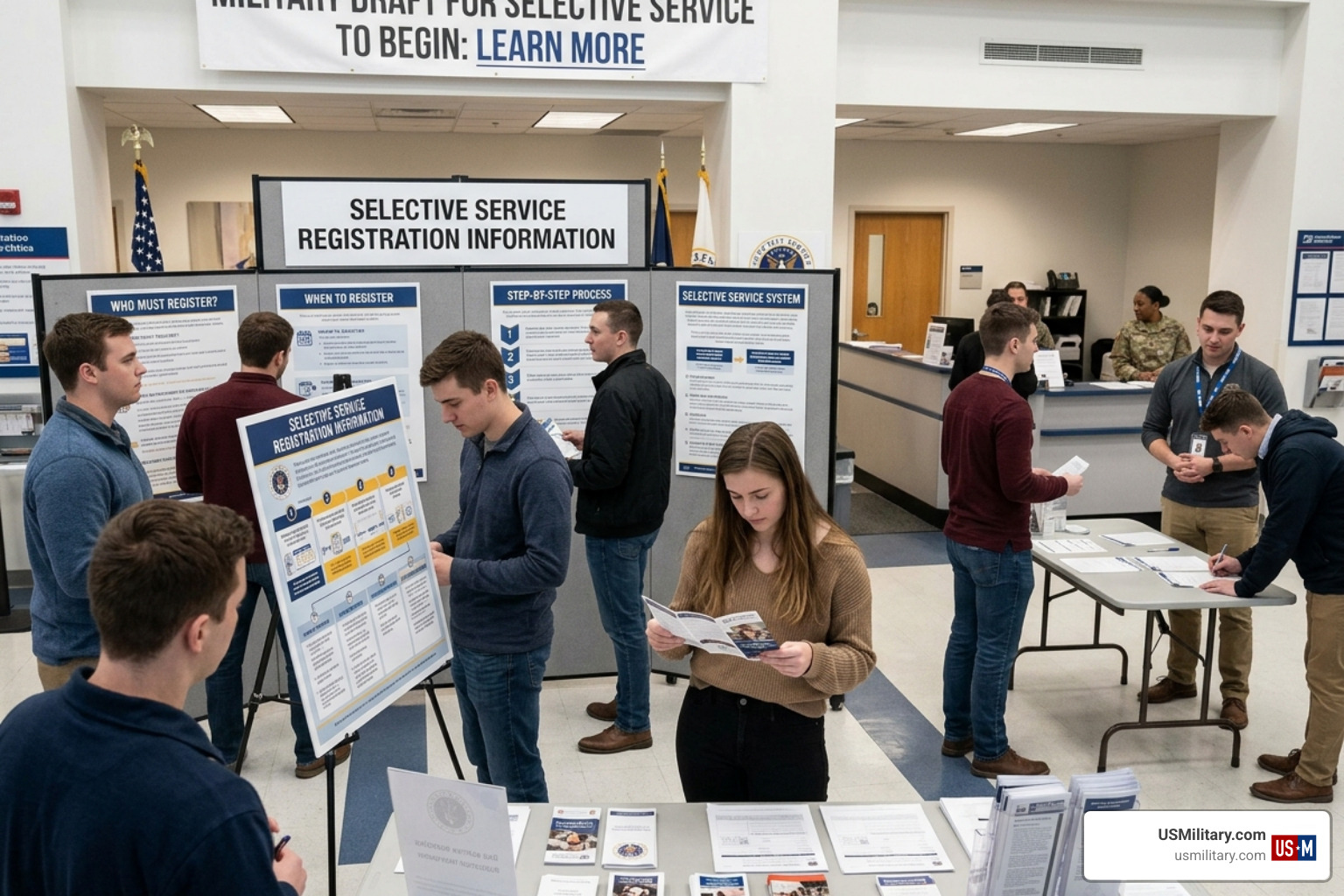
The official implementation date is set for December 18, 2026. This timeline follows the signing of the FY2026 NDAA by President Donald Trump in late 2025. While the news of a Military Draft For Selective Service To Begin automatic registration cycle has caused some concern on social media, it is important to distinguish between registration and an active draft.
According to reports on how Automatic military draft registration starts this year: What to know, the primary goal is cost savings and accuracy. A modernized Us Military Draft database ensures that if a crisis ever did occur, the government wouldn’t be working with an outdated or incomplete list.
| Feature | Manual Registration (Pre-2026) | Automatic Registration (Post-Dec 2026) |
|---|---|---|
| Responsibility | Individual male age 18-25 | Selective Service System (via federal data) |
| Method | Online form, post office, or FAFSA | Automatic data pull from SSA/DMV |
| Cost | High (requires ads and reminders) | Low (automated data integration) |
| Compliance | Fluctuating (81% in 2024) | Expected near 100% |
Registration Requirements and Legal Penalties
Eligibility for the Military Draft For Selective Service To Begin
Even with automation, the eligibility rules remain the same. Under federal law, nearly all male U.S. citizens and male immigrants (including undocumented individuals, legal permanent residents, and refugees) living in the U.S. who are between the ages of 18 and 25 are required to register.
The Selective Service System mandates that registration occurs within 30 days of a man’s 18th birthday. If you are an immigrant arriving in the U.S. between those ages, you must register within 30 days of arrival. It is important to note that What Disqualifies You From The Military Draft for actual service is different from the requirement to register. Even if you have a medical condition that might prevent you from serving, you are still legally required to be in the database.
Consequences of Failing to Register
While the move to automatic registration will prevent many “accidental” felons, the penalties for willful failure to register remain severe. Failing to comply with the Selective Service Act is a felony.
Potential Penalties Include:
- A fine of up to $250,000.
- Up to five years in prison.
- Permanent ineligibility for federal student loans and grants.
- Ineligibility for federal job training and most government jobs.
- Significant delays or denials for immigrants seeking U.S. citizenship.
We often hear from men over the age of 26 who realize too late that they never registered. Once you turn 26, you can no longer register, and those benefits may be lost forever. While there are certain Medical Conditions That Keep You Out Of The Draft during an actual induction, they do not excuse the legal requirement to register while you are in the 18-25 age bracket.
How a Potential Draft Activation Would Work
If the Military Draft For Selective Service To Begin actually moved from registration to induction, it would require an act of Congress and the President’s signature. This is not a decision the military makes on its own. You can find more details on this process at Will There Be A Military Draft In 2026.
In a draft scenario, the SSS uses a random lottery system based on birthdates. Once the lottery determines the order, men are called to report to a Military Entrance Processing Station (MEPS) for physical, mental, and moral evaluations. The SSS is required to deliver the first group of inductees to the military within 193 days of the draft being authorized.
Activation of the Military Draft For Selective Service To Begin
The order of the call-up is very specific. Rather than calling 18-year-olds first, the lottery prioritizes men in the year they turn 20. If more troops are needed, the lottery moves to those aged 21, then 22, 23, 24, 25, and finally 18 and 19.
Amid current geopolitical tensions, there has been much discussion about All About Can Trump Bring Back The Military Draft Amid Iran War. While administration officials have stated that a draft is “on the table” as a strategic option, they have also emphasized that there is no current plan to reinstate conscription. The U.S. remains committed to its all-volunteer force. However, the question of Can The Military Draft Coming Back remains a topic of national debate as recruitment challenges persist.
Exemptions, Deferments, and Conscientious Objectors
If a draft were activated, not everyone called would necessarily go to combat. There are several categories for deferment or exemption:
- Hardship Deferments: For those whose absence would cause extreme emotional or financial hardship to dependents.
- Ministerial Students: Deferments for those preparing for the ministry.
- Conscientious Objectors: Individuals who are opposed to serving in the armed forces based on sincere moral, ethical, or religious beliefs. They may be assigned to non-combatant military roles or civilian service.
- Health Care Personnel Delivery System (HCPDS): A specialized standby plan to draft medical professionals (including women, in some cases) if there is a shortage of doctors or nurses during a crisis.
There is also ongoing debate regarding Will The Pentagons Decision Allowing Women Into Combat Lead To A Possible Draft for females. While all combat roles were opened to women in 2015, the law currently only requires men to register for the Selective Service.
Historical Context and Geopolitical Tensions
The U.S. has a long history with the draft, stretching back to the Civil War and World War I. The modern Selective Service System was established in 1917. The last time the U.S. actively drafted soldiers was in 1973 during the Vietnam War. Following that conflict, the draft was suspended in 1975, only to be reinstated as a registration-only requirement by President Jimmy Carter in 1980 following the Soviet invasion of Afghanistan.
Today, as we look at the Automatic registration for US military draft-eligible men to begin in December through the lens of Us Military Draft 2024 updates, geopolitical tensions play a major role. With the ongoing situation in the Middle East and the recent Iran ceasefire, the U.S. maintains a policy of “strategic ambiguity.” By keeping the Selective Service database updated and automated, the U.S. signals its readiness for any contingency.
However, the sustainability of the all-volunteer force is a growing concern. Only about 23% of Americans ages 17-24 meet the basic eligibility standards for service due to health, education, or criminal record issues. This makes the accuracy of the SSS database more critical than ever for national security planning.
Frequently Asked Questions about the 2026 Selective Service Changes
Are women required to register for the draft in 2026?
No. Despite several legislative attempts and recommendations from national commissions, the current law only requires “male persons” to register. While women serve in all combat roles voluntarily, they are not currently subject to the Selective Service registration requirement.
Is the U.S. military currently reinstating an active draft?
No. There is no active draft in the United States. The changes taking place in December 2026 are purely administrative, shifting from manual registration to an automatic system to ensure the government has an accurate database of eligible men. An actual draft would require new legislation passed by Congress and signed by the President.
How does automatic registration affect my federal student loans?
In the past, failing to register for the Selective Service could disqualify you from receiving federal student aid. Because registration will now be automatic for most men starting in late 2026, the risk of losing financial aid due to a failure to register will be significantly reduced. The system will use your Social Security data to ensure you are compliant before you even apply for aid.
Conclusion
At USMilitary.com, we believe that staying informed is a key part of civic responsibility. While the news of the Military Draft For Selective Service To Begin automatic registration might seem daunting, it is essentially a “software update” for a system that has existed for over a century. This change ensures that the SSS remains a reliable tool for military readiness without the high costs and compliance gaps of the old manual system.
Whether you are a young man approaching your 18th birthday or a parent concerned about your son’s future, understanding the Military Draft 2025 and 2026 changes is vital. We are here to provide the non-biased information you need to navigate your military-related journey.
Learn more about the U.S. Military Draft and stay updated on the latest news affecting our armed forces and veterans.
Free for Service Members & Veterans
Get the military benefits intel no one tells you about.
Weekly updates on VA benefits, pay changes, and money tips — free for service members and veterans.
No spam. Unsubscribe anytime. Your info is never shared.


