 The Navy Pay Chart For 2027 is not final yet. For planning purposes, use the current 2026 basic-pay rate for your rank and years of service, then compare two proposals:
- Senate baseline: a flat 3.6% raise for every pay grade.
- House-supported tiered plan: 7% for E-5 and below, 6% for E-6 through O-3, and 5% for O-4 and above.
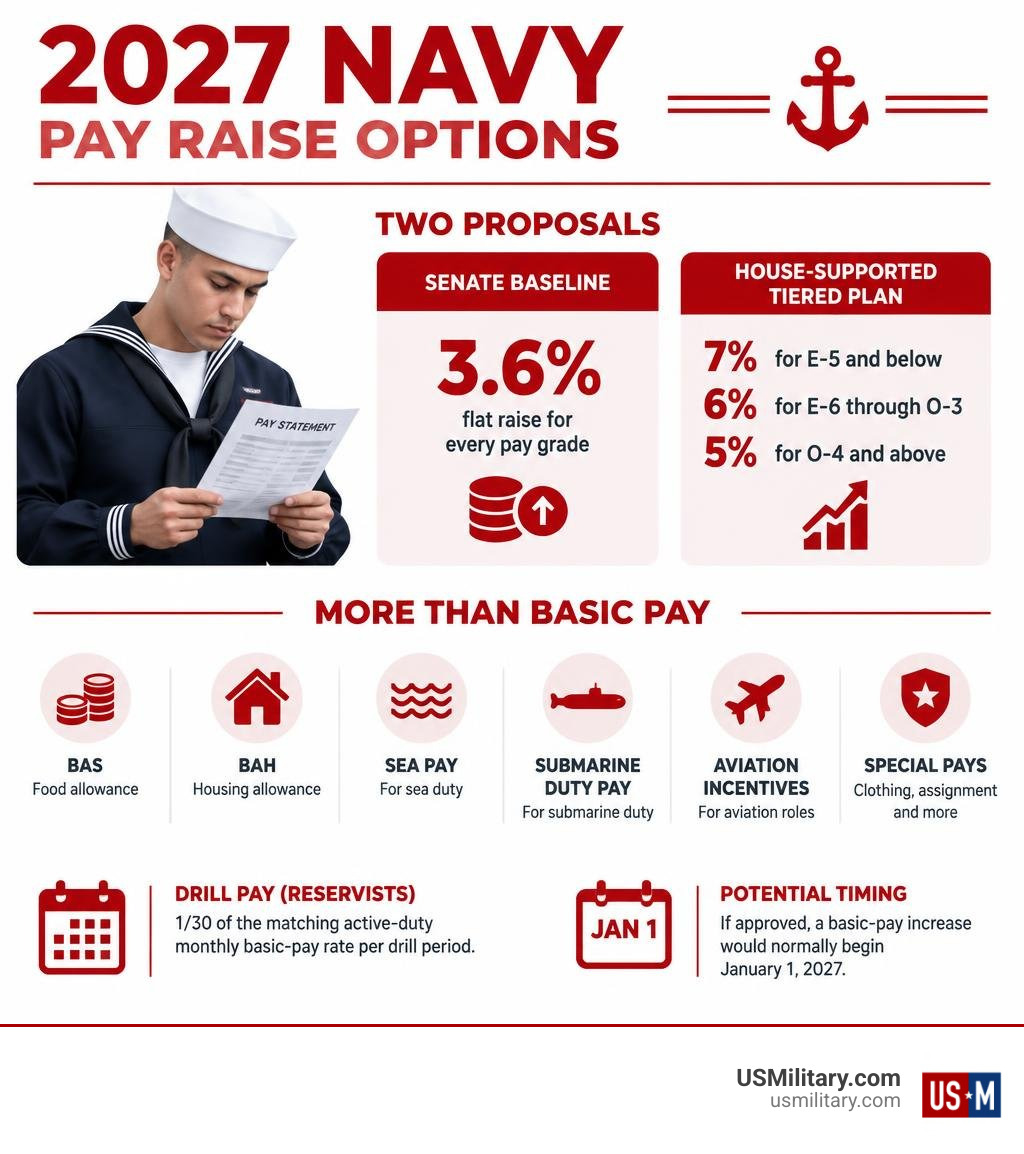 Handy Navy Pay Chart For 2027 terms:
Proposed 2027 Military Pay Raise: House Tiered Plan vs. Senate Flat Rate
As we look ahead to 2027, the annual defense authorization debate brings two competing approaches for military compensation. Every year, military basic pay adjustments are anchored by the Bureau of Labor Statistics’ Employment Cost Index (ECI). Under Title 37 U.S.C. Section 1009, the statutory default for the 2027 pay adjustment is set at 3.6%. However, lawmakers and defense leaders often modify that baseline to address pressing service needs, recruitment goals, and retention priorities. If you are tracking these proposals, our early look at the 2027 military pay chart highlights the differences between statutory formulas and targeted adjustments. Detailed pay calculations showcase how different ranks could see varying bumps in their monthly earnings under the competing proposals.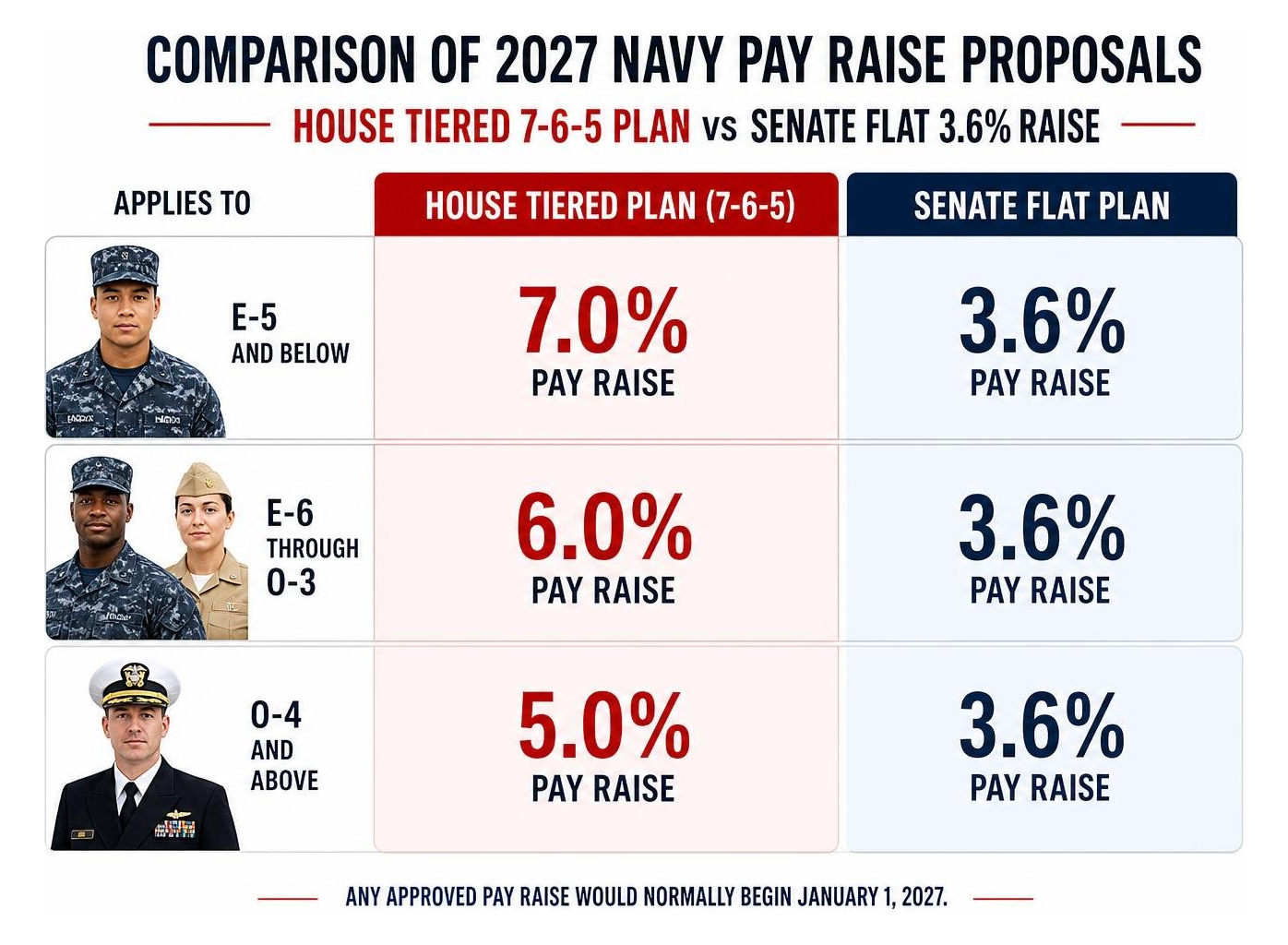
House 7-6-5 Tiered Proposal vs. Senate 3.6% Baseline
The House of Representatives, through the passage of H.R. 8800 on July 22, 2026 (passed by a 216-212 vote), approved an ambitious tiered model carrying a $5.8 billion price tag. This “7-6-5” plan provides:- 7.0% raise for junior enlisted sailors (grades E-1 through E-5)
- 6.0% raise for mid-level enlisted and junior officers (grades E-6 through O-3, plus warrant officers)
- 5.0% raise for senior officers (grades O-4 and above)
Legislative Timeline and Confirmation Dates
The military pay increase undergoes a structured legislative journey every year:- President’s Budget Request: Outlines White House funding goals and compensation targets.
- Chamber Action: The House and Senate Armed Services Committees draft and pass their individual versions of the National Defense Authorization Act (NDAA).
- Conference Committee Negotiations: Lawmakers reconcile the differences between the House and Senate bills throughout the autumn months.
- Final Enactment: The compromise bill is voted on and signed into law by December.
- DFAS Implementation: The Defense Finance and Accounting Service uploads official tables for disbursal starting January 1, 2027.
Comprehensive Breakdown of the Navy Pay Chart For 2027
 Military basic pay forms the taxable core of your compensation. It is determined solely by your paygrade (rank) and creditable time in service.
To help you forecast your personal budget, the table below compares actual 2026 active-duty rates against estimated 2027 monthly pay rates under both the flat 3.6% Senate baseline and the House tiered proposal.
| Paygrade | Years of Service (YOS) | 2026 Monthly Basic Pay | 2027 Estimated (3.6% Flat) | 2027 Estimated (Tiered 5-7%) |
|---|---|---|---|---|
| E-1 | < 4 months | $2,017.20 | $2,089.82 | $2,158.40 (7%) |
| E-2 | Over 2 YOS | $2,423.40 | $2,510.64 | $2,593.04 (7%) |
| E-3 | Over 2 YOS | $3,015.00 | $3,123.54 | $3,226.05 (7%) |
| E-4 | Over 4 YOS | $3,658.80 | $3,790.52 | $3,914.92 (7%) |
| E-5 | Over 6 YOS | $4,110.00 | $4,257.96 | $4,397.70 (7%) |
| E-6 | Over 10 YOS | $4,749.90 | $4,920.90 | $5,034.89 (6%) |
| E-7 | Over 16 YOS | $5,821.20 | $6,030.76 | $6,170.47 (6%) |
| E-8 | Over 20 YOS | $6,979.80 | $7,231.07 | $7,398.59 (6%) |
| E-9 | Over 24 YOS | $8,521.80 | $8,828.58 | $9,033.11 (6%) |
| W-2 | Over 6 YOS | $5,898.30 | $6,110.64 | $6,252.20 (6%) |
| W-4 | Over 16 YOS | $8,299.50 | $8,598.28 | $8,797.47 (6%) |
| O-1 | < 2 YOS | $3,826.20 | $3,963.94 | $4,055.77 (6%) |
| O-2 | Over 4 YOS | $5,739.00 | $5,945.60 | $6,083.34 (6%) |
| O-3 | Over 6 YOS | $7,737.90 | $8,016.46 | $8,202.17 (6%) |
| O-4 | Over 6 YOS | $8,332.20 | $8,632.16 | $8,748.81 (5%) |
| O-5 | Over 16 YOS | $11,109.90 | $11,509.86 | $11,665.40 (5%) |
| O-6 | Over 22 YOS | $13,998.00 | $14,501.93 | $14,697.90 (5%) |
How to Read the Enlisted Navy Pay Chart For 2027
Reading an enlisted pay table involves matching your paygrade (E-1 through E-9) on the vertical axis with your cumulative years of creditable service along the horizontal axis. Pay increases occur at longevity “step” intervals—traditionally every two years up to statutory ceilings. For service members advancing through their first enlistment, understanding basic allowances alongside base pay provides a full picture of personal finances. You can explore our deep dive into active duty military pay to understand how regular promotions and longevity bumps compound over an enlistment term. For verified historical scales, always consult the official Military Pay Tables & Information maintained by DFAS.Commissioned and Chief Warrant Officer Pay Scales
Commissioned officers (O-1 to O-10) and Chief Warrant Officers (W-2 to W-5) follow structured longevity tables. Senior officer pay is governed by statutory pay caps tied to the Executive Schedule under Title 5 U.S.C. Section 5307. Basic pay for general and flag officers (O-7 through O-10) is capped at Level II of the Executive Schedule, while O-6 pay cannot exceed Level V. Additionally, prior-enlisted commissioned officers with more than four years of active enlisted or warrant service qualify for special paygrades (O-1E, O-2E, O-3E). This track offers higher basic pay than standard junior officer grades to acknowledge technical leadership and fleet experience. Review our breakdown of the military pay scale for enlisted and officers for specific rank ceilings and service caps.Navy Reserve and Guard Drill Navy Pay Chart For 2027
Navy Reserve personnel perform inactive duty training (IDT), commonly referred to as drill weekends. Drill pay is derived straight from active-duty basic pay using a simple formula: $$\text{One Drill Period Pay} = \frac{\text{Monthly Active Basic Pay}}{30}$$ A standard weekend drill consists of four drill periods (two on Saturday, two on Sunday), earning four-thirtieths ($4/30$) of full monthly active basic pay.- Under the flat 3.6% proposal, an E-4 over 4 years earns approximately $126.35 per drill, or $505.40 per drill weekend. Under the 7% tiered plan, this rises to $130.50 per drill ($522.00 per weekend).
- An E-5 over 6 years under the tiered proposal receives roughly $146.59 per drill, resulting in $586.36 per standard drill weekend.
- Reservists on active duty for training (ADT) or mobilization receive standard daily prorated active-duty basic pay alongside applicable allowances.
Allowances and Special Pays Unique to Navy Personnel
Basic pay forms only the foundation of sea-service compensation. Allowances and specialty pays can make up 30% to 40% of total cash pay, helping sailors maintain parity with civilian lifestyles.Basic Allowance for Subsistence (BAS) and Housing (BAH) Adjustments
- Basic Allowance for Subsistence (BAS): A monthly non-taxable food allowance to offset meals. BAS rates are adjusted annually based on the USDA food cost index rather than the military basic pay raise. The 2026 rate of $465.75 per month for enlisted personnel and $318.84 for officers is expected to receive modest adjustments for 2027.
- Basic Allowance for Housing (BAH): A tax-free housing stipend set by local civilian rental costs in distinct Military Housing Areas (MHAs). BAH accounts for rank and dependency status and is updated every December through local housing market surveys.
Maritime and Hazardous Duty Incentives
Navy life brings unique deployment demands, shipboard environments, and hazardous operational profiles. The Department of the Navy maintains targeted incentive pays to reward specialized sea duty:- Career Sea Pay (CSP): Paid to sailors assigned to sea-going commands. Monthly rates scale by rank and cumulative sea time, providing up to $750+ monthly for senior sailors on extended sea duty. Consecutive Sea Pay (CSP-P) provides an additional bonus for sailors serving back-to-back sea tours.
- Submarine Duty Incentive Pay (SUBPAY): Compensates submarine crews for the demands of undersea missions. Monthly rates vary based on paygrade and years of submarine service.
- Aviation Incentive Pay (AvIP) & Crewmember Flight Pay: Structured monthly stipends for designated naval aviators, flight officers, and enlisted aircrew.
- Special Duty and Hazardous Assignment: Includes Dive Pay, Demolition Pay, and Special Warfare incentives. To understand specialized community compensation, review our Navy SEAL salary guide.
VA Home Loan
Your Service Earns a $0-Down Home Loan Benefit
Eligible service members and veterans can buy a home with no down payment and no PMI. Check your VA loan eligibility in a few minutes.
USMilitary.com may be compensated when you request quotes from lenders through this link.
Frequently Asked Questions About Navy Pay in 2027
When will the 2027 Navy pay raise take effect?
The 2027 military basic pay raise takes effect on January 1, 2027. Active-duty sailors and drilling reservists typically see the updated amounts on their mid-month January military pay statements via MyPay.How does the 2027 proposed pay compare to 2026 active duty rates?
In calendar year 2026, military personnel received a 3.8% across-the-board pay raise. For 2027, the baseline increase is 3.6%, with the possibility of up to 7% for junior enlisted members if the House’s tiered proposal is adopted. You can verify baseline numbers using our 2026 enlisted pay guide.How is drill pay calculated for Navy Reservists in 2027?
Navy Reserve drill pay is computed as 1/30 of the active-duty monthly basic pay rate for your rank and service time per drill period. A standard drill weekend contains four paid periods.Conclusion
Whether Congress agrees on the statutory 3.6% flat raise or adopts the 5-7% tiered plan, 2027 will bring another boost to military paychecks. At USMilitary.com, we recommend building your 2027 household budget around the conservative 3.6% baseline; any extra increase from a final tiered compromise can go directly toward personal savings and investments. For current reference figures, check our 2026 military pay chart reference and stay tuned as final NDAA actions wrap up.Free for Service Members & Veterans
Get the military benefits intel no one tells you about.
Weekly updates on VA benefits, pay changes, and money tips — free for service members and veterans.
No spam. Unsubscribe anytime. Your info is never shared.