Navy SEAL vs Delta Force: What’s the Difference?
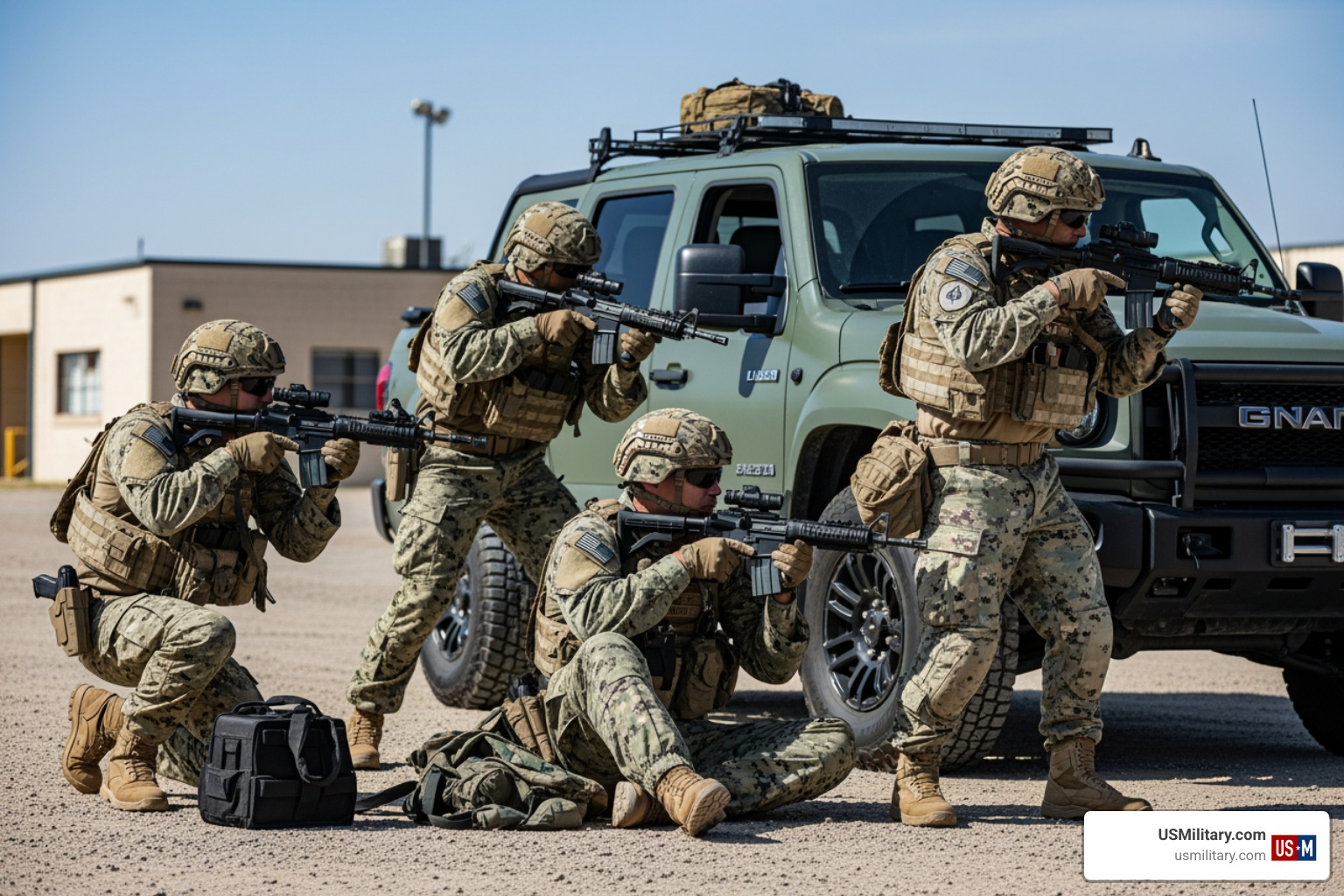
When comparing a navy seal vs delta force, the short answer is this: both are elite U.S. special operations units, but they serve different purposes and operate in different environments.
| Feature | Navy SEALs | Delta Force |
|---|---|---|
| Branch | U.S. Navy | U.S. Army |
| Tier | Tier 2 (SEAL Team 6/DEVGRU is Tier 1) | Tier 1 |
| Primary Environment | Maritime, amphibious, multi-domain | Land-based, covert |
| Main Missions | Maritime raids, direct action, special recon | Counterterrorism, hostage rescue, high-value targets |
| Founded | 1962 | 1977 |
| Training Focus | Team physical endurance (BUD/S) | Individual mental endurance (The Long Walk) |
| Recruitment | Open to civilians | Requires prior military service |
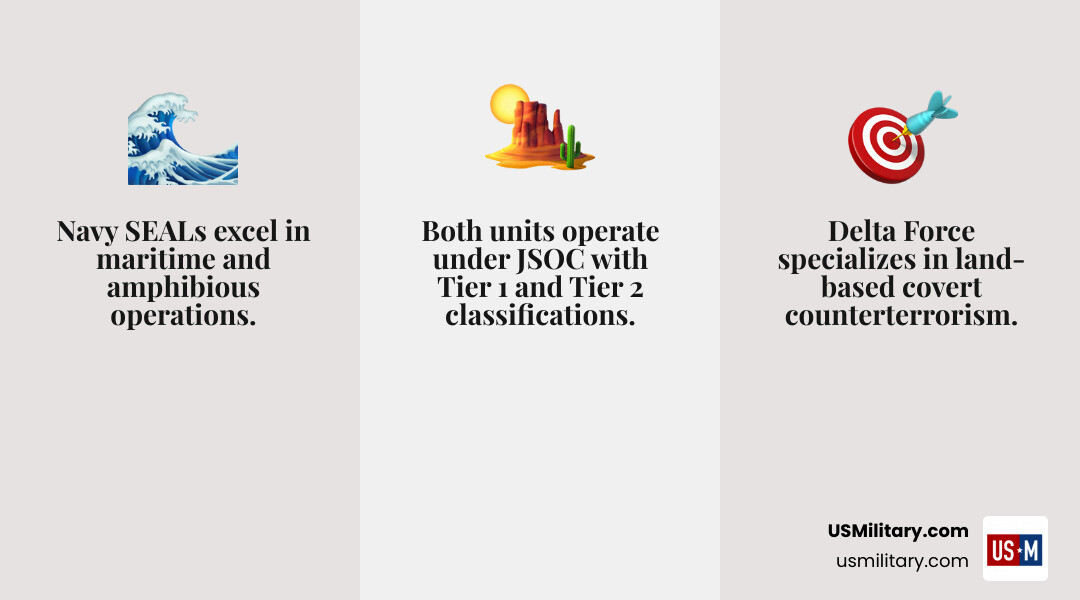
Navy SEALs are the go-to force for maritime and amphibious operations. Delta Force is the Army’s most secretive counterterrorism unit, built for surgical land-based strikes.
Neither unit is “better.” Each is designed for a specific job. The mission determines which unit gets the call.
Both units operate under the Joint Special Operations Command (JSOC) and have shaped modern warfare across conflicts from Somalia to Afghanistan to Iraq. Understanding what sets them apart matters — whether you’re exploring a military career, researching special operations, or trying to make sense of what you’ve seen in the news.
I’m Larry Fowler, publisher of USMilitary.com and a longtime resource for military members navigating career paths and VA benefits — including those considering the navy seal vs delta force question. In the sections below, we’ll break down exactly how these two elite forces differ, from their origins and training to their missions and culture.
Terms related to navy seal vs delta force:
- Navy SEALs BUD/S Training Requirements
- Pros and Cons Of Army Delta Force vs Navy SEALs
- Air Force Pararescuemen (PJs) vs Navy SEALs
Historical Origins: From Frogmen to the SAS Model
To understand the navy seal vs delta force dynamic in May 2026, we have to look back at why they were created in the first place. Their DNA is entirely different because they were born from different needs.
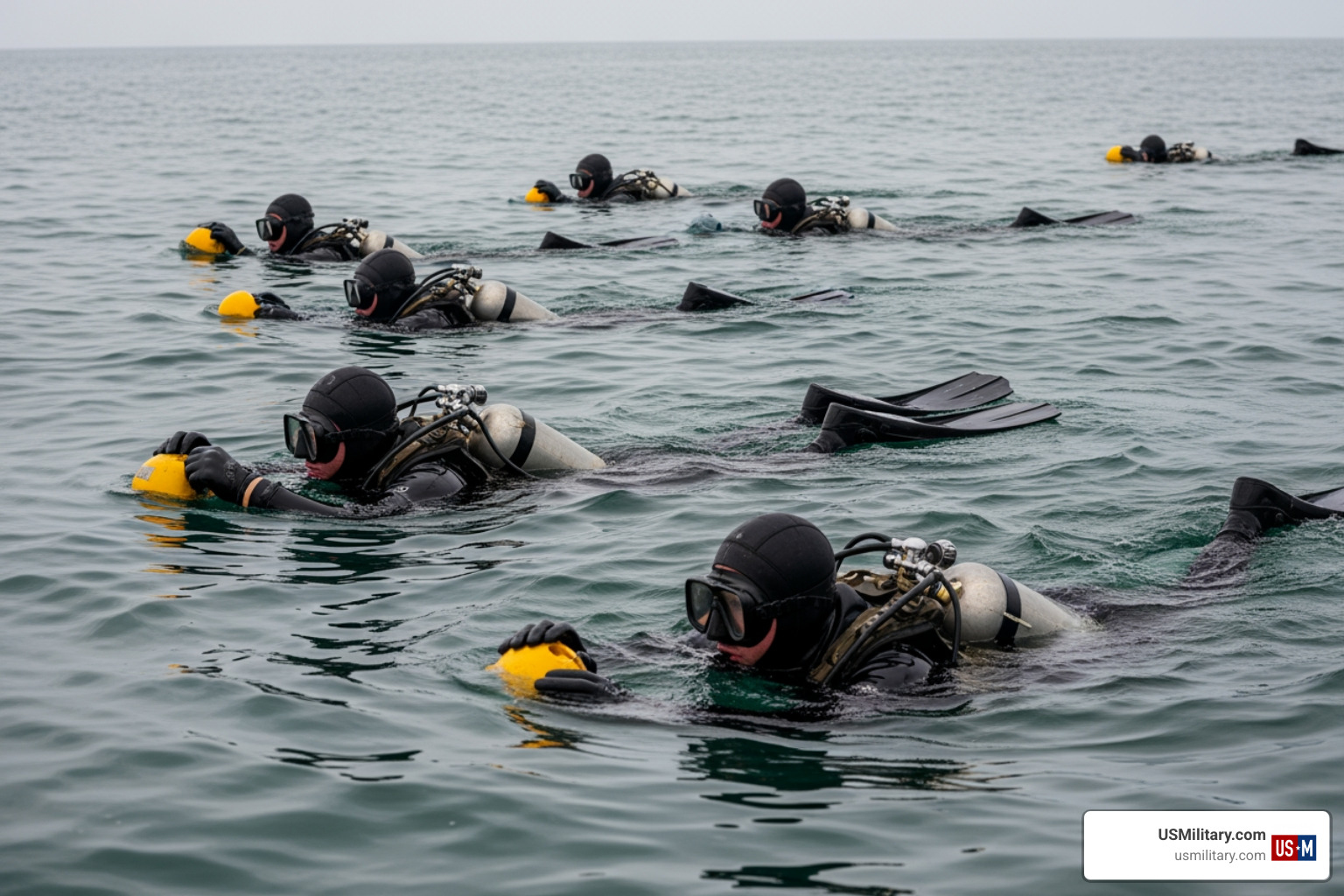
The Navy SEALs trace their lineage to the “Frogmen” and Underwater Demolition Teams (UDTs) of World War II. However, they were officially commissioned in 1962 by President John F. Kennedy. Kennedy recognized that the Cold War required a force capable of unconventional warfare in maritime and riverine environments. From the beginning, the SEALs (which stands for Sea, Air, and Land) were designed to be the Navy’s versatile answer to guerrilla warfare.
Delta Force, formally known as the 1st Special Forces Operational Detachment-Delta (1st SFOD-D), has a much more specific origin story. It was founded in 1977 by Colonel Charles Beckwith. Beckwith had served as an exchange officer with the British Special Air Service (SAS) and realized the U.S. Army lacked a dedicated, surgical counterterrorism unit.
While the SEALs were growing into a large, versatile force, Delta was built to be a small, highly specialized “scalpel.” The unit’s first major test was Operation Eagle Claw in 1980—the failed attempt to rescue American hostages in Iran. That failure led to the creation of JSOC and the modernization of both Delta and the specialized Navy unit known today as DEVGRU (SEAL Team 6). You can find more info about Delta Force history and how it differs from other elite tiers in this detailed breakdown of Delta Force vs. DEVGRU.
Navy SEAL vs Delta Force: Mission Sets and Environments
If you’re wondering who gets the call, it almost always comes down to the environment.

The Navy SEALs are masters of the water. If a mission involves ship boarding, oil rig takedowns, or swimming miles through cold water to infiltrate a beach, the SEALs are the primary choice. They are often described as the “hammer”—bringing overwhelming force and high-intensity direct action to maritime targets.
Delta Force, on the other hand, is the “scalpel.” They specialize in land-based counterterrorism, hostage rescue, and the capture of high-value targets (HVTs). While they are capable of operating anywhere, their expertise lies in surgical precision in urban or land-locked environments.
| Mission Type | Navy SEALs (Standard) | Delta Force |
|---|---|---|
| Maritime Raids | Primary Specialty | Secondary |
| Hostage Rescue | Capable | Primary Specialty |
| Direct Action | Frequent | Frequent (Surgical) |
| Unconventional Warfare | Occasional | Occasional |
| Special Recon | High Emphasis | High Emphasis |
As we look at the difference between Navy SEALs and Delta Force, it’s important to note that during the Global War on Terror, these roles overlapped significantly. In Iraq and Afghanistan, both units were hunting terrorists on land. However, their “home” environments remain distinct.
Selection and Training: BUD/S vs. The Long Walk
One of the most frequent questions we hear is: “Who has the tougher training?” The truth is, both are designed to break you, but they use different methods.
Selection Success Rates: Navy SEAL vs Delta Force
The attrition rates for both units are staggering. For Navy SEALs, the journey begins at BUD/S (Basic Underwater Demolition/SEAL). Historically, BUD/S has an attrition rate of approximately 75%. Out of a typical class, only about 25% of candidates will successfully complete the program. The focus here is on team-based physical endurance and “gutting it out” through cold water, sand, and sleep deprivation, most notably during the infamous “Hell Week.”
Delta Force selection is a different animal. While SEALs often recruit directly from civilian life, Delta requires you to be an experienced soldier first—usually from the Army Rangers or Green Berets. Their selection has an attrition rate where only about 10-12% of candidates complete the course. In a typical class of 120 highly experienced applicants, only 12-14 might be selected.
The focus in Delta selection is solitary mental endurance. Candidates are often given coordinates and told to march alone across rugged terrain with a heavy ruck, receiving zero feedback from instructors. The “Long Walk”—a 40-mile solo ruck march—is the final psychological test to see if a man can perform perfectly when he is completely alone and exhausted. You can read more about this comparison of SEAL and Delta training to see which mindset fits you.
The Training Pipeline: From Civilian to Operator
The path to becoming a SEAL involves BUD/S, followed by SEAL Qualification Training (SQT). It takes about a year of initial training before a SEAL is assigned to a team.
Delta operators go through a six-month Operator Training Course (OTC). Because they are already experienced soldiers, OTC focuses on advanced skills like high-speed driving, tradecraft, executive protection, and “shoot house” exercises where they practice surgical room clearing with live ammunition. This is a level of training that goes beyond standard special ops, which is why some compare the Navy SEAL vs Army Green Beret experience as a stepping stone toward these Tier 1 units.
Organizational Structure and Tier Classifications
In special operations, “Tiers” refer to the level of funding and the command structure.
Delta Force is a Tier 1 Special Mission Unit (SMU). This means they report directly to JSOC and receive the highest level of military funding and oversight.
Standard Navy SEAL Teams (Teams 1, 2, 3, 4, 5, 7, 8, and 10) are Tier 2 units. They are elite and highly capable, but they operate under Naval Special Warfare Command. The Navy’s Tier 1 equivalent to Delta is DEVGRU, formerly known as SEAL Team 6.
When people ask about US Navy SEALs vs Army Delta Force, they are often actually comparing Delta to SEAL Team 6. Both are Tier 1, both do hostage rescue, and both are the “best of the best” within their respective branches.
Operational Culture: The Hammer vs. The Scalpel
The culture of these two units is perhaps their most striking difference.
Navy SEALs have a much higher public profile. Between movies, books, and media coverage of high-profile missions like the Bin Laden raid, the SEALs have become a household name. While they are “quiet professionals,” the Navy has historically used the SEALs as a powerful recruiting and public relations tool.
Delta Force, however, is obsessed with secrecy. Operators sign legally binding non-disclosure agreements. The Army often refuses to even acknowledge the unit’s existence in official reports, sometimes listing operators as being assigned to “Special Operations Command” even when they are killed in action. This “black” status means Delta operators maintain a very low profile, often wearing civilian clothes and growing beards to blend into local populations.
Choosing a Career: Navy SEAL vs Delta Force
If you’re looking to join one of these units, the entry requirements are a major factor.
- Navy SEALs: You can walk into a recruiter’s office today as a civilian and sign a SEAL challenge contract. If you have the grit, you can go from your couch to BUD/S.
- Delta Force: You cannot join Delta from the street. You must first join the Army, usually serving in the 75th Ranger Regiment or Special Forces, and then wait for a recruitment briefing to try out for “The Unit.”
Both paths offer incredible careers, but the Delta path requires years of prior military experience and a proven track record in other elite units.
Frequently Asked Questions about Elite Units
Which unit is considered “better”?
There is no “better” unit, only the right unit for the mission. If you need to rescue a hostage from a hijacked cruise ship in the middle of the ocean, the Navy SEALs (specifically DEVGRU) are the best in the world. If you need to snatch a high-value target from a crowded city in a land-locked country with surgical precision, Delta Force is the primary choice. They have a deep professional respect for one another and often work together on joint task forces.
Can a Navy SEAL join Delta Force?
Yes! Delta Force is a “joint” unit. While the vast majority of its operators come from the Army, they have recruited Navy SEALs, Marine Raiders, and Air Force Pararescuemen. If an operator from another branch can pass the brutal Delta selection process, they can become a Delta operator.
What is the difference between SEAL Team 6 and Delta Force?
They are “sister units” under JSOC. The main difference is their heritage. SEAL Team 6 (DEVGRU) maintains its naval roots and specializes in maritime counterterrorism. Delta Force maintains its Army roots and specializes in land-based operations. They use similar equipment and often share intelligence, but their training pipelines remain separate.
Conclusion
Whether it’s the maritime “hammer” of the Navy SEALs or the surgical “scalpel” of Delta Force, both units represent the pinnacle of American military power in 2026. They are the ones who go where others cannot, ensuring our national security through incredible sacrifice and skill.
At USMilitary.com, we are dedicated to helping you understand these paths, whether you’re interested in joining or just want to stay informed. From career guidance to understanding your VA benefits and disability ratings, we are here to serve those who serve. If you want to dive deeper into Naval Special Warfare, be sure to explore the Navy SEALs Complete Guide.


