The Real Pros and Cons Of Army Delta Force vs Navy SEALs
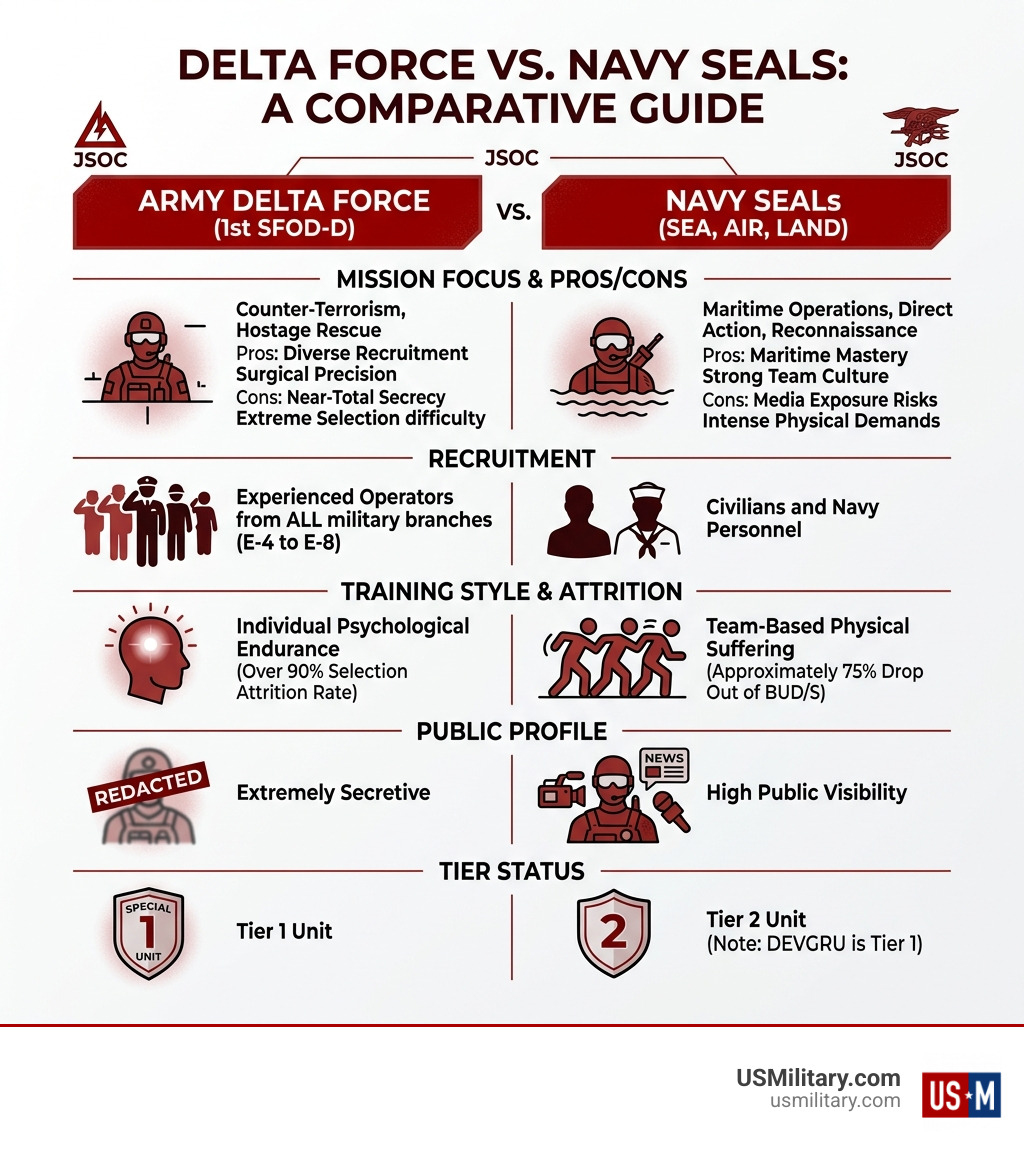
The pros and cons of Army Delta Force vs Navy SEALs come down to mission focus, training style, secrecy, and who can even apply. Here’s a quick breakdown:
| Factor | Army Delta Force | Navy SEALs |
|---|---|---|
| Mission focus | Land-based counter-terrorism, hostage rescue | Maritime, direct action, reconnaissance |
| Who can join | Any military branch (E-4 to E-8) | Civilians and Navy personnel |
| Training style | Individual psychological endurance | Team-based physical suffering |
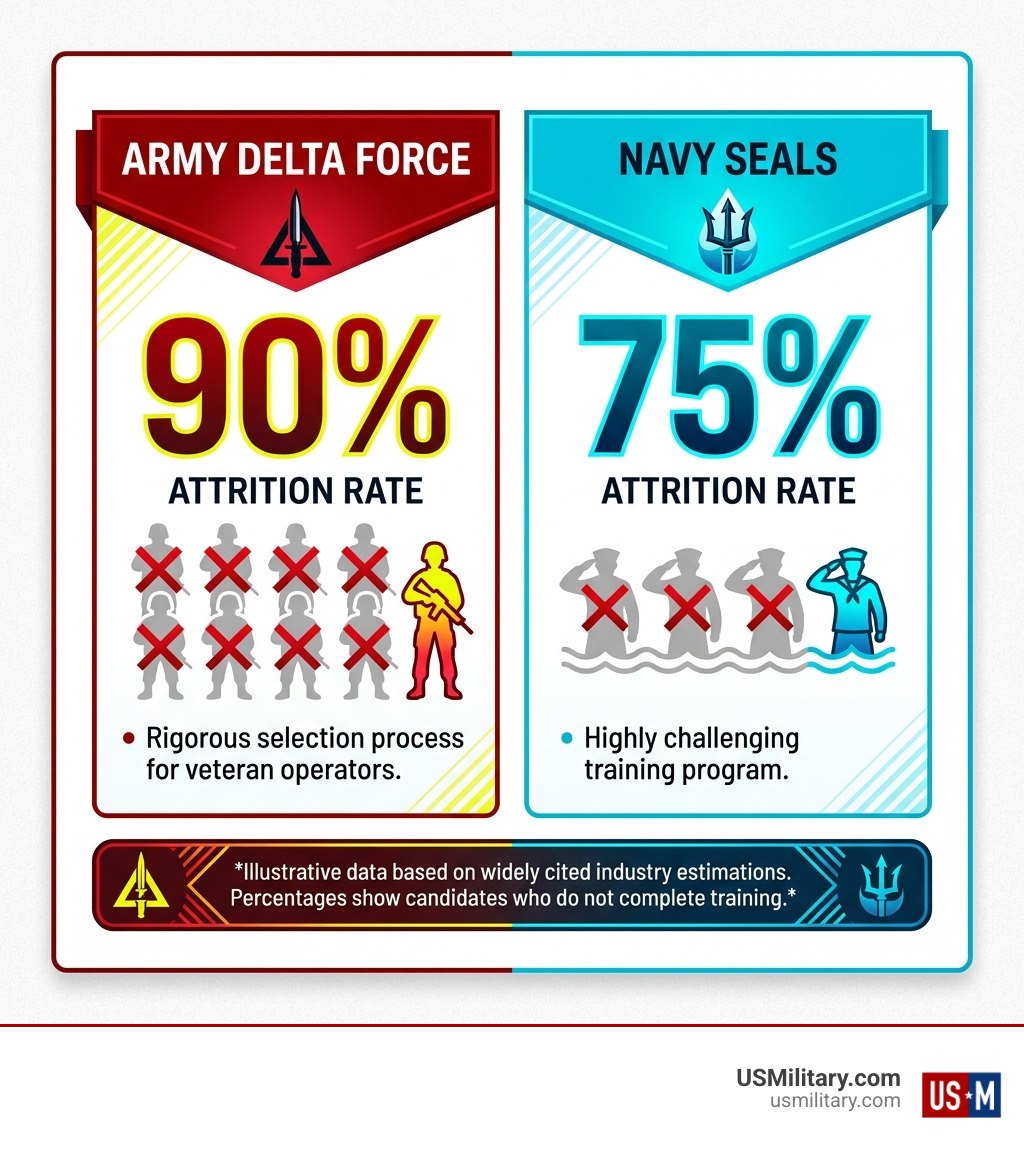
| Attrition rate | Over 90% at selection | ~75% drop out of BUD/S |
| Public profile | Extremely secretive | High public visibility |
| Tier status | Tier 1 | Tier 2 (DEVGRU is Tier 1) |
| Key pro | Diverse recruitment, surgical precision | Maritime mastery, strong team culture |
| Key con | Near-total secrecy, very hard to qualify | Media exposure risks, intense physical demands |
Both units operate under the Joint Special Operations Command (JSOC). Both are among the most capable fighting forces on earth. But they are not the same — and the differences matter a lot depending on your goals.
Delta Force (officially the 1st Special Forces Operational Detachment-Delta, or 1st SFOD-D) is the Army’s most secretive unit. It recruits experienced operators from across all military branches. Navy SEALs, on the other hand, can take in civilians with no prior service — making them a more accessible entry point into elite special operations.
I’m Larry Fowler, publisher of USMilitary.com and a longtime resource for active-duty military, veterans, and those exploring service careers — including helping people understand the pros and cons of Army Delta Force vs Navy SEALs to make smart career decisions. Let’s break down everything you need to know to understand how these two legendary units compare.
Easy Pros and Cons Of Army Delta Force vs Navy SEALs glossary:
- Who Has The Hardest Training: Navy SEALs vs Army Rangers
- us navy seals vs army delta force
- seal team six
Primary Missions and Operational Focus
When we look at the Pros and Cons Of Army Delta Force vs Navy SEALs, the conversation usually starts with their “office” environment. While both are masters of Direct Action (DA), their heritage dictates where they prefer to fight.
Navy SEALs are the masters of the maritime domain. Their name—Sea, Air, and Land—tells you they can go anywhere, but their bread and butter remains water-borne operations. Whether it’s ship boarding, underwater demolition, or coastal reconnaissance, the SEALs are the go-to “hammer” for maritime threats.
Delta Force, conversely, is often described as a “scalpel.” While they can certainly operate in any environment, their primary focus is land-based counter-terrorism and hostage rescue. They excel in urban environments and complex, high-stakes scenarios that require extreme technical precision.
| Mission Type | Delta Force Focus | Navy SEAL Focus |
|---|---|---|
| Counter-Terrorism | Primary (Surgical/Clandestine) | Secondary (Direct Action) |
| Hostage Rescue | Specialized (Land/Aircraft/Urban) | Specialized (Maritime/Ship-based) |
| Maritime Ops | Occasional Support | Primary Specialization |
| Direct Action Raids | High-Value Target Extraction | Large-Scale Assaults |
| Unconventional Warfare | Limited Focus | Core Capability |
In JSOC, the decision of Army Delta Force vs Navy SEALs: Who Gets The Call? often depends on the geography of the target. If a hostage is on a hijacked oil tanker, the SEALs (specifically SEAL Team 6) are likely going in. If a terrorist leader is hiding in a high-rise apartment in a landlocked city, Delta might take the lead. For more on how these units stack up against other Army elites, you can Compare Army Delta Force Vs Navy Seals/ to see the broader tactical picture.
Selection and Training: BUD/S vs. The Unit
The training pipelines for these units are legendary, but they test entirely different aspects of the human spirit.
Navy SEALs: The Team-Based Grind
For the SEALs, the journey begins at BUD/S (Basic Underwater Demolition/SEAL) in Coronado, California. This is widely considered the hardest entry-level training in the world. The goal is to see if you can handle “team-based suffering.”
The crown jewel of BUD/S is Hell Week—5.5 days of continuous physical activity with less than four hours of total sleep. Candidates are constantly cold, wet, and sandy. Statistics show that only about 25% of candidates complete BUD/S, with more than 75% dropping out, often during that first brutal week. It is a “loud” environment where instructors are constantly in your face, daring you to quit.
Delta Force: The Individual Mind Game
Delta Force selection is a different beast entirely. You don’t just “join” Delta from the street. You must already be in the military, usually an E-4 to E-8, often coming from the Army Ranger Vs Green Beret/ communities.
Delta selection takes place in the remote West Virginia mountains and is characterized by “the long walk”—a 40-mile solo rucksack march. Unlike the SEALs, where you suffer with your “class,” Delta selection is a solitary, quiet experience. Instructors don’t scream; they just watch. They want to see if you have the internal drive to perform perfectly when you are completely alone, exhausted, and have no one to lean on. The attrition rate for Delta selection regularly exceeds 90%.
Once selected, Delta operators enter the six-month Operator Training Course (OTC), which is so secretive that candidates often have little to no contact with their families during the process. To understand the differences in the broader Special Forces landscape, check out our guide on Green Beret Vs Navy Seal/.

Pros and Cons Of Army Delta Force vs Navy SEALs
When considering the Pros and Cons Of Army Delta Force vs Navy SEALs, it’s not about which unit is “better,” but which lifestyle and mission set fits an operator’s personality.
Pros of Delta Force:
- Diverse Recruitment: Because they recruit from all branches, Delta operators bring a massive variety of skills to the table.
- Surgical Precision: They are the ultimate specialists in high-stakes hostage rescue.
- Operational Secrecy: For those who value the “quiet professional” ethos, Delta is the pinnacle.
Cons of Delta Force:
- Extreme Secrecy: The lifestyle is hard on families; the unit’s existence is barely acknowledged.
- High Barrier to Entry: You must already be an elite soldier just to get an invite to try out.
Pros of Navy SEALs:
- Maritime Mastery: No one is better in the water.
- Public Recognition: The SEAL “brand” is world-famous, which can lead to significant post-service opportunities.
- Team Culture: The bond formed in BUD/S is unlike anything else in the military.
Cons of Navy SEALs:
- Physical Toll: The constant exposure to cold water and heavy impact leads to long-term joint and health issues.
- Media Exposure Risks: The high public profile has led to criticisms of “Hollywood” behavior and operational security (OPSEC) concerns.
Both units rely heavily on the 160th SOAR (Special Operations Aviation Regiment), known as the Night Stalkers, for insertion and extraction. For a deeper look at the technical differences, see Delta Force vs Navy SEALs: The Differences – USAMM and explore how they compare to the 75th Ranger Regiment in Army Rangers Vs Navy Seals Are They The Deadliest Elite Special Forces/.
Weighing the Pros and Cons Of Army Delta Force vs Navy SEALs for Recruits
If you are a 18-year-old civilian, the Pros and Cons Of Army Delta Force vs Navy SEALs are weighted heavily toward the SEALs. Why? Because you can actually join the Navy with a SEAL contract (Challenge Program) right now. You can’t do that with Delta.
To get to Delta, you first have to prove yourself in “regular” elite units. Most Delta operators are veteran NCOs who have already spent years in the Army Ranger Vs Green Beret/ communities. This means Delta operators are generally older—often in their 30s—and have significantly more military experience before they ever set foot in the Unit.
SEAL Team 6 (DEVGRU) is the Navy’s Tier 1 equivalent to Delta. However, unlike Delta, which takes people from the Air Force, Marines, and even the Coast Guard, DEVGRU selects exclusively from existing Navy SEAL teams. If you fail “Green Team” (DEVGRU selection), you simply go back to a regular SEAL team. If you fail Delta selection, you go back to your previous unit, which can be a tough pill to swallow.
Lifestyle and Career Pros and Cons Of Army Delta Force vs Navy SEALs
The lifestyle differences are stark. Delta operators are known for the “suburban dad” aesthetic. They often have longer hair, beards, and wear civilian clothes to blend in. They might look like a serious marathon runner you’d see at a local coffee shop. Their goal is to be invisible.
SEALs, particularly in the Tier 2 teams, often have a more recognizable “warrior” look—muscular builds, shorter hair, and often prominent tattoos. Because of their maritime heritage, their training involves a lot of “loud” teamwork, whereas Delta emphasizes individual autonomy and clandestine tradecraft.
Career-wise, the high visibility of the SEALs has created a “Hollywood” path with book deals and movies. While this is a “pro” for some, many in the special ops community view it as a “con” because it violates the “Quiet Professional” ethos. Delta Force remains much more behind-the-scenes, valuing secrecy above all else.

Unit Culture and Public Profiles
The cultural divide between these two units is perhaps the most fascinating part of the Pros and Cons Of Army Delta Force vs Navy SEALs.
Delta Force is a “Tier 1” or “Black” unit. For decades, the Pentagon wouldn’t even say their name. This secrecy is baked into their DNA. They even have a unique legal status; it is widely understood that Delta is the only unit with a functional exemption from the Posse Comitatus Act, allowing them to operate domestically in extreme counter-terrorism emergencies that exceed the FBI’s capabilities.
Navy SEALs (the Tier 2 teams) are “White” SOF, meaning they are part of the public-facing military. They engage in community outreach and are a major recruitment tool for the Navy. This public profile is a double-edged sword. It brings in high-quality recruits, but it also puts a target on the unit’s back when it comes to media scrutiny.
Historically, the units even “owned” different theaters. During the height of the Global War on Terror, Delta Force largely “owned” the operational space in Iraq, while the SEALs took the lead in Afghanistan. This division allowed each unit to hone its specific strengths—Delta in urban counter-insurgency and SEALs in the rugged, mountainous terrain.
For those interested in how other elite units compare, such as the Marine Raiders, you can read about the Marsoc Raiders Vs Army Green Berets Elite Forces Face Off/. If you’re looking at Air Force options, see how Air Force Pjs Vs Navy Seals Compared/.
Frequently Asked Questions about Delta and SEALs
Can a Navy SEAL join Delta Force?
Yes! Since Delta Force is a joint-service unit, they can—and do—recruit from all branches. There have been several documented cases of Navy SEALs, Marine Raiders, and Air Force PJs successfully passing Delta selection. However, it is much more common for a SEAL to try out for DEVGRU (SEAL Team 6) since they are already in the Navy pipeline.
Which unit is considered more elite?
This is the ultimate “monster truck vs. Formula 1 car” debate. Neither is “more” elite; they are just different tools. Delta Force operators are generally older and more experienced when they start, while SEALs undergo the most physically demanding entry-level training. Both units are Tier 1 assets under JSOC and are the best at what they do.
What is the difference between SEAL Team 6 and Delta Force?
SEAL Team 6 (DEVGRU) is the Navy’s Tier 1 unit, while Delta Force is the Army’s Tier 1 unit. They perform very similar missions for JSOC, but DEVGRU maintains a maritime specialization while Delta focuses on land-based operations. Delta recruits from the entire military, while DEVGRU only recruits from the Navy SEAL teams.
Conclusion
At the end of the day, the pros and cons of Army Delta Force vs Navy SEALs show us two different paths to the same goal: excellence in the defense of the United States. Whether you are drawn to the maritime brotherhood and high-octane missions of the SEALs or the quiet, surgical precision and extreme secrecy of Delta Force, both represent the absolute pinnacle of military service.
At USMilitary.com, we are dedicated to helping you find the right path and ensuring you get the benefits you’ve earned once your service is complete. Whether you’re interested in More info about Navy SEAL career paths or navigating the complexities of VA disability after a career in the teams, we’re here to serve as your central hub for military guidance.
Both paths lead to the very tip of the spear. The choice of which edge you want to be is yours. For those ready to take the next step, we encourage you to research the Navy SEALs Complete Guide and start your journey toward becoming an elite operator.
Free for Service Members & Veterans
Get the military benefits intel no one tells you about.
Weekly updates on VA benefits, pay changes, and money tips — free for service members and veterans.
No spam. Unsubscribe anytime. Your info is never shared.


