Understanding VA Disability in 2025: What Veterans Need to Know
The 10 most common VA disabilities in 2025 continue to be dominated by service-related hearing conditions, musculoskeletal injuries, and mental health disorders. Based on the most recent Veterans Benefits Administration Annual Benefits Report, here are the top 10 conditions affecting veterans:
- Tinnitus – 3,255,323 recipients
- Limitation of Flexion of the Knee – 2,069,942 recipients
- Paralysis of the Sciatic Nerve – 1,745,314 recipients
- Lumbosacral or Cervical Strain – 1,611,188 recipients
- Hearing Loss – 1,594,271 recipients
- Post-Traumatic Stress Disorder (PTSD) – 1,589,833 recipients
- Limitation of Motion of the Arm – 1,200,103 recipients
- Limitation of Motion of the Ankle – 1,142,492 recipients
- Scars and Burns – 1,125,720 recipients
- Migraines – 1,109,254 recipients
If you served in the military, chances are high you were exposed to noise, heavy physical demands, or traumatic stressors that could qualify you for VA disability benefits. The average veteran now has nearly 7 service-connected disabilities, and the VA paid out over $163 billion in disability compensation in 2024 alone.
The face of VA disability is changing. Gulf War-era veterans now make up 61.4% of all disability recipients, and Post-9/11 veterans are filing increasingly complex claims with multiple conditions. The PACT Act has expanded presumptive conditions for toxic exposure, making it easier for veterans to establish service connection for burn pit-related illnesses and other environmental hazards.
Understanding which disabilities are most common—and how they’re rated—can give you a strategic advantage when filing your claim. Whether you’re dealing with ringing in your ears from weapons fire, knee pain from ruck marches, or PTSD from combat deployments, knowing what the VA looks for can mean the difference between a denied claim and the benefits you’ve earned.
I’m Larry Fowler, publisher of the USMilitary.com Network, where I’ve been helping active-duty service members and veterans navigate VA benefits since 2007, including staying current on trends in the 10 most common VA disabilities in 2025. Through this work, I’ve seen how understanding the claims process can transform a veteran’s quality of life.

Relevant articles related to 10 most common va disabilities in 2025:
- What conditions qualify for veteran disability benefits
- What is the hardest VA Disability to get
- va disability rating chart 2026
The 10 Most Common VA Disability Claims in 2025
As we move through 2025, the landscape of veteran benefits is shifting toward higher complexity and higher ratings. According to the VBA Annual Benefits Report, the total number of service-connected disabilities has skyrocketed to over 41 million across nearly 6 million veterans. This means the “average” disabled veteran is no longer just dealing with one injury; they are managing a combination of physical and mental health challenges.
Below is a comparison table of the 10 most common VA disabilities in 2025, showing their prevalence and the typical rating ranges veterans receive.
| Disability Condition | Total Recipients (Approx.) | Common Rating Percentages |
|---|---|---|
| Tinnitus | 3.25 Million | 10% (Flat Rate) |
| Knee Flexion Limitation | 2.06 Million | 10% to 30% |
| Sciatic Nerve Paralysis | 1.74 Million | 10% to 80% |
| Lumbosacral/Cervical Strain | 1.61 Million | 10% to 100% |
| Hearing Loss | 1.59 Million | 0% to 100% |
| PTSD | 1.58 Million | 30%, 50%, 70%, 100% |
| Arm Motion Limitation | 1.20 Million | 20% to 40% |
| Ankle Motion Limitation | 1.14 Million | 10% to 20% |
| Scars (General) | 1.12 Million | 0% to 80% |
| Migraines | 1.10 Million | 0%, 10%, 30%, 50% |
For more detailed projections, check out our More info about 2026 rating guides and our comprehensive list of the top 10 VA disability claims.
Tinnitus and Hearing Loss: The Top 10 Most Common VA Disabilities in 2025
It’s no surprise that auditory issues top the list. Whether you were an aircraft mechanic on a flight deck or an infantryman in a firefight, acoustic trauma is a constant companion in military life.
- Tinnitus (Diagnostic Code 6260): This is the single most common claim. According to the National Institute for Deafness and Other Communication Disorders, tinnitus is the perception of sound when no external noise is present. Under 38 CFR § 4.87, the VA currently provides a flat 10% rating for recurrent tinnitus, whether it’s in one ear or both.
- Hearing Loss (Diagnostic Code 6100): This is rated based on very specific audiological testing. The VA requires two tests: the Maryland CNC test (for speech recognition) and Pure-Tone audiometry (for frequency thresholds). These are evaluated under 38 CFR § 4.85 using a complex grid system. While many veterans receive a 0% or 10% rating, severe cases can reach 100%.
One of the biggest helps for these claims is the Duty MOS Noise Exposure Listing. If your Military Occupational Specialty (MOS) is listed as having a “highly probable” risk of noise exposure, the VA may concede that your hearing issues were caused by your service without you needing to provide extra proof of a specific loud event. For the latest on how these are being processed, see our VA disability 2024-2025 updates.
Musculoskeletal and Mental Health: 10 Most Common VA Disabilities in 2025
The physical toll of carrying heavy gear and the psychological toll of high-stress environments make up the bulk of the remaining top claims.
- Knee Flexion (Diagnostic Code 5256): Many veterans suffer from a limited range of motion in their knees. Under 38 CFR § 4.71a, the VA rates this based on how far you can curl your leg inward. If you cannot flex your knee more than 45 degrees, you could qualify for a 60% rating.
- Sciatica (Diagnostic Code 8520): Paralysis or “shooting pain” of the sciatic nerve is often secondary to back injuries. Rated under 38 CFR § 4.124a, ratings range from 10% for mild cases to 80% for complete paralysis (which causes “foot drop”).
- PTSD (Diagnostic Code 9411): Post-Traumatic Stress Disorder is the most common mental health claim. It is rated under 38 CFR § 4.130 based on social and occupational impairment. Most veterans are rated at 70%, which indicates “deficiencies in most areas” like work, family relations, and judgment. For a deep dive into how to secure these benefits, read our PTSD VA rating guide and VA disability rating for PTSD.
How the VA Evaluates and Rates Common Conditions
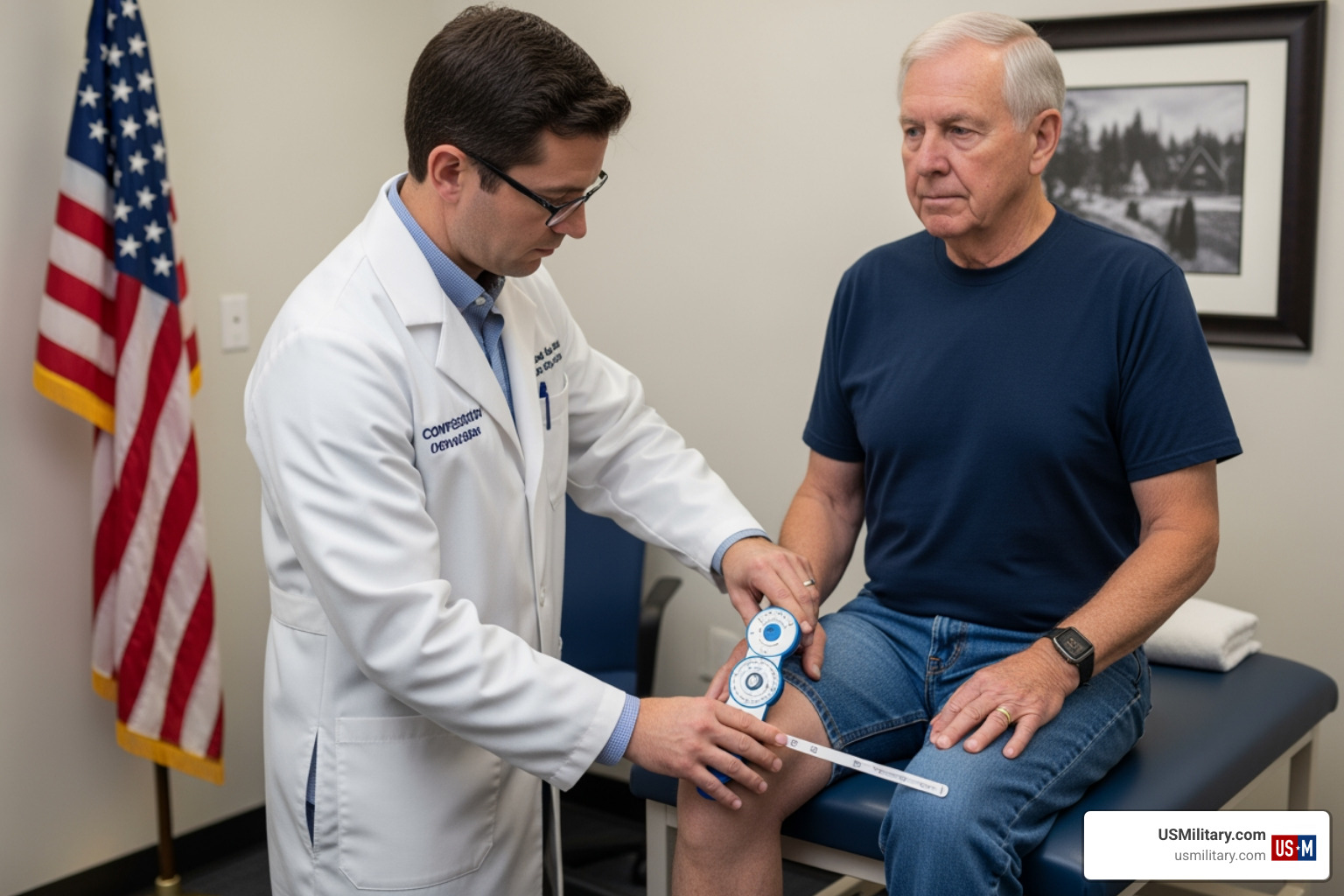
When you file for one of the 10 most common VA disabilities in 2025, you will likely be scheduled for a Compensation and Pension (C&P) exam. This is the VA’s way of verifying your diagnosis and determining the severity of your symptoms.
For musculoskeletal conditions (like back, knee, and ankle strains), the VA uses a tool called a goniometer to measure your Range of Motion (ROM). They look for:
- Flexion: How far you can move the joint.
- Extension: How far you can straighten it.
- Functional Loss: Even if you can move your arm, if it hurts to do so, the VA must consider that pain as a limitation.
A landmark court case, Sharp v. Shulkin, changed the game for veterans. It ruled that VA examiners must account for “flare-ups.” This means that if your back normally moves okay, but three times a month you can’t get out of bed, the examiner must estimate your functional loss during those bad days.
The VA assigns a Diagnostic Code to every condition, which then points to a specific rating schedule. To see where your conditions might land, check our guide on VA disability ratings 2026 or learn how to request a VA rating increase for my disability.
Strengthening Your Claim for Top VA Disabilities
Winning a claim for the 10 most common VA disabilities in 2025 requires more than just showing up to an exam. You need three things to establish service connection:
- A current medical diagnosis.
- Evidence of an in-service event, injury, or illness.
- A “nexus” (link) between the two.
Nexus Letters are perhaps the most powerful tool in your arsenal. This is a letter from a medical professional stating that your condition is “at least as likely as not” (50% probability or greater) caused by your military service.
Lay Statements (Buddy Letters) are also vital. These are statements from spouses, friends, or fellow service members who can describe how your disability affects your daily life or recount the specific event that caused the injury. If you were a combat engineer and your fellow soldier remembers the blast that caused your hearing loss, that statement can be the “missing link” in your medical file.
For those aiming for maximum benefits, understanding how to get a 100% VA disability rating is essential, especially with the recent VA disability rate increase that helps payments keep up with inflation.
Secondary Conditions and Impact on Total Compensation
One of the most overlooked strategies in VA disability is claiming secondary conditions. A secondary condition is a disability that was caused or aggravated by a primary, service-connected condition.
Common examples include:
- Sleep Apnea secondary to PTSD: Weight gain from medication or restricted airways due to stress-related issues can lead to apnea. The VA rates sleep apnea VA disability at 50% if a CPAP machine is required.
- Radiculopathy secondary to Back Strain: Nerve damage in the legs (sciatica) is almost always caused by a primary back injury.
- GERD secondary to Pain Meds: If you take heavy NSAIDs for a service-connected knee injury, you might develop GERD VA disability rating issues.
The VA uses a Combined Ratings Table (often called “VA Math”) to determine your total compensation. They don’t just add 50% + 50% to get 100%. Instead, they take 50% of your “healthy” whole, then 50% of what’s left. This is why adding secondary conditions is so important—it’s often the only way to reach that 100% threshold.
You can calculate your potential monthly take-home using the VA disability pay tables. And remember, a common question we get is, “Is VA disability income taxable?” The answer is a resounding no—your VA disability payments are tax-free at the federal level.
Frequently Asked Questions about 2025 VA Disabilities
What is the most common VA disability for Post-9/11 veterans?
For the Global War on Terror (GWOT) and Post-9/11 era, Tinnitus remains the #1 claim, followed closely by PTSD and Knee Conditions. Statistics from the Centers for Disease Control and Prevention indicate that veterans are significantly more likely to be disabled than their civilian counterparts. GWOT veterans specifically have the highest average number of rated conditions—roughly 9 per veteran—reflecting the intensity of modern deployments.
How do 2025 rule changes affect tinnitus and sleep apnea ratings?
There have been ongoing discussions regarding proposed changes to how the VA rates tinnitus and sleep apnea. One proposal suggested that tinnitus should only be rated as part of a hearing loss claim rather than as a standalone 10% rating. For sleep apnea, the VA has considered changing the sleep apnea VA rating criteria to focus more on whether the condition is “asymptomatic” even with a CPAP. As of early 2025, it is crucial to file your claims under the current rules to ensure you are “grandfathered” in should these changes take full effect.
Can I claim migraines as a secondary condition?
Absolutely. Migraines are frequently claimed as secondary to TBI (Traumatic Brain Injury) or mental health conditions like PTSD. To get a high rating (up to 50%) under 38 CFR § 4.124a, you must document “prostrating attacks”—meaning the headaches are so severe you have to lie down in a dark room and cannot work. We recommend keeping a headache log for at least three to six months to prove the frequency of these attacks.
Conclusion
Navigating the 10 most common VA disabilities in 2025 can feel like a full-time job, but you don’t have to do it alone. At USMilitary.com, we are dedicated to providing the resources you need to understand your rights and secure your earned benefits.
Establishing a solid service connection is the first step toward long-term financial security and health support. Whether you are just starting your journey or looking to increase a current rating, understanding the 100 percent disabled veteran benefits available to you is vital. From tax exemptions to healthcare for your family, the impact of a high VA rating is life-changing.
For more information on how to navigate the system, visit our central hub for Disabled Veteran Benefits. We thank you for your service and are honored to help you on your march toward the benefits you deserve.
Free for Service Members & Veterans
Get the military benefits intel no one tells you about.
Weekly updates on VA benefits, pay changes, and money tips — free for service members and veterans.
No spam. Unsubscribe anytime. Your info is never shared.


