The VA Benefit Most Veterans Don’t Know About

VR&E (Chapter 31): Benefits, Eligibility & How To Apply (2026) is one of the most powerful — and most overlooked — programs in the entire VA benefits system. Here’s a quick snapshot so you know what you’re dealing with:
Quick Answer: What Is VR&E (Chapter 31)?
- What it is: A VA program that helps veterans with service-connected disabilities get education, job training, and employment support
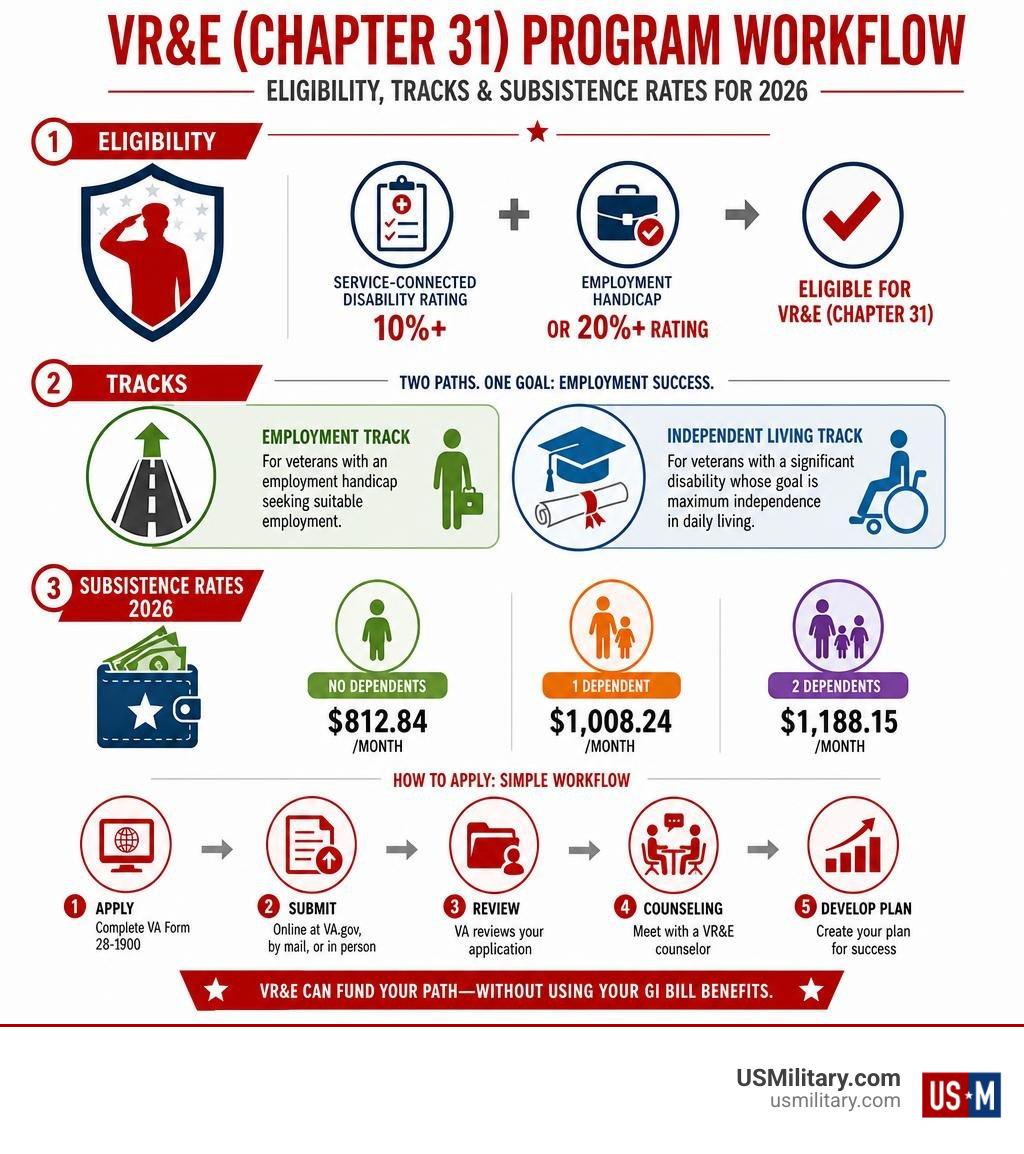
- Who qualifies: Veterans with a VA disability rating of at least 10% and an employment handicap (or 20%+ rating)
- What it covers: Full tuition (no cap), books, supplies, a laptop, and a monthly subsistence allowance
- 2026 subsistence rates: $812.84/month (no dependents), $1,008.24 (1 dependent), $1,188.15 (2 dependents)
- Entitlement: Up to 48 months — 12 more months than the Post-9/11 GI Bill
- Key advantage: Using VR&E first does not reduce your GI Bill entitlement
- How to apply: File VA Form 28-1900 online at VA.gov, by mail, or in person at a VA Regional Office
Most veterans assume VR&E is just a job-training program for people who can’t work. That’s not the full picture. If you have a service-connected disability, VR&E can pay for a complete college degree — even at an expensive private university — without touching a single month of your GI Bill.
The program operates under Chapter 31 of Title 38 of the U.S. Code, which is why it’s often called “Chapter 31.” It was renamed from Vocational Rehabilitation and Employment to Veteran Readiness and Employment in 2020, but the core benefit is the same: the VA funds your path to suitable employment when your disability creates a barrier.
The difference between veterans who maximize this benefit and those who leave money on the table often comes down to one thing — knowing the rules before you apply.
I’m Larry Fowler, publisher of the USMilitary.com Network and a longtime advocate for veteran VA benefits since 2007 — and VR&E (Chapter 31): Benefits, Eligibility & How To Apply (2026) is exactly the kind of high-value, underused benefit I’ve spent years helping veterans understand. In this guide, I’ll walk you through everything you need to know to qualify, apply, and get the most out of it.
Easy VR&E (Chapter 31): Benefits, Eligibility & How To Apply (2026) glossary:
- Apply for benefits
- Apply for disability
- Top 15 VA Benefits That Vets Most Often Forget
VR&E (Chapter 31): Benefits, Eligibility & How To Apply (2026)
When we talk about funding higher education or vocational training, most transitioning service members naturally think of the Post-9/11 GI Bill (Chapter 33). While the GI Bill is an incredible tool, VR&E (Chapter 31): Benefits, Eligibility & How To Apply (2026) is often the superior choice for veterans with service-connected disabilities.
To understand why, we have to look at how these two programs differ in scope, funding caps, and overall entitlement.
The Post-9/11 GI Bill provides up to 36 months of education benefits. It has a strict national cap on private school tuition, which sits at $29,920.95 per academic year for the term running from August 1, 2025, through July 31, 2026. If you want to attend an elite private university or a specialized high-cost program, the GI Bill might leave you with a massive out-of-pocket bill unless the school participates heavily in the Yellow Ribbon Program.
In contrast, Chapter 31 VR&E has no annual tuition cap. If your Vocational Rehabilitation Counselor (VRC) approves a program as part of your rehabilitation plan, the VA covers 100% of the tuition and fees at any approved institution, public or private. Whether the tuition is $10,000 or $80,000 a year, VR&E pays it in full.
Furthermore, VR&E provides up to 48 months of training entitlement under 38 USC § 3105. That is a full year more than the GI Bill. This extra time can be the difference between completing a bachelor’s degree and finishing both a bachelor’s and a master’s degree.
To make the most of your hard-earned benefits, we recommend exploring our comprehensive resource on VA Benefits. For a deeper dive into the strategic differences between these two programs, check out the VR&E vs GI Bill (2026): Why VR&E Usually Wins | Military Transition Toolkit and the VA Chapter 31 (VR&E) Benefits Explained (2026 Guide for Veterans) .
Here is a side-by-side comparison to help you visualize how these programs stack up:
| Feature | Chapter 31 (VR&E) | Post-9/11 GI Bill (Chapter 33) |
|---|---|---|
| Primary Goal | Employment preparation and job placement | Educational advancement |
| Entitlement Length | Up to 48 months (extensions possible) | 36 months |
| Tuition Limits | Uncapped at approved schools | Capped at $29,920.95/yr for private schools |
| Disability Required | Yes (10% minimum rating) | No |
| Book/Supply Stipend | 100% of required books/supplies covered | Capped at $1,000 per academic year |
| Equipment Provided | Laptops, software, and tools as required | None (must use personal funds/stipend) |
Understanding VR&E Eligibility and the 12-Year Rule

Before you can access these incredible benefits, you must establish basic eligibility. The VA looks at several factors, starting with your discharge status and your service-connected disability rating.
To qualify for VR&E, we must meet these foundational requirements:
- You must not have received a dishonorable discharge.
- You must have a service-connected disability rating from the VA of at least 10%.
However, having a rating is only the first step. The VA also evaluates whether you have an employment handicap or a serious employment handicap (SEH):
- 10% Disability Rating: If you have a 10% rating, you are not automatically entitled to VR&E. The VA must find that you have a serious employment handicap. This means your service-connected disability significantly limits your ability to prepare for, get, or keep a job.
- 20% or Higher Disability Rating: If your rating is 20% or higher, the threshold is lower. The VA only needs to find that you have a basic employment handicap.
Once eligibility is established, we must address the timeline. Historically, veterans had a strict 12-year basic period of eligibility to use their VR&E benefits. This 12-year window typically began on the date of your separation from active duty or the date you were first notified of your service-connected disability rating, whichever came later.
However, there is a massive exception to this rule. If you were discharged from active duty on or after January 1, 2013, the 12-year limit does not apply to you. You have a lifetime entitlement to apply for and use VR&E benefits, provided you still meet the disability and employment handicap criteria.
If you were discharged before 2013, the 12-year limit still applies, but it can be extended if a counselor determines you have a serious employment handicap, certain medical conditions prevented you from training, or you qualify under recent toxic-exposure laws like the PACT Act.
To learn more about how your rating affects your benefits, read our guide on Disabled Veteran Benefits. You can also verify your status directly via the official VR&E Eligibility Requirements page. For specialized help with eligibility and navigating the system, check out resources like vetchapter31.ai and the comprehensive VR&E (Chapter 31) — Veteran Readiness & Employment | VetAtlas .
Who Qualifies Under VR&E (Chapter 31): Benefits, Eligibility & How To Apply (2026)
Active-duty service members do not have to wait until they are discharged veterans to qualify for VR&E. If you are still in uniform, you can access these services early if you meet one of the following criteria:
- You have a pre-discharge disability rating (memorandum rating) of 20% or higher from the VA and expect to receive an honorable or other-than-dishonorable discharge.
- You are actively participating in the Integrated Disability Evaluation System (IDES) or are going through the Physical Evaluation Board (PEB) process.
- You are hospitalized or receiving outpatient medical care for a severe injury or illness that occurred in the line of duty, making you eligible for automatic services under Section 1631(b) of the National Defense Authorization Act (Public Law 110-181).
Getting a head start while on active duty is one of the smartest moves you can make. It allows you to transition smoothly from the military straight into a training program or a new career path without a gap in income or momentum. For active-duty personnel looking to transition, we highly recommend reading the Veteran Readiness and Employment For Service Members | The Official Army Benefits Website ?serv=122).
The Five VR&E Service Tracks Explained
VR&E is not a one-size-fits-all program. Once you are found eligible and entitled, you will work with your counselor to select one of five distinct service tracks designed to help you reach your goals.
- Reemployment: This track is designed for veterans who want to return to their previous civilian employers. The VA works with your employer to provide necessary accommodations, adaptive equipment, or specialized training so you can safely return to your old job.
- Rapid Access to Employment: If you already have the skills and education needed to work but just need help finding a job, this track gets you into the workforce quickly. It provides resume development, interview coaching, job placement services, and short-term training.
- Self-Employment: For veterans who want to start their own businesses. This is a highly competitive track that can provide help with business plans, marketing analysis, and even funding for essential equipment and licensing.
- Employment Through Long-Term Services: This is the most popular track for veterans seeking higher education or vocational training. We will focus on this track in detail below.
- Independent Living: Reserved for veterans with severe service-connected disabilities who cannot currently pursue traditional employment. This track focuses on helping you live as independently as possible in your home and community by providing assistive technology, home modifications, and independent living skills training.
If you are currently transitioning, you might also want to look into how programs like the DoD SkillBridge Program can work alongside your transition plans to give you hands-on industry experience.
Focus on Track 4: Employment Through Long-Term Services
If your service-connected disability prevents you from working in your current field, and you need a college degree, trade certificate, or technical license to enter a new, suitable career, Track 4 is where you want to be.
✉ Get updates like this in your inbox
Weekly VA benefit changes, pay updates, and money tips for service members, veterans, and military families. Free, no spam.
Under the Employment Through Long-Term Services track, the VA will fund the education required to make you employable in your target field. This goes far beyond standard university enrollment. The VA will cover:
- Associate, Bachelor’s, Master’s, or Doctorate degrees.
- Vocational school, technical certificates, and business school programs.
- On-the-job training (OJT), apprenticeships, and non-paid work experience.
The key to Track 4 is that the education must directly lead to a viable employment goal. You cannot use VR&E just to take classes or get a degree for personal enrichment. You and your counselor must identify a specific job goal (e.g., Accountant, Software Engineer, Clinical Social Worker) that is physically and mentally compatible with your disabilities, and then design an educational plan to get you there.
VR&E Financial Coverage and 2026 Subsistence Rates

One of the greatest financial reliefs of the VR&E program is the sheer completeness of its coverage. When we say the VA covers your education, we mean they cover everything.
Under an approved Track 4 plan, the VA pays for:
- 100% of Tuition and Fees: Paid directly to the school with no annual cap.
- Required Books and Supplies: Not a flat stipend, but the actual cost of every book, notebook, and calculator required by your syllabus.
- Necessary Equipment: This includes a standard-issue laptop, software, and any specialized tools (like a stethoscope for nursing students or a toolset for mechanics).
- Tutoring Assistance: If you struggle in a course, the VA can reimburse up to $100 per month (up to a $1,200 total cap) for professional tutoring, provided you are enrolled at least half-time and obtain a professor’s signature on VA Form 22-1990t.
In addition to having your educational costs covered, you will receive a monthly subsistence allowance to help cover your living expenses while you train.
For the Fiscal Year 2026 (effective October 1, 2025), VR&E subsistence rates received a 2.5% Cost of Living Adjustment (COLA) increase. The standard institutional rates are paid based on your enrollment status and the number of dependents you have:
- Full-Time Institutional Rate (No Dependents): $812.84 per month
- Full-Time Institutional Rate (1 Dependent): $1,008.24 per month
- Full-Time Institutional Rate (2 Dependents): $1,188.15 per month
- Each Additional Dependent: Adds $86.58 per month
To put this in perspective, the maximum theoretical monthly VR&E subsistence allowance for FY2026 is $3,439.23, which is calculated based on full-time enrollment for a veteran with a spouse, mother, father, and 25 children!
For a complete breakdown of all available veteran financial resources, consult our Ultimate US VA Benefits Guide. You can also view the official, up-to-date rate tables on the FY2026 VR&E Subsistence Rates page.
The Post-9/11 BAH Election Option
While the standard VR&E subsistence allowance is helpful, there is a financial strategy that can dramatically increase your monthly income.
If you have at least one day of remaining entitlement under the Post-9/11 GI Bill and are within your GI Bill eligibility period, you can elect to receive the Post-9/11 subsistence allowance rate instead of the standard Chapter 31 rate. This is done by filing VA Form 28-0987 with your counselor.
When you make this election, the VA pays you a monthly housing allowance (MHA) equivalent to the Basic Allowance for Housing (BAH) of an E-5 with dependents for the ZIP code of your school.
In high-cost-of-living areas, this difference is massive. For example, if you attend school in a major city:
- Standard VR&E rate with no dependents: $812.84/month
- Post-9/11 BAH rate in Boston or San Francisco: $4,500 to $5,000+/month
By electing the Post-9/11 rate, you get the higher housing allowance while still enjoying all the perks of VR&E (uncapped tuition, paid books, and a free laptop) — and the VA does not deduct any months from your actual GI Bill entitlement!
Strategic Sequencing: Maximizing VR&E Before the GI Bill
The single biggest mistake we see transitioning veterans make is using their Post-9/11 GI Bill first simply because they are more familiar with it. If you have a service-connected disability rating of 10% or higher, the smartest move is almost always to use VR&E first.
Here is why this sequencing strategy is so powerful:
Under VA rules, you can receive up to 48 months of combined VA education benefits. However, if you use your 36 months of Post-9/11 GI Bill first, you will only have 12 months of VR&E entitlement left unless you qualify for an extension.
But if you use VR&E first, those months of training do not count against your GI Bill. You can use up to 48 months of VR&E benefits to complete your undergraduate degree, and then still have your full 36 months of Post-9/11 GI Bill completely untouched. You can then use your GI Bill for graduate school, law school, or even transfer it to your spouse or children.
Furthermore, if you previously used your GI Bill but are now approved for VR&E, you may qualify for retroactive induction. This is a process where the VA retroactively changes your past GI Bill semesters to VR&E semesters, restoring those precious months of GI Bill entitlement back to your account.
To successfully pull off this strategy, you must also master the art of front-loading your degree plans. When you first apply for VR&E, you should declare your ultimate educational goal upfront (e.g., becoming a licensed attorney or a physical therapist). If your goal requires a graduate degree, the counselor must approve the entire path from day one. If you only apply for a bachelor’s degree first, the counselor may declare you “rehabilitated” and employable once you graduate, making it incredibly difficult to get them to fund your graduate education later.
For more strategic transition advice, check out our resources on Veterans Career Transitions. You can also read about real-world sequencing success stories in VR&E (Chapter 31) — The VA Benefit Most Veterans Don’t Know About .
Step-by-Step Guide: VR&E (Chapter 31): Benefits, Eligibility & How To Apply (2026)
Ready to apply? Follow this step-by-step process to navigate the application and evaluation phases successfully:
- File Your Application: Go to VA.gov and submit VA Form 28-1900 online to register your intent to apply.
- Gather Your Documentation: Before your initial meeting, gather your DD-214, your VA Disability Rating Decision, recent C&P exam reports, academic transcripts, and a current resume.
- Prepare Your Case: Treat your first meeting with your VRC like a job interview. Bring research on your target career field, including three local job postings, labor market data from the Bureau of Labor Statistics (BLS), and average salary reports.
- Connect Your Disability to Your Barrier: Be prepared to explain exactly how your service-connected disabilities prevent you from doing your current job, and how your proposed training plan will allow you to work in a new field without aggravating your conditions.
- Develop the IWRP: If found entitled, you and your counselor will co-sign an Individualized Written Rehabilitation Plan (IWRP) outlining your career goal, the school you will attend, and the exact courses and equipment the VA will fund.
- Address High-Cost Programs (If Applicable): If your target school’s tuition exceeds $50,000 per year, your counselor will need to submit a High-Cost Memo for administrative approval. These have tiered approval levels ranging from the VR&E Officer level up to the Executive Director level for programs exceeding $100,000 annually.
To start your application immediately, visit the official How to Apply for VR&E page.
Frequently Asked Questions about VR&E
Can I use VR&E if I already have a college degree?
Yes! VR&E does not care if you already have a bachelor’s, master’s, or even a doctorate degree. The program’s focus is on whether your service-connected disabilities create an employment barrier in your current field. If you have a degree in construction management but severe back injuries now prevent you from working on-site, VR&E can fund your retraining to become a computer programmer or a financial analyst.
What should I do if my VR&E application is denied?
If your counselor denies your application or refuses to approve your training plan, do not give up. Denials are often highly subjective and counselor-specific. You have several options to fight back:
- Request a Higher Level Review (HLR) to have a senior counselor review the decision.
- Get help from an accredited Veteran Service Officer (VSO) who understands M28C (the VR&E policy manual) regulations.
- If your counselor is completely unresponsive or acting outside of policy, escalate the issue in writing to the VR&E Officer at your local Regional Office, or contact the White House VA Hotline.
Does using VR&E reduce my Post-9/11 GI Bill months?
No, as long as you sequence your benefits correctly. If you use VR&E first, your GI Bill entitlement remains completely untouched. However, keep in mind that the reverse is not true: if you use your GI Bill first, those months will generally be deducted from your remaining 48 months of VR&E entitlement unless you qualify for an extension or retroactive induction.
Conclusion
At USMilitary.com, we believe that your transition from active duty to civilian life should be marked by opportunity, growth, and financial security. VR&E (Chapter 31): Benefits, Eligibility & How To Apply (2026) is one of the single most effective tools available to help you achieve long-term career success while preserving your other hard-earned education benefits.
Whether you are looking to earn a graduate degree, start a business, or transition into a civilian field that accommodates your service-connected injuries, taking the time to understand and apply for Chapter 31 benefits is a life-changing decision.
We encourage you to take charge of your future today. Explore more about your benefits at USMilitary.com, read up on the Benefits of Military Service, or find inspiration for your post-military journey in resources like Dare to Live Greatly. You’ve earned these benefits through your service and sacrifice — now it’s time to use them to build the future you deserve.
Free for Service Members & Veterans
Get the military benefits intel no one tells you about.
Weekly updates on VA benefits, pay changes, and money tips — free for service members and veterans.
No spam. Unsubscribe anytime. Your info is never shared.


