What the DOD SkillBridge Program Is and How It Works at a Glance

The DOD SkillBridge Program: How To Apply and What to Expect is something every transitioning service member should understand well before their separation date arrives.
Here’s the quick version:
- What it is: A DoD program that lets you train with a civilian employer during your last 180 days of active duty — while still getting your full military pay and benefits
- Who qualifies: Active duty service members with at least 180 continuous days served, an approved separation date, commander approval, and TAP completion
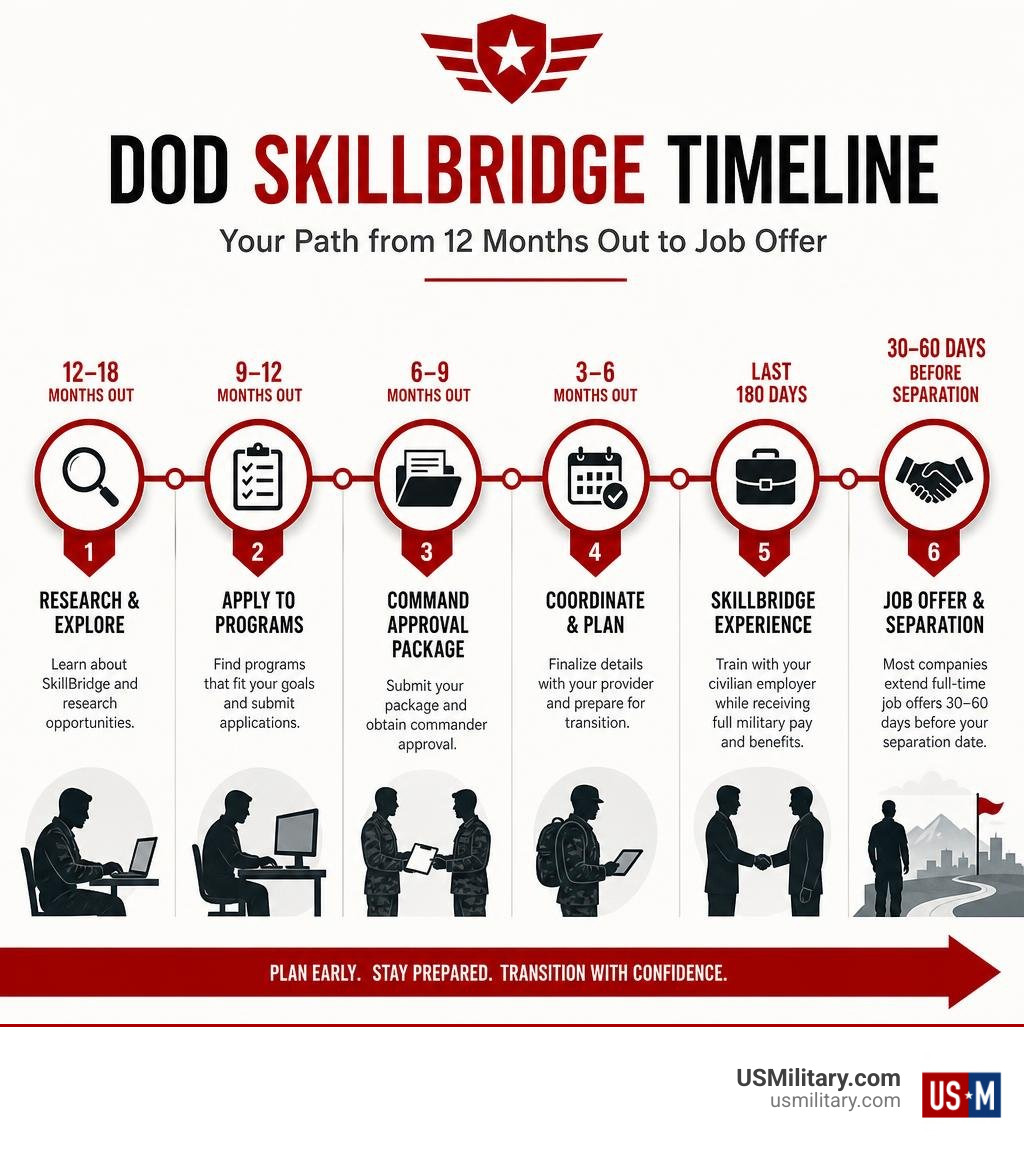
- How to apply: Research providers 12-18 months out, apply to programs 9-12 months out, then submit your command approval package 6-9 months before separation
- What you get: Full military pay, BAH, BAS, and Tricare — the employer pays you nothing, but DoD covers everything
- What happens after: Most companies make full-time job offers 30-60 days before your separation date
If you wait until your transition briefing to start, you are already behind. The real SkillBridge timeline is a 12-to-18-month process — not a 180-day one.
I’m Larry Fowler, publisher of USMilitary.com, and I’ve spent nearly two decades helping active duty members and veterans navigate complex programs like the DOD SkillBridge Program: How To Apply and What to Expect. In this guide, I’ll walk you through everything — from eligibility and branch-specific rules to choosing the right program and what to expect on day one.
DOD Skillbridge Program: How To Apply and What to Expect vocab to learn:
- High Paying Civilian Jobs That The Military Offers Best Training
- Requirements To Join The US Military
- military career paths
What is the DOD Skillbridge Program: How To Apply and What to Expect
The Department of Defense (DoD) SkillBridge program is an invaluable transition initiative designed to bridge the gap between military service and civilian careers. Authorized under 10 U.S.C. § 1143(e) and governed by DoD Instruction 1322.29, this program connects transitioning service members with industry partners to gain real-world job training, apprenticeships, and corporate internships.
The core power of the program lies in how it handles compensation. While you are participating in a SkillBridge placement, you remain on active duty status. This means you continue to receive your full military salary, Basic Allowance for Housing (BAH), Basic Allowance for Subsistence (BAS), and comprehensive healthcare coverage under Tricare. Because the DoD covers all your pay and benefits during this period, the participating civilian employers host you at absolutely no cost to them. This creates a win-win scenario: employers gain access to highly disciplined, trained military talent for free, and service members transition into high-quality civilian careers with a safety net.
Under the Official DoD SkillBridge Program guidelines, this opportunity is intended for the remaining 180 days of a member’s contract of service. It completely replaces your daily military duties, allowing you to focus entirely on learning the ropes of your new civilian career. Many service members find that leveraging this program is one of the most effective ways to maximize their transition. To see how this fits alongside other military perks, check out The Ultimate Guide To Military Benefits.
Eligibility Requirements for the DOD Skillbridge Program: How To Apply and What to Expect
While the program is highly rewarding, it is not an automatic entitlement. To qualify for the DOD SkillBridge Program: How To Apply and What to Expect, you must meet strict federal and military branch criteria:
- Active Duty Status: You must be an active duty service member (or a Guard/Reserve member serving on qualifying Title 10 active duty orders) with at least 180 continuous days of active service completed.
- Separation Timeline: You must be within your final 180 days of active service with an approved separation or retirement date.
- Command Approval: You must obtain written authorization from your unit commander. This is the single most critical gatekeeper step; commanders can deny requests based on operational requirements or manning shortfalls.
- Good Standing: You must be in good military standing with no pending adverse administrative or legal actions.
- Transition Assistance Program (TAP): You must have completed (or be actively completing) your branch’s mandatory TAP curriculum, including pre-separation counseling and ethics briefings.
- Discharge Rating: You must expect to receive a General (Under Honorable Conditions) or Honorable discharge.
Federal agencies and corporate partners also maintain their own selective criteria. For instance, the National Geospatial-Intelligence Agency (NGA) requires participants to hold a Top Secret clearance with a Counterintelligence (CI) polygraph. Corporate leaders like Bain offer highly competitive 10-week strategy consulting internships across major metropolitan offices, which are geared toward participants with over five years of military service and at least a bachelor’s, master’s, or MBA degree.
Step-by-Step Application Process and Timeline
Securing a coveted SkillBridge placement requires a disciplined approach. Because the top programs have low acceptance rates (often between 5% and 15%), we recommend a structured 12-to-18-month timeline to plan your transition. Treating this process like a military operation ensures you do not get caught in administrative delays.
First, you must build a competitive, civilian-friendly resume. Civilian hiring managers do not understand military acronyms, so translating your achievements into corporate language is vital. To start crafting your professional profile, read our guide on building a Military To Civilian Resume.

Navigating the DOD Skillbridge Program: How To Apply and What to Expect Month-by-Month
To maximize your success, we suggest following this backward-planned transition schedule:
- Month 12 to 18 — Reconnaissance: Start researching authorized providers on the Official DoD SkillBridge Portal and other resource databases. Identify 8 to 12 companies that align with your long-term career goals. Check your branch’s specific regulations and discuss your plans informally with your supervisor.
- Month 9 to 12 — Resume and Application Submission: Translate your military achievements into corporate terms. Submit applications directly to your target SkillBridge providers. Your goal in this phase is to secure a formal, tentative letter of acceptance (LOA) from an approved company. For a deep dive into structuring this phase, see The 12-Month SkillBridge Application Timeline (Month-by-Month Plan).
- Month 6 to 9 — Command Approval Package: Once you have a provider’s LOA and a clearly defined training plan, assemble your command approval package. Submit this package through your chain of command. Securing formal approval can take anywhere from 2 weeks to 90 days.
- Month 4 to 6 — Medical and Out-Processing: Complete your TAP requirements, schedule your VA Benefits Delivery at Discharge (BDD) claim (which must be filed between 180 and 90 days before separation), and begin local base out-processing.
- Month 1 to 3 — Execution: Step away from your military duties and begin your SkillBridge internship. Treat every day like an extended job interview.
For more detailed strategies on navigating this step-by-step process, you can read How to Use SkillBridge Internship Program: Complete Application Guide.
Branch-Specific Approval Processes and Regulations
Every branch implements the DoD guidelines through its own specific policies. Understanding these nuances is critical because the forms, authority levels, and duration caps vary widely.
| Military Branch | Governing Regulation | Approval Authority Level | Key Branch Policy Nuances |
|---|---|---|---|
| Army | AR 600-81 / MILPER 25-116 | Battalion Commander (or first O-5/O-6 in chain) | Part of the Career Skills Program (CSP). Highly structured; often requires packets to be submitted 30 to 120 days before start. |
| Navy | NAVADMIN 064/23 | Unit Commander | Managed via the Navy Career Transition Office (CTO). Applications must typically be routed 30 days prior to the proposed start date. |
| Marine Corps | MARADMIN 280/24 | First O-5 Commander in Chain | Coordinated through the Transition Readiness Program. Demands strict adherence to unit manning levels. |
| Air Force & Space Force | AFI 36-2671 / SPFI 36-2672 | Unit Commander / Tiered Approval | New 2026 policies introduce tiered approval windows based on rank and operational specialty. |
| Coast Guard | COMDTINST 1040.7A | Commanding Officer | Managed through local Education Services Officers (ESOs) and TAP coordinators. |
If you are still weighing which branch offers the best long-term transition programs or benefits, check out our comparison guide on Which Branch Should I Join.
What to Expect During Your SkillBridge Internship
When you walk through the door of your host company, you are no longer a service member in uniform—you are a professional civilian trainee. You should expect a highly structured, hands-on learning environment where you will work on real projects, attend team meetings, and learn the company’s culture.

Because the company is evaluating your cultural fit, communication skills, and work ethic, you must treat the internship as a continuous, 90-to-180-day job interview. This period is your opportunity to build a robust professional network. Attend company events, join veteran employee resource groups, and seek out mentorship from civilian colleagues.
Most participating companies use this program as a direct talent pipeline. If your performance aligns with their business needs and headcount, they will typically extend a formal, full-time job offer 30 to 60 days before your official military separation date. This allows you to transition seamlessly into a civilian role without a single day of unemployment. To find organizations with a proven track record of supporting transitioning military talent, explore our directory of Companies That Hire Vets.
Choosing a Quality Program and Avoiding Common Mistakes
With thousands of companies registered on the official website, selecting the right partner is crucial. You must evaluate opportunities based on structure, safety, and long-term viability rather than brand prestige alone.
When reviewing programs, watch out for these major red flags:
- No Structured Training Plan: A quality program must provide a week-by-week syllabus detailing what you will learn. If a company cannot show you a training plan, they may just want free labor.
- Low Conversion Rates: Always ask potential hosts: “What percentage of your SkillBridge interns receive full-time job offers?” Industry leaders like Northrop Grumman maintain a 95% conversion rate. If a company’s conversion rate is low, look elsewhere.
- Vague Roles: Avoid programs where you are relegated to administrative “busy work” or coffee runs. You need hands-on experience that translates directly to high-paying roles.
To ensure a smooth transition, avoid these common applicant mistakes:
- Starting the Process Too Late: Waiting until your final 6 months of service to research programs is the number-one reason applications fail or get denied by commands.
- Applying to Only One Program: Given the competitive nature of top-tier corporate internships, you should apply to 3 to 5 programs in parallel to secure a solid backup option.
- Failing to Track Leave and Out-Processing: SkillBridge and terminal leave are mutually exclusive. You must map out your out-processing, house hunting, terminal leave, and internship dates on a single master calendar.
For a detailed analysis of these common pitfalls and how to avoid them, read the SkillBridge Application Timeline: Full Start-to-Finish Guide.
Frequently Asked Questions about the DoD SkillBridge Program
Do you get paid during SkillBridge?
Yes, you continue to receive your full active duty military compensation. This includes your base pay, Basic Allowance for Housing (BAH) based on your command’s zip code (or your internship location if approved by finance), Basic Allowance for Subsistence (BAS), and complete medical coverage under Tricare.
Under DoD Instruction 1322.29, the SkillBridge provider is strictly prohibited from paying you any wages, stipends, or financial bonuses during your internship. Receiving outside corporate compensation while on active duty status is a violation of federal law.
What happens if my command denies my SkillBridge request?
Because SkillBridge is a voluntary program and not an entitlement, your unit commander has the final authority to deny your request. Common reasons for denial include critical manning shortages within your Military Occupational Specialty (MOS) or rating, upcoming unit deployments, or late submission of paperwork.
If your request is denied, you have several constructive options:
- Request a Meeting: Respectfully ask your chain of command for the specific reasons behind the denial.
- Negotiate a Compromise: Offer to shorten your internship from 180 days to 90 or 120 days, or adjust your start date to accommodate unit training cycles.
- Explore Alternate Programs: Look into other transition pathways, such as the Army Career Skills Program (CSP) or local base transition initiatives.
- Focus on Direct Employment: Re-route your energy into building a strong civilian resume and applying directly for post-separation civilian roles.
For more information on navigating command denials and understanding your rights, visit About The DOW SkillBridge Program – Military OneSource.
Can Guard and Reserve members participate in SkillBridge?
Yes, but eligibility depends entirely on your current duty orders. Traditional drilling National Guard and Reserve members are generally not eligible for the DoD SkillBridge program.
However, Guard and Reserve members serving on active duty orders under Title 10 of the United States Code for a continuous period of 180 days or more are fully eligible. They must obtain approval from their specific active-duty command and meet all standard program criteria. For further guidance on federal eligibility, consult the DoD SkillBridge Program – U.S. Department of the Interior.
Conclusion
Transitioning out of military service and into the civilian workforce is one of the most significant milestones of your life. The DOD SkillBridge Program: How To Apply and What to Expect offers an unmatched opportunity to gain professional civilian experience, build a corporate network, and secure a high-paying civilian career, all while maintaining the financial security of active duty pay and benefits.
Success in this program is not a matter of luck—it is a matter of early, disciplined planning. By starting your research 12 to 18 months before separation, translating your resume into civilian terms, and coordinating closely with your chain of command, you can set yourself up for a seamless transition.
At USMilitary.com, we are committed to supporting you at every stage of your military and veteran journey. Whether you are exploring new career paths, researching VA benefits, or planning your retirement, we are here to guide you. For more resources on maximizing your transition, check out our comprehensive guide on military career paths.
Ready to take the next step in your career transition?
- Explore our unbiased guide on Which Military Branch Should I Join to compare career paths and retirement benefits.
- Visit USMilitary.com for the latest news, VA home loan benefits, and transition resources.
- Looking for daily inspiration during your transition? Check out the powerful military and faith-based insights in Dare to Live Greatly.
Free for Service Members & Veterans
Get the military benefits intel no one tells you about.
Weekly updates on VA benefits, pay changes, and money tips — free for service members and veterans.
No spam. Unsubscribe anytime. Your info is never shared.


