What To Expect With VA Disability Rates 2027: Estimated COLA and Timeline

When planning household budgets, service-connected disabled veterans need to know what lies ahead for their monthly benefit checks. Understanding What To Expect With VA Disability Rates 2027 starts with analyzing current economic conditions, federal inflation indices, and official government administrative schedules.
Each year, VA disability compensation rates are adjusted to prevent inflation from eroding the purchasing power of military veterans and surviving family members. Based on current economic trends, the projected rates for 2027 reflect rising consumer costs across the nation.
2027 COLA Estimates vs Previous Years
Early estimates for the 2027 Cost-of-Living Adjustment (COLA) range from 3.8% to 4.7%. Projections from organizations like The Senior Citizens League suggest a solid baseline estimate of around 3.8% to 3.9%, while analysts tracking mid-2026 Consumer Price Index data project potential increases reaching up to 4.7% if price pressure continues.
This expected increase is noticeably higher than the 2.8% COLA applied to VA benefits in 2026. To put this in perspective, review how recent COLA percentage bumps compare:
- 2024 COLA: 3.2%
- 2025 COLA: 2.5%
- 2026 COLA: 2.8%
- 2027 Projected COLA: 3.8% to 4.7%
The jump in 2027 estimates stems directly from accelerating inflation figures observed throughout mid-2026. For a complete look at how previous rate changes took shape, read our guide on 2026 VA Disability Rates Everything You Need to Know.
Key Announcement and Effective Dates for What To Expect With VA Disability Rates 2027
The process for updating VA disability compensation follows a strict timeline established by federal law and Social Security Administration (SSA) protocols.
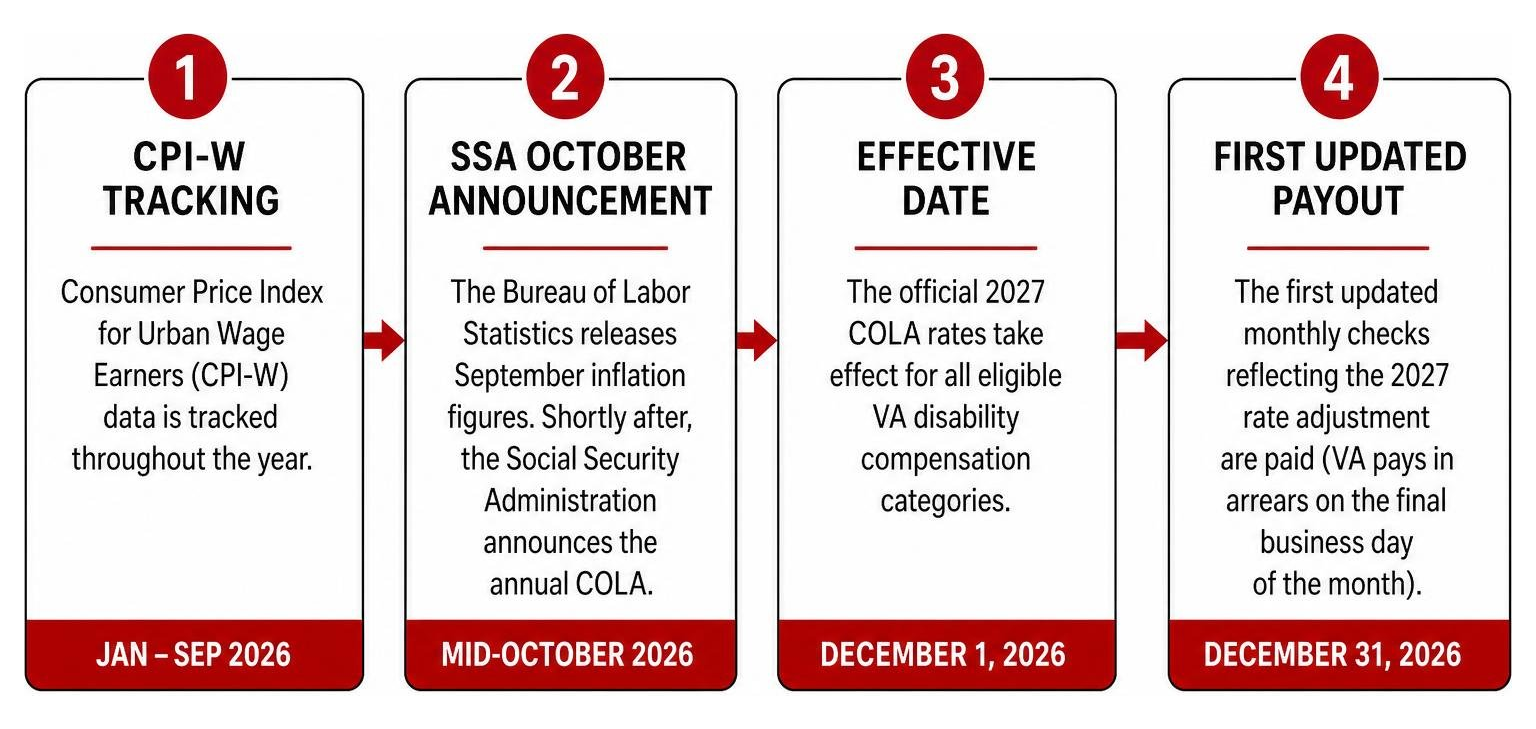
Here are the key milestone dates to keep on your calendar:
- Mid-October 2026: The Bureau of Labor Statistics releases the September inflation figures. Shortly after, the Social Security Administration officially announces the annual COLA percentage.
- December 1, 2026: The official 2027 COLA rates take effect for all eligible VA disability compensation categories.
- December 31, 2026: The first updated monthly checks reflecting the 2027 rate adjustment arrive in veteran bank accounts (because the VA pays disability compensation in arrears on the final business day of the month).
How the 2027 VA Disability COLA Is Calculated
Understanding how federal agencies arrive at these rate adjustments requires looking behind the scenes at statutory guidelines and economic formulas.
Understanding the CPI-W and Federal Formulas
Under federal law, VA disability compensation rate adjustments match the exact percentage increase granted to Social Security beneficiaries. The Social Security Administration calculates this figure using a specific economic metric: the Consumer Price Index for Urban Wage Earners and Clerical Workers (CPI-W), published monthly by the Bureau of Labor Statistics (BLS).
To compute the annual COLA:
- The BLS tracks price changes across consumer categories like housing, energy, food, transportation, and medical care.
- The SSA measures the average CPI-W during the third quarter (July, August, and September) of the current year.
- This Q3 average is compared against the average CPI-W from Q3 of the previous year.
- The percentage increase between these two averages becomes the exact COLA rate applied to military disability compensation starting December 1.
By May 2026, the year-over-year CPI-W had risen 4.4%, driving the upper boundary of preliminary 2027 projections up toward 4.7%.
Historical Inflation vs Purchasing Power
While annual COLA adjustments are designed to keep pace with living costs, historical data reveals that benefit updates do not always match actual real-time inflation. Because COLA calculations rely on backward-looking data from the third quarter, veterans often experience an economic lag where real-world prices rise months before monthly compensation reflects those price shifts.
An examination of historical trends between 2017 and 2026 shows that VA COLA adjustments either matched or fell short of actual annual inflation in 7 out of 10 years. For instance, in 2024, a 3.2% COLA was outpaced by 4.1% actual price inflation, resulting in a temporary loss of buying power. Detailed baseline comparisons and historical charts can be explored through our resource on VA Disability Rate Charts 2025.
Tracking these historical gaps illustrates why watching preliminary COLA ranges is essential for veteran household budgeting.
Projected 2027 VA Disability Payment Rates by Rating
To help you anticipate your monthly income for 2027, we have calculated projected rate charts based on standard single veteran base rates. These projections highlight how 2026 actual rates convert under a estimated 3.8% baseline COLA and a projected 4.7% maximum COLA scenario.
| Disability Rating | 2026 Actual Monthly Pay (Single) | Projected 2027 Monthly Pay (3.8% COLA) | Projected 2027 Monthly Pay (4.7% COLA) | Estimated Monthly Increase Range |
|---|---|---|---|---|
| 10% | $180.42 | $187.28 | $188.90 | +$6.86 to +$8.48 |
| 20% | $356.66 | $370.21 | $373.42 | +$13.55 to +$16.76 |
| 30% | $552.70 | $573.70 | $578.68 | +$21.00 to +$25.98 |
| 40% | $796.08 | $826.33 | $833.49 | +$30.25 to +$37.41 |
| 50% | $1,133.18 | $1,176.24 | $1,186.44 | +$43.06 to +$53.26 |
| 60% | $1,435.03 | $1,489.56 | $1,502.48 | +$54.53 to +$67.45 |
| 70% | $1,808.45 | $1,877.17 | $1,893.45 | +$68.72 to +$85.00 |
| 80% | $2,102.15 | $2,182.03 | $2,200.95 | +$79.88 to +$98.80 |
| 90% | $2,297.96 | $2,385.28 | $2,405.96 | +$87.32 to +$108.00 |
| 100% | $3,938.58 | $4,088.25 | $4,123.69 | +$149.67 to +$185.11 |
(Note: Official rates will be confirmed by the Department of Veterans Affairs in late 2026. For existing rate baselines, check our breakdown on VA Disability Pay Chart 2026.)
The Financial Impact of Dependents on What To Expect With VA Disability Rates 2027
Your final disability check may be higher than the single veteran base rates shown above. Veterans rated at 30% or higher are eligible for additional monthly compensation for qualifying family dependents, including:
- A legal spouse
- Dependent children under age 18
- Children between ages 18 and 23 enrolled in approved full-time qualifying education programs
- Dependent parents relying on the veteran for financial support
Veterans rated at 10% or 20% receive a flat base rate established by federal law, regardless of marital status or dependents.
To evaluate official rates and dependent tables across rating brackets, refer directly to Current Veterans Disability Compensation Rates – VA.gov.
The 90% to 100% Disability Rating Financial Cliff
When reviewing the projected payment rates, you will notice a substantial financial jump between the 90% rating and the 100% rating. This gap is known across the military community as the 90% to 100% rating cliff.
In 2027, a single veteran rated at 90% is projected to receive approximately $2,385.28 per month (under a 3.8% COLA). Achieving a 100% rating raises that projected check to $4,088.25—a direct monthly increase of $1,702.97 (over $20,400 annually).
This steep step reflects the VA’s recognition of total occupational impairment. Reaching 100% scheduler or total disability status also unlocks valuable ancillary benefits, such as full dental care through VA health systems, CHAMPVA medical coverage for dependents, property tax exemptions in many states, and educational assistance under Chapter 35 DEA benefits. If you are preparing to file for an increase, review our insights on VA Disability Ratings for 2026.
Impact of the 2027 COLA Increase on Special Benefits and Back Pay

The upcoming 2027 COLA adjustment does not just apply to basic service-connected disability pay. It also raises payouts across all associated VA cash benefit programs.
Automatic Adjustments and Retroactive Back Pay Rules
The 2027 COLA percentage applies automatically across secondary VA payment streams, including:
- Total Disability based on Individual Unemployability (TDIU): Veterans who cannot maintain substantially gainful employment due to service-connected conditions are paid at the full 100% rate ($4,088.25+ projected in 2027).
- Special Monthly Compensation (SMC): Additional non-service-connected or severe disability tiers (such as loss of use of limbs, blindness, or Aid and Attendance needs) receive the full COLA percentage bump. For example, standard SMC-K special add-ons are projected to rise from $139.87 to roughly $145.18 monthly.
- Dependency and Indemnity Compensation (DIC): Tax-free monetary benefits paid to eligible surviving spouses and dependents of fallen service members or severely disabled veterans will automatically increase by the final COLA percentage.
- VA Pension Payments: Non-service-connected low-income pension limits and Aid & Attendance thresholds increase in direct proportion to the COLA adjustment.
When it comes to retroactive pay and back pay, the VA uses a segmented calculation method. Back pay covering effective dates across multiple calendar years is calculated using each specific year’s historical rate rather than the current calendar year rate.
For instance, if you are awarded back pay spanning 2024 through 2027, the months in 2024 are paid at 2024 compensation rates, 2025 months at 2025 rates, 2026 months at 2026 rates, and 2027 months at the updated 2027 rate. To learn more about how back-pay calculations work, read Understanding VA Disability Rates and COLA in 2026.
What To Do If COLA Increases Are Not Enough
While an estimated 3.8% to 4.7% increase provides welcome relief, routine COLA bumps might not keep up if your medical condition has worsened or if household expenses continue to mount.
If annual COLA adjustments fall short of your financial requirements, consider taking these strategic claim steps:
- File for a Disability Rating Increase: If a service-connected disability has grown more severe, submit a supplemental claim with recent clinical records, diagnostic imaging, or treatment notes documenting the change.
- Claim Secondary Service Connections: Many service-connected conditions cause secondary health issues over time (for example, physical joint conditions leading to secondary severe depression or medication side effects causing gastrointestinal problems). Claiming secondary conditions can raise your combined disability rating percentage.
- Apply for TDIU Benefits: If your service-connected conditions prevent you from keeping gainful employment, you can request 100% level compensation through TDIU even if your combined rating is below 100% (such as a single 60% rating or a combined 70% rating with one condition rated at 40%+).
- Gather Nexus Letters and DBQs: Ensure medical opinions clearly link new conditions to active duty service or primary service-connected disabilities using formal Nexus Letters and Disability Benefits Questionnaires (DBQs) completed by licensed medical providers.
Frequently Asked Questions About 2027 VA Disability Rates
Do veterans need to apply to get the 2027 COLA increase?
No. You do not need to file any paperwork, submit an application, or contact the Department of Veterans Affairs to receive the 2027 COLA increase. The percentage adjustment is automatically applied by federal law to all eligible recipients starting with the December 1, 2026 effective date.
Are 2027 VA disability compensation payments taxable?
No. All VA disability compensation payments, including base monthly compensation, dependent add-ons, Special Monthly Compensation (SMC), and TDIU payments, are 100% tax-free at both the federal and state levels. These benefit payments do not need to be reported as taxable earned income on IRS income tax returns.
How does the 2027 COLA affect TDIU and SMC compensation?
Veterans receiving TDIU are compensated at the full 100% disability evaluation rate, meaning their base check will rise to the projected $4,088.25–$4,123.69 range per month in 2027. Special Monthly Compensation (SMC) rates across all statutory tiers (SMC-K through SMC-R) receive the exact same COLA percentage adjustment as basic disability compensation.
Conclusion

Knowing What To Expect With VA Disability Rates 2027 gives military families a clear head start on financial planning for the coming year. With preliminary estimates pointing to a COLA boost between 3.8% and 4.7%, veterans can expect a meaningful increase in monthly tax-free compensation starting at the end of December 2026.
Keep a close watch on the official Social Security Administration announcement in mid-October 2026 to confirm the final COLA percentage. In the meantime, evaluate your current medical evidence, check your combined rating percentage, and ensure all qualifying dependents are registered on your VA award profile.
For updated guides on military transition strategies, pay charts, and benefit tools, explore our resource hub at USMilitary.com. You can also check out active duty and drill pay comparisons on our USMilitary.com Military Pay Chart 2026 or find personal inspiration for overcoming life’s hurdles in Dare to Live Greatly. We stand ready to supply accurate information to secure the benefits you earned through service!
Free for Service Members & Veterans
Get the military benefits intel no one tells you about.
Weekly updates on VA benefits, pay changes, and money tips — free for service members and veterans.
No spam. Unsubscribe anytime. Your info is never shared.


