Why 2027 May Be a Strong Year to Enlist

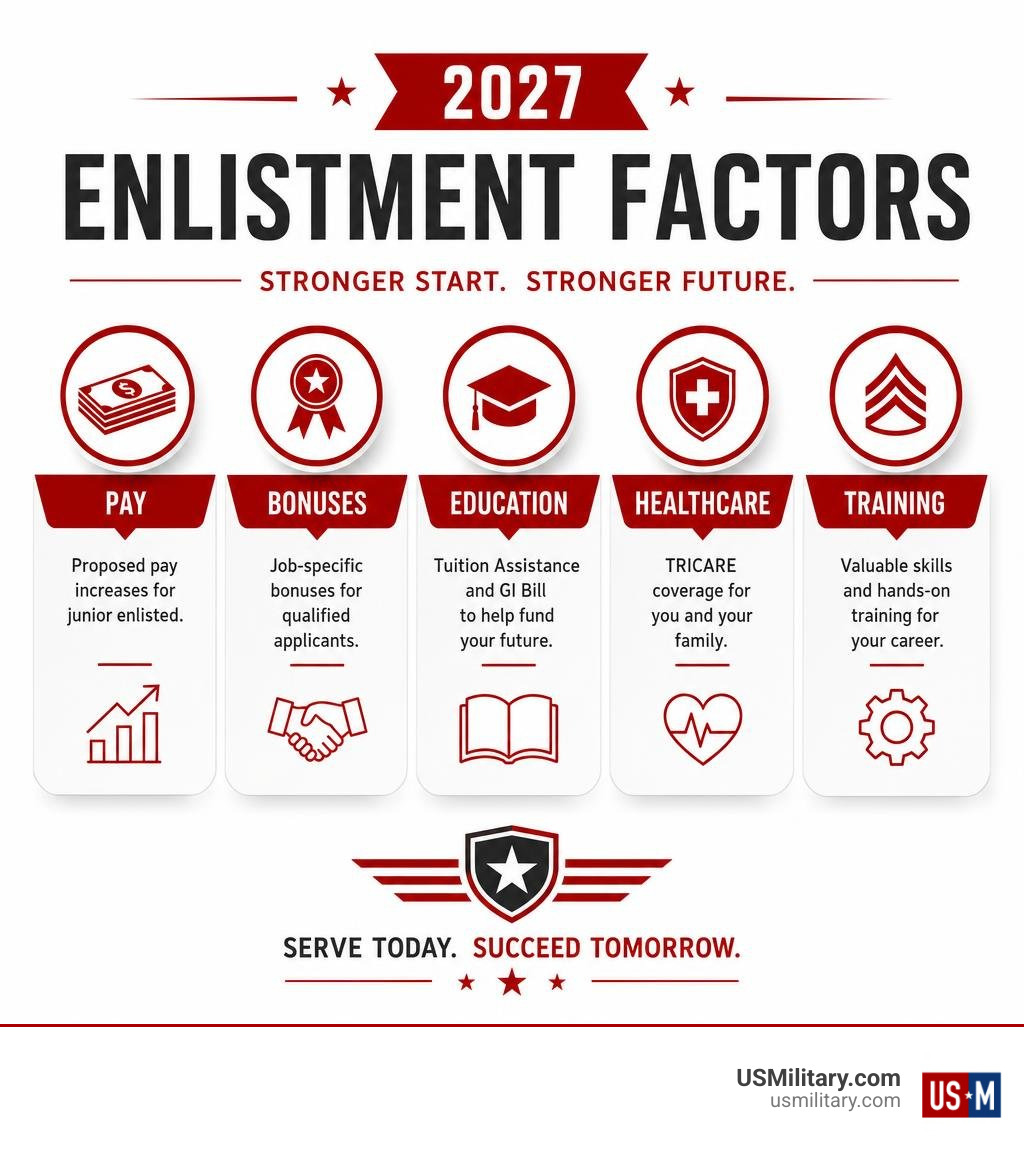
2027 may be an especially good time to enlist because proposed junior-enlisted pay increases, major job-specific bonuses, education funding, and steady health coverage could improve the value of a first military contract. The biggest potential gain is a proposed 7% basic-pay raise for E-5 and below; however, it is not final until Congress completes the FY2027 defense authorization process.
Here are the key reasons behind 10 Facts Why 2027 May Be The Best Time To Enlist in the Military:
- Junior enlisted members could receive the largest proposed pay raise.
- Qualified Navy applicants shipping before October 2027 may be eligible for bonuses totaling up to $140,000.
- Cyber, AI, drone, nuclear, aviation, and special operations jobs can offer valuable training and incentives.
- Tuition Assistance and the Post-9/11 GI Bill can reduce or avoid college debt.
- A military contract provides regular pay, TRICARE coverage, paid leave, and possible housing and food allowances.
The opportunity comes with an important reality check: bonus amounts, job openings, eligibility rules, and the proposed pay raise can change. Compare offers across branches, get every promised incentive in writing in your enlistment contract, and choose a career field that fits both your qualifications and long-term goals.
I am LARRY FOWLER, publisher of the USMilitary.com Network, which has helped connect prospective service members with military career information since 2007. In researching 10 Facts Why 2027 May Be The Best Time To Enlist in the Military, I focus on making pay, benefits, recruiting trends, and service decisions easier to understand before you speak with a recruiter.
Historic Compensation: 10 Facts Why 2027 May Be The Best Time To Enlist in the Military
Military compensation is undergoing its most aggressive restructuring in decades. Between the FY2027 National Defense Authorization Act (NDAA) proposals and aggressive branch-specific enlistment packages, the Department of Defense is reshaping entry-level pay to remain competitive with the civilian private sector.
For decades, military annual pay raises followed a flat percentage across all ranks, pegged strictly to the Employment Cost Index (ECI). However, the FY2027 budget proposal challenges this model by prioritizing the junior enlisted ranks—those who need it most when starting out.
| Pay Grade | Rank Examples (Army / Navy / USAF) | Estimated 2026 Monthly Base Pay | Proposed 2027 Raise (%) | Projected 2027 Monthly Base Pay |
|---|---|---|---|---|
| E-1 | Private / Seaman Recruit / Airman Basic | $2,110 | 7.0% | $2,257.70 |
| E-2 | Private PV2 / Seaman Apprentice / Airman | $2,365 | 7.0% | $2,530.55 |
| E-3 | Private First Class / Seaman / Airman 1st Class | $2,487 | 7.0% | $2,661.09 |
| E-4 | Specialist / Corporal / Petty Officer 3rd Class / Senior Airman | $2,891 | 7.0% | $3,093.37 |
| E-5 | Sergeant / Petty Officer 2nd Class / Staff Sergeant | $3,212 | 7.0% | $3,436.84 |
| E-6 | Staff Sergeant / Petty Officer 1st Class / Tech Sergeant | $3,650 | 6.0% | $3,869.00 |
| O-1 | Second Lieutenant / Ensign | $3,825 | 6.0% | $4,054.50 |
| O-4 | Major / Lieutenant Commander | $6,740 | 5.0% | $7,077.00 |
Note: Base pay figures are estimates based on standard time-in-service benchmarks and represent taxable base pay before tax-free allowances like Basic Allowance for Housing (BAH) and Basic Allowance for Subsistence (BAS).
Fact 1: Tiered 5% to 7% Pay Raise Boosts Junior Enlisted Earnings
The headline feature of the 2027 budget is the White House and House-backed tiered pay model. Rather than applying a blanket adjustment across the board, the plan delivers a 7% base pay increase for pay grades E-1 through E-5, a 6% raise for mid-grade personnel (E-6 through O-3), and 5% for senior officers (O-4 and above).
This progressive structure is engineered specifically to help young service members combat inflation, cover personal expenses, and build early wealth. When compared to the historical baseline provided in The Ultimate Guide to 2026 Military Pay Chart, this proposed 7% increase provides real discretionary income for entry-level troops. Because housing, meals, and medical care are already covered by the government, almost the entirety of this raise goes directly into a recruit’s savings, investments, or checking account.
Fact 2: Record Enlistment Bonuses Reach Up to $140K
Recruitment budgets have unlocked record-setting financial incentives across several service branches for individuals shipping to basic training before October 2027.
The U.S. Navy leads the pack with combined maximum incentives reaching up to $140,000 for high-demand technical ratings. Recruits entering critical specialties—such as the Nuclear Field (Submarine and Surface electronics, machinists, and reactor operators) or Special Warfare Boat Operators (SWCC)—can lock in massive signing packages. To understand how these opportunities stack up against other services, you can review Which Military Branch Offers the Highest Cash Recruitment Bonuses in 2026 to evaluate the shifting bonus environment across the Army, Navy, and Air Force.
Similarly, technical career fields across the board are receiving heavy cash backing. For those interested in aviation and technical trades, we have outlined how the Air Force targets its critical career fields in Unlock Your Potential Air Force Enlistment Bonuses Explained. Special operations candidates in the Navy, Army, and Air Force who achieve superior scores on their Physical Screening Test (PST) can earn additional bonuses ranging from $10,000 to $35,000 on top of their standard contract guarantees.
Fact 3: Compounded Retirement Pension Growth and TSP Matching
A major raise on day one echoes throughout your entire financial life. Under the Department of Defense’s Blended Retirement System (BRS), the military matches your contributions to the Thrift Savings Plan (TSP) up to 5% of your base pay. When your base pay rises by 7%, the government’s 5% matching dollar amount rises proportionally.
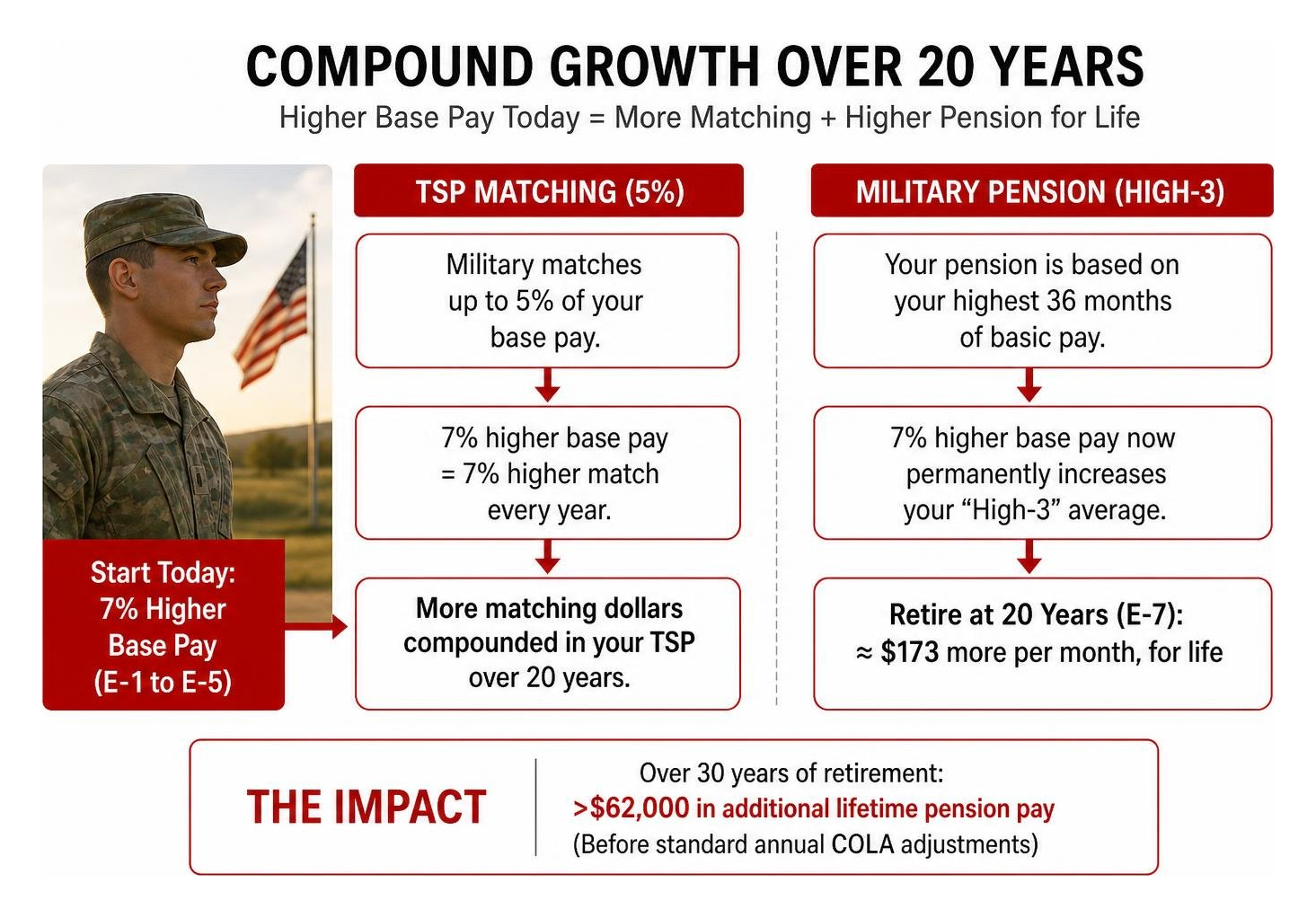
Furthermore, military retirement pensions calculated using the “High-3” average (the average of your highest 36 months of basic pay) will see a permanent compounding boost. According to retirement data on the 2027 Military Pay Chart and Raise by Rank: 3.6% Automatic, 7-6-5 Proposed, an enlisted member who serves a 20-year career retiring at rank E-7 would receive approximately $173 more per month for life compared to the baseline automatic ECI raise. Over a 30-year retirement, that single tiered raise represents over $62,000 in additional lifetime pension pay, before accounting for standard annual retiree Cost-of-Living Adjustments (COLA).
Leverage, Eligibility, and Expanding Career Pathways
The dynamic between the Department of Defense and incoming recruits has shifted dramatically. Entering service in 2027 puts applicants in an unprecedented position of negotiation leverage due to nationwide eligibility trends and evolving military operational demands.

✉ Get updates like this in your inbox
Weekly VA benefit changes, pay updates, and money tips for service members, veterans, and military families. Free, no spam.
Fact 4: 10 Facts Why 2027 May Be The Best Time To Enlist in the Military: Youth Eligibility Crisis Gives Recruits Massive Leverage
The primary reason branches are offering historic bonuses and modern quality-of-life perks is straightforward: qualified recruits are scarce. Department of Defense data reveals that approximately 71% of American youth ages 17 to 24 are ineligible for military service without waivers due to medical conditions, physical fitness, prescription drug histories, or academic aptitude barriers.
This qualified-applicant shortage creates huge leverage for prospective enlistees. Recruits who meet basic physical and mental standards can negotiate guaranteed job assignments (MOS/Rating/AFSC), station-of-choice options, and accelerated promotion tracks right in their initial contracts. As explored in How has military enlistment changed?, the military has adapted its recruitment models to meet ambitious personnel requirements. For candidates entering the armed forces at varying life stages, our guide From 17 to 42 The Ultimate Guide to Enlisting in the US Military explains how expanded age limits and enlistment windows provide unique career avenues.
Fact 5: Future Soldier Preparatory Course Opens Doors for 90%+ of Candidates
Rather than turning away motivated recruits who narrowly miss fitness or academic thresholds, the armed services have developed dedicated preparatory pipelines. The Army’s Future Soldier Preparatory Course (FSPC), established at Fort Jackson, serves as the premier model.
The program provides structured academic prep to boost Armed Forces Qualification Test (AFQT) scores and supervised physical conditioning to help recruits meet body composition standards before attending basic training. Over 90% of candidates who enter the preparatory course successfully graduate and transition directly into regular initial entry training. This initiative allows recruits to unlock higher-tier jobs and larger bonuses that were previously out of reach, ensuring that all candidates can meet official Requirements to join the U.S. military.
Fact 6: Cutting-Edge High-Tech Training in AI, Cyber, and Drone Operations
The military is shifting away from traditional industrial-era combat support roles toward digital-first warfare. Enlistees in 2027 have access to world-class technical training schools in disciplines that command six-figure salaries in the civilian economy:
- Cyber Warfare & Information Operations: Defensive and offensive network security, zero-trust infrastructure, and electronic warfare.
- Artificial Intelligence & Machine Learning Integration: Managing autonomous drone swarms, predictive logistics modeling, and algorithmic intelligence analysis.
- Unmanned Aerial Systems (UAS): Piloting, operating, and maintaining military reconnaissance and tactical strike drones.
- Space Systems Operations: Satellite command, telemetry tracking, and orbital defense via the U.S. Space Force.
These programs provide recruits with federally accredited training, hands-on enterprise-level experience, and Top Secret/Sensitive Compartmented Information (TS/SCI) security clearances—bypassing years of entry-level civilian apprenticeship or unpaid tech internships.
Unrivaled Long-Term Financial and Quality-of-Life Advantages
Enlisting in the military is fundamentally a lifestyle and wealth-building strategy. Beyond base salary, the military safety net eliminates the core living expenses that burden young civilian workers.

Fact 7: 10 Facts Why 2027 May Be The Best Time To Enlist in the Military: Zero Student Debt with Expanded Education Benefits
With national student loan debt continuing to strain young adults, military educational programs provide a debt-free route to undergraduate and advanced degrees.
Active-duty service members can utilize Federal Tuition Assistance (TA) to pay up to $4,500 annually for college courses while serving, leaving their Post-9/11 GI Bill entirely intact for later use. The Post-9/11 GI Bill covers 100% of in-state tuition at public universities, provides a monthly housing allowance (MHA) equal to an E-5 with dependents in that zip code, and supplies an annual stipend for books and supplies. Furthermore, individuals with existing student debt can negotiate up to $65,000 in Student Loan Repayment Program (LRP) benefits into their active-duty enlistment contracts. For a full breakdown of these educational programs, see The Ultimate Guide to Military Benefits.
Fact 8: Modernized Housing, Mental Health, and Work-Life Initiatives
The Department of Defense has committed multi-billion-dollar capital investments toward overhauling enlisted living standards. Initiatives taking effect for 2027 include:
- Barracks Modernization: Replacing aged communal living spaces with modern, apartment-style single-occupancy suites featuring private bathrooms and updated appliances.
- Cognitive Readiness & Embedded Mental Health: Expanding direct access to dedicated mental health providers within operational units, removing administrative hurdles for proactive mental wellness care.
- Optimized Operational Tempos: Standardizing predictable deployment schedules and reducing non-essential field rotations to support sustainable work-life balance and family time.
Fact 9: Absolute Job Stability and TRICARE Healthcare Shield Against Economic Downturns
In an unpredictable civilian labor market shaped by corporate layoffs and automated restructuring, military enlistment provides a guaranteed employment contract. Service members are insulated from market contractions, receiving on-time paychecks on the 1st and 15th of every month.
Additionally, military service members and their families receive TRICARE Prime, which provides comprehensive medical, surgical, dental, and mental healthcare with zero monthly premiums, zero deductibles, and zero out-of-pocket costs for active-duty members. When combined with tax-free allowances like the Basic Allowance for Housing (BAH) and Basic Allowance for Subsistence (BAS), an enlisted member’s total compensation package significantly exceeds its nominal taxable salary.
Fact 10: FY2027 NDAA Reforms Streamline Healthcare and Reserve Retirement
The legislative framework in the FY2027 NDAA includes targeted quality-of-service reforms designed to smooth administrative processes across all branches:
- Expedited Healthcare Transitions: New policies require the VA and DoD to process health care eligibility enrollment within two business days of active-duty separation, eliminating coverage gaps for transitioning veterans.
- Reserve Retirement Modernization: Qualifying non-regular Reserve and National Guard service now counts toward time-in-grade requirements for retirement rank, accelerating promotion tracks for part-time service members.
- Air Force Academy & Cadet Wing Expansion: Structural reforms to military service academies improve academic resource allocations and expand commissioning pipelines.
Frequently Asked Questions About Enlisting in 2027
How much is the proposed 2027 military pay raise for junior enlisted?
The proposed pay raise for junior enlisted members (grades E-1 through E-5) is 7.0%. Mid-grade personnel (E-6 through O-3) are slated for a 6.0% raise, while senior officers (O-4 and above) are budgeted for a 5.0% increase under the House-passed FY2027 defense authorization framework.
What branch offers the highest enlistment bonuses in 2027?
The U.S. Navy offers the highest individual signing bonus packages, reaching up to $140,000 for high-priority technical fields (such as the Nuclear Program) and special operations rates when combined with early-shipping incentives before October 2027. The Army and Air Force also offer significant packages ranging from $20,000 to $50,000 for critical skills.
What happens if Congress does not pass the tiered 5-7% pay raise?
If Congress does not pass the proposed tiered pay structure, military pay does not freeze. By law, annual military basic pay automatically increases based on the Employment Cost Index (ECI). The statutory default raise for 2027 would provide a baseline increase of 3.6% across all ranks.
Conclusion
Choosing to enlist in the United States Armed Forces is a transformative career and personal decision. In 2027, the alignment of a proposed 7% junior-enlisted pay raise, six-figure recruitment bonuses, debt-free higher education benefits, and advanced technical job training creates one of the most advantageous enlistment environments in modern history.
Whether your goal is to master cutting-edge cybersecurity tools, build lasting financial independence through the Blended Retirement System, or serve a purpose greater than yourself, preparing early gives you the upper hand. Review the standards, verify your records, and explore military recruiting opportunities and career paths to secure the best contract and start your journey on your own terms.
Free for Service Members & Veterans
Get the military benefits intel no one tells you about.
Weekly updates on VA benefits, pay changes, and money tips — free for service members and veterans.
No spam. Unsubscribe anytime. Your info is never shared.