Understanding Army Ranger Compensation: Beyond the Base Salary
Army Rangers salary encompasses much more than a simple paycheck. Here’s what you need to know about total compensation for these elite soldiers:
Quick Answer: Army Ranger Total Compensation
- Base Pay Range: $24,206 – $51,030 annually (varies by rank and experience)
- Tax-Free Allowances: $250+ per month for food (BAS), plus location-based housing allowance (BAH)
- Special Pay: Additional compensation for hazardous duty, parachute operations, and special assignments
- Total Estimated Compensation: $43,000 – $73,000+ per year for enlisted Rangers
- 2025 Pay Increase: 4.5% raise across all military pay tables
The 75th Ranger Regiment represents the Army’s premier special operations force. These highly trained soldiers are often the first boots on the ground in hostile environments, leading small units in the most challenging missions. But what does this elite status mean for your wallet?
Understanding military compensation can feel overwhelming. Unlike civilian jobs where you see one salary number, Army Rangers receive a complex package of base pay, allowances, bonuses, and benefits that together create your total compensation. The pay structure depends on your rank, years of service, duty location, family status, and specialized skills.
Many potential recruits focus solely on base pay and miss the bigger picture. When you factor in tax-free allowances, special duty pay, free healthcare, and educational benefits, the financial value of serving as a Ranger often exceeds comparable civilian positions—especially when you’re just starting your career.
I’m Larry Fowler, publisher of the USMilitary.com Network, and since 2007 I’ve helped hundreds of thousands of service members and veterans understand their benefits and compensation, including the unique army rangers salary structure and special pays available to elite units. This guide will break down every component of Ranger compensation so you can make an informed decision about this demanding but rewarding career path.
Deconstructing the Army Rangers Salary: Pay, Allowances, and Bonuses
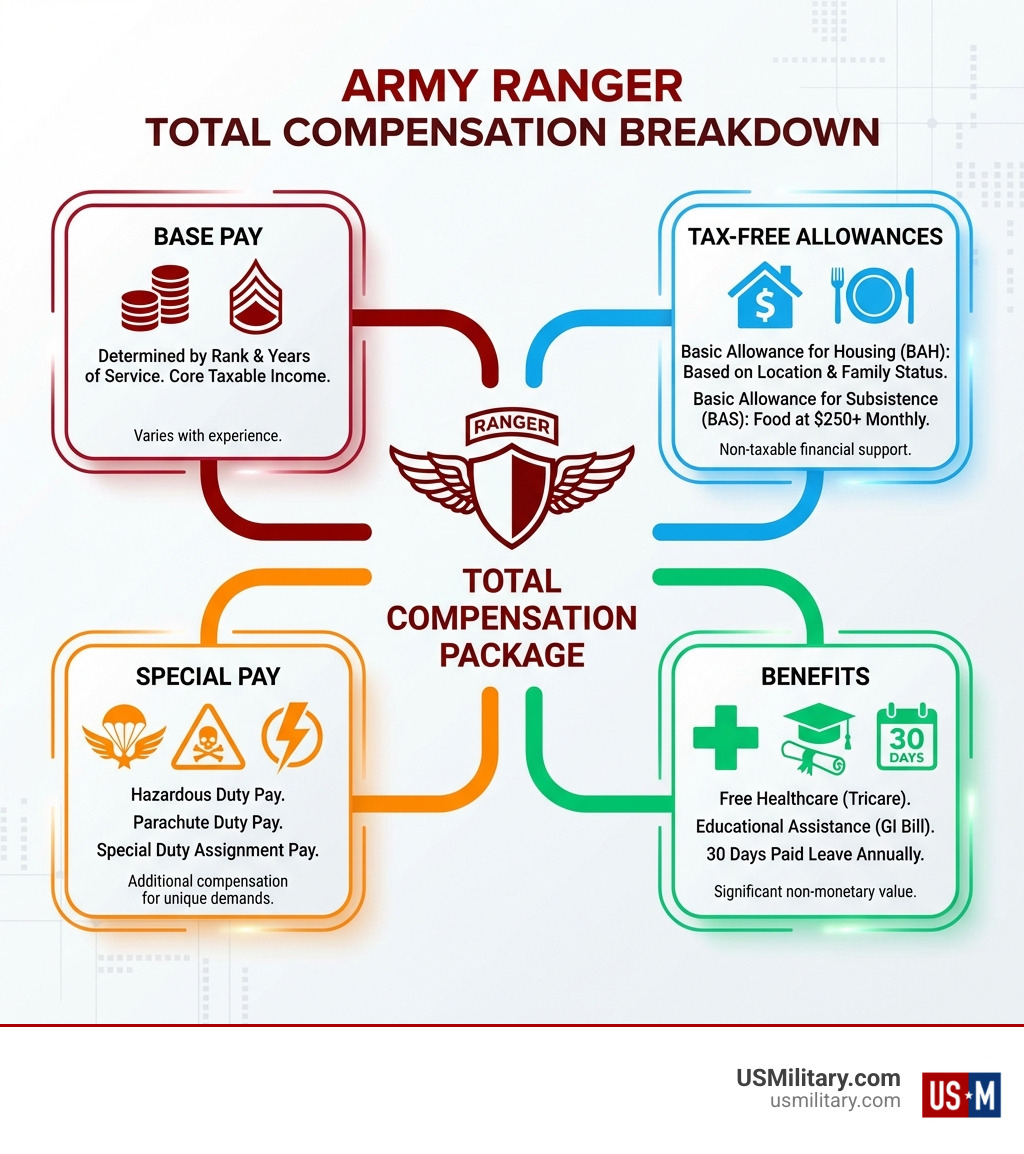
When we talk about an army rangers salary, we’re discussing a comprehensive compensation package, not just a single annual figure. This package is designed to reward the unique skills, dangers, and demands placed upon these elite soldiers. To truly understand the financial picture, we need to break down the base pay, various allowances, and special pays that contribute to the total earnings.

Basic Pay: The Foundation of Your Earnings
Basic Pay forms the bedrock of every U.S. Army soldier’s compensation. It’s determined by two primary factors: your pay grade (rank) and your years of service. As you advance in rank and accumulate more time in service, your basic pay increases.
For enlisted members, pay grades range from E-1 (Private) to E-9 (Sergeant Major of the Army). Officers have their own scale, from O-1 (Second Lieutenant) to O-10 (General). Rangers can be both enlisted personnel or officers, and their basic pay will align with their respective pay charts.
Let’s look at some examples from recent pay tables:
- A Private (E-1) with under two years of experience received $24,206.40 annually in 2024.
- A Staff Sergeant (E-6) with eight years of experience received $51,030.00 annually in 2024.
These figures represent basic pay only. Military pay tables are updated annually. For instance, the 2025 basic pay tables reflect a 4.5% raise, which will further increase these amounts. You can always find the most up-to-date information on official military pay charts. For a comprehensive look, we encourage you to visit the Army Pay Charts | U.S. Army page.
Tax-Free Allowances: More Than Just a Paycheck
Beyond basic pay, allowances significantly boost a Ranger’s total compensation, and crucially, many of these are tax-free. This means a larger portion of your earnings goes directly into your pocket. The two most common allowances are:
- Basic Allowance for Housing (BAH): This allowance helps cover housing costs when government quarters are not provided. The amount varies significantly based on your duty station’s cost of living, your pay grade, and whether you have dependents. For example, a Ranger stationed in a high cost-of-living area with a family will receive substantially more BAH than a single Ranger in a lower cost-of-living area.
- Basic Allowance for Subsistence (BAS): This allowance is provided to offset the cost of a soldier’s food. For all enlisted members, BAS is a fixed monthly rate, typically over $250 per month. This is a non-taxable allowance, providing a valuable boost to your take-home pay.
These allowances are vital components of the total army rangers salary, often making military compensation more competitive than it appears at first glance. They adjust for factors like location and family status, ensuring soldiers can maintain a reasonable standard of living.
Special Pay & Bonuses: The Ranger Advantage
This is where the army rangers salary truly distinguishes itself from many other roles within the Army. Due to the hazardous nature, specialized skills, and demanding missions of the 75th Ranger Regiment, Rangers are eligible for several types of special pay and bonuses. These additional payments acknowledge the increased risk and expertise required for their duties.
Examples of special pays that can significantly increase a Ranger’s earnings include:
- Hazardous Duty Pay (HDP): Paid for performing duties that involve inherent dangers, such as demolition, flight operations, or handling toxic fuels.
- Imminent Danger Pay (IDP) / Hostile Fire Pay (HFP): Provided to soldiers serving in designated hostile fire or imminent danger zones.
- Parachute Duty (Jump Pay): A monthly stipend for qualified airborne personnel, which includes all Army Rangers due to their airborne assault capabilities.
- Special Duty Assignment Pay (SDAP): Awarded to enlisted soldiers in specific difficult or demanding assignments or duties.
- Special Skills Pay: For certain Military Occupational Specialties (MOS) that require highly specialized or critical skills.
In addition to ongoing special pays, prospective and current Rangers may also qualify for various bonuses:
- Enlistment Bonuses: Incentives offered to new recruits who sign up for specific MOSs or lengths of service, especially those critical to the Army’s needs.
- Re-enlistment Bonuses: Offered to retain experienced soldiers in critical roles, including those within the Ranger Regiment.
When we consider the estimated total pay range for a Ranger, which Glassdoor suggests is between $43,000 and $73,000 per year, including base salary and additional pay, these special pays and bonuses play a crucial role in pushing the total compensation above standard Army roles. The average Ranger base salary is estimated at $56,000 per year, but the additional pay components are what truly reflect the specialized nature of their service.
The Path to Becoming a Ranger: Requirements and Training
Becoming an Army Ranger is not for the faint of heart. It requires exceptional physical and mental fortitude, a commitment to excellence, and the ability to operate under extreme pressure. The rigorous selection and training process ensures that only the most capable individuals earn the coveted Ranger tab.

Eligibility Requirements to Join the Ranks
Before even attempting the specialized Ranger training, candidates must meet a stringent set of eligibility requirements. These ensure that individuals possess the foundational qualities necessary for such an elite unit.
To become an Army Ranger, you generally need to meet the following criteria:
- U.S. Citizenship: All candidates must be U.S. citizens.
- Age Requirements: Typically, candidates must be between 17 and 34 years old.
- Military Status: You must be an Army volunteer, either already serving or enlisting specifically for this path.
- ASVAB Test Scores: Candidates must achieve a minimum required score on the Armed Services Vocational Aptitude Battery (ASVAB) tests to qualify for airborne training and an eligible Military Occupational Specialty (MOS).
- Physical Fitness Test: A high level of physical fitness is non-negotiable. You must pass challenging physical readiness tests.
- Security Clearance: The nature of Ranger missions often requires access to sensitive information, necessitating the ability to attain a top-secret security clearance.
- Eligible Military Occupational Specialty (MOS): While Rangers come from various MOSs, certain roles are more commonly found within the 75th Ranger Regiment. You must either possess or be able to train for an MOS that is compatible with Ranger operations.
- Clean Record: Candidates must have no Uniform Code of Military Justice (UCMJ) offenses or drug/alcohol incidents within the past 24 months. A clean record demonstrates reliability and good judgment.
These requirements are the gateway to an incredibly demanding, yet profoundly rewarding, military career.
The Gauntlet: Ranger Training and Success Rates
Once eligible, the true test begins. The training pipeline for an Army Ranger is one of the most grueling in the world, designed to push individuals to their absolute limits and beyond.
The journey typically involves:
- Basic Combat Training (BCT) and Advanced Individual Training (AIT): All soldiers start here, learning fundamental soldiering skills and their specific MOS.
- Airborne School: A three-week course teaching soldiers how to conduct parachute operations. All Rangers are airborne qualified.
Ranger Assessment and Selection Program (RASP): This is the crucial 8-week program for those aspiring to join the 75th Ranger Regiment. RASP is incredibly demanding, focusing on physical and mental endurance, tactical skills, and teamwork. It includes a notorious “RAP week” (Ranger Assessment Phase) which starts at 3:30 a.m. and includes:
- 49 pushups
- 59 sit-ups
- 6 chin-ups
- A 5-mile run in 40 minutes or less
- Land navigation tests, a water survival assessment, and a 12-mile march carrying 35 pounds of gear.
The attrition rate during RASP is notoriously high. Approximately one-third of each class is typically eliminated during RAP week alone.
Ranger School: This is a separate, even more intense, 61-day leadership course, considered one of the top military leadership training courses globally. While not all soldiers in the 75th Ranger Regiment are Ranger School graduates, many pursue it to improve their leadership skills. Ranger School is divided into three phases:
- Benning Phase (21 days): Focuses on basic patrolling, reconnaissance, and combat skills. Only about half of all candidates survive this initial phase.
- Mountain Phase: Teaches military mountaineering, climbing, and cold-weather operations.
- Florida Phase: Concentrates on waterborne operations, small boat tactics, and urban assaults in swampy terrain.
The success rate for Ranger School is low, with many candidates failing to complete all phases. This high attrition rate underscores the immense physical and mental challenges involved, ensuring that only the most resilient and capable individuals earn the right to be called a Ranger.
How Ranger Pay Compares: Military Context
Understanding an army rangers salary requires looking at it within the broader landscape of military compensation. Rangers, as part of the Special Operations Forces (SOF), often have a different financial trajectory compared to their conventional counterparts.
Ranger vs. Other Army Roles
When comparing a Ranger’s pay to other roles within the Army, we find that the total compensation for a Ranger is generally higher, primarily due to the specialized skills and hazardous nature of their duties. While basic pay is standardized by rank and time in service, the addition of special pays and allowances creates a significant difference.
Let’s consider a hypothetical comparison for an E-5 (Sergeant) with 8 years of experience in 2024:
- Conventional Infantry Soldier (E-5, 8 years): Their basic pay would be around $46,184.40 annually. They would also receive BAH and BAS, but generally not the same level of special duty or hazardous pays as a Ranger.
- Army Ranger (E-5, 8 years): Their basic pay would be the same $46,184.40. However, they would also receive monthly jump pay, potentially hazardous duty pay, and other special pays related to their assignments and missions. The estimated total pay range for a Ranger is $43,000–$73,000 per year, which is 39% higher than the average US Army salary of $56,104 per year for the general “Ranger” role (which includes non-Army Ranger roles in its calculation). For an actual Army Ranger, this difference is even more pronounced.
This means that while the base salary might be similar for soldiers of the same rank and experience, the additional compensation for Rangers can easily push their total annual income significantly higher. The value of their specialized skills and the inherent dangers of their missions are directly reflected in their overall compensation.
Understanding Army Pay in a Broader Context
The U.S. Army’s pay structure is designed to provide a stable income, along with comprehensive benefits that civilian employers rarely match. Factors affecting pay include not only rank and years of service but also location (due to BAH variations) and specific job qualifications.
For more detailed information on how Army pay is structured, including basic pay, allowances, and incentives, you can visit the official More info on Army Basic Pay page.
It’s also interesting to compare this to military roles in other countries. For instance, the Canadian Army has a different pay structure. A Private in the Canadian Army starts at $39,000 annually, increasing to $72,000 at the rank of Corporal. Canadian Reservists earn $100/day as a Private, increasing to $140/day as a Corporal. When we compare these figures to the U.S. Army’s 2024 basic pay for a Private (E-1) at $24,206.40 and a Staff Sergeant (E-6) at $51,030.00, and especially considering the additional pays for U.S. Army Rangers that push their total compensation to the $43,000-$73,000 range, it’s clear that U.S. Army Rangers generally earn more than entry-level and mid-level Canadian Army personnel. This highlights the varying compensation philosophies and economic contexts between different nations’ armed forces.
Long-Term Career Prospects and Civilian Transition
The decision to become an Army Ranger is a significant commitment, but it’s one that often pays dividends far beyond the immediate financial compensation. The training, experience, and leadership development gained as a Ranger provide a powerful foundation for both continued military service and successful transition into the civilian workforce.
Career Progression Within the 75th Ranger Regiment
Within the 75th Ranger Regiment, opportunities for career progression are abundant for those who prove themselves. As Rangers gain experience, demonstrate exceptional leadership, and hone their specialized skills, they become eligible for promotions to higher ranks. Each promotion brings an increase in basic pay, as well as greater responsibility and influence.
Long-term service in the Ranger Regiment can lead to senior enlisted leadership positions (e.g., First Sergeant, Command Sergeant Major) or commissioned officer roles for those who pursue that path. These positions come with significantly higher pay and benefits, including eligibility for the military retirement system after 20 or more years of service, which provides a defined benefit pension for life.
Civilian Career Paths for Former Rangers
One of the most compelling aspects of serving as an Army Ranger is the unparalleled preparation it provides for success in the civilian sector. The skills honed in the Ranger Regiment are highly sought after by employers across a wide range of industries.
Former Rangers often transition into civilian careers where their unique skill set is a tremendous asset:
- Leadership and Management: Rangers are trained to lead small, highly effective teams in complex and high-stakes environments. This translates directly to corporate leadership, project management, and operational roles.
- Problem-Solving and Decision-Making: Under immense pressure, Rangers must quickly analyze situations, devise solutions, and execute plans. These critical thinking skills are invaluable in any professional setting.
- Discipline and Work Ethic: The rigorous demands of Ranger life instill an unparalleled level of discipline, self-motivation, and resilience.
- Private Security and Federal Law Enforcement: Many former Rangers find fulfilling careers in executive protection, security consulting, or join federal agencies such as the FBI, DEA, Secret Service, or Border Patrol, where their tactical expertise is highly valued.
- Entrepreneurship: The independence, resourcefulness, and ability to overcome obstacles often found in Rangers make them natural entrepreneurs.
The market value of these transferable skills often means that former Rangers command competitive salaries in the civilian world, leveraging their military experience for significant earning potential.
Comparing a Civilian vs. Army Rangers Salary Over a Career
When comparing a civilian career to an army rangers salary over a lifetime, it’s crucial to look beyond the immediate paychecks and consider the total value proposition. While some entry-level civilian jobs might offer a higher initial nominal salary, the comprehensive benefits package and long-term advantages of military service often create a more robust financial future.
Here’s why military service, particularly as a Ranger, can be financially advantageous in the long run:
- Debt-Free Education: The Post-9/11 GI Bill and other educational benefits allow former Rangers to pursue higher education or vocational training with little to no personal cost, avoiding student loan debt that plagues many civilians. This directly impacts their earning potential in subsequent civilian careers.
- Comprehensive Healthcare: Active duty military members and their families receive free or low-cost healthcare. This is a massive financial benefit that can save thousands of dollars annually compared to civilian health insurance costs.
- Guaranteed Income and Job Security: While serving, Rangers have guaranteed employment and a steady income, regardless of economic downturns.
- Retirement Pension: After 20 years of service, military members receive a pension for life, providing a stable income stream in retirement. This is a benefit increasingly rare in the civilian sector.
- Leadership Development: The intensive leadership training received as a Ranger is often equivalent to high-cost executive education programs, giving them a significant advantage in civilian leadership roles.
Considering these factors, the initial army rangers salary might seem modest compared to some civilian paths, but the cumulative financial benefits, including education, healthcare, and retirement, often make it a highly valuable career choice with strong long-term earning potential.
Frequently Asked Questions about Army Ranger Compensation
We understand that the intricacies of military pay can raise many questions, especially for those considering a demanding role like an Army Ranger. Here, we address some of the most common inquiries regarding army rangers salary and compensation.
What is the typical starting army rangers salary?
The typical starting army rangers salary is based on the entry-level enlisted pay grades (E-1 to E-4) combined with allowances and special pays. For a Private (E-1) with under two years of experience, the 2024 basic pay was $24,206.40 annually. However, this is just the base.
When you factor in:
- Basic Allowance for Subsistence (BAS): Over $250 per month, tax-free.
- Basic Allowance for Housing (BAH): Varies by location and family status, but can add hundreds or even thousands of dollars monthly, also tax-free.
- Parachute Duty (Jump Pay): A monthly stipend for all airborne-qualified Rangers.
- Other Potential Special Pays: Depending on specific assignments.
- Enlistment Bonuses: Which can be substantial for critical skills or long-term commitments.
An entry-level Ranger’s total initial compensation package, including these non-taxable allowances and special pays, can easily push their effective annual earnings well above the basic pay figure, often aligning with the lower end of the $43,000–$73,000 total estimated range.
Is all pay for an Army Ranger tax-free?
No, not all pay for an Army Ranger is tax-free, but a significant portion of their total compensation often is.
- Taxable Income: Your Basic Pay is considered taxable income and is subject to federal and state income taxes (unless stationed in a state with no income tax or in a combat zone).
- Non-Taxable Income: Allowances such as the Basic Allowance for Housing (BAH) and Basic Allowance for Subsistence (BAS) are generally non-taxable. This is a major financial advantage, as it means more of your take-home pay is exempt from taxes.
- Combat Zone Tax Exclusion (CZTE): If deployed to a designated combat zone, a Ranger’s income (basic pay and certain special pays) can be partially or entirely exempt from federal income tax. This further improves their take-home pay during deployments.
So, while the basic army rangers salary component is taxable, the substantial tax-free allowances and potential for combat zone exclusions mean that the overall tax burden for a Ranger is often lower than for a civilian earning a comparable gross salary.
Can an officer be an Army Ranger and how does their pay differ?
Yes, an officer can absolutely be an Army Ranger. In fact, many officers choose to attend Ranger School to develop their leadership skills and earn the prestigious Ranger tab. Officers who serve in the 75th Ranger Regiment hold leadership positions within the unit, commanding platoons, companies, and higher echelons.
The pay for an officer Ranger differs from an enlisted Ranger primarily because officers follow a separate pay scale (O-1 to O-10). Generally, officers have a higher basic pay scale than enlisted personnel, reflecting their increased leadership responsibilities, educational requirements (a bachelor’s degree is typically required to commission as an officer), and strategic roles.
For example, a Second Lieutenant (O-1) with under two years of experience had a basic pay of $45,914.40 annually in 2024, which is already significantly higher than an entry-level enlisted Private (E-1). As officers promote through ranks like Captain (O-3) or Major (O-4), their basic pay increases substantially.
Officer Rangers also receive BAH, BAS, and are eligible for the same special pays (e.g., Jump Pay, Hazardous Duty Pay) as enlisted Rangers, further increasing their total compensation. You can review the official officer pay tables for more detailed figures on basic pay for various ranks and years of service: Official Officer Pay Tables.
Your Future, Ranger Ready
Becoming an Army Ranger is a commitment to excellence, demanding the utmost in physical and mental resilience. While the path is challenging, the rewards, both personal and financial, are substantial. The comprehensive army rangers salary package, comprising basic pay, generous tax-free allowances, and specialized bonuses, offers a robust financial foundation for a career dedicated to serving our nation.
Beyond the immediate compensation, the long-term benefits—from world-class leadership training and unparalleled experiences to comprehensive healthcare, educational opportunities, and a secure retirement—create a value proposition that is hard to match in the civilian sector. The skills and discipline gained as a Ranger are invaluable for any future career, military or civilian, opening doors to high-demand roles and significant earning potential.
At USMilitary.com, we are dedicated to providing comprehensive resources for military members and veterans, helping you steer your career and maximize your benefits. If you’re considering this elite path, we encourage you to explore further and understand every aspect of what it means to be Ranger Ready.
For more detailed information on the requirements, training, and overall journey to joining this elite force, explore our comprehensive guide: The Ultimate Guide to Joining the Army’s Toughest.
Free for Service Members & Veterans
Get the military benefits intel no one tells you about.
Weekly updates on VA benefits, pay changes, and money tips — free for service members and veterans.
No spam. Unsubscribe anytime. Your info is never shared.