Why So Many Military Veterans Struggle With Mental Health and Suicide
The 10 reasons why military veterans have mental issues leading to suicide are rooted in a combination of trauma, isolation, financial strain, and systemic barriers — and the data makes the crisis impossible to ignore.
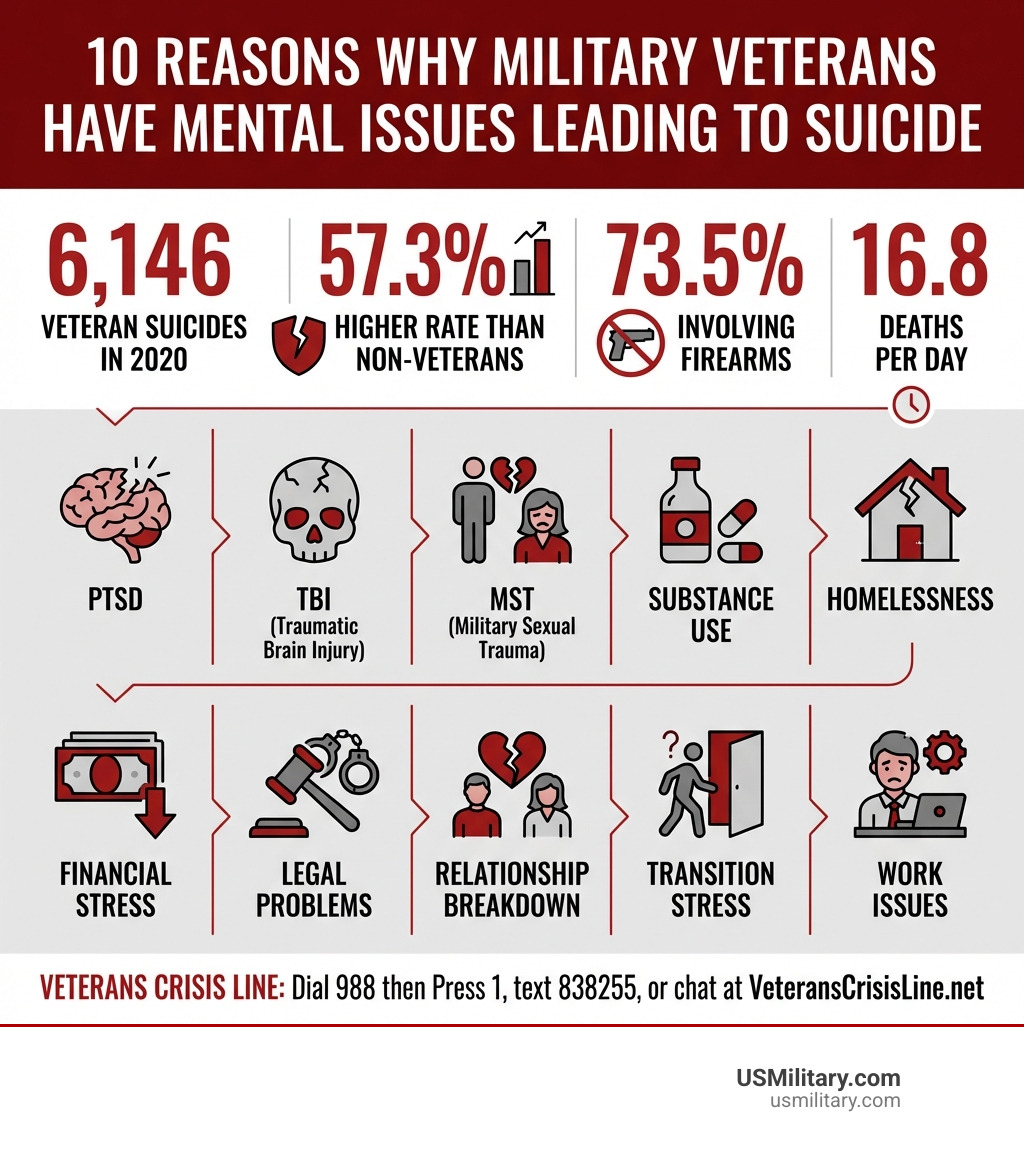
Here is a quick overview of all 10 reasons:
- PTSD, depression, and anxiety disorders – mental health conditions tied directly to military trauma
- Substance use disorders – veterans who misuse drugs or alcohol are 2x more likely to die by suicide
- Traumatic Brain Injury (TBI) – veterans with TBI are more than twice as likely to die by suicide
- Relationship and family breakdown – failed partnerships and loss are leading stressors before suicide
- Financial hardship – excessive debt, bankruptcy, and economic instability increase risk
- Justice system involvement – legal problems, incarceration, and “bad paper” discharges raise suicide risk nearly 3x
- Military Sexual Trauma (MST) – MST survivors are 1.7 to 2.3 times more likely to die by suicide
- Homelessness and isolation – homeless veterans are 7.8 times more likely to attempt suicide
- Transition stress – the highest risk window is the first 3 months after leaving service
- Work-related problems – job performance issues and supervisory conflicts are common triggers
The numbers are sobering. In 2020 alone, 6,146 veterans died by suicide — that is 16.8 every single day. Veterans are 57.3% more likely to die by suicide than non-veterans. For women veterans, the rate is 2.5 times higher than non-veteran women.
This is not just a statistic. Each number is a person who served their country.
I’m Larry Fowler, publisher of USMilitary.com since 2007, and through years of covering veteran benefits, VA disability trends, and military mental health, I have seen how the 10 reasons why military veterans have mental issues leading to suicide intersect in devastating ways. I’ll break down each reason clearly so veterans, families, and supporters can better understand and act.
If you or a veteran you know is in crisis, contact the Veterans Crisis Line at VeteransCrisisLine.net.
Understanding the 10 Reasons Why Military Veterans Have Mental Issues Leading to Suicide
When we look at Veteran mental health, we aren’t just looking at a single diagnosis. We are looking at a complex web of biological, psychological, and social factors. Research shows that many veterans who die by suicide had Health Care Contacts in the Year Before Suicide Death, yet the underlying “mental issues” often remain untreated or under-addressed.
PTSD, Depression, and Anxiety
Post-Traumatic Stress Disorder (PTSD) is perhaps the most well-known of the 10 reasons why military veterans have mental issues leading to suicide. Veterans with PTSD are four times more likely to experience suicidal ideation. Often, this is compounded by major depressive disorder and generalized anxiety. In the VHA system, the suicide rate for those with a mental health or substance use diagnosis was 57.2 per 100,000—more than double the rate of those without such a diagnosis. For a deeper dive, read more info about PTSD in veterans.
Traumatic Brain Injury (TBI)
TBI is the “invisible wound” of the post-9/11 wars. Between 2000 and 2019, over 413,000 service members were diagnosed with TBI. The physical damage to the brain can lead to impulsivity, depression, and cognitive decline. Research published in the Journal of Head Trauma Rehabilitation indicates that veterans with a TBI diagnosis are more than twice as likely to die by suicide compared to those without.
Substance Use Disorders (SUD)
Over 1 in 10 veterans are diagnosed with a substance use disorder. Whether it is alcohol used to numb the symptoms of PTSD or opioids prescribed for chronic service-related pain, substance misuse acts as a massive amplifier for suicide risk. Veterans with SUD are more than twice as likely to die by suicide, with the highest risks found among those with opioid use disorder or bipolar disorder.

Comparing Veteran vs. Civilian Suicide Methods
One of the most critical differences in veteran suicide is the method used. Veterans are significantly more likely to use firearms, which have a much higher lethality rate than other methods.
| Statistic | Military Veterans | General Population (Non-Veterans) |
|---|---|---|
| Suicide Rate (per 100k) | 31.7 – 33.9 | 16.5 – 17.2 |
| Firearm Usage | 71% – 73.5% | 48.2% – 52.2% |
| Daily Average Deaths | 16.8 – 17.5 | N/A |
| Lethality of Attempts | Extremely High | Moderate |
How Relationship and Financial Stressors are 10 Reasons Why Military Veterans Have Mental Issues Leading to Suicide
We often focus on the “combat” side of veteran life, but the “home” side is just as volatile. Relationship problems, such as failed intimate partnerships or the death of a family member, are leading stressors identified in suicide investigations.
Social Isolation and Loneliness
Transitioning from a tight-knit military unit to a fragmented civilian world can be jarring. This isolation often leads to a sense of “thwarted belongingness.” When a veteran feels they are a burden to their family or that they no longer belong in society, the risk of suicide skyrockets.
Financial Strain and Homelessness
Financial stressors like excessive debt or bankruptcy are major contributors to the 10 reasons why military veterans have mental issues leading to suicide. Veterans in “Priority Group 5” (those eligible for VA care based on low income) consistently show some of the highest suicide rates. Even more tragic is the link to homelessness. Veterans with a history of homelessness are 7.8 times more likely to attempt suicide.
Early identification is key. We recommend that all providers utilize the Assessment of Rates of Suicide Risk Screening and Prevalence of Positive Screening Results to catch these stressors before they become fatal. If you are struggling to make ends meet, remember you can Apply for disability or look into VA aid and attendance to help ease the financial burden.
Why Legal Problems and Justice Involvement are 10 Reasons Why Military Veterans Have Mental Issues Leading to Suicide
The path from service to the justice system is a documented risk factor. Nearly 1 in 3 veterans have been arrested at least once, compared to 1 in 5 non-veterans.
See Military Jobs That Have High Rate Suicides.
The Justice-Suicide Link
Justice-involved veterans are nearly twice as likely to attempt suicide. This is often due to “overlapping risk factors”:
✉ Get updates like this in your inbox
Weekly VA benefit changes, pay updates, and money tips for service members, veterans, and military families. Free, no spam.
- PTSD: Veterans with PTSD are 61% more likely to have justice system involvement.
- TBI: 15% of justice-involved veterans have a TBI diagnosis.
- Bad Paper Discharges: 18% of incarcerated veterans received a “bad paper” (Other Than Honorable) discharge. These veterans are nearly three times more likely to be at risk of suicide because they often lose access to VA healthcare and benefits.
Military Sexual Trauma (MST)
MST is a devastating reality that contributes heavily to the 10 reasons why military veterans have mental issues leading to suicide. Among female justice-involved veterans, nearly 52% reported experiencing MST. Survivors are 1.7 to 2.3 times more likely to die by suicide. This trauma creates a cycle of mental health decline, substance use, and legal trouble that can feel impossible to escape.
We also see a correlation between certain high-stress roles and these outcomes. For more context, check out more info about high-risk military jobs.
High-Risk Demographics: Age and Gender Disparities
While suicide affects every corner of the veteran community, certain age groups and genders face disproportionate risks.
The Younger Generation (Ages 18-34)
Younger veterans have the highest suicide rate of any age group, reaching 45.9 per 100,000 in recent years. This is nearly three times higher than their non-veteran peers. The stress of transitioning to civilian life, combined with early-career combat exposure and higher rates of TBI, makes this group extremely vulnerable.
The Older Generation (Ages 55-74)
While younger veterans have the highest rate, the 55-74 age group often sees the highest total number of suicides. For these veterans, chronic pain, medical illness, and the loss of social networks as they age are significant triggers.
Female Veterans
The disparity for women is shocking. Female veterans are 2.5 times more likely to die by suicide than non-veteran women. This is often linked to higher rates of MST and the unique challenges of being a woman in a male-dominated military culture.
Research on Suicide and Traumatic Brain Injury Among Individuals Seeking VHA Services highlights that when these physical injuries are combined with the “moral injury” of service—the psychological distress from actions that violate one’s moral code—the risk of self-harm becomes acute.
Recognizing the Warning Signs and the Role of Firearms
Knowing the 10 reasons why military veterans have mental issues leading to suicide is only half the battle. We must also recognize the warning signs.
Warning Signs to Watch For:
- Insomnia and Agitation: Chronic sleep loss is a major predictor of suicide.
- Social Withdrawal: Pulling away from friends, family, and former battle buddies.
- Risky Behavior: Increased substance use or reckless driving.
- Hopelessness: Statements like “They’d be better off without me” or “Nothing will ever change.”
The Role of Firearms
We cannot talk about veteran suicide without talking about firearms. In 2022, 73.5% of veteran suicides involved a firearm, compared to about 50% for civilians. Veterans are more likely to own firearms (45% vs 19% of civilians) and are more comfortable using them.
Because a suicidal crisis is often impulsive—sometimes lasting less than 10 minutes—having a firearm readily available is often the difference between a suicide attempt and a suicide death. This is why “Lethal Means Safety” is so vital. Storing firearms locked and unloaded, with ammunition separate, creates the “time and space” needed for a veteran to move past the immediate crisis.
For those managing PTSD, it’s also important to stay updated on the latest medical advice; see more info about PTSD treatment guidelines.
Frequently Asked Questions about Veteran Mental Health
What is the overall suicide rate among military veterans compared to the general population?
Veterans are 57.3% more likely to die by suicide than non-veteran adults. The unadjusted rate for veterans is roughly 32.0 to 33.9 per 100,000, while the rate for the general population sits around 17.2 per 100,000. This means veterans die by suicide at a rate 1.5 times higher than civilians (and 2.5 times higher for women).
Why do veterans use firearms more frequently in suicides compared to civilians?
Veterans have a higher rate of firearm ownership (45% vs 19%) and extensive training that makes them more comfortable with the lethality of the weapon. Research shows that 68% to 73.5% of veteran suicides involve a firearm, which is significantly higher than the civilian average. This contributes to the higher “completion” rate of veteran suicide attempts.
How does military sexual trauma (MST) contribute to higher suicide rates?
MST is a profound violation that often leads to complex PTSD, depression, and a sense of isolation. MST survivors are 1.7 to 2.3 times more likely to die by suicide. Among women veterans, those who are MST-positive have a 75% higher suicide rate than those who are not. MST often co-occurs with other stressors, such as justice involvement and homelessness, creating a compounding risk.
Conclusion
At USMilitary.com, we believe that every veteran’s life is worth saving. Understanding the 10 reasons why military veterans have mental issues leading to suicide is the first step toward building a stronger support system. Whether it is through Benefits of military service and support or community outreach, we must work together to reduce the stigma of seeking help.
The “protective factors” are just as real as the risk factors:
- Social Support: Staying connected to family, friends, and fellow veterans.
- Purpose: Finding meaningful work or volunteer opportunities after service.
- Access to Care: Utilizing VA and community resources early and often.
If you are a veteran, know that you are not a burden. Your service matters, and your life matters. If you are a family member, stay vigilant. Ask the hard questions. Validate their feelings. And most importantly, encourage them to get help.
Crisis Resources:
- Veterans Crisis Line: Chat online at VeteransCrisisLine.net.
- National Call Center for Homeless Veterans: Support is available through the VA website.
- Military OneSource: Support is available online at MilitaryOneSource.mil.
Together, we can turn the tide on this crisis and ensure that those who served our country receive the peace and support they deserve here at home.
Free for Service Members & Veterans
Get the military benefits intel no one tells you about.
Weekly updates on VA benefits, pay changes, and money tips — free for service members and veterans.
No spam. Unsubscribe anytime. Your info is never shared.


