Understanding America’s Military Structure
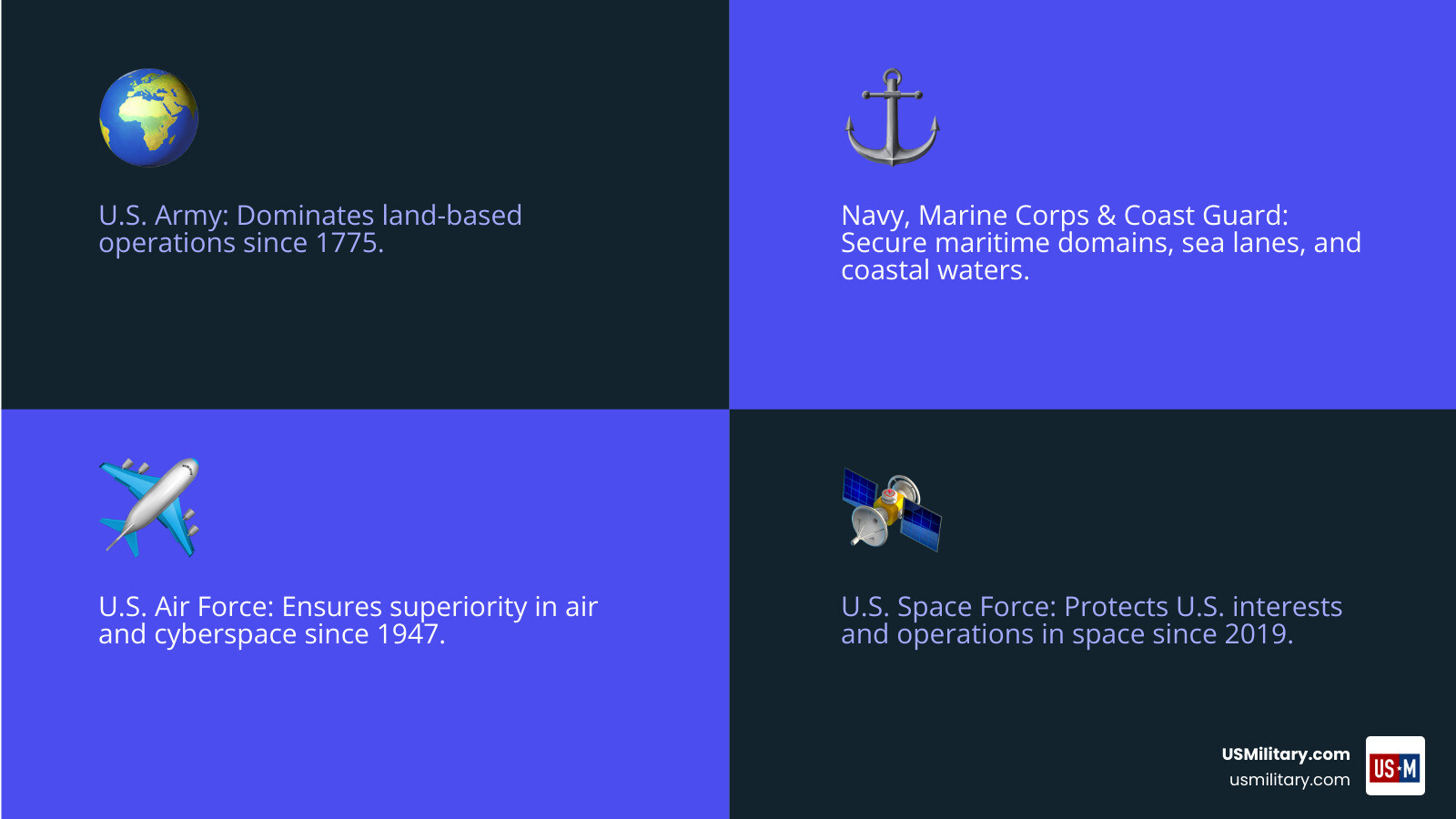
The 7 branches of the military is a common search term, but the truth is simpler: the United States Armed Forces consists of six official military branches, plus reserve components that support them. Here’s the complete breakdown:
The Six Official U.S. Military Branches:
- U.S. Army – Land-based operations (established 1775)
- U.S. Navy – Maritime operations (established 1775)
- U.S. Marine Corps – Expeditionary and amphibious warfare (established 1775)
- U.S. Air Force – Air and cyberspace operations (established 1947)
- U.S. Space Force – Space operations (established 2019)
- U.S. Coast Guard – Maritime law enforcement and security (established 1790)
The confusion about a “seventh branch” often comes from the Army National Guard and Air National Guard, which are actually reserve components of the Army and Air Force. These forces operate under both state and federal authority, making them unique within the military structure.
Each branch has distinct responsibilities, training programs, and cultures. The Army focuses on ground combat. The Navy dominates the seas. The Marine Corps serves as a rapid-response expeditionary force. The Air Force controls the skies. The Space Force protects our interests beyond Earth. And the Coast Guard secures our coastlines and waterways while also serving as a federal law enforcement agency.
The president of the United States serves as commander in chief of all branches. Five branches fall under the Department of Defense, while the Coast Guard operates under the Department of Homeland Security during peacetime.
My name is Larry Fowler, founder of USMilitary.com. Since 2007, I’ve helped service members, veterans, and their families understand the military and their service options. We’ve connected thousands with recruiters and provided essential information on VA benefits, careers, and opportunities across all branches.
7 branches of the military terminology:
- active duty military benefits
- active duty pay
- 1600 military time
A Closer Look at the 6 Official Military Branches
While often grouped under the umbrella of “military service,” each branch of the U.S. Armed Forces offers a unique path, purpose, and culture. Let’s explore what makes each one distinct.
U.S. Army

The U.S. Army is the nation’s primary land warfare service. Established in 1775, it is the oldest military branch. Its core mission is to fight and win our nation’s wars through sustained land dominance. Soldiers are trained for a vast array of combat and support roles in diverse environments. The Army includes elite units like the Green Berets (U.S. Army Special Forces) and Army Rangers, who conduct special operations missions. The branch continuously modernizes its technology to ensure its forces remain at the forefront of combat readiness.
We provide extensive resources for those considering a career in this foundational branch. Learn more about Army opportunities at USMilitary.com.
U.S. Navy

The U.S. Navy ensures maritime dominance, protecting global sea lanes and projecting power across the oceans. Established in 1775, its functions include sea control, power projection, and deterrence. Sailors operate a vast fleet of advanced vessels, including powerful aircraft carriers that serve as mobile airbases and a sophisticated submarine force for strategic deterrence and covert operations. The Navy is also home to the legendary Navy SEALs (Sea, Air, and Land Teams), who undertake highly specialized missions. The Navy is constantly modernizing its fleet to ensure naval superiority for decades to come.
Explore Navy careers and information at USMilitary.com.
U.S. Marine Corps
The U.S. Marine Corps is the nation’s expeditionary force in readiness, specializing in amphibious operations and rapid crisis response. Established in 1775, the Marine Corps is known for being “first to fight.” Although part of the Department of the Navy, the Marines maintain a distinct identity and culture. Marines are trained to operate in any clime and place, often deploying from Navy ships. The Corps’ primary operational unit is the Marine Air-Ground Task Force (MAGTF), which integrates ground, aviation, and logistics elements for a wide range of missions. The Marine Raiders (Marine Corps Special Operations Command) conduct special operations missions. The Corps is modernizing through its Force Design 2030 initiative to meet future challenges.
Find Marine Corps resources at USMilitary.com.
U.S. Air Force
The U.S. Air Force is dedicated to air and cyberspace superiority. Established as a separate branch in 1947, its mission is to fly, fight, and win in air, space, and cyberspace. Airmen operate the world’s most advanced air force, including stealth fighters like the F-22 Raptor and strategic bombers like the B-2 Spirit. The Air Force also excels in global airlift, aerial refueling, and maintains the land-based leg of the nuclear triad with intercontinental ballistic missiles (ICBMs). Special Warfare Airmen conduct highly specialized ground operations in support of other special forces. The branch continues to innovate with advanced drone and cyber capabilities.
Find Air Force opportunities at USMilitary.com.
U.S. Space Force
The U.S. Space Force is the newest military branch, established in 2019. Its mission is to organize, train, and equip space forces to protect U.S. interests in space and provide space capabilities to the joint force. Guardians, as its members are known, are focused on this critical domain. Housed within the Department of the Air Force, it operates as a distinct service. The Space Force’s capabilities include operating and defending vital satellite systems like the Global Positioning System (GPS), communications satellites, and missile warning systems. It is also expanding its cyber capabilities to protect critical space infrastructure.
Learn about the Space Force at USMilitary.com.
U.S. Coast Guard
The U.S. Coast Guard has a unique dual role as both a military service and a federal law enforcement agency. Established in 1790, its missions include maritime law enforcement, search and rescue, environmental protection, and port security. Coastguardsmen operate under the Department of Homeland Security (DHS) during peacetime, allowing them to enforce U.S. laws at sea. In times of war, the Coast Guard can be transferred to the Department of the Navy to support naval operations. The Coast Guard Reserve supports these missions, and specialized units like the Maritime Security Response Team handle high-threat operations. It is a globally recognized humanitarian and security force.
Find Coast Guard information at USMilitary.com.
The National Guard & Reserves: Clarifying the “7th Branch”
The concept of the “7 branches of the military” often arises from the inclusion of the National Guard. While vital to our national defense, the National Guard is not a separate, standalone branch but rather a unique component of two existing branches.
What are the reserve components of the 7 branches of the military?
Each of the six official military branches, with the current exception of the Space Force, maintains reserve components. These forces allow individuals to serve our country on a part-time basis while often pursuing civilian careers or education. They are often referred to as “Citizen-Soldiers” and “Citizen-Airmen” because they live and work in their communities but are ready to answer the call to duty.
Our nation’s reserve components include:
- Army Reserve: Supports the active Army with trained units and individuals, providing critical capabilities across the globe.
- Navy Reserve: Provides strategic depth and operational support to the Navy, maintaining a pool of skilled Sailors ready for mobilization.
- Marine Corps Reserve: Offers trained units and individuals to augment the active Marine Corps, ready for expeditionary and amphibious operations.
- Air Force Reserve: Supports the active Air Force with combat-ready units and personnel, contributing to air and space power.
- Coast Guard Reserve: Augments the active Coast Guard in its diverse missions, from maritime law enforcement to search and rescue.
- Army National Guard: This is where the distinction becomes particularly interesting. The Army National Guard is a reserve component of the Army, but it operates under a dual state and federal authority. Governors can activate Guard units for state emergencies, such as natural disasters, while the President can federalize them for national or overseas missions. The Army National Guard is unique as the only branch of the military whose existence is constitutionally required.
- Air National Guard: Similarly, the Air National Guard is a reserve component of the Air Force, also operating under dual state and federal command. They provide air support for state emergencies and federal missions.
These reserve components are crucial to our national security, providing trained personnel and specialized units that can be mobilized rapidly to support active-duty operations, respond to domestic emergencies, or contribute to overseas missions.
Learn about Guard or Reserve service at USMilitary.com.
Understanding Military Personnel Status
When we talk about the military, it’s important to understand the different categories of personnel:
- Active Duty: These are full-time service members who live and work on military bases in the U.S. and around the world, ready to deploy at a moment’s notice.
- Reserve Components: As discussed, these individuals serve part-time, typically training one weekend a month and two weeks a year, but they are fully trained and ready for mobilization when their skills are needed.
- Veterans: This category includes all former service members. USMilitary.com is dedicated to providing them with resources for post-service life, including employment opportunities and benefits.
The U.S. Armed Forces has about 1.3 million active-duty members and nearly 800,000 in the reserves. This combined force provides the strength and flexibility to respond to global challenges.
Command Structure and Joint Operations
Understanding how our military branches are organized and how they work together is key to appreciating their effectiveness.
How are the branches organized and who is in charge?
At the top of the chain of command is the President of the United States, who serves as the Commander-in-Chief of all U.S. Armed Forces. Beneath the President, the Department of Defense (DoD) oversees the Army, Navy, Marine Corps, Air Force, and Space Force. The Secretary of Defense, a civilian appointee, leads the DoD and exercises authority, direction, and control over these five branches.
The U.S. Coast Guard, as we’ve noted, typically operates under the Department of Homeland Security (DHS) during peacetime. This unique arrangement reflects its dual military and law enforcement functions.
Within the DoD, the Joint Chiefs of Staff (JCS) serve as the senior-most military body. Comprising the Chairman, the Vice Chairman, and the service chiefs of the Army, Marine Corps, Navy, Air Force, and Space Force, the JCS advises the President, the Secretary of Defense, and the National Security Council on military matters. They ensure that our military forces are ready to meet national security needs.
This structure emphasizes strong civilian leadership and oversight, ensuring that military actions align with democratic principles and national policy.
For those interested in the historical evolution of this intricate system, we encourage you to research the history of U.S. military organization at the National Archives.
How the Branches Work Together
Despite their distinct roles, the various branches of the U.S. military are designed to work seamlessly together, forming a powerful joint force. This interoperability is crucial for executing complex missions and ensuring national security.
A primary mechanism for inter-service cooperation is the establishment of Unified Combatant Commands. These commands are organized either geographically (e.g., U.S. Indo-Pacific Command, U.S. European Command) or functionally (e.g., U.S. Special Operations Command, U.S. Strategic Command). They integrate forces from multiple branches to conduct operations in specific regions or domains, ensuring a coordinated and effective response.
Joint operations involve personnel and assets from two or more branches working side-by-side. This could mean Air Force planes providing close air support for Army ground troops, Navy ships transporting Marine expeditionary units, or Space Force Guardians providing critical satellite intelligence to all branches. This combined arms approach leverages each branch’s strengths to achieve objectives that no single service could accomplish alone.
Inter-service support is also a cornerstone of military cooperation. This involves sharing resources, logistics, and intelligence to maximize efficiency and effectiveness. For instance, the Defense Logistics Agency (DLA) provides worldwide logistics support to all military services, while agencies like the Defense Health Agency (DHA) ensure comprehensive healthcare.
The branches work together under a unified national security strategy, ensuring that our collective capabilities—land, sea, air, space, and cyber—are synchronized to protect the United States and its allies.
Frequently Asked Questions about the 7 Branches of the Military
We often hear common questions about the distinct aspects of military service. Let’s address some of the most frequent ones.
Which military branch is the hardest to get into?
The “hardest” branch to get into can be subjective, as it depends on individual qualifications, physical fitness, and specific career aspirations. However, we can look at certain factors:
- Entry Requirements: All branches have minimum entry requirements, including age, education (typically a high school diploma or GED), and physical and mental health standards. Each branch also requires a minimum score on the Armed Services Vocational Aptitude Battery (ASVAB) test. These scores vary by branch and the specific job (MOS/AFSC/Rating) you’re trying to qualify for. For instance, some Navy rates might require different ASVAB scores than Army specialties.
- Physical Fitness Standards: While all branches demand a good level of physical fitness, some are notoriously more rigorous. The Marine Corps, for example, is known for having one of the most demanding basic training programs, both physically and mentally, lasting approximately 13 weeks. Army basic training is usually around 10 weeks, Navy’s 7-8 weeks, and Air Force’s 8.5 weeks.
- Special Operations Forces (SOF): Within each branch, special operations units are exceptionally difficult to join. These include the Navy SEALs, Army Green Berets, Marine Corps Force Reconnaissance and Marine Raiders (MARSOC), and Air Force Special Warfare. Selection processes for these units are grueling, with very high attrition rates, making them arguably the hardest paths to pursue in the entire U.S. military.
- Educational Requirements: While a high school diploma is generally sufficient for enlisted roles, certain officer positions or highly technical jobs may require a college degree or even advanced degrees.
Dedication, preparation, and meeting specific requirements are key to joining any branch. We encourage anyone interested to prepare thoroughly. Take a practice ASVAB test at USMilitary.com to gauge your aptitude.
What is the key difference between the Coast Guard and the other branches?
The most significant difference between the U.S. Coast Guard and the other five military branches (Army, Navy, Marine Corps, Air Force, Space Force) lies in its governing department and its unique blend of military and law enforcement authorities.
- Governing Department: The Army, Navy, Marine Corps, Air Force, and Space Force all fall under the Department of Defense (DoD). The Coast Guard, however, operates under the Department of Homeland Security (DHS) during peacetime. This places it alongside agencies like Customs and Border Protection and the Secret Service.
- Law Enforcement Authority: Unlike the DoD branches, the Coast Guard possesses inherent federal law enforcement authority. This allows Coastguardsmen to enforce U.S. laws at sea, conduct boardings, make arrests, and carry out various regulatory functions. The Posse Comitatus Act generally restricts DoD military branches from participating in domestic law enforcement activities, but this restriction does not apply to the Coast Guard.
- Peacetime vs. Wartime Roles: While the Coast Guard’s peacetime missions are extensive (search and rescue, drug interdiction, port security, environmental protection), it is a military branch and can be transferred to the Department of the Navy by the President or Congress during times of war or national emergency. This capability allows it to seamlessly integrate into naval operations, providing coastal defense, port security, and other vital support.
This unique operational flexibility makes the Coast Guard an indispensable part of our national security apparatus, capable of addressing both domestic maritime threats and contributing to global military operations.
How do the 7 branches of the military work together for national security?
The six branches of the military, along with their reserve components, work together through a highly integrated system of joint operations, mutual support, and complementary capabilities to ensure national security.
- Joint Task Forces: For specific missions or contingencies, the DoD often forms Joint Task Forces (JTFs). These are temporary, purpose-built commands composed of personnel and assets from multiple branches. For instance, a humanitarian relief mission might involve Navy ships transporting Army engineers, while Air Force aircraft provide logistical support and Marine Corps units secure the area.
- Mutual Support and Interoperability: Each branch’s unique strengths are designed to complement the others. The Army provides ground combat power, which may be supported by Air Force air superiority and close air support. The Navy and Marine Corps work in tandem, with the Navy providing sea control and transport for Marine expeditionary forces. The Space Force provides critical satellite communications, navigation (GPS), and intelligence to all branches, while the Coast Guard secures maritime approaches and can be integrated into naval defense.
- Global Force Projection: Together, these branches allow the U.S. to project power and maintain a presence across the globe. Whether it’s rapid response to crises, sustained combat operations, or humanitarian aid, the ability to deploy forces from land, sea, and air, supported by space assets, provides best strategic flexibility.
- A Unified Defense Strategy: All branches operate under a unified defense strategy set by the Department of Defense and the President. This overarching strategy ensures that resources are allocated effectively, operations are coordinated, and our military remains prepared for any threat, from conventional warfare to cyberattacks and space-based challenges. The goal is a seamless, synergistic effort where the sum is greater than its individual parts.
Find Your Place in the U.S. Military
We’ve explored the six official branches of the U.S. military: the Army, Navy, Marine Corps, Air Force, Space Force, and Coast Guard. We’ve seen how each has its own unique history, primary mission, capabilities, and culture, from the ground-pounding might of the Army to the silent strength of the Navy’s submarines, the rapid response of the Marine Corps, the aerial dominance of the Air Force, the cutting-edge vigilance of the Space Force, and the vital law enforcement and humanitarian efforts of the Coast Guard.
We’ve also clarified the role of the Reserve and National Guard components, recognizing them as indispensable parts of our unified fighting force, providing critical support and flexibility.
Choosing to serve in the U.S. military is a profound decision, and understanding these differences is your first step toward finding the path that best suits your skills, interests, and aspirations. Whether you dream of leading troops on land, navigating the high seas, soaring through the skies, protecting our interests in orbit, or safeguarding our coastlines, there’s a place for you.
At USMilitary.com, we are committed to providing you with comprehensive, unbiased information to help you make this important choice. We offer resources on everything from career paths and benefits to eligibility requirements and joining processes.
Ready to take the next step? Contact a Recruiter to explore your options at USMilitary.com. Your journey to serving our nation starts here.
Free for Service Members & Veterans
Get the military benefits intel no one tells you about.
Weekly updates on VA benefits, pay changes, and money tips — free for service members and veterans.
No spam. Unsubscribe anytime. Your info is never shared.


