Understanding Eligibility and Necessary Evidence Before Filing

Written by Larry Fowler, USMilitary.com
Before submitting your paperwork, confirm you meet basic eligibility standards. The Department of Veterans Affairs (VA) provides monthly, tax-free compensation to veterans who developed an injury, illness, or mental health condition connected to their military service.
As a disabled veteran and publisher of USMilitary.com, I recommend filing your VA claim correctly the first time. Do your due diligence and follow the rules. For me, the VA has been a big-time help during my personal medical bouts, including cancer. I can’t say enough good things about the VA! And I wish the same for you!
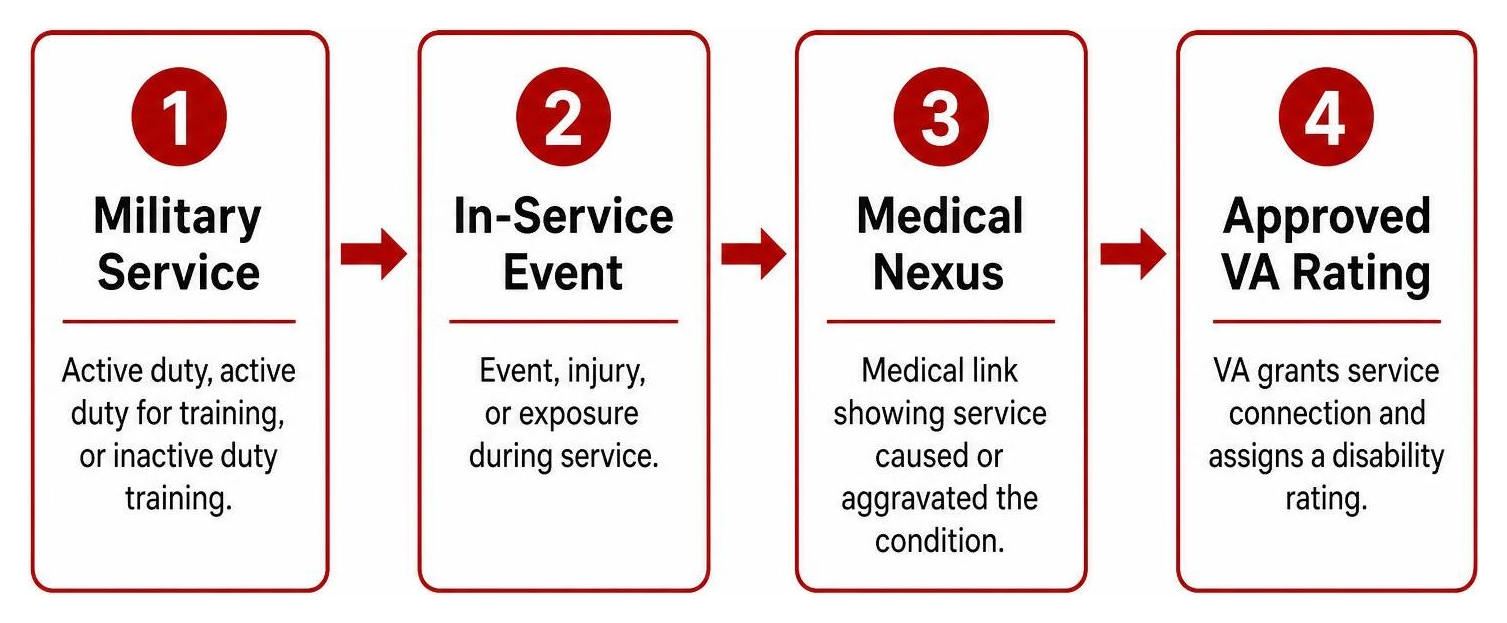
To establish service connection, your claim must demonstrate three core elements:
- A current physical or mental diagnosis: You must have an active, documented condition.
- An in-service event, injury, or exposure: Evidence of an incident during active duty, active duty for training, or inactive duty training.
- A medical link (nexus): A direct connection showing that your active military service caused or aggravated your current medical diagnosis.
Reviewing what conditions qualify for veteran disability benefits helps determine whether your symptoms qualify as a direct service connection, an aggravated pre-existing condition, or a secondary condition caused by an existing service-connected disability.
Locking in Your Effective Date with an Intent to File
If you are still gathering your medical records, do not wait to notify the VA. Submitting an Intent to File sets your potential start date—known as the effective date—for benefit payments. When the VA grants service connection, it calculates your retroactive compensation (back pay) back to that effective date.
You have up to 365 days from the date you notify the VA of your intent to complete your final application.
You can establish an Intent to File by:
- Starting an application online at VA.gov (which sets the date automatically once you begin).
- Mailing or faxing VA Form 21-0966 (Intent to File a Claim for Compensation and/or Pension).
- Calling the VA directly at 1-800-827-1000.
For a deeper look at how to maximize your timeline and avoid back-pay mistakes, consult the complete guide to VA disability claims.
Essential Documents Needed for Your Disability Application
Strong claims depend on solid medical and military records. Before completing your application forms, gather the following:
- DD Form 214 or Separation Documents: Verifies your active-duty service dates and discharge characterization.
- Service Treatment Records (STRs): Military medical and dental logs documenting when your injury, illness, or complaints first arose.
- Private and Civilian Medical Records: Hospital treatment reports, diagnostic test results, and notes from non-VA medical providers. If you cannot obtain private records yourself, you can submit VA Form 21-4142a to authorize the VA to request them on your behalf.
- Nexus Letters and Medical Opinions: Written statements from licensed healthcare providers linking your current diagnosis directly to your military service.
- Buddy Statements and Lay Evidence: Written declarations on VA Form 21-10210 from fellow service members, friends, or family describing how the event occurred and how your symptoms impact daily living.
Applying these 12 easiest VA disability claims tips ensures your evidence packet is clear, complete, and properly formatted before submission.
Step-by-Step Guide on How to File VA Claim Applications
The VA offers two primary pathways for filing: the Fully Developed Claim (FDC) program and the Standard Claim process.
When you file an FDC, you certify that you have submitted all relevant private medical records and personal statements alongside your initial application. This speeds processing because the VA doesn’t need to pause and request civilian files for you. Review the official guidance on filing a VA disability claim to see which method fits your current documentation level.
| Submission Method | Best For | Processing Speed | Proof of Receipt |
|---|---|---|---|
| Online (VA.gov) | Fastest route; direct digital uploads | Fast (Average ~68.2 days) | Instant digital confirmation & tracking |
| Paper records; manual filers | Slower (Includes transit/scanning time) | Use USPS Certified Mail with Return Receipt | |
| Fax | Secure paper submissions | Moderate | Save fax confirmation printout |
| In Person / VSO | Hands-on assistance & regional support | Moderate to Fast | Physical receipt stamp at Regional Office |
How to File VA Claim Forms Online via VA.gov
Filing electronically through VA.gov is the most secure and direct method. Over 60% of veterans choose digital submission to eliminate mail delays.
- Log in to VA.gov: Use an identity-verified credential such as Login.gov or ID.me.
- Access Form 21-526EZ: Navigate directly to the portal for filing for disability compensation with VA Form 21-526EZ.
- Enter Service & Condition Details: List your specific physical and mental conditions, specify when they began, and describe how they relate to your military service. Disclose any toxic exposure history (such as burn pits or contaminated water).
- Upload Digital Evidence: Attach scanned copies of your DD-214, service medical files, private records, and buddy statements directly to the portal.
- Review and Submit: Verify your direct deposit information, review every section for accuracy, and click submit. Make note of your submission confirmation number.
For detailed digital workflows, follow this step-by-step application guide to avoid common online data-entry errors.
How to File a VA Claim by Mail, Fax, or In Person
If you prefer submitting hard copies, print and complete VA Form 21-526EZ (Application for Disability Compensation and Related Compensation Benefits). Write your Social Security Number or VA file number clearly at the top of every single page.
✉ Get updates like this in your inbox
Weekly VA benefit changes, pay updates, and money tips for service members, veterans, and military families. Free, no spam.
- Filing by Mail: Mail your completed application and copied records to the centralized intake facility:
Department of Veterans Affairs
Claims Intake Center
PO Box 4444
Janesville, WI 53547-4444
(Always send via Certified Mail with Return Receipt Requested). - Filing by Fax: Transmit your claim package to the VA Claims Intake Center toll-free fax line at 1-844-531-7818 and keep the transmission verification sheet.
- In-Person Filing: Bring your documents to your nearest VA Regional Office.
- Working with an Accredited Representative: You can appoint an accredited Veterans Service Officer (VSO) from organizations like the VFW, DAV, or American Legion using VA Form 21-22. Recognized VSOs provide claims assistance at no cost.
Learning how to do the VA claim process the right way protects you against clerical mistakes that delay paper applications.
What Happens After Submission: C&P Exams and Claim Tracking
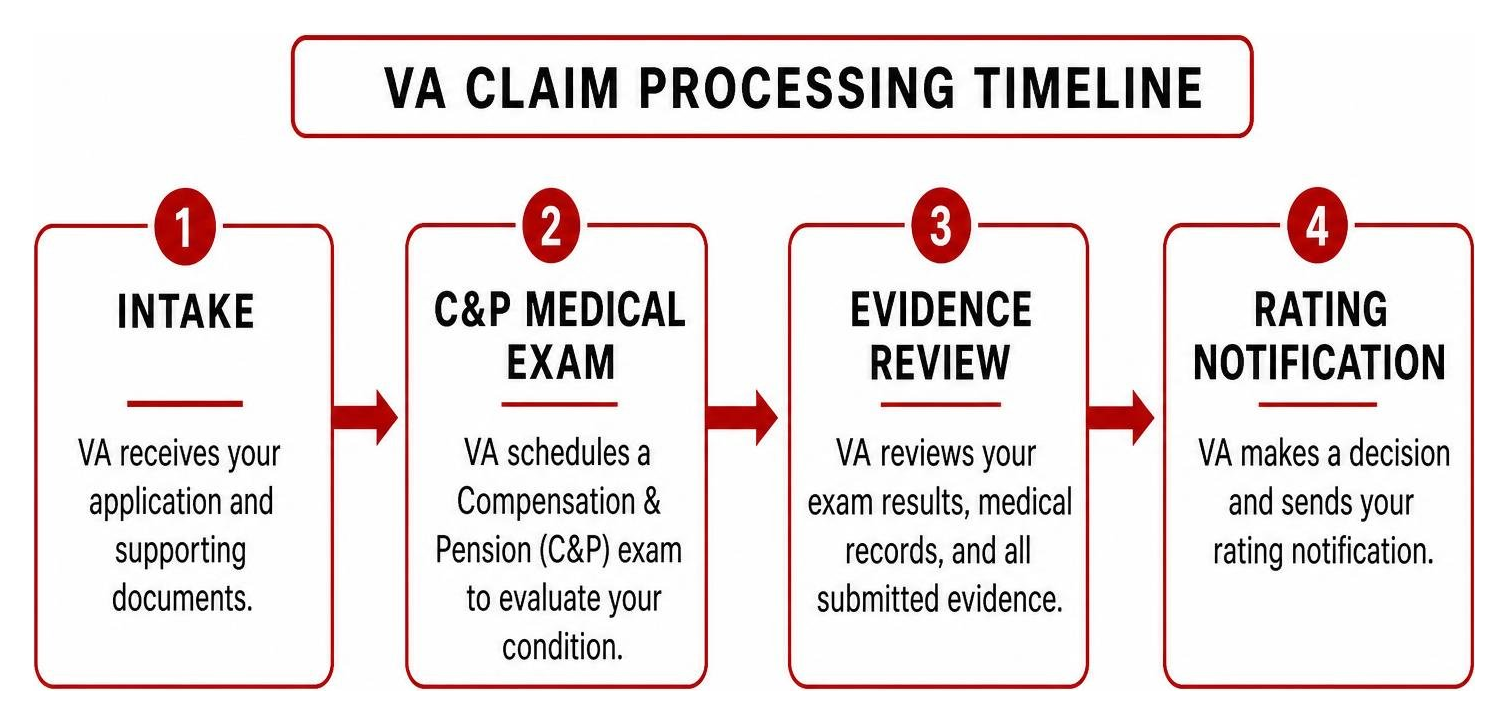
Once your application reaches the VA, it moves through several administrative phases: initial review, evidence gathering, rating decision, and notification.
The Compensation and Pension (C&P) Exam
In most cases, the VA will schedule you for a Compensation and Pension (C&P) exam. This evaluation is conducted by a VA clinician or an approved contracted provider (such as VES, QTC, or Loyal Source).
During the exam, the medical provider completes a Disability Benefits Questionnaire (DBQ) to assess your symptoms and determine whether your disability relates to your military service.
- Never miss a scheduled C&P exam. Missing it will almost always result in an immediate claim denial.
- If you have an unavoidable emergency, contact the VA and the exam contractor immediately to reschedule.
Tracking Progress
You can track your claim’s real-time status online at VA.gov under your personal dashboard. As of late 2026, the average processing time to complete a disability-related claim is approximately 68.2 days. Discover actionable strategies for winning the battle for your VA disability approval by staying proactive while your file is reviewed.
Understanding Your VA Rating Decision and Appeals Process
When the VA finishes rating your file, you will receive an official decision packet in the mail. This packet contains a Rating Decision detailing the approved or denied status of each claimed condition, your overall combined disability percentage (from 0% to 100% in 10% increments), and your effective payment date.
Approved service-connected ratings unlock monthly, tax-free compensation. Check the 2026 VA disability rates to see your exact monthly payment based on your percentage and eligible dependents.
Key Benefits of VA Ratings:
- Ratings of 10% or higher exempt you from outpatient medical copays for service-connected care at VA facilities.
- Ratings of 30% or higher qualify you for additional monthly compensation allowances for your spouse, children, and dependent parents.
- A 100% rating provides maximum monthly compensation along with comprehensive medical and family support.
Navigating Supplemental Claims, Higher-Level Reviews, and Appeals
If the VA denies service connection or assigns a lower rating than your medical evidence supports, you have one year from the date on your decision letter to challenge the ruling without losing your original effective date.
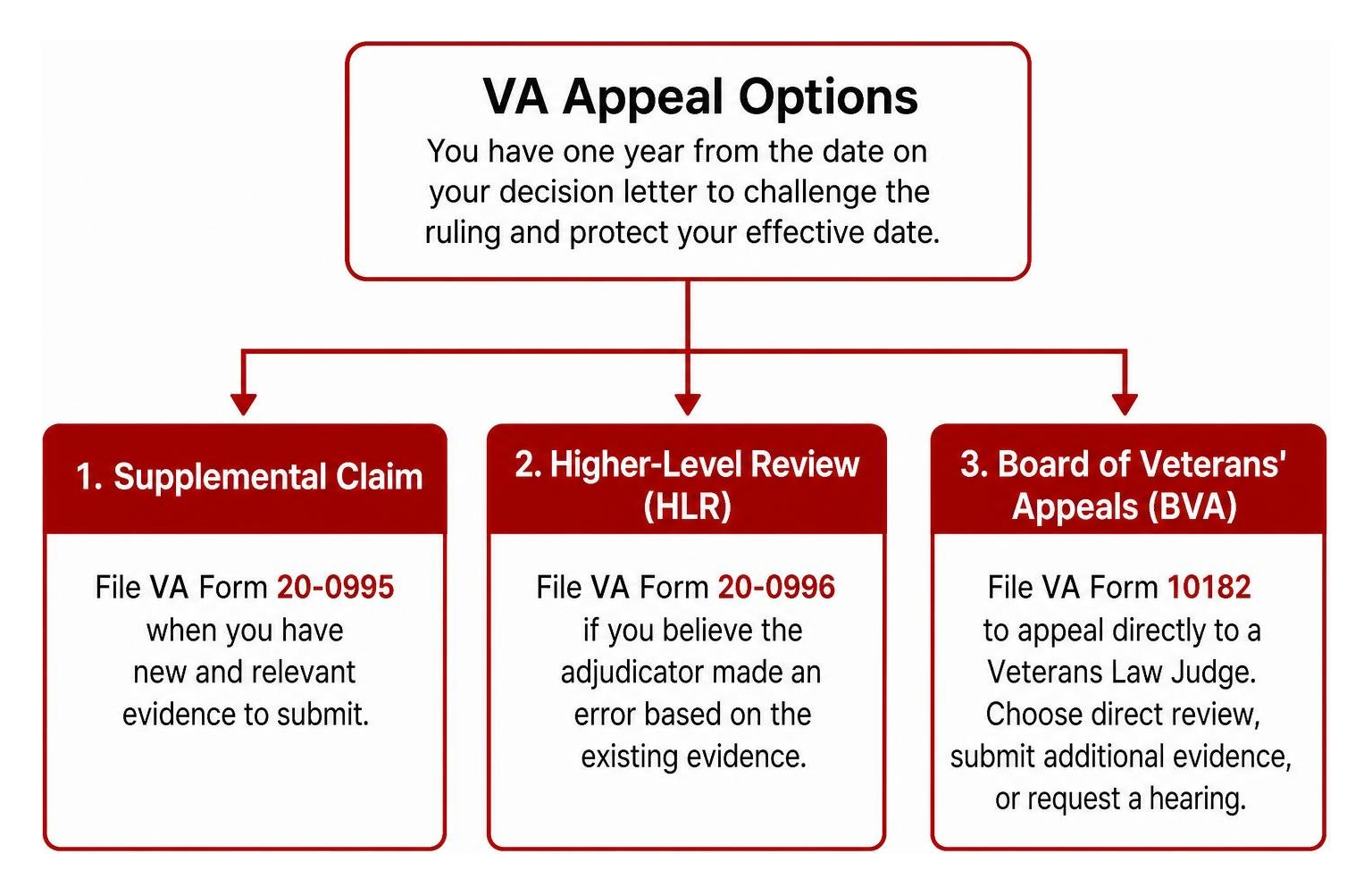
You can choose from three primary review options:
- Supplemental Claim: File VA Form 20-0995 when you have new and relevant evidence to submit, such as an updated nexus letter or private diagnostic scans. Read our guide on giving your claim new life with Form 20-0995.
- Higher-Level Review (HLR): File VA Form 20-0996 if you believe the adjudicator made an error based on the existing evidence. A senior rater reviews the exact same record without accepting new documentation.
- Board of Veterans’ Appeals (BVA): File VA Form 10182 to appeal directly to a Veterans Law Judge in Washington, D.C. You can choose a direct review, submit additional evidence, or request a hearing.
Mastering how to turn your VA denial into a winning appeal ensures that an initial denial is never the final word on your benefits.
Frequently Asked Questions About Filing a VA Claim
How long does it take for the VA to make a claim decision?
As of late 2026, the VA averages 68.2 days to process and decide disability claims. Online submissions backed by complete medical evidence (Fully Developed Claims) move significantly faster than paper submissions requiring third-party record requests.
Can I submit a VA disability claim before leaving active duty?
Yes. Active-duty service members can file a pre-discharge claim through the Benefits Delivery at Discharge (BDD) program between 180 and 90 days before separation. This program allows you to complete C&P exams while still in uniform so your compensation can begin shortly after discharge.
Where do I mail my paper VA Form 21-526EZ application?
All paper-based disability applications, Intent to File forms, and supporting evidence should be mailed to:
Department of Veterans Affairs, Claims Intake Center, PO Box 4444, Janesville, WI 53547-4444.
Always send your application via USPS Certified Mail with Return Receipt Requested and keep copies of every page.
Conclusion
Securing your earned VA disability benefits requires clear documentation, timely filing, and an understanding of how the VA evaluates service-connected conditions. By filing an Intent to File early, assembling comprehensive medical records, and tracking your claim through VA.gov, you protect your effective date and maximize potential retroactive back pay.
At USMilitary.com, our mission is to provide sservice membersand veterans with actionable, transparent guidance across every military branch and benefit program. Explore our comprehensive 100 percent disabled veteran benefits overview to learn about the full range of healthcare, housing grants, and financial protections available to you and your family.
Free for Service Members & Veterans
Get the military benefits intel no one tells you about.
Weekly updates on VA benefits, pay changes, and money tips — free for service members and veterans.
No spam. Unsubscribe anytime. Your info is never shared.



Leave a Reply