Find a Reliable VA Disability Calculator for 2027

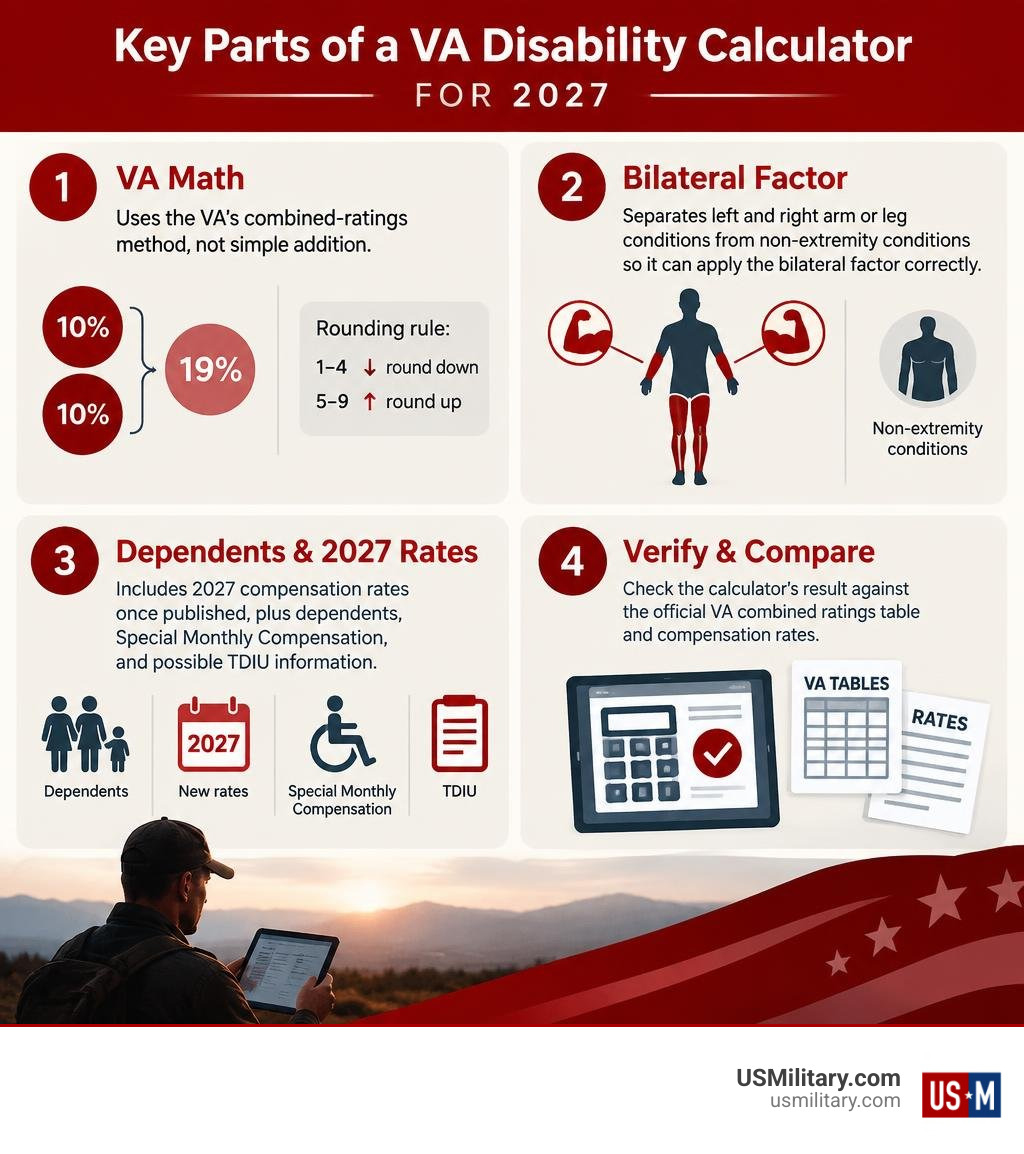
To find the best VA disability calculator for 2027, choose one that:
- Uses the VA’s combined-ratings method, not simple addition.
- Separates left and right arm or leg conditions from non-extremity conditions so it can apply the bilateral factor correctly.
- Includes 2027 compensation rates once VA publishes them, plus dependents, Special Monthly Compensation, and possible TDIU information.
- Lets you compare its combined-rating result and monthly estimate with the official VA combined ratings table and compensation rates.
A trustworthy calculator explains its work. VA math starts with the part of the body considered still healthy, so two 10% ratings combine to 19%, not 20%. VA then rounds the final combined value: 1 through 4 rounds down, while 5 through 9 rounds up to the nearest 10%.
For 2027, be careful with any tool that claims final payment figures before the new annual rates are official. VA disability compensation generally follows the same cost-of-living adjustment percentage used for Social Security, so verify the calculator’s update date and cross-check its payment estimate against VA’s published rate tables.
I am LARRY FOWLER, publisher of the USMilitary.com Network, where I have helped service members and veterans follow VA benefit and disability-compensation trends since 2007. This guide to How To Find The Best VA Disability Calculator For 2027 will help you check the math, spot outdated tools, and estimate benefits with more confidence.
Simple How To Find The Best VA Disability Calculator For 2027 glossary:
Understanding VA Math and the Whole Person Theory
When veterans first look at their combined rating decision letter, confusion is almost universal. If you have a 50% rating for PTSD, a 50% rating for sleep apnea, a 20% rating for diabetes, and a 20% rating for a lumbar spine condition, standard grade-school addition tells you that your total is 140%.
However, under the Department of Veterans Affairs rating schedule, your combined rating is actually 80%.
This happens because the VA calculates disability compensation using the “Whole Person Theory.” Under this legal doctrine, no veteran can be more than 100% able-bodied or more than 100% disabled. The VA views you as a whole individual (100% efficient). Every service-connected condition reduces only a percentage of your remaining healthy efficiency rather than subtracting from your original 100%.
Here is the exact step-by-step logic the VA applies:
- Sort Ratings from Highest to Lowest: The VA orders all of your individual ratings in descending order.
- Apply the First Rating: Your highest disability percentage is subtracted from 100% efficiency. For example, a 50% rating leaves you 50% efficient (100 – 50 = 50).
- Apply Subsequent Ratings to Remaining Health: The next highest rating is taken as a percentage of the remaining efficiency. If your second condition is 50%, it takes 50% of your remaining 50% efficiency, which equals 25%. You are now considered 75% disabled (50 + 25 = 75), leaving 25% efficiency.
- Continue Sequentially: The next condition (say, 20% diabetes) takes 20% of the remaining 25% efficiency, which is 5%. Your total disability becomes 80% (75 + 5 = 80), leaving 20% efficiency.
- Add the Final Ratings: The next 20% back condition takes 20% of the remaining 20% efficiency, which is 4%. Your unrounded combined total is 84% (80 + 4 = 84).
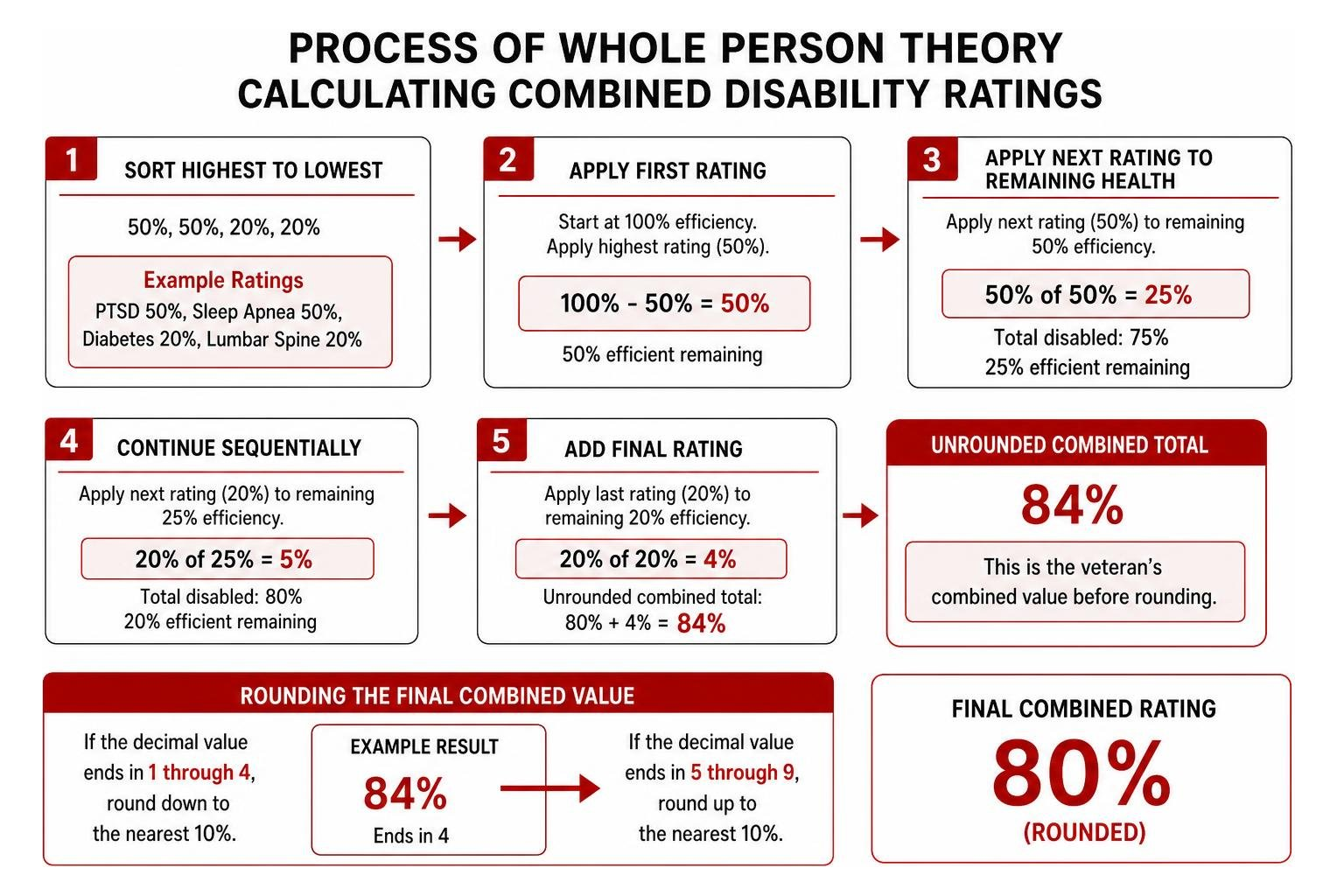
Once all non-bilateral conditions are calculated, the VA applies statutory rounding rules:
- Any combined decimal value ending in 1 through 4 is rounded down to the nearest 10%.
- Any combined decimal value ending in 5 through 9 is rounded up to the nearest 10%.
In our example, 84% rounds down to a final combined rating of 80%.
Understanding this non-additive principle is vital. If a veteran has two separate 10% ratings, the first 10% leaves 90% efficiency. The second 10% takes 10% of that 90% (which is 9%), yielding an unrounded combined rating of 19%. Following the rounding rule, 19% rounds up to a final 20% rating.
To review how the government sets these schedules, check out the official VA disability rating guidance and reference our comprehensive VA disability rating chart guide. If you have pending claims, calculating VA retroactive benefits also relies directly on these same whole-person tables across previous fiscal years.
| Individual Disability Ratings | Simple Addition Sum | VA Whole Person Combined (Exact) | Final Rounded VA Rating |
|---|---|---|---|
| 10% + 10% | 20% | 19% | 20% |
| 50% + 30% | 80% | 65% | 70% |
| 50% + 50% | 100% | 75% | 80% |
| 50% + 50% + 20% + 20% | 140% | 84% | 80% |
| 70% + 40% + 20% | 130% | 86% | 90% |
How To Find The Best VA Disability Calculator For 2027
Finding an accurate rating tool requires looking past basic web forms that merely sum up numbers. In current planning for late 2026 and fiscal year 2027, an online calculator must incorporate intricate statutory rules established under Title 38 of the Code of Federal Regulations (38 CFR).
A high-performing digital calculator does not guess; it mimics the precise decision tree used by Veterans Benefits Administration (VBA) adjudicators. By law, VA disability compensation matches the cost-of-living adjustment (COLA) determined by the Social Security Administration based on the Consumer Price Index (CPI-W). When seeking a modern calculation tool, ensure it clearly indicates which fiscal year rate baseline it is using and whether upcoming COLA adjustments have been formalized or are projected estimates.
Essential Evaluation Criteria: How To Find The Best VA Disability Calculator For 2027
To make sure you are relying on accurate numbers, evaluate any 2027 tool against these core technical benchmarks:
- Annual COLA Update Transparency: Look for calculators that state the exact date of their rate tables. For instance, reputable tools update their underlying data annually as soon as new rates are finalized each December. You can cross-reference payment projections with our 2026 and 2027 VA disability rates overview.
- Algorithmic Accuracy & Order of Operations: The tool must automatically rank conditions from highest to lowest percentage before combining them.
- Data Privacy & Security Standards: You should never be required to input personally identifiable information (such as your Social Security Number, date of birth, or home address) just to calculate an estimated compensation amount.
- Dynamic Real-Time Recalculation: The interface should let you add, modify, or remove conditions on the fly to see how individual rating increases alter your overall combined bracket.
Features to Look For: How To Find The Best VA Disability Calculator For 2027
A bare-bones percentage counter will not give you an actionable monthly dollar figure. The best calculators for 2027 include advanced regulatory features:
- Automated Bilateral Factor Engine: It must let you specify whether an injury is on the left or right side of your body and automatically combine paired limbs before factoring in the rest of your body.
- Comprehensive Dependent Tiers: Monthly compensation jumps significantly once you reach a 30% disability rating if you have eligible dependents. Top tools include options for spouses, dependent parents, minor children, and student dependents aged 18 to 23.
- Special Monthly Compensation (SMC) & TDIU Prompts: If you cannot maintain substantially gainful employment due to your conditions, or if you suffer from severe functional loss (such as limb loss or severe visual impairment), the tool should alert you to Total Disability based on Individual Unemployability (TDIU) or SMC brackets.
For a broader breakdown of evolving VBA policy, read our complete guide to navigating VA disability changes.
Extremity Ratings and Applying the Bilateral Factor Correctly
One of the most common reasons online calculators provide incorrect estimates is the misapplication of the Bilateral Factor (38 CFR § 4.26).
The bilateral factor is an additional 10% boost added to the combined rating of disabilities that affect paired extremities—both arms, both legs, or paired skeletal muscles. The VA recognizes that having service-connected disabilities on opposite sides of your body causes an exponential increase in physical impairment.

Extremity vs. Non-Extremity Conditions
To use a 2027 disability calculator correctly, you must know how to categorize your medical conditions:
- Extremity Conditions: Any service-connected issue affecting your upper extremities (shoulders, elbows, wrists, hands, fingers) or lower extremities (hips, knees, ankles, feet, toes).
- Non-Extremity Conditions: Internal, systemic, or axial conditions. These include mental health (PTSD, depression, generalized anxiety), respiratory disorders (asthma, sleep apnea), digestive problems (GERD, IBS), cardiovascular conditions, and spinal issues (cervical or lumbar strain).
How the Bilateral Calculation Works
A reliable calculator does not simply add 10% to your final score. Instead, it follows a strict regulatory sequence:
- It identifies all disabilities affecting paired extremities (for example, a 20% left knee condition and a 10% right ankle condition).
- It combines these extremity conditions together using whole-person math (20% combined with 10% = 28%).
- It calculates 10% of that combined extremity value (10% of 28% = 2.8%).
- It adds that 2.8% to the extremity total (28% + 2.8% = 30.8%).
- This total (30.8%) is then treated as a single combined condition and combined with your non-extremity ratings (such as a 50% PTSD rating) using standard whole-person math.
- Only after all conditions are combined is the final number rounded to the nearest 10%.
If you enter paired conditions as generic non-extremity disabilities into a poorly designed calculator, you will miss out on this statutory boost. Review our 38 CFR knee and extremity rating guidelines to see how specific joint measurements and range-of-motion limitations factor into extremity ratings.
Critical Data to Gather Before Using an Online Calculator
To generate an accurate monthly compensation estimate for 2027, gather your service and medical records before sitting down with an online calculator.
Here is the checklist of required information:
- Official VA Decision Letters: Your exact diagnostic codes and individual percentage ratings for every service-connected condition.
- Anatomical Specifics: Documentation identifying whether extremity conditions affect the left side, right side, or both.
- Spousal Status: Verification of legal marriage, including whether your spouse requires Aid and Attendance.
- Dependent Children: Details for children under 18, as well as unmarried dependent children between ages 18 and 23 who are enrolled in an approved college or vocational program.
- Dependent Parents: Documentation showing whether one or both of your parents are financially dependent on you.
- Employment Status: Evidence showing whether your service-connected disabilities prevent you from securing or maintaining substantially gainful employment.
The financial difference between rating tiers is substantial. In 2026 baseline figures, a single veteran rated at 80% receives approximately $2,044.89 per month, whereas a single veteran rated at 100% receives $3,831.30 per month. That represents nearly double the monthly payment for a 20% jump in combined rating.
If your ratings do not combine to 100% mathematically, but your service-connected disabilities prevent you from working, learning about understanding VA TDIU eligibility and rates can help you secure compensation at the full 100% rate. For higher tier planning, see our breakdown of 100 percent disabled veteran compensation.
Common Calculator Errors and How to Avoid Them
Even with the best online tools, user input errors can lead to misleading estimates. Avoid these frequent pitfalls:
- Using Simple Addition: Assuming that individual ratings add up normally (e.g., believing 30% + 30% = 60%, when it actually equals 51%, rounding down to 50%).
- Misclassifying Bilateral Conditions: Failing to designate left versus right limbs, causing the calculator to skip the 10% bilateral factor boost.
- Omitting Eligible Dependents: Forgetting that dependent allowances begin at a combined rating of 30%. Failing to add your spouse or children leads to an underestimated monthly payment.
- Relying on Expired Rate Tables: Using outdated calculators that do not incorporate recent cost-of-living adjustments.
- Overlooking Secondary Service Connection: Failing to account for conditions caused or aggravated by an existing service-connected disability (e.g., radiculopathy secondary to a back injury).
- Rounding Prematurely: Rounding intermediate steps to the nearest 10% instead of keeping exact decimal values until the final step.
If your calculated rating shows you are close to the next compensation threshold, review our critical steps to increase your VA disability rating and our guide on how to file a VA disability claim.
Frequently Asked Questions about VA Disability Calculators
Why is my calculator result different from simply adding my disability percentages?
The VA does not use simple addition. Under 38 CFR Part 4, all disability compensation is calculated using the Whole Person Theory. The VA treats you as starting with 100% efficiency. Each disability percentage is subtracted only from your remaining non-disabled efficiency.
Because each subsequent rating applies to a smaller remaining percentage of health, the combined total is always less than the sum of the individual ratings.
How do dependents change my monthly VA disability payment?
If your combined disability rating is 10% or 20%, you receive a flat monthly rate regardless of dependents. However, once your combined rating reaches 30% or higher, the VA adds additional monthly compensation for:
- A spouse
- Dependent children under age 18
- Children between 18 and 23 in school
- Dependent parents
- A spouse receiving Aid and Attendance
Adding dependents can increase your monthly compensation by hundreds of dollars depending on your rating tier and family size.
When do 2027 VA disability compensation rate adjustments take effect?
VA disability compensation rate changes match the annual Social Security cost-of-living adjustment (COLA). The Social Security Administration typically announces the finalized COLA percentage in mid-October based on third-quarter Consumer Price Index (CPI-W) data.
By law, the new compensation rates go into effect on December 1 of each year and appear in veterans’ monthly benefit payments starting on January 1.
Conclusion
Navigating VA disability compensation does not have to be an overwhelming mathematical chore. By understanding the whole person theory, ensuring the bilateral factor is properly applied to paired extremities, and using a modern calculator aligned with current 38 CFR standards, you can project your monthly benefits with complete confidence.
At USMilitary.com, we are committed to providing our nation’s service members, veterans, and military families with transparent, unbiased resources. Whether you are preparing to submit your initial application, filing for an increased rating, or planning your family finances for 2027, take the next step by exploring our comprehensive guide to applying for VA disability benefits today.
Free for Service Members & Veterans
Get the military benefits intel no one tells you about.
Weekly updates on VA benefits, pay changes, and money tips — free for service members and veterans.
No spam. Unsubscribe anytime. Your info is never shared.


