Why Becoming an Army Ranger Officer is One of the Military’s Toughest Challenges
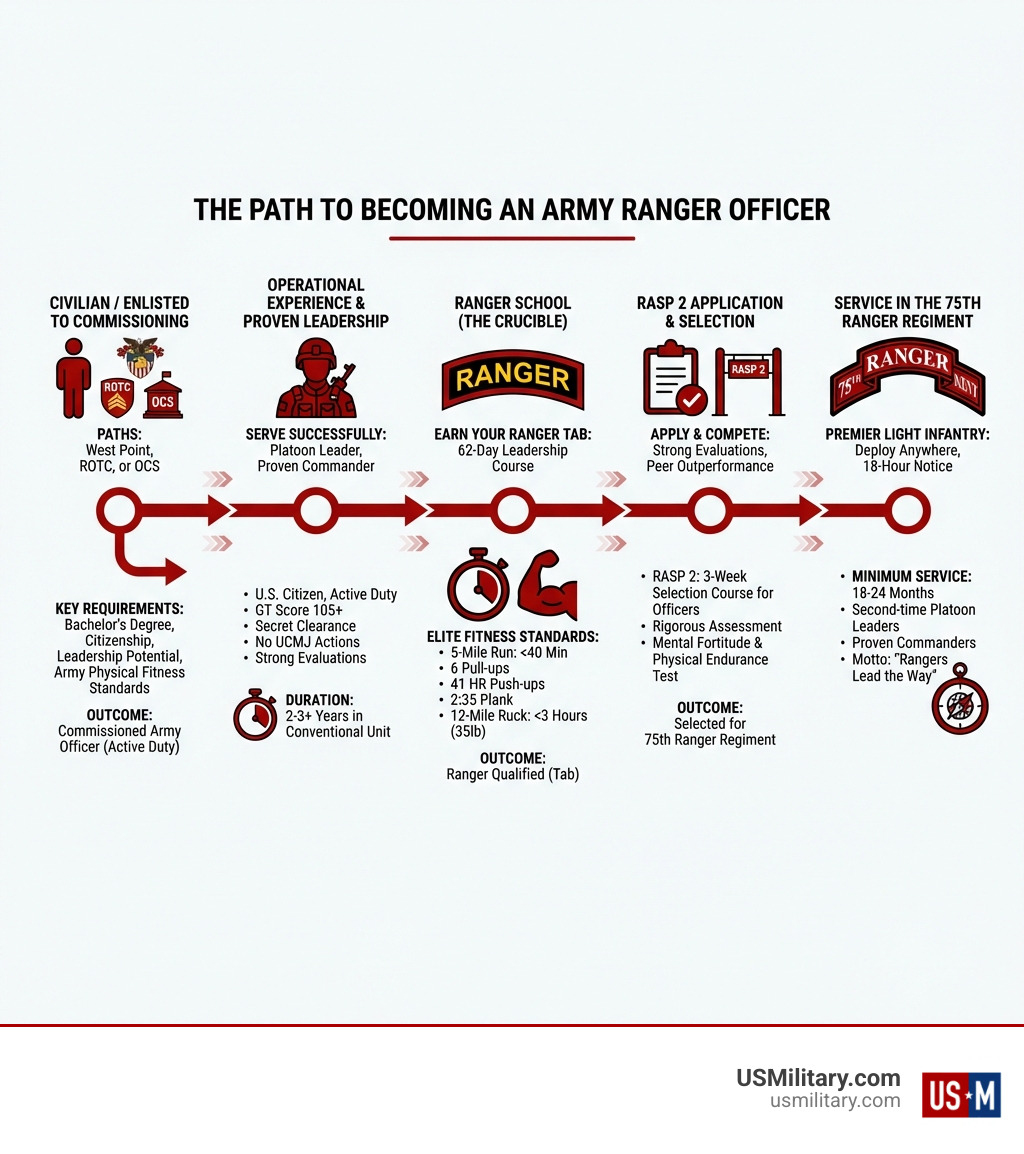
How to become an army ranger officer requires navigating a highly selective process that tests your physical endurance, mental fortitude, and leadership. Here’s the essential path:
Quick Answer: The Path to Ranger Officer
- Become a commissioned Army officer (through West Point, ROTC, or OCS)
- Serve successfully in an operational unit as a proven leader
- Meet strict requirements: U.S. citizen, active duty, GT score 105+, secret clearance, no UCMJ actions
- Achieve elite fitness standards: 5-mile run under 40 minutes, 6 pull-ups, 12-mile ruck march
- Earn your Ranger Tab at Ranger School (62-day leadership course)
- Apply to the 75th Ranger Regiment through proper channels with strong evaluations
- Pass RASP 2 (3-week selection course for officers)
- Serve 18-24 months minimum in the Regiment
The 75th Ranger Regiment seeks the best officers—proven commanders who have outperformed their peers and shown exceptional leadership under pressure.
The journey is difficult because Rangers are the premier light infantry force in U.S. Special Operations, ready to deploy worldwide in 18 hours. Their motto, “Rangers Lead the Way,” starts with officers proven to handle the impossible.
Unlike enlisted soldiers with an Option 40 contract, officers must first earn a commission, prove themselves in conventional units, and then compete for limited slots. Your path starts years before applying to RASP 2.
The physical standards eliminate most candidates, but fitness is just the entry fee. Your leadership record, evaluations, and reputation matter even more.
I’m Larry Fowler, publisher of USMilitary.com. Since 2007, I’ve helped thousands understand complex military careers. This guide breaks down every requirement and competitive factor for becoming a Ranger officer.
Foundational Requirements: Are You Ranger Material?
To lead Rangers, you must meet non-negotiable eligibility requirements, including citizenship, active-duty status, mental aptitude, and a spotless record.

The 75th Ranger Regiment only accepts U.S. citizens who are on active duty and volunteer for the assignment. A General Technical (GT) score of at least 105 is critical (100+ may be waiverable), indicating your aptitude for technical information.
You must be eligible for at least a Secret clearance (often Top Secret) to handle sensitive information. The Regiment also demands impeccable character, with no pending UCMJ actions or drug/alcohol incidents in the last 24 months. Sound judgment is non-negotiable.
You must also volunteer for Airborne training, a core Ranger capability. A PULHES profile of 111221 or better is required, as the role demands peak physical fitness, good eyesight, and emotional stability. Exploring commissioning sources like Army West Point Education helps build a strong foundation.
Basic Eligibility Checklist
To summarize, here’s a quick checklist for the core requirements to become an Army Ranger officer:
- U.S. Citizenship: A fundamental requirement for all members of the 75th Ranger Regiment.
- Age Requirements: While specific age limits for Ranger officers aren’t always explicitly listed, officers typically commission between 19 and 32 years old, with some roles extending to 41.
- Active-Duty Volunteer: You must be an active-duty soldier and voluntarily seek assignment to the Regiment.
- GT Score of 105+: A General Technical score of at least 105 is generally required, though a 100+ may be considered with a waiver.
- Secret or Top Secret Clearance Eligibility: You must be able to obtain and maintain the necessary security clearance.
- No Drug or Alcohol Incidents in Last 24 Months: A clean record regarding substance abuse is essential, demonstrating good judgment and reliability.
The Unwavering Physical Standards
Physical prowess is about survival and mission success. The 75th Ranger Regiment has an “unwavering” standard for physical fitness, assessed through the Ranger Fitness Test (RFT). The minimums include a 5-mile run in under 40 minutes, 41 hand-release push-ups, 6 pull-ups, a 2:35 plank, a 12-mile ruck march in under 3 hours, and a Water Survival Assessment. These are just the minimums; competitive candidates far exceed them, often after 12+ weeks of dedicated training. Resources like Army Educational ROTC Opportunities can help build this foundation early in your career.
The Commissioning Pathways to an Army Officership
Unlike enlisted Rangers, an officer’s journey begins with earning a commission. You must become an officer, gain experience, and then compete for a slot in the 75th Ranger Regiment, building your leadership foundation long before you apply.
For Civilians: From College to Commission
Civilians can earn a commission through three primary routes:
- West Point (United States Military Academy): This prestigious four-year academy provides an undergraduate education, commissioning you as a Second Lieutenant while instilling military discipline and leadership.
- ROTC (Reserve Officer Training Corps): Attend a civilian college while receiving military training. You’ll commission as a Second Lieutenant upon graduation. Many future Ranger officers come from ROTC.
- Officer Candidate School (OCS): If you have a bachelor’s degree, OCS is a 12-week accelerated commissioning course at Fort Moore, GA. It’s a competitive but viable option focused on leadership and military skills.
Regardless of the path, a bachelor’s degree is a prerequisite for civilian applicants to OCS and is integral to West Point and ROTC. This academic and leadership foundation is the bedrock of your officer career. For more details, refer to our guide on Army Officer Candidate School.
For Enlisted Soldiers and Prior Service
Enlisted soldiers and those with prior service have unique pathways to becoming a Ranger officer.
- Officer Candidate School (OCS): Enlisted soldiers with at least 90 college credits can apply to OCS, leveraging their military experience to transition into leadership roles.
- Warrant Officer Path: Warrant Officers are technical experts in fields like Logistics, Intel, and Signal. NCOs selected for Warrant Officer Candidate School (WOCS) may be invited to RASP 2, offering a direct route for specialists to serve in the Regiment. Learn more about Army Warrant Officer Careers.
- Green to Gold Program: This program helps active-duty enlisted soldiers complete a bachelor’s degree and earn a commission through ROTC.
These pathways highlight that the Army values both academic routes and the experience of its enlisted force, providing multiple avenues for dedicated individuals to become officers.
The Two Gates: Ranger School vs. RASP
A common misconception is that Ranger School and RASP are the same. They are distinct programs with different purposes, a crucial distinction for aspiring Ranger officers.
| Feature | Ranger School | RASP (Ranger Assessment and Selection Program) |
|---|---|---|
| Purpose | Forge premier small unit leaders (leadership course) | Select and prepare soldiers for assignment to the 75th Ranger Regiment (selection program) |
| Outcome | Earn the Ranger Tab; return to your unit | Assignment to the 75th Ranger Regiment; wear the tan beret |
| Attendance | Voluntary; open to all branches/allied countries; officers & enlisted | Mandatory for 75th RR assignment; RASP 1 (enlisted), RASP 2 (officers & WOs) |
| Length | Approximately 62 days | 8 weeks total (RASP 1 is 5 weeks, RASP 2 is 3 weeks) |
Ranger School: Forging Premier Leaders
Ranger School is the Army’s premier leadership course. This grueling 62-day program develops small unit leaders under extreme stress, culminating in the coveted Ranger Tab.
However, earning the Ranger Tab does not grant assignment to the 75th Ranger Regiment. Graduates return to their original units with improved leadership skills. This distinction is vital for anyone asking how to become an army ranger officer.
Ranger School has three challenging phases:
✉ Get updates like this in your inbox
Weekly VA benefit changes, pay updates, and money tips for service members, veterans, and military families. Free, no spam.
- Darby Phase (Fort Moore, GA): Focuses on squad-level operations and physical conditioning.
- Mountain Phase (Camp Merrill, GA): Teaches combat patrols in mountainous terrain.
- Florida Phase (Eglin AFB, FL): Tests tactical skills in swamp and coastal environments.
Throughout, candidates operate on minimal sleep and food, pushing their limits to develop leadership capacity. A detailed Ranger School packing list is essential for preparation.
RASP: The Key to the 75th Ranger Regiment
The Ranger Assessment and Selection Program (RASP) is the mandatory gateway to the 75th Ranger Regiment. Its purpose is to assess and train individuals for assignment to a Ranger battalion. Passing RASP is required to wear the tan beret.
RASP is split by rank:
- RASP 1: This 5-week course is for Junior Noncommissioned Officers and Enlisted Soldiers (pay grades E-1 through E-5).
- RASP 2: A 3-week course for Senior NCOs, Officers, and Warrant Officers.
For officers, RASP 2 tests and refines critical skills for the unique demands of the 75th Ranger Regiment. It teaches Regimental tactics and clarifies leadership expectations. While Ranger School teaches small unit leadership, RASP teaches leadership within the Regiment.
How to Become an Army Ranger Officer: The Application and Selection Process
The path to becoming a Ranger officer is incredibly competitive, demanding toughness, a stellar leadership record, and strategic career planning. You must understand what the 75th Ranger Regiment seeks in its leaders.
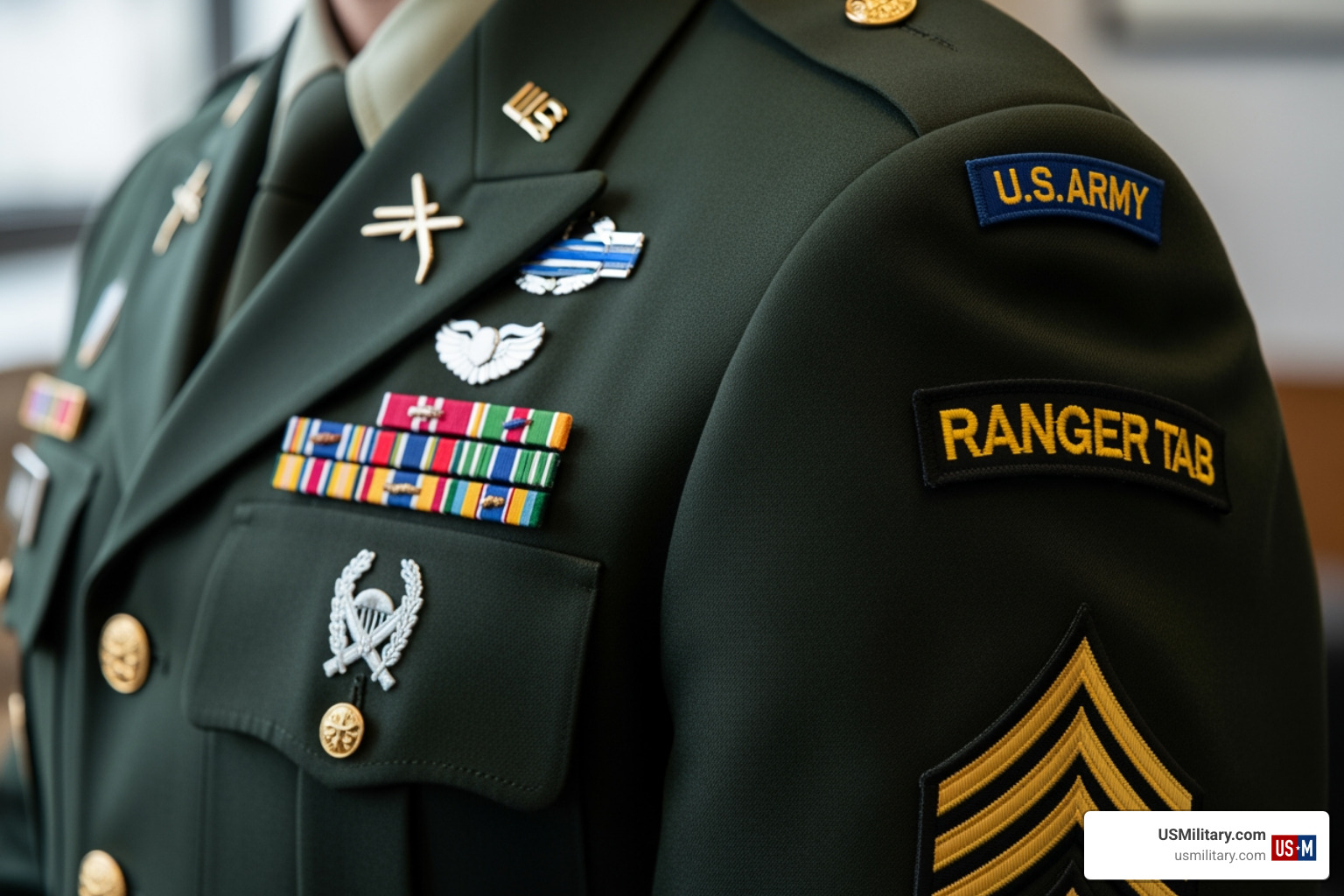
The Regiment is growing, creating more opportunities, but standards remain high. It seeks officers who are proven top performers from conventional units.
The Application Packet: Your First Step to Become an Army Ranger Officer
The formal application process is your chance to demonstrate your qualifications on paper before attending RASP 2.
An officer’s application packet typically includes:
- Initial Application via AIM Portal: Many applications begin through the Army’s Assignment Interactive Module (AIM).
- DA Form 4187: A personnel action form submitted through your chain of command requesting assignment.
- Letter of Intent: A one-page memo articulating your desire to serve in the Regiment.
- Letters of Recommendation (LORs): Up to four strongly worded LORs from your Rater and Senior Rater.
- Officer/Academic Evaluation Reports (OERs/AERs): All reports, showing a strong record of superior performance (e.g., “Top Blocks,” “Commandant’s List”).
- Current APFT or ACFT Score Card: Proof of your physical fitness.
- Service Record Brief (SRB): A copy of your official service record.
- Ranger Physical: A current (within 18 months) physical stamped “AIRBORNE RANGER.”
- RASP 2 Pre-Screening Questionnaire: A required form to ensure you meet initial criteria.
The selection process is highly competitive, seeking experienced officers who have outperformed their peers. For unlisted branches, email 75officerrecruit@socom.mil to inquire about opportunities.
Competitive Qualifications: What it Takes to Become an Army Ranger Officer
Beyond the application, certain qualifications make an officer highly competitive for the 75th Ranger Regiment.
- Proven Leadership: A demonstrated history of effective leadership in operational units.
- Top Block OERs: Evaluations with “Majority ‘Top Blocks’ ACOM / MQ” and strong comments from your Senior Rater are critical.
- Commandant’s List / Honor Graduate: Superior performance in professional military education demonstrates your drive.
- Ranger Tab (Highly Recommended): It is generally required for officers attending RASP 2. Earning the tab makes you competitive and demonstrates foundational leadership skills.
- Relevant Military Schools: Excelling in schools like RSLC, IMLC, Jumpmaster, or UMO provides a significant advantage.
- Strong Physical Fitness Scores: Consistently high scores on the APFT or ACFT showcase your dedication to physical readiness.
- Time on Station and Utilization: A minimum of 12 months time on station is required before a PCS. Officers are expected to serve 18-24 months in the Regiment.
In-Demand Officer MOS for the 75th Ranger Regiment
The 75th Ranger Regiment requires a wide array of officer MOSs beyond Infantry (11A) to support its complex operations. Officers must hold an MOS found in the Regiment. Due to recent growth, positions in most MOSs have increased. Key in-demand officer MOSs include:
- Infantry Officer (11A): The core of the fighting force.
- Military Intelligence Officer (35A): Provides crucial intelligence analysis. Warrants also serve in MI roles (350F, 351L).
- Signal Corps Officer (25A): Manages vital communications and network operations. Warrants also serve in Signal roles (255A, 255N).
- Logistics Officer (90A): Manages supplies, equipment, and transportation. Warrants also serve in Logistics roles (920A).
- Cyber Operations Officer (17A): Focuses on offensive and defensive cyber operations.
- Fires Officer (13A): Coordinates indirect fire support. Warrants also serve in Fires roles.
- Human Resources Officer (42A): Manages personnel within the Regiment. Warrants also serve in HR roles (420A).
Some support branches manage “Ranger Regiment Pipelines,” identifying talented junior officers for potential Ranger School and RASP 2 attendance to ensure a flow of specialized talent. Explore more Army Officer Careers to learn about different roles.
Life and Career as a Ranger Officer
Serving as a Ranger officer is a lifestyle of intense training, high operational tempo, and unique leadership opportunities that shape your military and post-service career.
Ranger Officers bring exceptional leadership and operational expertise, often serving as “second-time” platoon leaders or commanders. They apply experience gained in conventional units to the special operations environment.
Career Progression and Leadership Roles
Career progression in the 75th Ranger Regiment is challenging and accelerated:
- Second-time Platoon Leader: Lead highly trained Rangers, applying tactics unique to the Regiment.
- Company Commander: Take on immense responsibility for a company’s readiness, training, and operational execution.
- Battalion Staff: Serve in staff positions, planning and executing complex special operations missions.
- 18-24 Month Utilization: A minimum service of 18-24 months is expected, ensuring immersion in the Ranger culture.
- Continuous Training: Non-deployed time is spent on physical fitness, skill refinement, and specialized courses to maintain peak readiness for an 18-hour deployment notice.
- High Operational Tempo: As a Special Operations force of choice, expect a high operational tempo and frequent deployments.
Ranger Warrant Officers provide critical technical expertise in Logistics, MI, Signal, HR, and Fires, ensuring the smooth function of complex operations.
Long-Term Benefits and Post-Service Opportunities
Experience as a Ranger officer provides a robust foundation for civilian success.
- Elite Leadership Experience: Leading the world’s most capable soldiers provides highly sought-after leadership, decision-making, and crisis management skills.
- Advanced Training: You receive unparalleled special skills training in combat, survival, and tactics, fostering a continuous learning mindset.
- SOCOM Network: Service in the 75th connects you to a vast network of capable individuals, a significant asset for future careers.
- Civilian Careers: Highly transferable skills like project management, strategic planning, and resilience lead to success in corporate leadership, consulting, and entrepreneurship.
- Post-Graduate Education: Many officers use their GI Bill benefits and service credibility to pursue advanced degrees at top-tier universities.
The discipline, integrity, and problem-solving abilities cultivated as a Ranger officer are qualities that are universally admired and in high demand, ensuring a fulfilling and impactful career both during and after your service.
Frequently Asked Questions about Becoming a Ranger Officer
We understand that the path to becoming an Army Ranger officer can seem complex. Here, we address some of the most common questions to provide clarity.
Do I need a Ranger Tab to apply to the 75th Ranger Regiment?
While not an absolute prerequisite to apply, a Ranger Tab is highly recommended and generally required for officers to attend RASP 2. Exceptions require approval from the Regimental Commander. To be competitive, you should earn your Ranger Tab, as it signifies proven leadership ability under extreme duress. Non-Ranger qualified applicants must attend Ranger School through their current unit.
Can I join the 75th Ranger Regiment directly from OCS, ROTC, or West Point?
It is extremely rare for an officer to join the 75th Ranger Regiment directly after commissioning. The Regiment seeks experienced officers who have already proven themselves as leaders in conventional units. In exceptionally rare cases (fewer than 5 per year), a talented junior officer—usually a prior-service, Ranger-qualified 2nd Lieutenant—may be selected early. For nearly everyone, the path involves commissioning, serving successfully in a conventional unit, and then applying.
Are women allowed to serve as Ranger Officers in the 75th Ranger Regiment?
According to current recruiting information, officer positions within the 75th Ranger Regiment are open to males only. While women can earn the Ranger Tab by graduating from Army Ranger School, the combat-specific officer roles in the Regiment are currently restricted to men.
Conclusion
The journey to become an Army Ranger officer is undoubtedly one of the most demanding and prestigious paths in the U.S. Army. It requires an unwavering commitment to elite standards, exceptional physical and mental toughness, and a proven track record of leadership excellence. From earning your commission and excelling in conventional units to conquering Ranger School and passing the rigorous RASP 2, every step is designed to forge the most capable leaders for the 75th Ranger Regiment.
As USMilitary.com, we are committed to providing you with the most accurate and up-to-date information to steer these complex career paths. If you’re ready to accept the challenge and lead the way, the opportunity awaits. Explore our comprehensive guide, Ranger Ready: The Ultimate Guide to Joining the Army’s Toughest, for even more insights into joining the ranks of these elite warriors.
Free for Service Members & Veterans
Get the military benefits intel no one tells you about.
Weekly updates on VA benefits, pay changes, and money tips — free for service members and veterans.
No spam. Unsubscribe anytime. Your info is never shared.


