What It Really Takes to Become an Army Ranger

Learning how to become an Army Ranger starts with understanding one thing: this is one of the most demanding paths in the entire U.S. military.
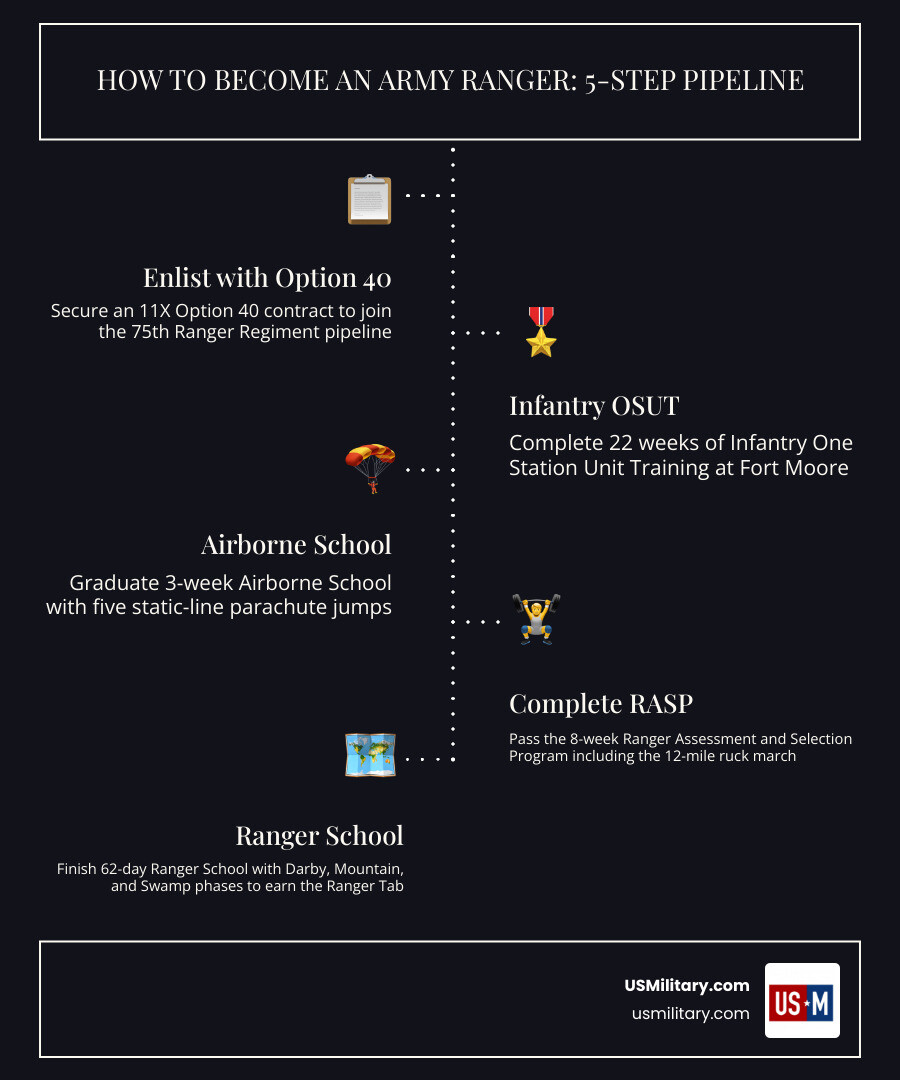
Here is the fast answer:
- Enlist with an Option 40 (11X) Ranger contract
- Complete Infantry OSUT (22 weeks)
- Graduate Airborne School (3 weeks)
- Pass RASP — the Ranger Assessment and Selection Program (8 weeks)
- Attend Ranger School (62 days) to earn the right to lead
Rangers serve in the 75th Ranger Regiment, the Army’s premier special operations light infantry unit. They run raids deep in enemy territory, seize airfields, and conduct special reconnaissance missions — tasks that demand both extreme physical fitness and sharp tactical skill.
This is not a path for everyone. Less than 50% of candidates make it through the first phase of Ranger School alone.
I’m Larry Fowler, publisher of USMilitary.com, and through nearly two decades of connecting civilians and veterans with accurate military career information — including detailed guidance on how to become an Army Ranger — I’ve helped thousands of readers navigate exactly this kind of high-stakes decision. Let’s walk through every step so you know what to expect.
How to become an Army Ranger terms to learn:
Requirements: How to Become an Army Ranger
Before you can even think about donning the tan beret or pinning the prestigious Ranger Tab to your shoulder, you must first clear the baseline military hurdles. The road to the 75th Ranger Regiment begins at a local recruiting office, but the physical, mental, and moral standards are set high from day one.
To enlist in the Army and pursue a slot in the Rangers, you must be a U.S. citizen between the ages of 17 and 34. You will also need a high school diploma or equivalent. From a testing standpoint, the Armed Services Vocational Aptitude Battery (ASVAB) is your first major gateway. You must achieve a General Technical (GT) score of 105 or higher to qualify for Ranger selection.
Additionally, you must meet the physical requirements of a “111121” or better on the PULHES medical classification scale, meaning you have excellent physical capacity, psychiatric stability, and perfect color vision. Because Rangers handle highly sensitive national security missions, you must also be eligible to obtain and maintain at least a Secret security clearance. You can explore the various specialized roles available within the regiment on the official Army Rangers career page.
Basic Eligibility Criteria
Beyond the administrative boxes, we must look at the physical and moral standards. The Army expects future Rangers to possess impeccable moral character. This means a clean record free of pending Uniform Code of Military Justice (UCMJ) actions, major civil convictions, or any history of drug or alcohol incidents within the past 24 months.
Financially and professionally, entering this elite pipeline is a major commitment, but the military rewards this level of dedication. If you are curious about how elite status translates to your bank account, you can read our breakdown of compensation in Your Ranger Paycheck: Breaking Down Active Duty Compensation.
Enlisted vs. Officer Pathways
The journey to the Regiment differs significantly depending on whether you enter as an enlisted soldier, a non-commissioned officer (NCO), or a commissioned officer.
- Enlisted Soldiers: Most Rangers begin here. You walk into a recruiting office, sign a contract with a guaranteed tryout (Option 40), and head straight from basic training to Airborne School and then RASP.
- NCOs (Non-Commissioned Officers): If you are already serving in the conventional Army as a Sergeant or Staff Sergeant, you can submit your Soldier Record Brief (SRB) to the Regiment’s recruiting team. If accepted, you will attend RASP to earn your spot.
- Commissioned Officers and Warrant Officers: Officers must apply through a highly competitive selection process. Instead of RASP 1, officers and senior NCOs must pass RASP 2—a intense three-week selection course focused on leadership under extreme pressure. For a complete guide on navigating this leadership path, check out Beyond Basic: Your Step-by-Step Guide to Becoming an Army Ranger Officer.
The 5-Step Pipeline to the 75th Ranger Regiment

To transform from a civilian into a highly trained special operations asset, you must complete a multi-stage training pipeline. This sequence is designed to progressively build your physical stamina, tactical competence, and mental resilience. To learn more about the broader scope of this journey, you can read the official Road to becoming an Army Ranger guide.
Step 1: Enlist with an Option 40 Contract to Learn How to Become an Army Ranger
The most direct way to secure your shot at the Regiment is by signing an Option 40 contract during enlistment. Typically tied to the 11X (Infantry) designation, an Option 40 contract guarantees you a slot in Airborne School and the Ranger Assessment and Selection Program (RASP)—provided you do not fail or wash out of the preceding training phases.
Be cautious when speaking with recruiters. Some may tell you that Option 40 contracts are unavailable or do not exist. If a recruiter insists you cannot get one, it is often wise to seek a second opinion or wait until a slot opens. Do not sign a standard contract unless you are prepared to take the much harder route of volunteering for RASP during your initial entry training. For more context on the pride, heritage, and identity associated with the uniform, read our comparison in Army Ranger vs Beret.
Step 2: Complete Infantry OSUT
Once enlisted, your training begins at Fort Moore, Georgia (formerly Fort Benning). If you are an infantryman, you will undergo One Station Unit Training (OSUT), which combines Basic Combat Training (BCT) and Advanced Individual Training (AIT) into one continuous 22-week block.
OSUT is designed to build the foundational skills of a rifleman: marksmanship, land navigation, radio communications, and squad-level tactics. For Ranger candidates, OSUT is merely a warm-up. You must maintain peak physical condition throughout these 22 weeks, as conventional training tempos do not always prepare your body for the extreme athletic demands of special operations. To understand the psychological and physical hurdles of this initial phase, read Beyond Basic Training: Unpacking the Challenges of Becoming an Army Ranger.
Step 3: Graduate Airborne School
After surviving OSUT, you will move down the road to the Basic Airborne Course (Airborne School), which lasts 3 weeks. Here, you will learn the mechanics of military static-line parachuting.
- Week 1 (Ground Week): You will learn how to wear the parachute harness, exit mock aircraft, and land safely using the Parachute Landing Fall (PLF) technique.
- Week 2 (Tower Week): You will practice exits from the 34-foot and 250-foot towers, reinforcing proper body position during the drop.
- Week 3 (Jump Week): You will execute five qualifying jumps from a C-130 or C-17 aircraft, including at least one night jump, to earn your “Jump Wings.”
Step 4: Conquer the Ranger Assessment and Selection Program (RASP)
Graduating Airborne School earns you a ticket to RASP, an 8-week selection program designed to screen out those who lack the physical grit or mental fortitude to serve in the 75th Ranger Regiment. RASP is split into two distinct phases:
- Phase 1 (5 Weeks): This phase focuses on physical and psychological testing. You will face endless physical training, land navigation courses, medical first responder training, and the infamous 12-mile ruck march carrying a 35-pound dry rucksack (which easily exceeds 45 pounds with water and gear) in full uniform under strict time limits.
- Phase 2 (3 Weeks): Here, the focus shifts to advanced tactical skills. You will learn direct-action combat techniques, airfield seizure procedures, explosives handling, and advanced marksmanship.
Throughout this grueling process, candidates are constantly evaluated on their adherence to the elite standards of the unit. To prepare your mind for this trial, familiarize yourself with the foundational values found in the Army Ranger Creed.
Step 5: Complete Ranger School to Lead
Once you pass RASP, you are awarded the Ranger Scroll and assigned to one of the battalions within the 75th Ranger Regiment. However, your training is far from over. To lead other Rangers—whether as a team leader, squad leader, or officer—you must volunteer for and graduate from Ranger School.
Ranger School is a legendary 62-day combat leadership course that tests your ability to lead small units under extreme sleep and food deprivation. It is divided into three distinct geographic phases:
- Darby Phase (Fort Moore, Georgia): Focuses on squad-level operations, physical endurance, and basic patrolling.
- Mountain Phase (Dahlonega, Georgia): Focuses on platoon-level operations, mountaineering, and navigating rugged terrain.
- Swamp Phase (Eglin Air Force Base, Florida): Focuses on waterborne operations, swamp survival, and coastal patrolling.
To explore the deep history and institutional evolution of this premier school, read more on the Ranger School – Wikipedia page.
Physical Fitness Standards and Training Changes
The physical standards required to become a Ranger are among the most demanding in the world. Recently, the military has updated its physical testing protocols to better align with functional, combat-focused fitness.
| Standard / Event | RASP RPA 2.1 | Ranger School RPA (Classic/New) |
|---|---|---|
| Push-Ups | Dead-stop push-ups | 49 standard (or 30 dead-stop in new RPA) |
| Sit-Ups / Core | High-rep core assessment | 59 standard sit-ups |
| Pull-Ups / Chin-Ups | Strict bodyweight (6 min) | 6 strict chin-ups (no kipping) |
| Running | 4-mile run (under 32 mins) | 5-mile run (under 40 mins) |
| Rucking | 12-mile ruck (35-lb dry load) | 12-mile foot march (47-lb combat load) |
| Combat Events | Skedco drag (90 lbs), Farmer’s carry | Sandbag lifts to platform, 800m run |
The Ultimate Physical Preparation on How to Become an Army Ranger
To prepare for these assessments, you cannot rely on simple weightlifting or casual jogging. You must build hybrid fitness: a mix of raw strength, muscular endurance, and aerobic capacity.
The classic Ranger Physical Assessment (RPA) requires you to complete 49 push-ups, 59 sit-ups, a 5-mile run in 40 minutes or less, and 6 strict chin-ups—all performed back-to-back with minimal rest. This is followed by a grueling 12-mile foot march carrying an average combat load of 47 pounds. To see how these physical standards stack up against other special operations pipelines, read our analysis of Army Ranger School vs Navy SEAL Training.
RASP RPA 2.1 vs. Ranger School RPA
Aspiring Rangers must understand that RASP and Ranger School utilize different physical fitness tests, despite their similar names.
RASP utilizes the RPA 2.1, which features functional combat movements. This includes an 800-meter run, a 6-foot wall climb, a 50-meter farmer’s carry with two 40-pound water cans, and a 100-meter Skedco drag pulling a 90-pound sled.
Meanwhile, Ranger School has updated its entry standards to emphasize functional strength under a strict time limit. Candidates must complete a series of events—including dead-stop push-ups, a sprint, and lifting 16 sandbags to a 68-inch platform—all within 14 minutes while wearing advanced combat uniforms and boots. For the most up-to-date candidate preparation packets and testing details, consult the official Fort Moore | Student Information portal.
Frequently Asked Questions About Becoming an Army Ranger
What is the difference between the Ranger Tab and the Ranger Scroll?
The difference comes down to school vs. unit:
- The Ranger Tab is a metal or cloth arch earned by graduating from the 62-day Ranger School. It is an individual tactical qualification. Any qualified service member from any branch can earn it and return to their regular unit wearing the Tab.
- The Ranger Scroll is the unit patch of the 75th Ranger Regiment. You can only wear the Scroll if you have passed RASP and are actively serving within the Regiment.
To dive deeper into how the Regiment compares to other elite Army units, read Army Ranger vs Green Beret: Who is Tougher?.
Can members of other military branches attend Ranger School?
Yes. Ranger School is a joint-service training environment. While it is run by the U.S. Army, slots are regularly open to qualified personnel from the Marine Corps, Navy, Air Force, and Space Force, as well as selected military students from allied foreign nations. You can find specific detachment information and branch prerequisites on the Ranger School joint-service page.
What qualifies someone for the US Army Ranger Association?
The US Army Ranger Association (USARA) preserves the heritage and camaraderie of those who have served. To qualify for Regular Membership, you must meet one of three criteria:
- Be awarded the Ranger Tab.
- Have served in a combat arms capacity for at least 12 months in the 75th Ranger Regiment or a unit within its direct historical lineage (such as WWII Ranger Battalions or Merrill’s Marauders).
- Have served in a combat arms role within the Regiment and earned a Combat Infantryman Badge (CIB), Combat Medical Badge (CMB), or Combat Action Badge (CAB).
You will need to submit official military documentation, such as a DD Form 214 or official Department of the Army orders, to verify your service.
Conclusion
The path of how to become an Army Ranger is simple to understand, yet incredibly difficult to execute. It demands absolute physical preparation, unwavering moral character, and a relentless mental drive to never quit.
At USMilitary.com, we are dedicated to providing the resources, guides, and support you need to make your military dreams a reality. If you are ready to take the next step toward joining the ranks of America’s elite warfighters, read our comprehensive guide, Ranger-Ready: The Ultimate Guide to Joining the Army’s Toughest.
Free for Service Members & Veterans
Get the military benefits intel no one tells you about.
Weekly updates on VA benefits, pay changes, and money tips — free for service members and veterans.
No spam. Unsubscribe anytime. Your info is never shared.


