What Are the 75th Ranger Regiment Battalions — and Where Are They Based?
The 75th Ranger Regiment battalions make up the U.S. Army’s premier large-scale Special Operations Force, operating under both the U.S. Army Special Operations Command (USSOCOM) and the Joint Special Operations Command (JSOC).
Here is a quick breakdown of the regiment’s battalion structure and home bases:
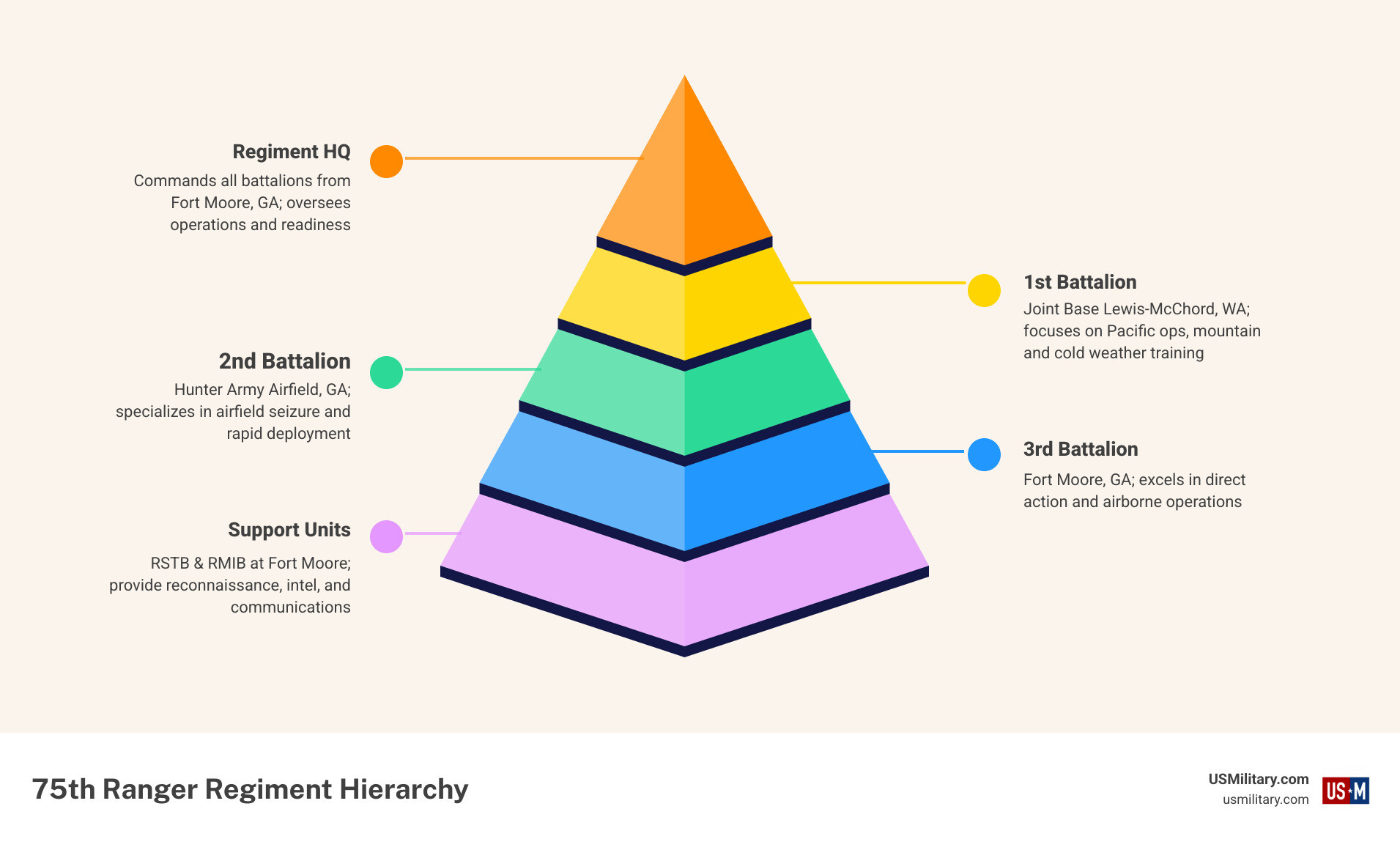
| Battalion | Location | Primary Focus |
|---|---|---|
| 1st Ranger Battalion | Hunter Army Airfield, Georgia | Direct action, airfield seizure |
| 2nd Ranger Battalion | Joint Base Lewis-McChord, Washington | Pacific reach, mountain/cold weather ops |
| 3rd Ranger Battalion | Fort Moore, Georgia | Direct action, airborne operations |
| Regimental Special Troops Battalion (RSTB) | Fort Moore, Georgia | Reconnaissance, intelligence, communications |
| Regimental Military Intelligence Battalion (RMIB) | Fort Moore, Georgia | Multi-domain intelligence support |
Together, these five units form a force of 3,623 personnel — capable of deploying anywhere in the world within 18 hours of alert notification.
The regiment’s motto says it best: “Rangers Lead the Way.” That isn’t just a slogan. It describes how this force has operated across every major U.S. conflict from World War II to the Global War on Terror — always first in, always ready.
I’m Larry Fowler, publisher of the USMilitary.com Network since 2007, and I’ve spent nearly two decades helping active-duty service members, veterans, and military hopefuls navigate complex information — including everything related to 75th Ranger Regiment battalions and the paths that lead to serving in them. In the sections below, I’ll walk you through exactly how this regiment is built, where each battalion operates, and what it takes to earn your place among them.
Key terms for 75th ranger regiment battalions:
The Core Structure of the 75th Ranger Regiment Battalions

As we look at the unit today in April 2026, the 75th Ranger Regiment remains a uniquely flexible organization. It isn’t just a collection of infantrymen; it is a highly calibrated machine designed for high-stakes missions. The authorized strength of the Regiment is 3,623 personnel, which includes 3,566 military members and 57 civilian support staff.
While the Regiment is a large-scale force, it maintains the agility of a much smaller unit. This is largely due to how the 75th Ranger Regiment battalions are organized. Each of the three main “line” battalions—the 1st, 2nd, and 3rd—is roughly 600 Rangers strong. To understand the scale of the force, you can look at exactly how many Rangers exist today across the entire Army.
| Feature | 1st Battalion | 2nd Battalion | 3rd Battalion |
|---|---|---|---|
| Base | Hunter Army Airfield, GA | Joint Base Lewis-McChord, WA | Fort Moore, GA |
| Established (Modern) | 1974 | 1974 | 1984 |
| Environment focus | Coastal/Airfield Seizure | Mountain/Pacific Rim | Airborne/Global Response |
Composition of the 75th Ranger Regiment Battalions
The internal “meat and potatoes” of a Ranger battalion is the rifle company. A standard Ranger rifle company consists of 152 Rangers. These companies are further divided into three rifle platoons and a machine gun squad.
We also see specialized sections that give the battalion its heavy-hitting capabilities. Each battalion includes a weapons platoon equipped with 60mm mortars, anti-armor sections (using the Carl Gustaf Recoilless Rifle and Javelin missiles), and highly skilled sniper teams. In recent years, the structure has expanded to include Delta and Echo Companies, which provide additional combat power and specialized support functions respectively, ensuring that a battalion has everything it needs to sustain itself in a fight.
Specialized Support Units: RSTB and RMIB
The modern battlefield requires more than just boots on the ground; it requires digital and technical dominance. That’s where the Regimental Special Troops Battalion (RSTB) and the Regimental Military Intelligence Battalion (RMIB) come in.
The RSTB, reactivated in 2007, is the “brain” and “nervous system” of the Regiment. It includes:
- Regimental Reconnaissance Company (RRC): A specialized element that often works with Joint Special Operations Command (JSOC) for high-level reconnaissance.
- Ranger Communications Company (RCC): Ensuring the Regiment can talk to anyone, anywhere, under any conditions.
- Ranger Operations Company (ROC): Managing the selection and training processes that keep the pipeline moving.
The RMIB provides the “eyes” for the force, handling everything from cyber operations to multi-domain intelligence support. This ensures that when the 75th Ranger Regiment battalions deploy, they aren’t just going in strong—they’re going in smart.
Strategic Locations: Where the Rangers Call Home
The sun never sets on the 75th Ranger Regiment, but they do have three primary “homes” in the United States. These locations aren’t chosen at random; they are strategically positioned to allow for rapid global reach and diverse training environments.
The 1st Battalion, 75th Ranger Regiment and the 3d Battalion, 75th Ranger Regiment are both located in Georgia, while the 2nd Battalion holds down the West Coast.
1st Ranger Battalion: Hunter Army Airfield, GA
Located in Savannah, Georgia, the 1st Ranger Battalion (1/75) is perfectly positioned for rapid deployment. Hunter Army Airfield provides immediate access to large transport aircraft, and its proximity to the coast allows for maritime training. 1/75 has a storied history of being the first called upon for airfield seizure missions, a specialty they have honed since their reactivation in 1974.
2nd Ranger Battalion: Joint Base Lewis-McChord, WA
Across the country in Washington state, the 2nd Ranger Battalion (2/75) provides the Regiment with a strategic foothold in the Pacific Northwest. Their location at Joint Base Lewis-McChord (JBLM) allows them to train in rugged, mountainous terrain and cold weather environments. This makes them the go-to choice for operations requiring high-altitude expertise or Pacific Rim contingencies.
3rd Ranger Battalion and Headquarters: Fort Moore, GA
Fort Moore (formerly Fort Benning) is the heart of the Ranger community. It houses the Regimental Headquarters, the 3rd Ranger Battalion, the RSTB, and the RMIB. Because Fort Moore is also the home of the U.S. Army Infantry School and the Airborne School, it serves as the primary training hub for the entire Regiment. If you are a Ranger, chances are you will spend a significant portion of your career at Fort Moore.
Roles and Missions: The 18-Hour Deployment Standard
The most impressive stat in the Ranger repertoire is the 18-hour notice. This means that within 18 hours of the phone ringing, a full Ranger battalion can be wheels-up and heading anywhere on the planet.
Their mission set is diverse, but it centers on “Direct Action.” This includes:
- Airfield Seizure: Parachuting into an enemy-held airport to secure it for following forces.
- Personnel Recovery: Rescuing POWs or isolated personnel (like the famous rescue of PFC Jessica Lynch).
- Special Reconnaissance: Gathering intelligence deep behind enemy lines.
- High-Value Target (HVT) Raids: Capturing or neutralizing enemy leaders.
While they share some similarities with other elite units, there are key differences between an Army Ranger and a Green Beret. While Green Berets focus on unconventional warfare and training foreign forces, Rangers are the Army’s premier “door kickers”—the large-scale raid force. This high-octane lifestyle comes with specialized compensation; you can see how it affects your bank account by breaking down active duty compensation and Ranger pay.
The ‘Big Five’ Philosophy
Readiness isn’t an accident. The 75th Ranger Regiment battalions maintain their edge by focusing on what they call the “Big Five.” Every Ranger must be a master of:
- Marksmanship: Being able to hit the target under any conditions.
- Physical Training: Maintaining the stamina to out-march and out-fight the enemy.
- Medical Training: Every Ranger is trained to provide life-saving care on the battlefield.
- Small-Unit Tactics: Mastery of squad and platoon-level movement.
- Mobility: Proficiency in various vehicle platforms and insertion methods.
Support to Joint Special Operations
Rangers often act as the “security envelope” for even more secretive units. During Operation Gothic Serpent in Somalia (the “Black Hawk Down” incident), Rangers provided the security cordon for Delta Force operators. This role as a Quick Reaction Force (QRF) makes them an indispensable partner in the Joint Special Operations community.
Training and Selection: RASP vs. Ranger School
One of the biggest points of confusion for civilians is the difference between “having a Ranger Tab” and “being a Ranger in the Regiment.” To serve in the 75th Ranger Regiment battalions, you must pass the Ranger Assessment and Selection Program (RASP).
- RASP 1: An 8-week course for junior enlisted Soldiers (E-1 through E-5). It tests physical and mental limits to ensure only the most disciplined join the line battalions.
- RASP 2: A 21-day (3-week) selection course for officers, warrant officers, and senior NCOs. It focuses on leadership under extreme stress.
If you are interested in the journey, you can read our guides on how to become an Army Ranger and check if you can qualify as an elite Army Ranger.
Distinguishing the Regiment from Ranger School Graduates
Ranger School is a 61-day leadership course open to the entire Army. Those who pass earn the Ranger Tab. However, only those who pass RASP and serve in the 75th Ranger Regiment wear the Tan Beret and the Ranger Scroll.
A Soldier in the 101st Airborne might have a Ranger Tab, but they are not “a Ranger” in the sense of being a member of the Regiment. The Regiment is an all-volunteer force where every member, from the cook to the commander, is a RASP graduate. For those aiming for the top, the life of an Army Ranger officer involves constant evaluation and a commitment to the highest standards of the “Ranger Creed.”
A Legacy of Valor: Combat Achievements and History
The lineage of the Rangers is as old as America itself, but the modern 75th Ranger Regiment battalions trace their DNA back to World War II. Major William Orlando Darby formed the 1st Ranger Battalion in 1942, leading them through North Africa and Italy. Meanwhile, in the Pacific, “Merrill’s Marauders” (the 5307th Composite Unit) were conducting long-range penetration missions that would eventually form the basis for the 75th’s designation.
Rangers have played a pivotal role in every major American conflict:
- WWII: Scaling the cliffs of Pointe du Hoc during Operation Overlord.
- Korea: Ranger companies conducted daring raids behind enemy lines.
- Vietnam: Long Range Reconnaissance Patrols (LRRPs) provided vital intelligence in the jungle.
- Modern Era: On December 17, 2020, the Regiment marked 7,000 consecutive days of combat operations.
Army Ranger careers date back to World War II service, and that history is felt in the halls of every battalion today.
Notable Modern Deployments
The 1980s saw the reactivation of the full Regiment as we know it. General Creighton Abrams famously chartered the battalions to be the “best light infantry unit in the world.” Since then, they have spearheaded:
- Operation Urgent Fury (1983): Seizing Point Salines Airfield in Grenada.
- Operation Just Cause (1989): Parachute assaults on airfields in Panama.
- Operation Enduring Freedom (2001): The jump on “Objective Rhino” in Afghanistan, which captured key logistical data and proved the viability of long-range parachute assaults.
Frequently Asked Questions about 75th Ranger Regiment Battalions
Where are the 75th Ranger Regiment battalions located?
The 1st Battalion is at Hunter Army Airfield (Savannah, GA). The 2nd Battalion is at Joint Base Lewis-McChord (Tacoma, WA). The 3rd Battalion, RSTB, RMIB, and Regimental HQ are all at Fort Moore (Columbus, GA).
How many personnel are in a Ranger battalion?
Each of the three line battalions (1st, 2nd, and 3rd) consists of approximately 600 Rangers. The entire Regiment, including support and intelligence battalions, has an authorized strength of 3,623 personnel.
What is the difference between RASP 1 and RASP 2?
RASP 1 is an 8-week course designed for junior enlisted Soldiers to join the Regiment. RASP 2 is a 3-week selection and orientation course for senior NCOs (Staff Sergeant and above) and Officers to ensure they are capable of leading in the Regiment’s unique environment.
Conclusion
The 75th Ranger Regiment battalions represent the pinnacle of American light infantry. From the coastal marshes of Georgia to the rugged mountains of Washington, these elite Soldiers maintain a state of constant readiness that is unmatched in the modern world.
At USMilitary.com, we are proud to provide the resources and guidance for those looking to join these storied ranks. Whether you are interested in the history of Merrill’s Marauders or looking for a path to RASP in 2026, the standard is high, the commitment is total, and the legacy is one of pure valor.
If you think you have what it takes to join the elite and “Lead the Way,” take the first step today and explore our ultimate guide to joining the Army’s toughest unit.
Free for Service Members & Veterans
Get the military benefits intel no one tells you about.
Weekly updates on VA benefits, pay changes, and money tips — free for service members and veterans.
No spam. Unsubscribe anytime. Your info is never shared.


