Why Burn Pit Exposure VA Benefits Matter for Every Eligible Veteran
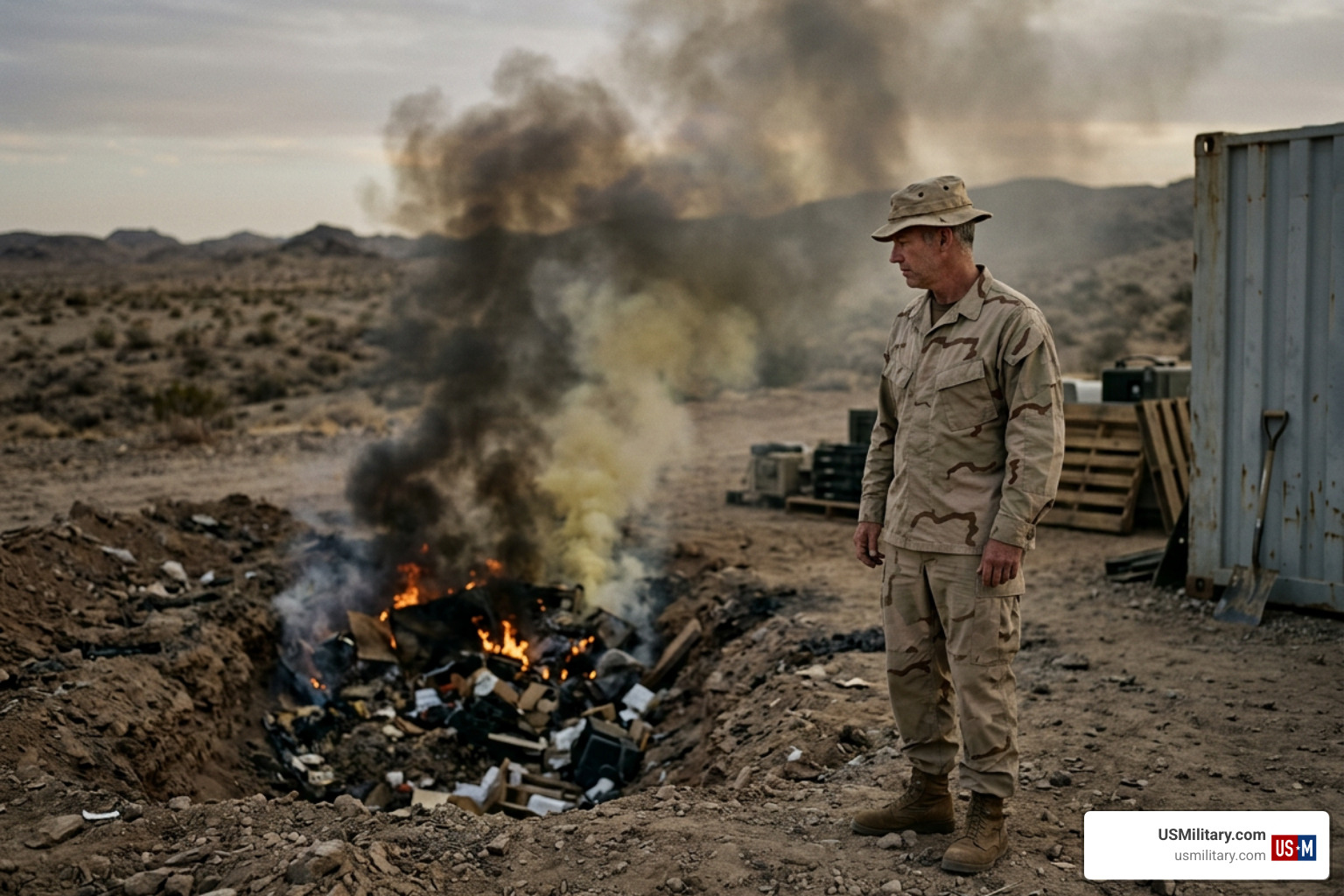
Burn Pit Exposure VA benefits are now more accessible than ever — and if you served in Iraq, Afghanistan, or other qualifying locations, you may be owed tax-free monthly compensation.
Here’s a quick summary of what you need to know:
| Question | Quick Answer |
|---|---|
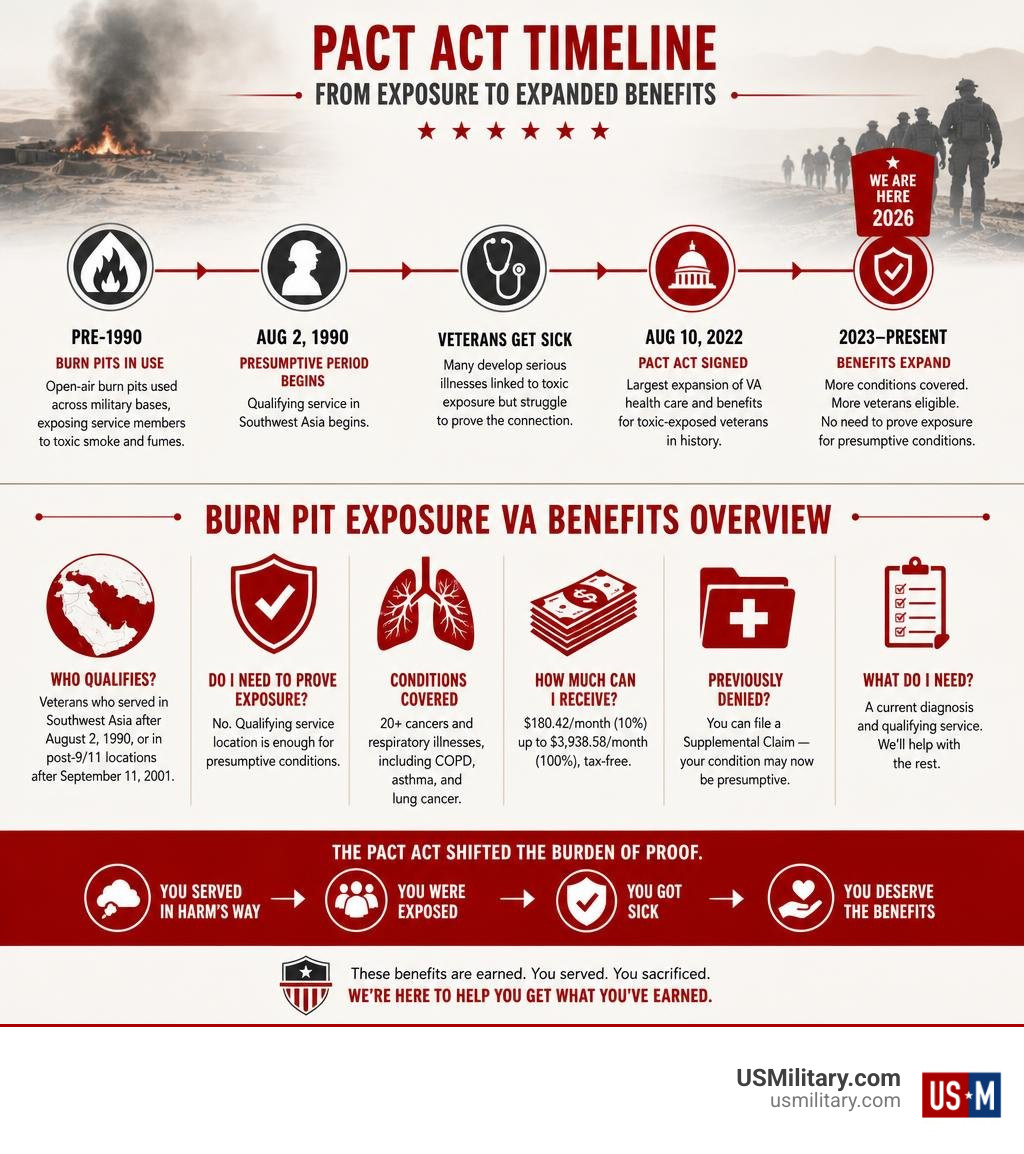
| What law expanded these benefits? | The PACT Act, signed August 10, 2022 |
| Who qualifies? | Veterans who served in Southwest Asia after August 2, 1990, or post-9/11 locations after September 11, 2001 |
| Do I need to prove exposure? | No — qualifying service location is enough for presumptive conditions |
| What conditions are covered? | 20+ cancers and respiratory illnesses, including COPD, asthma, and lung cancer |
| How much can I receive? | $180.42/month (10%) up to $3,938.58/month (100%), tax-free |
| What if I was previously denied? | You can file a Supplemental Claim — your condition may now be presumptive |
For generations, service members returned home carrying invisible wounds from toxic smoke, contaminated soil, and poisoned air. Burn pits — massive open-air waste fires that burned everything from jet fuel to medical waste — were standard operating procedure on military bases across Iraq, Afghanistan, and beyond. Approximately 5 million U.S. veterans have possible exposure to these open burn pits.
Many of those veterans got sick. Many filed claims. And many were denied — because they couldn’t prove that the smoke they breathed every day was what made them ill.
That changed in 2022.
The PACT Act — the largest toxic exposure health care and benefits expansion in VA history — shifted the burden of proof. The VA now presumes that qualifying service caused your condition. You no longer have to prove the link. You just need a diagnosis and qualifying service.
This guide walks you through everything: what counts as qualifying service, which conditions are covered, how to file, what to do if you were denied before, and how much compensation you may be entitled to.
I’m Larry Fowler, publisher of USMilitary.com and a longtime advocate for veterans navigating VA benefits — including the complex landscape of Burn Pit Exposure VA benefits — having tracked these issues for veterans since 2007. Whether you’re filing for the first time or refiling after a denial, this checklist is designed to cut through the confusion and help you claim what you’ve earned.
Burn Pit Exposure VA benefits helpful reading:
- VA Veteran Benefits
- Maximizing 100 Percent Disabled Veteran Benefits
- Will The VA Cover The In Home Care Costs For Wartime Veterans
Understanding Military Burn Pits and the PACT Act
To understand why Burn Pit Exposure VA benefits are so vital, we have to look at how military bases operated in combat zones for decades. On forward operating bases (FOBs) throughout Iraq, Afghanistan, and the Southwest Asia theater, there were no local garbage trucks or modern waste management facilities.
Instead, the military relied on open-air incinerators — commonly known as burn pits — to dispose of waste.
These pits burned day and night, often situated close to where service members lived, worked, and ate. The smoke was thick, black, and impossible to escape. For years, veterans returned home with severe respiratory issues, rare cancers, and cardiovascular problems, only to face a steep uphill battle when applying for VA benefits.
Historically, the burden of proof fell entirely on the veteran to show a direct medical link between their illness and the smoke they inhaled. Thanks to major legislative updates, that burden of proof has finally shifted.
What Were Military Burn Pits?
Military burn pits were massive, uncontrolled open-air waste disposal sites. The sheer scale of these operations was staggering. For example, the burn pit at Joint Base Balad in Iraq spanned over 10 acres, burning hundreds of tons of waste every single day.
These pits did not just burn paper and wood. They incinerated everything a military base generated, including:
- Plastics and water bottles
- Medical and hazardous waste (including amputated body parts and bloody gauze)
- Rubber tires and vehicle parts
- Unused munitions and explosives
- Chemical waste and paint
- Human waste (often mixed with JP-8 jet fuel to keep it burning)
When these items were burned together, they released a toxic cocktail of fine particulate matter (PM2.5), volatile organic compounds (VOCs), polycyclic aromatic hydrocarbons (PAHs), and toxic organic halogenated dioxins (including TCDD, the highly toxic compound found in Agent Orange).
Many of these airborne toxins are classified as Class A human carcinogens. When inhaled, this fine particulate matter penetrates deep into the lungs and enters the bloodstream, causing chronic, long-term cellular damage.
How the PACT Act Changed Burn Pit Exposure VA benefits
For years, the VA denied the vast majority of burn pit-related claims, often confusing them with general Gulf War Illness or citing a lack of “medical nexus” (proof of connection). This changed dramatically when the Sergeant First Class Heath Robinson Honoring our Promise to Address Comprehensive Toxics (PACT) Act was signed into law on August 10, 2022.
Named in honor of a National Guard soldier who died from a rare autoimmune disease and lung cancer caused by burn pit exposure, the PACT Act represents the most significant expansion of Veteran Affairs Benefits in modern history.
The core of the PACT Act is the establishment of a presumptive service connection. Under The PACT Act And Your VA Benefits | Veterans Affairs, if you served in a qualifying location during the designated timeframes and develop a presumptive condition, the VA legally assumes your military service caused the illness.
You do not need to prove that you stood next to a burn pit, nor do you need a doctor to write a complicated nexus letter linking your service to your disease. The law does that work for you.
To learn more about the strategic advantages of this law, check out this comprehensive Burn pit PACT Act VA Claim: Guide to Presumptive Conditions.
Qualifying for Burn Pit Exposure VA benefits: Locations and Presumptive Conditions
To qualify for Burn Pit Exposure VA benefits under the presumptive rules, you must meet three basic requirements:
- A diagnosed qualifying condition from a medical professional.
- Qualifying service in an eligible location and timeframe.
- A discharge status that is honorable or under conditions other than dishonorable.
As part of your ongoing care, we highly recommend getting a toxic exposure screening at your local VA medical center. These screenings are quick, non-invasive, and help document your exposure history in your official medical file.
Eligible Service Locations and Time Periods
The VA presumes exposure to burn pits and other airborne hazards if you served in any of the following locations during these specific timeframes:
On or after August 2, 1990:
- Bahrain, Iraq, Kuwait, Oman, Qatar, Saudi Arabia, Somalia, the United Arab Emirates (UAE), and the Gulf of Aden, Gulf of Oman, Persian Gulf, Red Sea, Arabian Sea, and the airspace above these locations.
On or after September 11, 2001:
- Afghanistan, Djibouti, Egypt, Jordan, Lebanon, Syria, Yemen, Uzbekistan, and the airspace above these locations.
Even if your specific base is not listed on a primary registry, serving in the airspace or waterways of these nations during these windows is legally sufficient to establish your exposure. For a complete breakdown of these geographic boundaries, you can review the official VA page on Exposure To Burn Pits And Other Specific Environmental ….
Presumptive Cancers and Respiratory Illnesses
The PACT Act added more than 20 presumptive conditions related to toxic exposures, and the list continues to expand. In January 2025, the VA added several new conditions, including bladder cancer, ureter cancer, leukemia, multiple myeloma, myelodysplastic syndromes, and myelofibrosis.
By July 2026, the list has been fully integrated into the VA’s automated processing systems, streamlining approvals.
Here is a quick-reference table comparing the primary presumptive respiratory conditions and cancers currently covered:
| Presumptive Respiratory Conditions | Presumptive Cancers |
|---|---|
| • Asthma (diagnosed after service) • Chronic Bronchitis • Chronic Obstructive Pulmonary Disease (COPD) • Emphysema • Chronic Rhinitis and Chronic Sinusitis • Constrictive Bronchiolitis • Interstitial Lung Disease & Pulmonary Fibrosis • Sarcoidosis • Pleuritis | • Brain Cancer & Glioblastoma • Respiratory/Lung Cancers (bronchus, trachea, larynx) • Gastrointestinal Cancers (stomach, colon, liver, pancreatic) • Head, Neck, and Oral Cancers • Lymphomas (Hodgkin’s and Non-Hodgkin’s) • Melanoma and other skin cancers • Reproductive Cancers (prostate, ovarian, testicular) • Genitourinary Cancers (bladder, kidney, ureter) |
If you have been diagnosed with any of these conditions, you should review the List of VA Disability Conditions to understand how they align with standard VA rating criteria. You can also read the official breakdown of Presumptive Cancers Related To Burn Pit Exposure | Veterans Affairs.
Step-by-Step Guide to Filing Your Claim
Filing a claim for Burn Pit Exposure VA benefits does not have to be overwhelming. The process is much simpler now that presumptive service connection is established, but you still need a clear paper trail to avoid administrative delays.
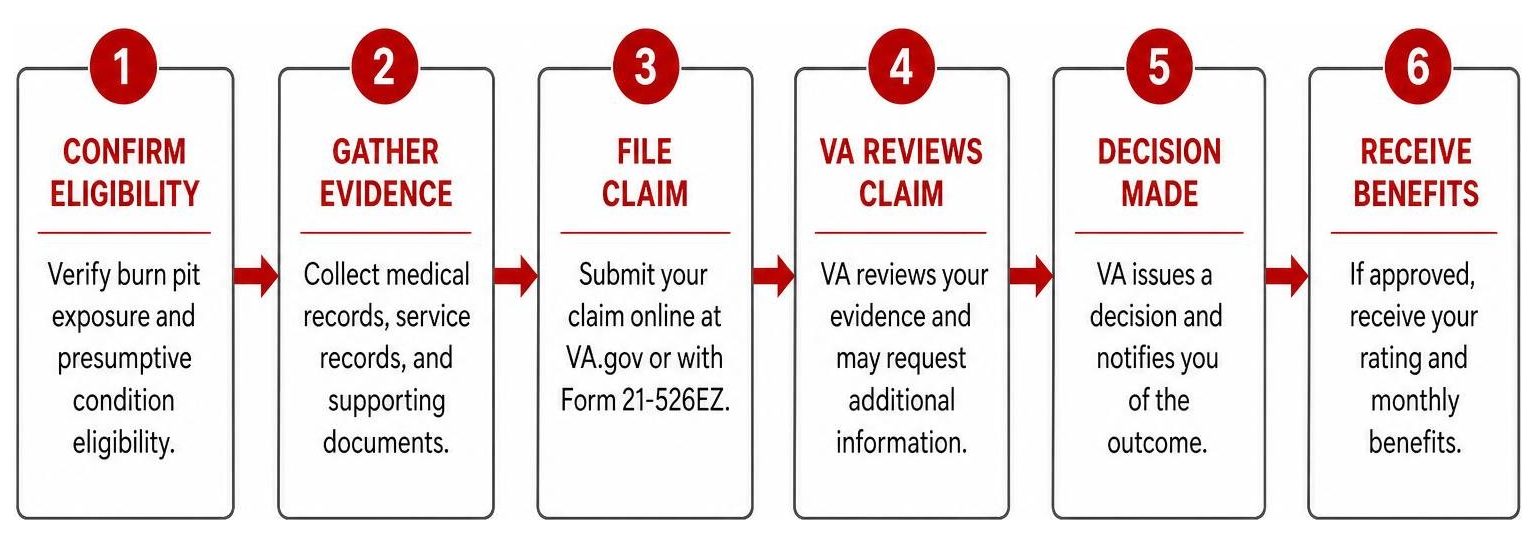
As of July 2026, the VA has streamlined its online portal, making digital filing the fastest way to secure a decision.
Gathering Evidence for Your Burn Pit Exposure VA benefits Claim

Even though you do not need to prove a medical link (nexus) for presumptive conditions, you still need to provide evidence of your service and your current medical diagnosis.
Before submitting your VA Form 21-526EZ (Application for Disability Compensation), gather the following documents:
- DD Form 214: This is the most critical document. It proves your dates of service, deployment locations, and discharge status.
- Deployment Orders or Travel Vouchers: If your DD-214 does not explicitly list your deployment locations (such as specific bases in Iraq or Afghanistan), orders, evaluation reports, or awards can prove you were physically present in a qualifying zone.
- Medical Records: You must show a current diagnosis. This includes civilian medical records, VA medical records, imaging results (CT scans, X-rays), and laboratory reports.
- Physician Statements: A brief statement from your treating doctor confirming your diagnosis and outlining the severity of your symptoms is incredibly helpful.
If you are filing for a non-presumptive condition, you will also need a “medical nexus letter” from a doctor stating that your condition is “at least as likely as not” related to your burn pit exposure. For step-by-step submission instructions, refer to our guide on How to File a VA Disability Claim.
The Airborne Hazards and Open Burn Pit Registry
The Airborne Hazards and Open Burn Pit Registry is a secure, voluntary database managed by the VA. It allows veterans to document their exposure to burn pits, sandstorms, and other airborne hazards during deployment.
Participating in the registry involves completing an online questionnaire and, if desired, scheduling a free environmental health evaluation at a VA medical facility. This clinical exam is a great way to get feedback on potential health issues and discuss your concerns with a specialist.
It is important to understand that joining the registry does not initiate a VA disability claim, nor does it affect your active claims processing time. However, the medical evaluation notes and questionnaire responses can serve as excellent supporting medical evidence in your claim file.
To learn more about how to register and get care, visit Airborne Hazards and Burn Pit Exposures – Public Health.
What to Do If Your Claim Was Previously Denied
If you filed a claim for a burn pit-related condition years ago and were denied, do not lose hope. Because the law has changed, you have a legal right to have your claim re-evaluated under the new presumptive guidelines.
You should not file a brand-new claim. Instead, you must submit a Supplemental Claim using VA Form 20-0995.
On this form, you will state that your condition is now presumptively service-connected under the PACT Act. The change in law itself counts as the “new and relevant evidence” required to reopen your case.
One of the biggest advantages of filing a Supplemental Claim is the potential for retroactive back pay. If you file within the designated windows, your effective date — and your back pay — could be backdated to the date the PACT Act was signed into law (August 10, 2022) or the date you originally filed your denied claim, potentially resulting in thousands of dollars in tax-free retroactive compensation.
For a detailed walkthrough of this process, consult the Condition And That Condition Became Presumptively self-help guide.
VA Disability Ratings and Compensation for Burn Pit Conditions
Once the VA grants service connection for your burn pit condition, they will assign a disability rating ranging from 0% to 100%. This rating is based on the severity of your symptoms and how much they impact your ability to work and perform daily activities.
If you have multiple conditions (such as asthma and skin issues), the VA will use “VA math” to combine your ratings into a single combined rating.
How the VA Rates Respiratory and Cancer Conditions
The VA uses specific diagnostic codes to evaluate burn pit conditions. For respiratory illnesses, the rating is heavily dependent on Pulmonary Function Tests (PFTs). These tests measure your Forced Expiratory Volume in 1 second (FEV1) and your Forced Vital Capacity (FVC):
- Asthma: Rated at 10%, 30%, 50%, or 100%. A 30% rating typically requires the daily use of an inhaler, while a 50% rating may be assigned if you require systemic oral or parenteral corticosteroids.
- COPD and Bronchitis: Rated based on your FEV1/FVC percentages. For example, an FEV1 of 40% to 59% of predicted value typically qualifies for a 50% rating, while an FEV1 of 25% to 39% qualifies for a 70% rating.
- Cancers: Any presumptive cancer that is active or undergoing treatment (such as chemotherapy or radiation) is automatically rated at 100%. Once the cancer is in remission, the VA will schedule a re-evaluation. If the cancer remains inactive, they will rate you based on the permanent residual symptoms or damage left behind (such as surgical scars, respiratory impairment, or organ dysfunction).
To see exactly how these ratings are structured, explore the VA Disability Rating Charts Ultimate Guide. For a deeper look at how the VA structures ratings specifically for toxic exposure, check out Burn Pit VA Ratings and Disability Compensation.
2026 Monthly Compensation Rates

VA disability compensation is completely tax-free. The amount you receive depends on your overall combined rating percentage and whether you have eligible dependents (such as a spouse, children, or dependent parents).
Here are the baseline monthly compensation rates for 2026 (for a single veteran with no dependents):
- 10% disability rating: $180.42 per month
- 20% disability rating: $356.66 per month
- 30% disability rating: $552.47 per month
- 40% disability rating: $795.84 per month
- 50% disability rating: $1,132.90 per month
- 60% disability rating: $1,435.02 per month
- 70% disability rating: $1,808.45 per month
- 80% disability rating: $2,102.15 per month
- 90% disability rating: $2,362.30 per month
- 100% disability rating: $3,938.58 per month
If your rating is 30% or higher, adding dependents will increase your monthly payment. If your burn pit conditions prevent you from maintaining substantially gainful employment, you may also qualify for Total Disability based on Individual Unemployability (TDIU), which pays you at the 100% rate even if your combined rating is lower.
You can calculate your potential monthly payments using the VA Disability Rating Charts Ultimate Guide.
Frequently Asked Questions about Burn Pit Claims
We know that navigating the VA claims system can raise a lot of questions. Here are some of the most common inquiries we receive from veterans about Burn Pit Exposure VA benefits.
How long does it take for a burn pit claim to be approved in 2026?
In July 2026, the average processing time for a fully documented presumptive burn pit claim is 4 to 6 months.
However, if your claim is incomplete, requires additional medical exams (C&P exams), or involves non-presumptive conditions, the timeline can stretch to 9 to 18 months. To get a decision as quickly as possible, make sure you submit a “Fully Developed Claim” (FDC) with all your medical records attached upfront.
Can I file a claim if my base is not on the official VA list?
Yes, absolutely. The VA’s official list of presumptive locations is extensive, but it is not exhaustive.
If you served at a base that is not officially listed but had active burn pit operations, you can still file. In these cases, you will need to provide “lay evidence” — such as personal statements (VA Form 21-4138), buddy statements from fellow service members, photos of the burn pits, or unit logs — to establish a “reasonable likelihood” of exposure.
What is the difference between burn pit exposure and Gulf War Illness?
While both stem from service in Southwest Asia, they are handled under separate VA regulations:
- Gulf War Illness (or Gulf War Syndrome): Refers to a cluster of chronic, unexplained multi-symptom illnesses (such as chronic fatigue syndrome, fibromyalgia, and functional gastrointestinal disorders) affecting veterans of the 1990–1991 Gulf War.
- Burn Pit Exposure: Focuses specifically on the physical damage caused by inhaling toxic smoke and particulate matter, resulting in clear, diagnosable respiratory diseases and cancers.
It is possible to file claims for both categories if you meet the distinct diagnostic criteria for each.
Conclusion
Securing your Burn Pit Exposure VA benefits is about more than just financial compensation — it is about getting the medical recognition, health care, and peace of mind you earned through your service. The PACT Act has leveled the playing field, making this the best time in history to file or appeal a toxic exposure claim.
At USMilitary.com, we are dedicated to helping you navigate this journey. Take action today: gather your medical records, submit an Intent to File to lock in your effective date, and claim the benefits you deserve.
For more resources and guidance on your transition and benefits, read More info about veteran benefits or visit our main hub at USMilitary.com.
Free for Service Members & Veterans
Get the military benefits intel no one tells you about.
Weekly updates on VA benefits, pay changes, and money tips — free for service members and veterans.
No spam. Unsubscribe anytime. Your info is never shared.


