What You Need to Know About the Military Draft at a Glance
Since the beginning of the Iran war, large numbers of teens and parents are thinking about the prospects of a military draft. Could a military draft be possible? Or not? Let’s face it, we are a spoiled country, taking our standards, leisure, and security for granted. I know that I do. It may be a good time to reset in light of the Iran war. Even healthy. Be thankful. Imagine that. Everything You Need to Know About the Military Draft is a topic that’s surging in searches — and for good reason. Global tensions, recruitment shortfalls, and social media rumors have millions of Americans wondering whether a draft could actually happen.
Here are the key facts up front:
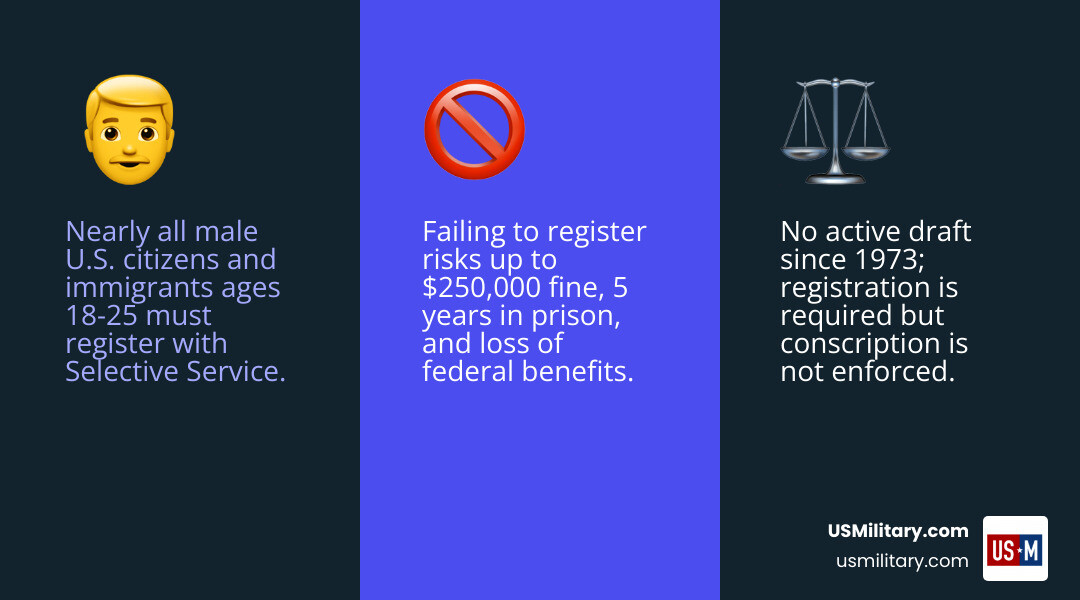
- Who must register: Nearly all male U.S. citizens and male immigrants ages 18 to 25
- Is there an active draft? No. The U.S. has not enforced conscription since 1973
- Penalty for not registering: Up to $250,000 fine, up to 5 years in prison, and loss of federal benefits
- Can women be drafted? Not under current law — only men are required to register
- How would a draft start? Congress must pass legislation and the President must sign it — no president can do it alone
- Who gets called first? Men turning 20 in the year of the draft would be the first priority group
- Where to register: Online at sss.gov, at a post office, through your high school, or when applying for federal student aid
The Selective Service System exists as a contingency — a backup plan in case the all-volunteer military can’t meet the nation’s needs. Right now, it’s a registration program, not an active draft. But understanding how it works matters, because the legal and financial consequences of ignoring it are very real.
I’m Larry Fowler, publisher of USMilitary.com and a longtime resource for active-duty members, veterans, and those exploring military service — and covering everything you need to know about the military draft is exactly the kind of topic our network has been built to address. In the sections below, we’ll break down every part of the system clearly, so you know exactly where you stand.
Everything You Need to Know About the Military Draft terms explained:
- Can you refuse to go to war if drafted?
- What Disqualifies You From A Military Draft?
- Who gets pulled first in a draft?
- Ages of the military draft
What is the Selective Service System?
The Selective Service System (SSS) is the independent agency of the United States government that maintains information on those potentially subject to military conscription. While many people use the terms “Selective Service” and “the draft” interchangeably, they aren’t quite the same thing. The SSS is the machinery that stays oiled and ready in the background, while “the draft” is the actual act of calling people into service.
Currently, the U.S. operates an all-volunteer force. However, federal law requires nearly all male U.S. citizens and male immigrants living in the U.S. who are ages 18 through 25 to register. This includes:
- Citizens: All born males, whether living in the U.S. or abroad.
- Immigrants: This includes documented immigrants (permanent residents), undocumented immigrants, refugees, and asylum seekers.
- Dual Nationals: U.S. citizens who hold citizenship in another country must still register, regardless of where they live.
- Disabled Men: Even if a man has a condition that would likely disqualify him from service, he is still legally required to register if he is able to function in society.
There are very few exceptions. Those currently on active duty do not need to register (as they are already in the system), and certain non-immigrants on specific technical visas (like diplomatic or student visas) are exempt. It is important to note that the Selective Service System official site emphasizes that registration is based on the gender assigned at birth.

For a deeper look at the specifics, you can view the full list of registration requirements. One major upcoming change we should highlight: Starting December 18, 2026, Selective Service registration is set to become automatic for men ages 18-25 through federal database matching, which will eventually remove the burden of manual registration.
How to Register for the Draft
Until that automatic system kicks in, the responsibility lies with the individual. Fortunately, the government makes it relatively easy to comply. You can register for Selective Service here online in just a few minutes.
Other common ways to register include:
- At the Post Office: You can pick up a registration form at any U.S. Post Office.
- High School: Many high schools have a staff member who serves as a Selective Service Registrar.
- The FAFSA: When applying for federal student aid, there was historically a checkbox to register you automatically.
- Driver’s License: In many states, applying for or renewing your license automatically registers you with the SSS.
Everything You Need to Know About the Military Draft: Classifications and Exemptions
If a draft were ever activated, the Selective Service wouldn’t just send everyone to the front lines immediately. There is a complex process of “classification.” During the Vietnam era, these codes (like 1-A or 4-F) became part of the American lexicon.
Today, no one is currently “classified.” If a draft were authorized, registrants would be sent an induction notice and then evaluated to determine their status.
- 1-A: This means you are available for military service immediately.
- 1-A-O: Conscientious Objector available for noncombatant military service only.
- 4-F: Research shows this is one of the most famous codes; it means you are not qualified for service due to physical, mental, or moral reasons.
- 3-A: Hardship deferment, usually for those whose induction would cause extreme financial or emotional hardship to their dependents.
- 4-D: An exemption for ministers of religion.
Conscientious Objectors (COs) are individuals who, by reason of religious training or belief, are sincerely opposed to participation in war in any form. Even if you are a CO, you must still register. If a draft starts, you would then file a claim to be classified as a CO. If approved, you might be assigned to noncombatant roles or “alternative service,” such as working in healthcare or conservation.
For those already in the community, such as military veterans or reservists under age 26, registration is still a requirement. However, if you have already served, your DD Form 214 serves as evidence that any failure to register was not “knowing and willful.”
Everything You Need to Know About the Military Draft Lottery
If Congress and the President authorized a return to the draft, the first step would be a national lottery. This isn’t a “first-come, first-served” situation. The lottery is designed to be a random and fair way to determine the order in which men are called.
The process involves two large air-mix drums. One drum contains 366 capsules (representing every possible birthdate, including February 29). The second drum contains capsules with numbers from 1 to 366. A birthdate is drawn, followed by a number. If your birthday is drawn with the number “1,” you are among the first to be called for evaluation.
Priority Groups: The SSS uses a “Maximum Age Selection Group” strategy. If a draft were held today, the first priority would be men in the calendar year they turn 20. If more men are needed, the system moves to 21-year-olds, then 22, and so on, up to age 26. Interestingly, 18 and 19-year-olds are actually the last to be called.
Everything You Need to Know About the Military Draft for Women
One of the most frequent questions we get is: “Do women have to sign up?” As of right now, the answer is no. Only “male persons” are required to register under the Military Selective Service Act.
However, this has been a point of intense legal and political debate. Since the Department of Defense lifted all gender-based restrictions on military service in 2015, allowing women into all combat roles, the logic for a male-only draft has been challenged in court. In 2019, a federal judge actually ruled the male-only draft unconstitutional, though that was later overturned by an appeals court.
Congress has come close to changing the law. In 2021, a provision was nearly included in the National Defense Authorization Act (NDAA) that would have required women to register. You can read more about the current debate on women in the draft to see how lawmakers have toggled between supporting and stripping these provisions. For now, the status quo remains: only men register.
How a Draft Would Be Reinstated in 2025
Let’s address the elephant in the room: Is a draft coming in 2025? With tensions between Iran and Israel and the ongoing conflict in Ukraine, social media has been buzzing with rumors.
It is vital to understand the legal framework. No President, regardless of political party, has the power to simply “order” a draft via executive order. Reinstating the draft requires:
- Congressional Action: Both the House and the Senate must pass a law authorizing the induction of individuals.
- Presidential Signature: The President must sign that law into effect.
Currently, there is no legislation on the floor of Congress to reinstate the draft. While some political figures and reports, like a Washington Post report on national service mandates, have mentioned that some officials are worried about a “crisis” in the all-volunteer force, these are mostly philosophical discussions about national service rather than imminent plans for conscription.
The SSS estimates it would take roughly 193 days from the moment a draft is authorized to the time the first draftees are actually inducted into the military. This timeline allows for the lottery, physical examinations at Military Entrance Processing Stations (MEPS), and the appeals process for those seeking deferments. You can find more details on the process of returning to a draft on the official SSS site.
Penalties for Draft Evasion and Non-Compliance
While the government hasn’t prosecuted anyone for failing to register since 1986, you should not take that as a sign that registration is optional. The “collateral damage” of not registering is significant and often permanent.
The Legal Hammer: Technically, failing to register is a federal felony. It is punishable by:
- A fine of up to $250,000.
- A prison term of up to 5 years.
The Real-World Consequences: The government’s strategy has shifted from jailing people to simply denying them the benefits of American citizenship. According to research, more than 1 million men have been denied government benefits because they didn’t register.
If you fail to register before you turn 26, you may be permanently barred from:
- Federal Student Aid: You cannot get Pell Grants or federal student loans.
- Federal Employment: You are ineligible for jobs with the federal government and many state government positions.
- Job Training: Programs like the Workforce Innovation and Opportunity Act (WIOA) are off-limits.
- U.S. Citizenship: For immigrants, failing to register can be seen as a lack of “good moral character,” leading to the denial of citizenship applications.
If you are over 26 and realize you never registered, you can request a “Status Information Letter” from the SSS. You will have to prove that your failure to register was not “knowing and willful”—a difficult bar to clear. You can find more on the consequences of failing to register through various news resources.
Historical Context and Global Comparisons
The U.S. has used conscription since the Revolutionary War, but the modern Selective Service System traces its roots to the World War eras. The most recent and controversial use of the draft was during the Vietnam War.
In 1969, the first draft lottery since WWII was held. It was a time of massive social upheaval, with nearly 570,000 people classified as “draft dodgers.” Of those, 210,000 were charged, but only about 3,250 were actually jailed. The draft ended in January 1973, and the U.S. has relied on an all-volunteer force ever since.
How the U.S. Compares Internationally: While the U.S. draft is currently inactive, many other nations maintain active conscription.
| Country | Status of Conscription | Notes |
|---|---|---|
| United States | Inactive (Registration only) | All-volunteer since 1973. |
| Israel | Active (Universal) | Men and women both serve; high integration of diverse populations. |
| Estonia | Active | Relies on conscripts for most branches; uses Estonian rapid response units. |
| Taiwan | Active | Recently extended service length due to regional tensions. |
| Norway | Active (Gender-Neutral) | First NATO country to draft women on the same terms as men. |
The arguments for and against conscription haven’t changed much over the centuries. Proponents argue it ensures military readiness, fosters a sense of civic duty, and ensures that the burden of defense is shared across all social classes. Opponents argue it is a form of “involuntary servitude,” is economically inefficient, and that a professional, volunteer military is more effective in high-tech modern warfare.
Frequently Asked Questions about the Military Draft
Is a military draft likely in 2025?
Based on current legislative reality, it is highly unlikely. While global tensions (like Iran-Israel or Russia-Ukraine) are high, the U.S. military leadership continues to support the all-volunteer model. Reinstating a draft is politically radioactive; it would require a level of congressional consensus that rarely exists in the modern era.
What happens if I fail to register before age 26?
Once you turn 26, the “window” to register closes forever. You cannot register late. This means you may face a lifetime ban on federal employment and certain student aid. If you are an immigrant, it could permanently derail your path to citizenship. If you find yourself in this position, your only recourse is to request a Status Information Letter and hope to prove the omission was an honest mistake.
Can I choose my branch if I am drafted?
Generally, no. If a draft is reinstated, you are inducted based on the “needs of the military.” While you would take the ASVAB test to determine your skills and aptitudes, the SSS would assign you to the branch and role where you are most needed. If you want to choose your branch (Army, Navy, Air Force, Marines, Coast Guard, or Space Force), the best way to do that is to enlist voluntarily before a draft is ever enacted.
Conclusion
We hope this guide has cleared up the confusion surrounding Everything You Need to Know About the Military Draft. While the word “draft” can be scary, the reality in 2025 is that the Selective Service is primarily a database for national preparedness. However, the requirement for young men to register is a serious legal obligation with lifelong consequences.
At USMilitary.com, our mission is to provide you with the most accurate, nonbiased information to help you navigate your relationship with the U.S. Armed Forces. Whether you are looking for VA disability info, exploring military career paths, or just trying to stay informed on the news, we are here to serve as your central hub.
If you are interested in serving on your own terms rather than waiting for a “what if” scenario, there are incredible benefits to joining the all-volunteer force today—from education funding to specialized career training. Sign up now to hear from a recruiter and learn about the paths available to you.
u-s-military-draft us-military-draft-2025-2 could-there-be-a-military-draft-in-the-us
Free for Service Members & Veterans
Get the military benefits intel no one tells you about.
Weekly updates on VA benefits, pay changes, and money tips — free for service members and veterans.
No spam. Unsubscribe anytime. Your info is never shared.


